
中国水稻科学 ›› 2026, Vol. 40 ›› Issue (2): 264-272.DOI: 10.16819/j.1001-7216.2026.241113
王未英1, 赵洪2, 陈瑜2,*( ), 姚晓明3, 陆剑飞3, 郭前爽4, 杜永均4,*()
收稿日期:2024-12-01
修回日期:2025-01-25
出版日期:2026-03-10
发布日期:2026-03-16
通讯作者:
* email: chenyu932023@outlook.com;
yongjundu@zju.edu.cn基金资助:
WANG Weiying1, ZHAO Hong2, CHEN Yu2,*(), YAO Xiaoming3, LU Jianfei3, GUO Qianshuang4, DU Yongjun4,*()
Received:2024-12-01
Revised:2025-01-25
Online:2026-03-10
Published:2026-03-16
Contact:
* email: chenyu932023@outlook.com;
yongjundu@zju.edu.cn摘要:
【目的】单双季水稻混栽区的耕作制度为二化螟越冬代和后续的2~3个世代提供了不间断的食料条件,导致虫量增加,危害加重。本研究评价了智能主动喷射型交配干扰释放器对早晚两季水稻二化螟的防控效果。【方法】在浙江嵊州三界镇的单双季混栽稻区,设置交配干扰区和农户自防对照区,在2024年4月12日,即水稻移栽8 d前,在交配干扰区设置主动释放的智能喷射型性信息素释放器,在早稻和晚稻期间连续不间断地喷射高剂量的性信息素干扰二化螟的求偶。同时,调查监测诱捕器中的诱蛾量、水稻被害植株数量和二化螟各龄幼虫数量,早稻、晚稻期间分别采用马氏网、吸虫器调查田间天敌种群量。【结果】越冬代二化螟成虫的交配干扰抑制率为94.1%±0.02%,一代成虫抑制率为78.6%±12.7%,二代成虫抑制率为87.3%±0.01%。同时,对早稻大螟成虫的抑制率为85.6%±0.07%,晚稻稻纵卷叶螟成虫的抑制率为79.2%±0.07%。早稻期间,交配干扰区二化螟幼虫数量减少了71.5%~83.3%,水稻植株被害率下降了59.4%~74.5%。自然天敌的种群数量差异不显著,但对照区益害比为148.8%±38.4%,交配干扰区益害比为2470.6%±594.5%。晚稻期间,交配干扰区二化螟幼虫数量减少了80.7%~90.9%,水稻植株被害率减少了61.2%~89.6%,稻纵卷叶螟卷叶率降低了63.7%。自然天敌数量没有差异,但益害比对照区为64.2%±24.9%,交配干扰区为333.3%±91.3%。【结论】主动释放的智能喷射型性信息素交配干扰技术有效控制了单双季稻区二化螟幼虫的数量,减轻了其危害,对大螟和稻纵卷叶螟也有显著的防治作用, 同时,对稻田自然天敌种群没有负面的影响,其益害比反而更高。
王未英, 赵洪, 陈瑜, 姚晓明, 陆剑飞, 郭前爽, 杜永均. 智能喷射释放性信息素对水稻主要鳞翅目害虫的交配干扰效果[J]. 中国水稻科学, 2026, 40(2): 264-272.
WANG Weiying, ZHAO Hong, CHEN Yu, YAO Xiaoming, LU Jianfei, GUO Qianshuang, DU Yongjun. Disruption Efficacy of Intelligent Active Aerosol Sex Pheromone on Mating Behavior of Major Lepidopteran Pests in Rice[J]. Chinese Journal OF Rice Science, 2026, 40(2): 264-272.
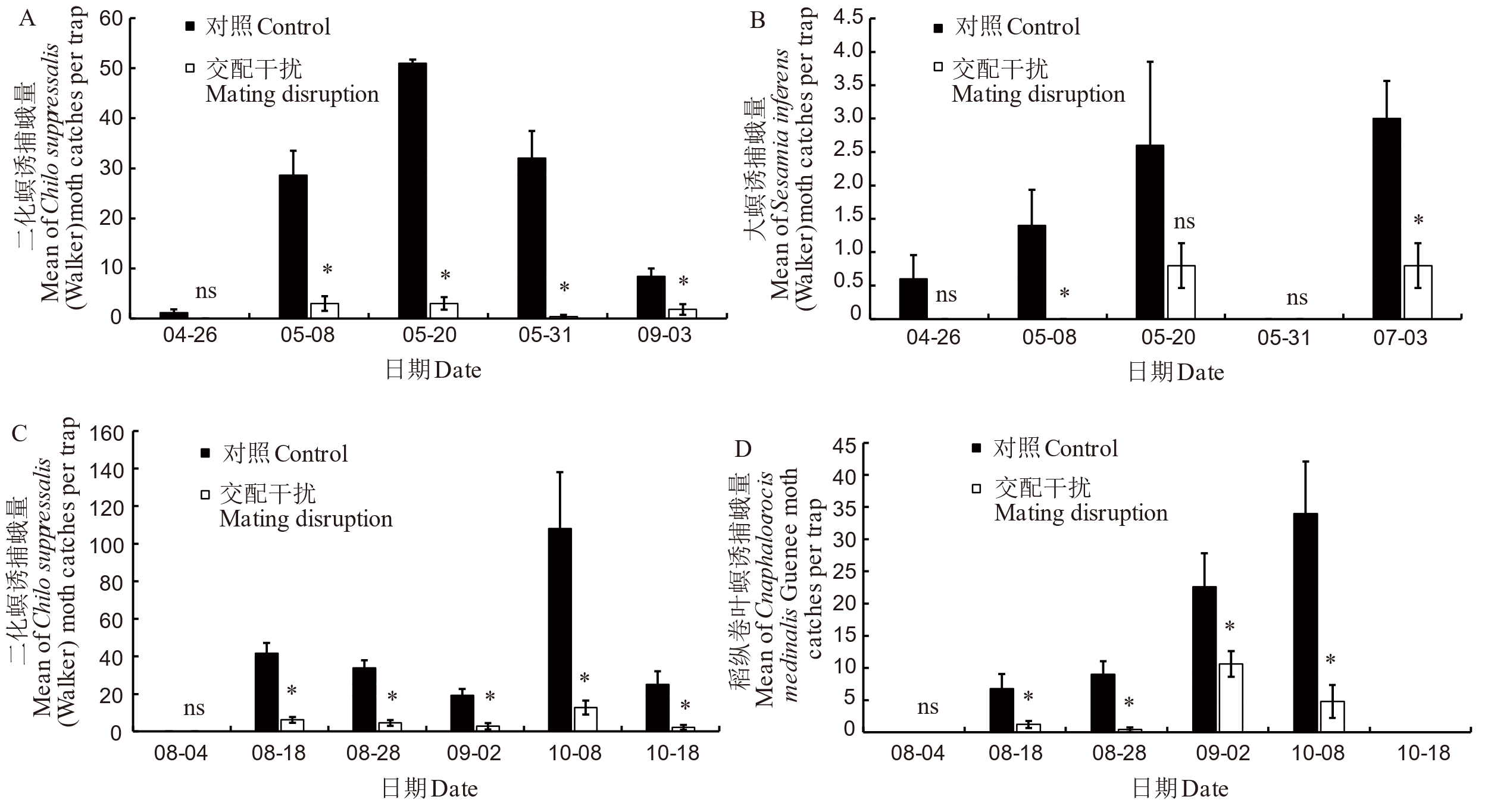
图1 交配干扰区和农户自防对照区蛾诱捕量比较 A: 早稻二化螟; B: 早稻大螟;C:晚稻二化螟;D:晚稻稻纵卷叶螟。柱上星号表示差异显著(P<0.05, t检验),ns表示差异不显著(P>0.05, t检验)。下同。
Fig. 1. Comparison of moth catches in the sex pheromone monitoring traps between mating disruption and control area A, Chilo suppressalis in early rice field; B, Sesamia inferens in early rice field; C, Chilo suppressalis in late rice field; D, Cnaphalocrocis medinalis in late rice field. *, Significant difference at 0.05 level; ns, No significant difference at 0.05 level(Student’s t-test).
| 调查日期 Investigation date (Month-day) | 处理 Treatment | 平均危害率 Average damage rate(%) | 每百丛平均幼虫数 Mean of larvae per hundred hills | 防控效果 Control efficacy (%) | 幼虫减退率 Larval reduction rate (%) |
|---|---|---|---|---|---|
| 04-26 | 农户自防对照Control | 0.00±0.00 | 0.00±0.00 | ||
| 交配干扰Mating disruption | 0.00±0.00ns | 0.00±0.00ns | |||
| 05-08 | 农户自防对照Control | 0.00±0.00 | 0.00±0.00 | ||
| 交配干扰Mating disruption | 0.00±0.00ns | 0.00±0.00ns | |||
| 05-20 | 农户自防对照Control | 0.00±0.00 | 0.00±0.00 | ||
| 交配干扰Mating disruption | 0.00±0.00ns | 0.00±0.00ns | |||
| 05-31 | 农户自防对照Control | 0.85±0.24 | 0.60±0.16 | 74.5 | 83.3 |
| 交配干扰Mating disruption | 0.22±0.10* | 0.10±0.07* | |||
| 07-03 | 农户自防对照Control | 1.68±0.07 | 0.12±0.06 | 59.4 | 71.5 |
| 交配干扰Mating disruption | 0.68±0.12* | 0.03±0.03* |
表1 早稻交配干扰区和农户自防对照区二化螟幼虫量和为害情况
Table 1. Chilo suppressalis larval count and plant damage in early rice under mating disruption and control
| 调查日期 Investigation date (Month-day) | 处理 Treatment | 平均危害率 Average damage rate(%) | 每百丛平均幼虫数 Mean of larvae per hundred hills | 防控效果 Control efficacy (%) | 幼虫减退率 Larval reduction rate (%) |
|---|---|---|---|---|---|
| 04-26 | 农户自防对照Control | 0.00±0.00 | 0.00±0.00 | ||
| 交配干扰Mating disruption | 0.00±0.00ns | 0.00±0.00ns | |||
| 05-08 | 农户自防对照Control | 0.00±0.00 | 0.00±0.00 | ||
| 交配干扰Mating disruption | 0.00±0.00ns | 0.00±0.00ns | |||
| 05-20 | 农户自防对照Control | 0.00±0.00 | 0.00±0.00 | ||
| 交配干扰Mating disruption | 0.00±0.00ns | 0.00±0.00ns | |||
| 05-31 | 农户自防对照Control | 0.85±0.24 | 0.60±0.16 | 74.5 | 83.3 |
| 交配干扰Mating disruption | 0.22±0.10* | 0.10±0.07* | |||
| 07-03 | 农户自防对照Control | 1.68±0.07 | 0.12±0.06 | 59.4 | 71.5 |
| 交配干扰Mating disruption | 0.68±0.12* | 0.03±0.03* |
| 调查日期 Investigation date (Month-day) | 处理 Treatment | 平均危害率 Average damage rate (%) | 每百丛平均幼虫数 Mean of larvae per hundred hills | 防控效果 Control efficacy (%) | 幼虫减退率 Larval reduction rate(%) |
|---|---|---|---|---|---|
| 08-19 | 农户自防对照Control | 0.59±0.48 | 0.16±0.12 | 87.8 | 90.9 |
| 交配干扰Mating disruption | 0.07±0.05ns | 0.01±0.01* | |||
| 08-29 | 农户自防对照Control | 0.96±0.36 | 0.44±0.20 | 89.6 | 87.1 |
| 交配干扰Mating disruption | 0.10±0.05* | 0.06±0.04* | |||
| 09-02 | 农户自防对照Control | 1.10±0.31 | 1.87±0.66 | 68.9 | 85.5 |
| 交配干扰Mating disruption | 0.34±0.06* | 0.27±0.07* | |||
| 10-08 | 农户自防对照Control | 1.40±0.16 | 1.71±0.38 | 61.2 | 83.3 |
| 交配干扰Mating disruption | 0.54±0.22* | 0.29±0.16* | |||
| 10-18 | 农户自防对照Control | 2.14±0.34 | 3.11±0.30 | 74.0 | 80.7 |
| 交配干扰Mating disruption | 0.56±0.10* | 0.60±0.22* |
表2 晚稻交配干扰区和农户自防对照区二化螟幼虫量和为害情况
Table 2. Chilo suppressalis larval count and plant damage in late rice under mating disruption and control
| 调查日期 Investigation date (Month-day) | 处理 Treatment | 平均危害率 Average damage rate (%) | 每百丛平均幼虫数 Mean of larvae per hundred hills | 防控效果 Control efficacy (%) | 幼虫减退率 Larval reduction rate(%) |
|---|---|---|---|---|---|
| 08-19 | 农户自防对照Control | 0.59±0.48 | 0.16±0.12 | 87.8 | 90.9 |
| 交配干扰Mating disruption | 0.07±0.05ns | 0.01±0.01* | |||
| 08-29 | 农户自防对照Control | 0.96±0.36 | 0.44±0.20 | 89.6 | 87.1 |
| 交配干扰Mating disruption | 0.10±0.05* | 0.06±0.04* | |||
| 09-02 | 农户自防对照Control | 1.10±0.31 | 1.87±0.66 | 68.9 | 85.5 |
| 交配干扰Mating disruption | 0.34±0.06* | 0.27±0.07* | |||
| 10-08 | 农户自防对照Control | 1.40±0.16 | 1.71±0.38 | 61.2 | 83.3 |
| 交配干扰Mating disruption | 0.54±0.22* | 0.29±0.16* | |||
| 10-18 | 农户自防对照Control | 2.14±0.34 | 3.11±0.30 | 74.0 | 80.7 |
| 交配干扰Mating disruption | 0.56±0.10* | 0.60±0.22* |
| 调查日期 Investitation date (Month-day) | 处理 Treatment | 卷叶率 Leaf rolling rate (%) | 幼虫数量(头/丛) No. of larvae per hill | 防控效果 Control effect(%) | 幼虫减退率 Larval reduction rate (%) |
|---|---|---|---|---|---|
| 08-19 | 农户自防对照Control | 0.00±0.00 | 0.00±0.00 | ||
| 交配干扰Mating disruption | 0.00±0.00ns | 0.00±0.00ns | |||
| 08-29 | 农户自防对照Control | 0.04±0.02 | 0.50±0.02 | 20.0 | |
| 交配干扰Mating disruption | 0.10±0.05ns | 0.40±0.02ns | |||
| 09-02 | 农户自防对照Control | 0.02±0.01 | 0.00±0.00 | ||
| 交配干扰Mating disruption | 0.03±0.03ns | 0.00±0.00ns | |||
| 10-08 | 农户自防对照Control | 0.03±0.01 | 0.00±0.00 | 44.2 | |
| 交配干扰Mating disruption | 0.02±0.01ns | 0.00±0.00ns | |||
| 10-18 | 农户自防对照Control | 0.06±0.02 | 0.00±0.00 | 63.7 | |
| 交配干扰Mating disruption | 0.02±0.01* | 0.00±0.00ns |
表3 晚稻交配干扰区和农户自防对照区稻纵卷叶螟幼虫量和卷叶率
Table 3. Number of Cnaphalocrocis medinalis larvae and leaf rolling rate under mating disruption and control in late rice
| 调查日期 Investitation date (Month-day) | 处理 Treatment | 卷叶率 Leaf rolling rate (%) | 幼虫数量(头/丛) No. of larvae per hill | 防控效果 Control effect(%) | 幼虫减退率 Larval reduction rate (%) |
|---|---|---|---|---|---|
| 08-19 | 农户自防对照Control | 0.00±0.00 | 0.00±0.00 | ||
| 交配干扰Mating disruption | 0.00±0.00ns | 0.00±0.00ns | |||
| 08-29 | 农户自防对照Control | 0.04±0.02 | 0.50±0.02 | 20.0 | |
| 交配干扰Mating disruption | 0.10±0.05ns | 0.40±0.02ns | |||
| 09-02 | 农户自防对照Control | 0.02±0.01 | 0.00±0.00 | ||
| 交配干扰Mating disruption | 0.03±0.03ns | 0.00±0.00ns | |||
| 10-08 | 农户自防对照Control | 0.03±0.01 | 0.00±0.00 | 44.2 | |
| 交配干扰Mating disruption | 0.02±0.01ns | 0.00±0.00ns | |||
| 10-18 | 农户自防对照Control | 0.06±0.02 | 0.00±0.00 | 63.7 | |
| 交配干扰Mating disruption | 0.02±0.01* | 0.00±0.00ns |
| 水稻季别 Growing season | 处理 Treatment | 蜘蛛 Spider | 瓢虫 Coccinellidae | 寄生蜂 Parasitoids |
|---|---|---|---|---|
| 早稻 Early rice | 农户自防对照Control | 0 | 1 | 0 |
| 4 | 2 | 4 | ||
| 5 | 2 | 3 | ||
| 3 | 3 | 2 | ||
| 1 | 0 | 1 | ||
| 8 | 2 | 28 | ||
| 交配干扰Mating disruption | 11 | 5 | 8 | |
| 3 | 3 | 25 | ||
| 2 | 0 | 11 | ||
| 2 | 0 | 12 | ||
| 2 | 2 | 2 | ||
| 18 | 0 | 7 | ||
| 晚稻 Late rice | 农户自防对照Control | 12 | 0 | 1 |
| 22 | 0 | 1 | ||
| 15 | 0 | 5 | ||
| 12 | 0 | 2 | ||
| 12 | 1 | 1 | ||
| 交配干扰Mating disruption | 19 | 1 | 2 | |
| 22 | 0 | 2 | ||
| 14 | 1 | 1 | ||
| 11 | 4 | 1 | ||
| 8 | 4 | 4 |
表4 交配干扰区和农户自防对照区天敌数量调查
Table 4. Investigation of natural enemies under mating disruption and control
| 水稻季别 Growing season | 处理 Treatment | 蜘蛛 Spider | 瓢虫 Coccinellidae | 寄生蜂 Parasitoids |
|---|---|---|---|---|
| 早稻 Early rice | 农户自防对照Control | 0 | 1 | 0 |
| 4 | 2 | 4 | ||
| 5 | 2 | 3 | ||
| 3 | 3 | 2 | ||
| 1 | 0 | 1 | ||
| 8 | 2 | 28 | ||
| 交配干扰Mating disruption | 11 | 5 | 8 | |
| 3 | 3 | 25 | ||
| 2 | 0 | 11 | ||
| 2 | 0 | 12 | ||
| 2 | 2 | 2 | ||
| 18 | 0 | 7 | ||
| 晚稻 Late rice | 农户自防对照Control | 12 | 0 | 1 |
| 22 | 0 | 1 | ||
| 15 | 0 | 5 | ||
| 12 | 0 | 2 | ||
| 12 | 1 | 1 | ||
| 交配干扰Mating disruption | 19 | 1 | 2 | |
| 22 | 0 | 2 | ||
| 14 | 1 | 1 | ||
| 11 | 4 | 1 | ||
| 8 | 4 | 4 |
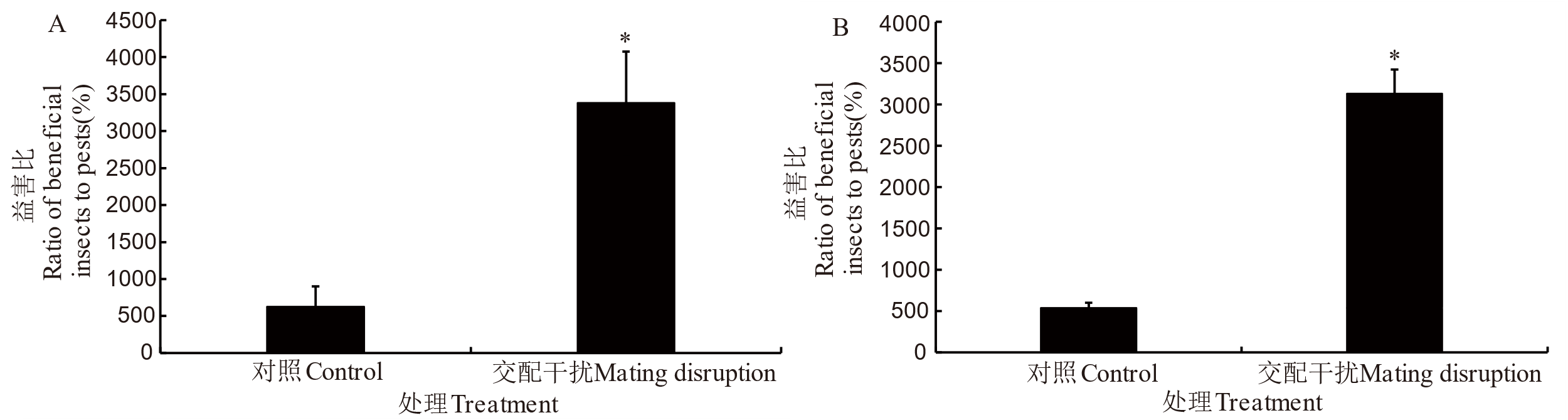
图2 交配干扰区和农户自防对照区稻田的益害比 A: 早稻田; B: 晚稻田。
Fig. 2. Ratios of beneficial insects to pests in the mating disruption and control rice fields A, Early rice field; B, Late rice field.
| [1] | 叶恭银, 方琦, 徐红星, 吴顺凡, 滕子文, 徐刚, 党聪, 熊时姣. 我国水稻螟虫发生及治理研究进展[J]. 植物保护, 2023, 49(5): 167-180. |
| Ye G Y, Fang Q, Xu H X, Wu S F, Teng Z W, Xu G, Dang C, Xiong S J. Research advances on the occurrence, damage and management of rice stem borers in China[J]. Plant Protection, 2023, 49(5): 167-180. (in Chinese with English abstract) | |
| [2] | Hajjar M J, Ahmed N, Alhudaib K A, Ullah H. Integrated insect pest management techniques for rice[J]. Sustainability, 2023, 15(5): 4499. |
| [3] | Luo G H, Yao J, Yang Q, Zhang Z C, Hoffmann A A, Fang J C. Variability in development of the striped rice borer, Chilo suppressalis (Lepidoptera: Pyralidae), due to instar number and last instar duration[J]. Scientific Reports, 2016, 6: 35231. |
| [4] | Zhu P Y, Liang R, Qin Y, Xu H X, Zou Y, Johnson A C, Zhang F C, Gurr G M, Lu Z X. Extrafloras and floral nectar promote biocontrol services provided by parasitoid wasps to rice crops[J]. Entomologia Generalis, 2023, 43(5): 971-979. |
| [5] | Wang P, Li M J, Bai Q R, Ali A, Desneux N, Dai H J, Zang L S. Performance of Trichogramma japonicum as a vector of Beauveria bassiana for parasitizing eggs of rice striped stem borer, Chilo suppressalis[J]. Entomologia Generalis, 2021, 41(2): 147-155. |
| [6] | 焦晓国, 宣维健, 盛承发. 用诱蛾量和有效积温模型预测东北越冬代水稻二化螟发生期[J]. 昆虫学报, 2006, 49(4): 705-709. |
| Jiao X G, Xuan W J, Sheng C F. A forecasting model for emergence and flight pattern of the overwintering generation of Chilo suppressalis(Lepidoptera: Pyralidae) based on pheromone trap catches and degree-days in northeastern China[J]. Acta Entomologica Sinica, 2006, 49(4): 705-709. (in Chinese with English abstract) | |
| [7] | Su J, Xuan W, Sheng C, Ge F. Suppression of rice stem borer, Chilo suppressalis, by mass trapping using synthetic sex pheromone in paddy field[J]. Rice Science, 2023, 11(1): 52-56. |
| [8] | 刘万才, 刘振东, 朱晓明, 杜永均. 我国昆虫性信息素技术的研发与应用进展[J]. 中国生物防治学报, 2022, 38(4): 803-811. |
| Liu W C, Liu Z D, Zhu X M, Du Y J. Development and application of insect sex pheromone technology in China[J]. Chinese Journal of Biological Control, 2022, 38(4): 803-811. (in Chinese with English abstract) | |
| [9] | 杜永均, 郭荣, 韩清瑞. 利用昆虫性信息素防治水稻二化螟和稻纵卷叶螟应用技术[J]. 中国植保导刊, 2013, 33(11): 40-42, 39. |
| Du Y J, Guo R, Han Q R. Application technology of using insect sex pheromone to control rice stem borer and rice leaf roller[J]. China Plant Protection, 2013, 33(11): 40-42, 39. (in Chinese) | |
| [10] | Beevor P S, Hall D R, Nesbitt B F, Dyck V A, Arida G, Lippold P C, Oloumi-Sadeghi H. Field trials of the synthetic sex pheromones of the striped rice borer, Chilo suppressalis (Walker) (Lepidoptera: Pyralidae), and of related compounds[J]. Bulletin of Entomological Research, 1977, 67(3): 439-447. |
| [11] | Chen Q H, Zhu F, Tian Z, Zhang W M, Guo R, Liu W, Pan L, Du Y. Minor components play an important role in interspecific recognition of insects: A basis to pheromone based electronic monitoring tools for rice pests[J]. Insects, 2018, 9(4): 192. |
| [12] | Mochida O, Arida G S, Tatsuki S, Fukami J. A field test on a third component of the female sex pheromone of the rice striped stem borer, Chilo suppressalis, in the Philippines[J]. Entomologia Experimentalis et Applicata, 1984, 36(3): 295-296. |
| [13] | Tatsuki S, Kurihara M, Usui K, Ohguchi Y, Uchiumi K, Arai K, Yabuki S, Tanaka F. Sex pheromone of the rice stem borer, Chilo suppressalis (WALKER) (Lepidoptera: Pyralidae): The third component, Z-9-hexadecenal[J]. Applied Entomology and Zoology, 1983, 18(3): 443-446. |
| [14] | Wu J, Wu X, Chen H, Xu L, Liu G, Mao B, Quo R, Du Y. Optimization of the sex pheromone of the rice leaffolder moth Cnaphalocrocis medinalis as a monitoring tool in China[J]. Journal of Applied Entomology, 2013, 137(7): 509-518. |
| [15] | Cheng J, Chen Q, Guo Q, Du Y. Moth sex pheromones affect interspecific competition among sympatric species and possibly population distribution by modulating pre-mating behavior[J]. Insect Science, 2023, 30(2): 501-516. |
| [16] | 刘天伟, 陈运康, 许春梅, 郭荣, 冯波, 杜永均. 田间二化螟雄蛾对不同配比性信息素的嗅觉反应及性信息素识别相关基因表达水平差异[J]. 昆虫学报, 2021, 64(5): 585-596. |
| Liu T W, Chen Y K, Xu C M, Guo R, Feng B, Du Y J. Variation in the olfactory response and expression levels of genes involved in sex pheromone recognition in male moths of field Chilo suppressalis (Lepidoptera: Crambidae) to sex pheromone blends at different ratios[J]. Acta Entomologica Sinica, 2021, 64(5): 585-596. (in Chinese with English abstract) | |
| [17] | Kanno H. Mating behaviour of the rice stem borer moth, chilosuppressalis WALKER (Lepidoptera: Pyralidae): V. critical illumination intensity for female calling and male sexual response under various temperatures[J]. Applied Entomology and Zoology, 1981, 16(3): 179-185. |
| [18] | Kanno H. Mating behaviour of the rice stem borer moth, chilosuppressalis WALKER: Lepidoptera: Pyralidae: VI. Effects of photoperiod on the diel rhythms of mating behaviours[J]. Applied Entomology and Zoology, 1981, 16(4): 406-411. |
| [19] | Kanno H. Seasonal variation in periodicity of mating behaviour in the rice stem borer, Chilo suppressalis (Walker) (Lepidoptera: Pyralidae)[J]. Bulletin of Entomological Research, 1981, 71(4): 631-637. |
| [20] | Kondo A, Tanaka F. Effect of wild virgin females on pheromone trap efficiency in two annual generations of the rice stem borer moth, Chilo suppressalis (WALKER) (Lepidoptera: Pyralidae)[J]. Applied Entomology and Zoology, 1994, 29(2): 279-281. |
| [21] | Kanno H, Sato A. Mating behaviour of the rice stem borer moth, Chilo suppressalis WALKER (Lepidoptera: Pyralidae): II. effects of temperature and relative humidity on mating activity[J]. Applied Entomology and Zoology, 1979, 14(4): 419-427. |
| [22] | 冯波, 刘天伟, 陆明红, 钟玲, 郭荣, 刘万才, 郭前爽, 杜永均. 二化螟的多次交配及其对雌蛾产卵量的影响[J]. 昆虫学报, 2020, 63(6): 759-768. |
| Feng B, Liu T W, Lu M H, Zhong L, Guo R, Liu W C, Guo Q S, Du Y J. Multiple mating of Chilo suppressalis (Lepidoptera: Pyralidae) and its effect on the oviposition of female moths[J]. Acta Entomologica Sinica, 2020, 63(6): 759-768. (in Chinese with English abstract) | |
| [23] | Alfaro C, Navarro-Llopis V, Primo J. Optimization of pheromone dispenser density for managing the rice striped stem borer, Chilo suppressalis (Walker), by mating disruption[J]. Crop Protection, 2009, 28(7): 567-572. |
| [24] | Vacas S, Navarro I, Primo J, Navarro-Llopis V. Mating disruption to control the striped rice stem borer: Pheromone blend, dispensing technology and number of releasing points[J]. Journal of Asia-Pacific Entomology, 2016, 19(2): 253-259. |
| [25] | Vacas S, Alfaro C, Navarro-Llopis V, Zarzo M, Primo J. Study on the optimum pheromone release rate for attraction of Chilo suppressalis (Lepidoptera: Pyralidae)[J]. Journal of Economic Entomology, 2009, 102(3): 1094-1100. |
| [26] | 姚晓明, 翟婧, 孙健, 王婉强, 张晓萌, 吴降星, 郭前爽, 杜永均. 主动型释放器喷射性信息素对二化螟虫量的影响及应用效果[J]. 中国植保导刊, 2024, 44(7): 59-63, 68. |
| Yao X M, Zhai J, Sun J, Wang W Q, Zhang X M, Wu J X, Guo Q S, Du Y J. Impact of sex pheromone aerosol puff on the behavior of Chilo suppressalis and its control effect in rice fields[J]. China Plant Protection, 2024, 44(7): 59-63, 68. (in Chinese with English abstract) | |
| [27] | 王未英, 陈瑜, 赵洪, 郭前爽, 杜永均. 高剂量喷射型主动交配干扰技术对水稻害虫的防控效果评价[J]. 中国生物防治学报, 2024, 40(6): 1293-1301. |
| Wang W Y, Chen Y, Zhao H, Guo Q S, Du Y J. Evaluation of the control efficacy of mating disruption by active high dose aerosol pheromone dispensers on rice pests[J]. Chinese Journal of Biological Control, 2024, 40(6): 1293-1301. (in Chinese with English abstract) | |
| [28] | Huang J, Wu E, Yang C, Han X, Zhang J, Cao M, Deng F, Guo Q, Du Y. Mating disruption of the tomato leaf miner Tuta absoluta (Lepidoptera: Gelechiidae) on greenhouse tomatoes[J]. Crop Health, 2024, 2(1): 15. |
| [29] | 郭前爽, 陈立玲, 隋华, 杨斌, 卓富彦, 朱晓明, 郭荣, 杜永均. 风洞条件下高剂量性信息素对二化螟求偶、交配和产卵的影响[J]. 浙江大学学报: 农业与生命科学版, 2022, 48(6): 787-796. |
| Guo Q S, Chen L L, Sui H, Yang B, Zhuo F Y, Zhu X M, Guo R, Du Y J. Effects of high dose sex pheromone on courtship, mating and oviposition of Chilo suppressalis (Walker) in the wind tunnel[J]. Journal of Zhejiang University: Agriculture and Life Sciences, 2022, 48(6): 787-796. (in Chinese with English abstract) | |
| [30] | Zhu P, Kong F, Wang Z. Sex pheromone components of purple stem borer Sesamia inferens (Walker)[J]. Journal of Chemical Ecology, 1987, 13(5): 983-989. |
| [31] | 桂嘉唯, 王未英, 姚晓明, 伍绍龙, 刘天波, 林宇丰, 赵洪, 郭前爽, 杜永均. 大螟成虫在高剂量性信息素交配干扰环境中的求偶和交配行为[J]. 昆虫学报, 2024, 67(4): 507-516. |
| Gui J W, Wang W Y, Yao X M, Wu S L, Liu T B, Lin Y F, Zhao H, Guo Q S, Du Y J. Calling and mating behaviors of Sesamia inferens (Lepidoptera: Noctuidae) adults in the environment of high-dose sex pheromone for mating disruption[J]. Acta Entomologica Sinica, 2024, 67(4): 507-516. (in Chinese with English abstract) | |
| [32] | Lu J, Yao X, Shen Y, Du C, Guo Q, Du Y. Physiological status of rice leaf-roller Cnaphalocrocis medinalis (Lepidoptera: Crambidae) adults trapped by sex pheromone and floral odor[J]. Insects, 2024, 15(9): 637. |
| [33] | Gratton C, Denno R F. Seasonal shift from bottom-up to top-down impact in phytophagous insect populations[J]. Oecologia, 2003, 134(4): 487-495. |
| [1] | 唐志伟, 朱相成, 张俊, 邓艾兴, 张卫建. 水分调控下绿肥种植和石灰施用对双季稻稻米镉含量的影响[J]. 中国水稻科学, 2024, 38(2): 211-222. |
| [2] | 刘艳, 何林凤, 汪书超, 杨凤霞, 高聪芬, 吴顺凡. 二化螟对甲氧虫酰肼的抗性风险、交互抗性及亚致死效应研究[J]. 中国水稻科学, 2023, 37(4): 427-435. |
| [3] | 杨陶陶, 邹积祥, 伍龙梅, 包晓哲, 江瑜, 张楠, 张彬. 开放式增温对华南双季稻稻米品质的影响[J]. 中国水稻科学, 2023, 37(1): 66-77. |
| [4] | 刘琴, 夏杨, 韩光杰, 李传明, 陆玉荣, 黄立鑫, 祁建杭, 徐健. 水稻二化螟病原线虫N-Yz1的分离鉴定及其感染特性[J]. 中国水稻科学, 2022, 36(6): 639-646. |
| [5] | 陈奕璇, 覃贵亮, 周晓欣, 黄军军, 蒙全, 吴俊辉, 闫晓静, 袁会珠. 不同植保机械喷施雾滴在水稻冠层沉积分布规律及对病虫害防效比较[J]. 中国水稻科学, 2022, 36(2): 207-214. |
| [6] | 王丰, 廖亦龙, 柳武革, 刘迪林, 曾学勤, 傅友强, 朱满山, 李金华, 付崇允, 马晓智, 霍兴. 籼型杂交稻恢复系动态株型与光能利用率评价[J]. 中国水稻科学, 2021, 35(2): 141-154. |
| [7] | 杨通, 吴俊男, 鲍婷, 李凤博, 冯金飞, 周锡跃, 方福平. 耕作方式对双季稻田土壤剖面CH4和N2O分布特征的影响[J]. 中国水稻科学, 2021, 35(1): 78-88. |
| [8] | 张珏锋, 张琴, 李芳, 钟海英, 陈建明. 氯虫苯甲酰胺胁迫下二化螟中肠细菌类微生物的多样性[J]. 中国水稻科学, 2020, 34(6): 586-594. |
| [9] | 叶春, 李艳大, 曹中盛, 黄俊宝, 孙滨峰, 舒时富, 吴罗发. 不同育秧盘对机插双季稻株型与产量的影响[J]. 中国水稻科学, 2020, 34(5): 435-442. |
| [10] | 钟雪梅, 黄铁平, 彭建伟, 卢文璐, 康兴蓉, 孙梦飞, 宋思明, 唐启源, 陈裕新, 湛冬至, 周旋. 机插同步一次性精量施肥对双季稻养分累积及利用率的影响[J]. 中国水稻科学, 2019, 33(5): 436-446. |
| [11] | 宋瑞雪, 鲁涵, 鲁艳辉, 郑许松, 吕仲贤. 取食香根草后水稻螟虫对杀虫剂敏感度变化[J]. 中国水稻科学, 2019, 33(3): 282-286. |
| [12] | 徐红星, 王国荣, 鲁艳辉, 杨亚军, 郑许松, 田俊策, 吕仲贤. 二化螟实时荧光定量PCR内参基因筛选和表达稳定性评价[J]. 中国水稻科学, 2019, 33(1): 75-84. |
| [13] | 陈中督, 徐春春, 纪龙, 方福平. 基于农户调查的长江中游地区双季稻生产碳足迹及其构成[J]. 中国水稻科学, 2018, 32(6): 601-609. |
| [14] | 杨陶陶, 胡启星, 黄山, 曾研华, 谭雪明, 曾勇军, 潘晓华, 石庆华, 张俊. 双季优质稻产量和品质形成对开放式主动增温的响应[J]. 中国水稻科学, 2018, 32(6): 572-580. |
| [15] | 陈中督 徐春春 纪龙 方福平*. 基于农户调查的长江中游地区双季稻生产碳足迹及其构成[J]. 中国水稻科学, 2018, 32(6): 601-609. |
| 阅读次数 | ||||||
|
全文 |
|
|||||
|
摘要 |
|
|||||
