
中国水稻科学 ›› 2026, Vol. 40 ›› Issue (2): 273-280.DOI: 10.16819/j.1001-7216.2026.241011
• 研究报告 • 上一篇
郑许松1, 徐红星1, 吕海涛1, 李建忠2,*( ), 吕仲贤1, 鲁艳辉1,*()
收稿日期:2024-10-31
修回日期:2025-01-08
出版日期:2026-03-10
发布日期:2026-03-16
通讯作者:
* email: 411266002@qq.com;
luyanhui4321@126.com基金资助:
ZHENG Xusong1, XU Hongxing1, LÜ Haitao1, LI Jianzhong2,*(), LÜ Zhongxian1, LU Yanhui1,*()
Received:2024-10-31
Revised:2025-01-08
Online:2026-03-10
Published:2026-03-16
Contact:
* email: 411266002@qq.com;
luyanhui4321@126.com摘要:
【目的】研究福寿螺(Pomacea canaliculata)对不同品种水稻直播稻苗的取食为害特性,为直播稻田中福寿螺的有效防控提供理论依据。【方法】以甬优1540(籼粳杂交)、秀水134(粳稻)、中早39(籼稻)为试验材料,室内模拟观察研究不同大小的福寿螺(小螺0.51 g,中螺4.37 g,大螺7.82 g)对不同品种直播稻苗的取食和为害特性。【结果】小螺对不同水稻品种直播稻苗的为害期为 7 d,直播后1~4 d是为害高峰期;大螺和中螺对不同水稻品种直播稻苗的为害期为21 d左右,直播后的1~10 d是为害高峰期;小螺、中螺和大螺对不同水稻品种的直播稻苗的为害量分别达到1.9~2.6株/天、9.2~12.1株/天和16.2~23.1株/天,大螺的取食量分别是小螺和中螺的22.3~30.1倍和1.7~1.9倍,中螺是小螺的11.5~18.3倍。【结论】福寿螺对不同类型水稻直播稻苗取食为害期约为21 d,直播后的10 d是福寿螺的为害高峰期;小螺对直播稻苗的危害较小,大、中螺对直播稻苗构成主要危害;福寿螺对籼型水稻的取食量最大,对粳型水稻的取食量最小,籼粳杂交型水稻介于两者之间。根据福寿螺对直播稻苗的取食为害特性,提出了针对性的防控措施建议。
郑许松, 徐红星, 吕海涛, 李建忠, 吕仲贤, 鲁艳辉. 福寿螺对不同品种直播稻苗的取食为害特性[J]. 中国水稻科学, 2026, 40(2): 273-280.
ZHENG Xusong, XU Hongxing, LÜ Haitao, LI Jianzhong, LÜ Zhongxian, LU Yanhui. Feeding and Damage Characteristics of Pomacea canaliculata on Direct-seeded Rice Seedlings of Different Varieties[J]. Chinese Journal OF Rice Science, 2026, 40(2): 273-280.
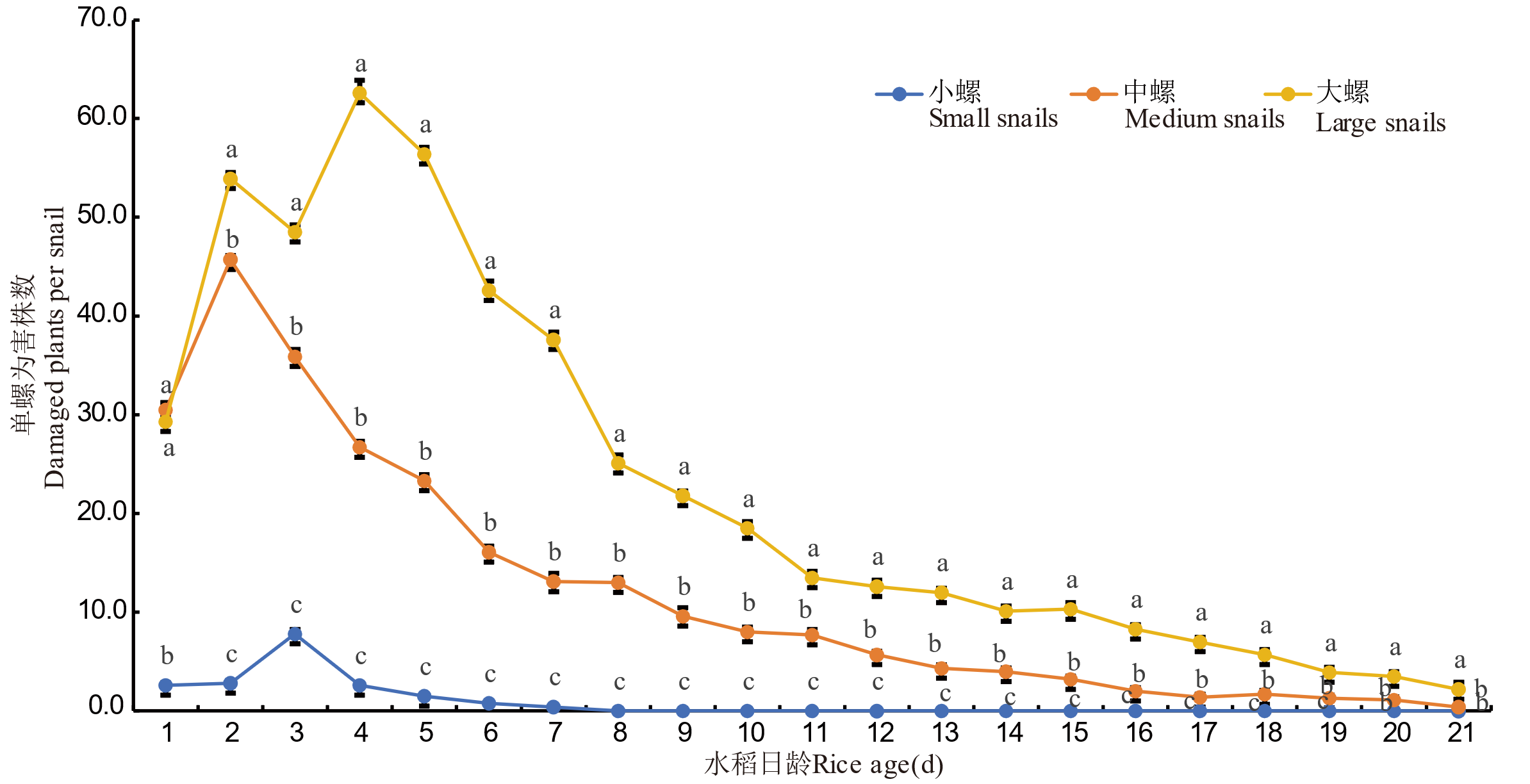
图1 福寿螺对籼稻品种中早39直播稻苗的取食为害动态
Fig. 1. Feeding and damage dynamics of Pomacea canaliculata on direct-seeded rice seedlings of indica rice variety Zhongzao 39
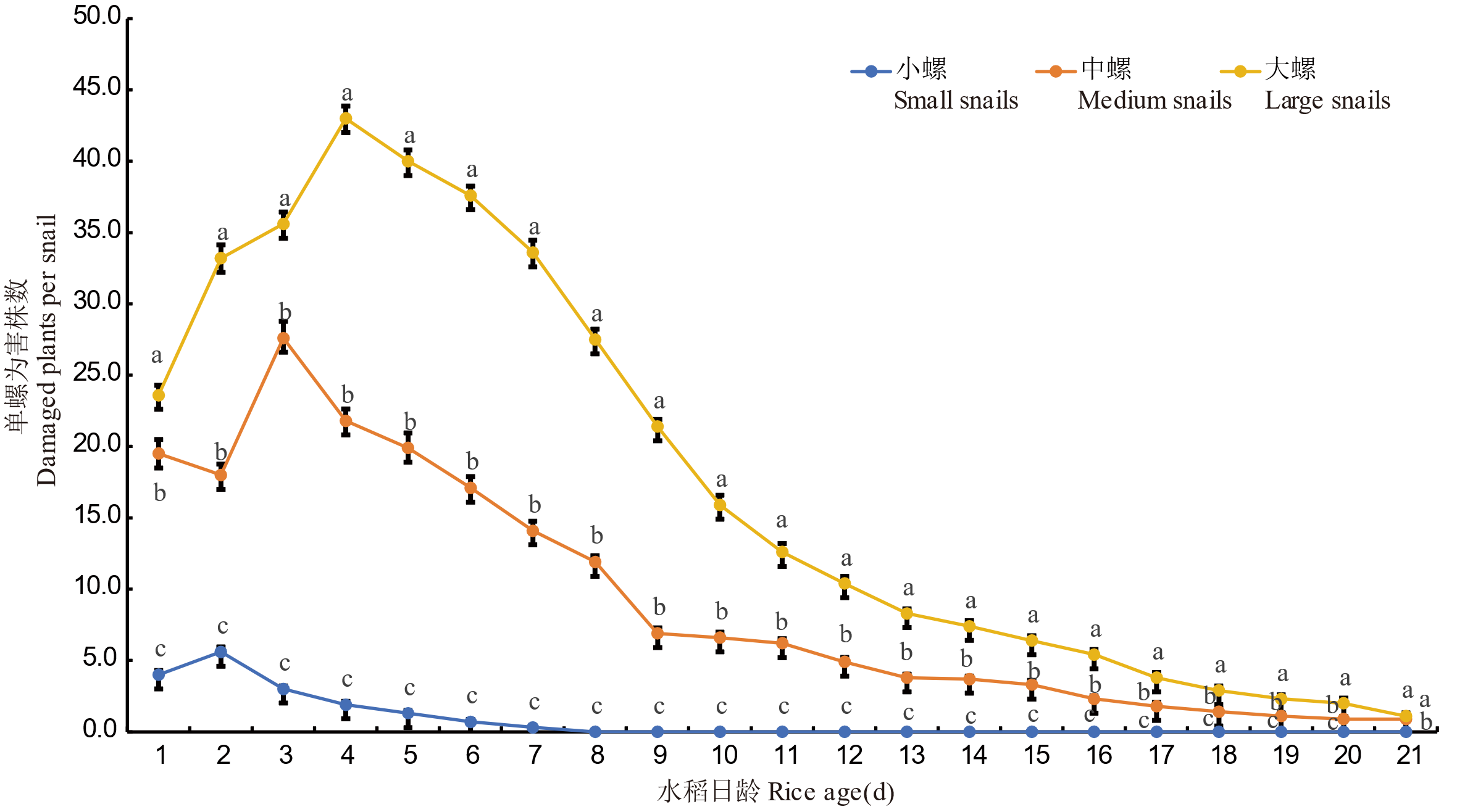
图2 福寿螺对籼粳杂交稻品种甬优1540直播稻苗的取食为害动态
Fig. 2. Feeding and damage dynamics of Pomacea canaliculata on direct-seeded rice seedlings of indica-japonica hybrid rice variety Yongyou 1540
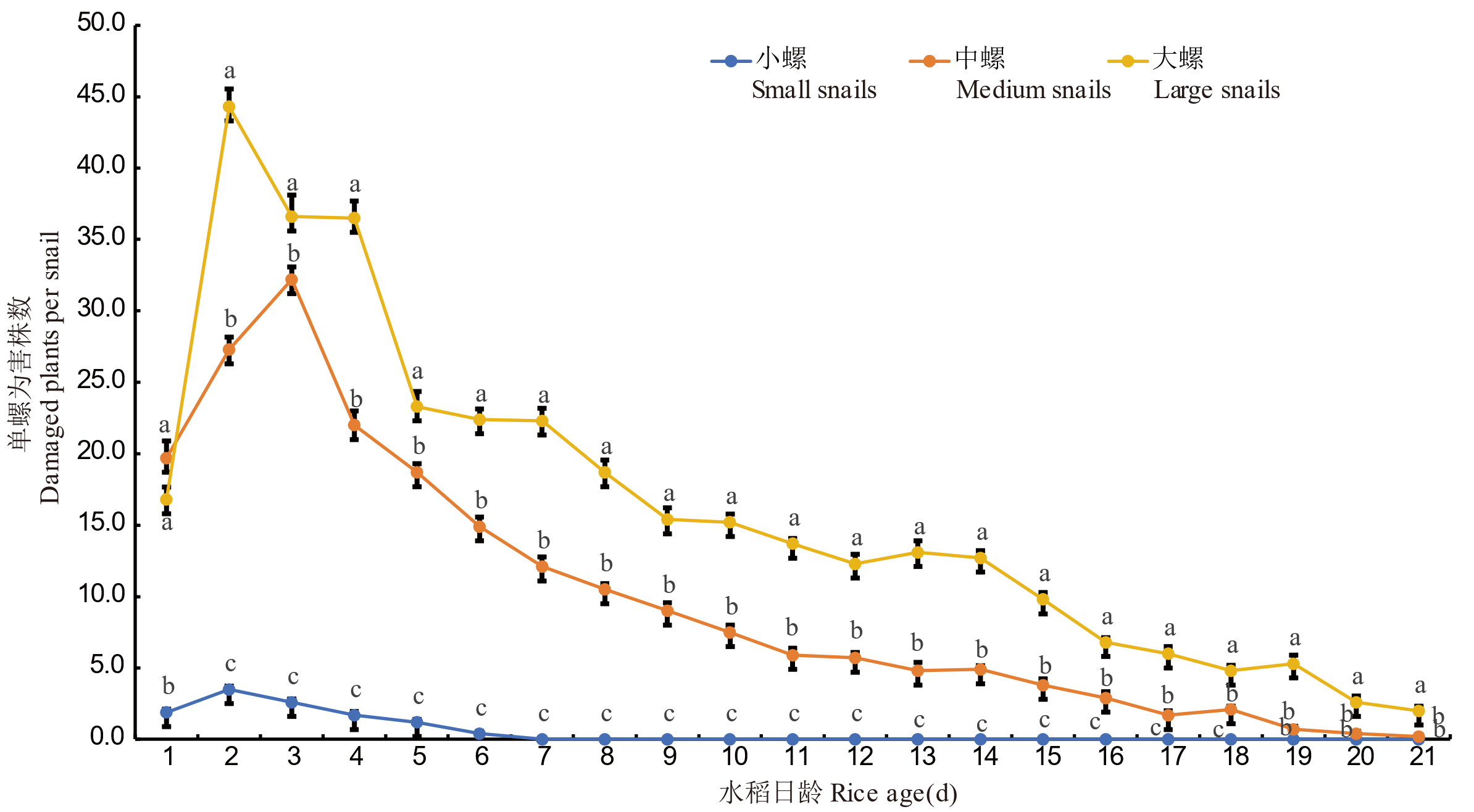
图3 福寿螺对粳稻品种秀水134直播稻苗的取食为害动态
Fig. 3. Feeding and damage dynamics of Pomacea canaliculata on direct-seeded rice seedlings of japonica variety Xiushui 134
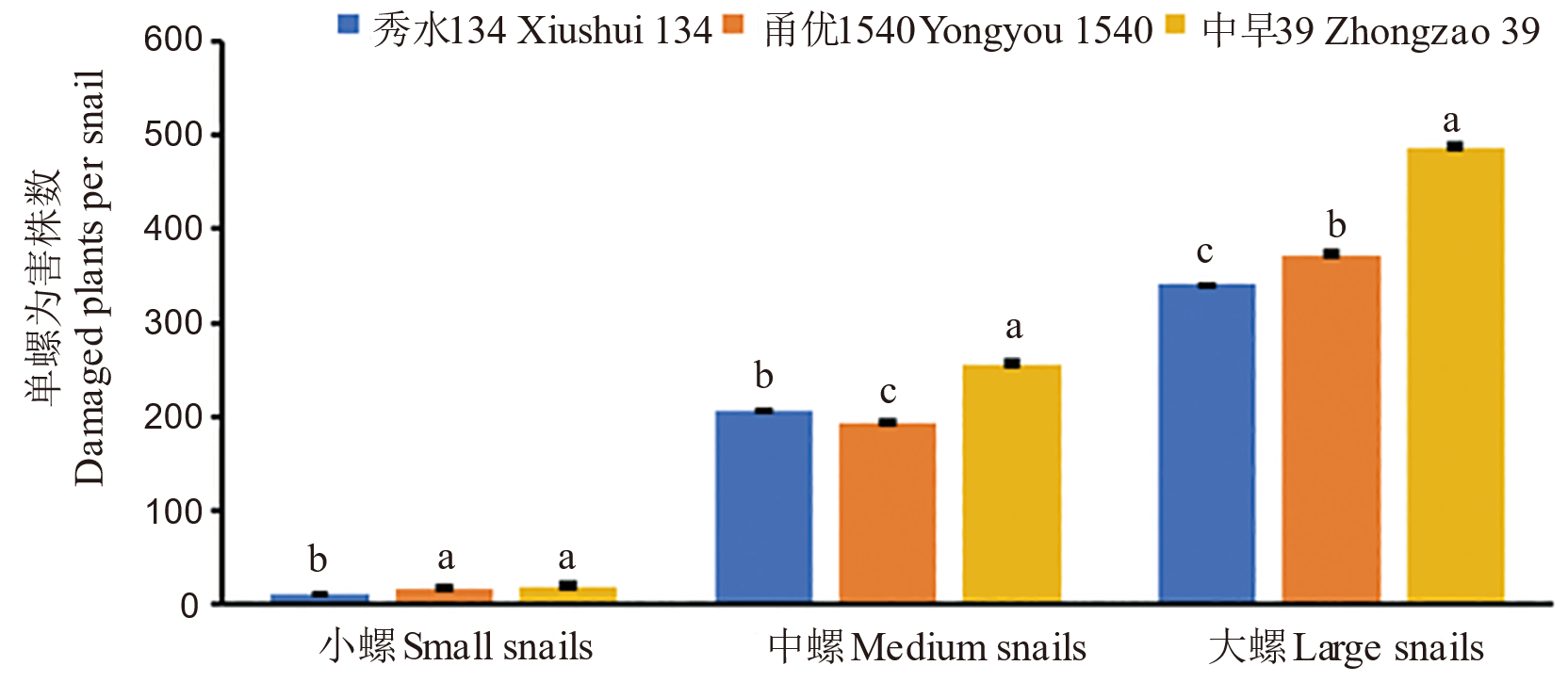
图4 不同大小的福寿螺对不同品种直播稻苗的为害量
Fig. 4. Damage caused by different sizes of Pomacea canaliculata to direct-seeded seedlings of different rice varieties
| 水稻品种 Rice variety | F/P值 F/P value | 水稻秧龄 Rice seedling age | 福寿螺大小 Snail size | 水稻秧龄×福寿螺大小 Rice age × Snail size |
|---|---|---|---|---|
| 中早39 Zhongzao 39 | F | 1415.11 | 10237.50 | 376.76 |
| P | < 0.001 | < 0.001 | < 0.001 | |
| 甬优1540 Yongyou 1540 | F | 787.31 | 6482.06 | 209.83 |
| P | < 0.001 | < 0.001 | < 0.001 | |
| 秀水134 Xiushui 134 | F | 466.53 | 3987.28 | 103.26 |
| P | < 0.001 | < 0.001 | < 0.001 |
表1 水稻秧龄和福寿螺大小对取食为害量的双因素方差分析
Table 1. Two-way ANOVA on the effects of rice age and snail size on feeding damage
| 水稻品种 Rice variety | F/P值 F/P value | 水稻秧龄 Rice seedling age | 福寿螺大小 Snail size | 水稻秧龄×福寿螺大小 Rice age × Snail size |
|---|---|---|---|---|
| 中早39 Zhongzao 39 | F | 1415.11 | 10237.50 | 376.76 |
| P | < 0.001 | < 0.001 | < 0.001 | |
| 甬优1540 Yongyou 1540 | F | 787.31 | 6482.06 | 209.83 |
| P | < 0.001 | < 0.001 | < 0.001 | |
| 秀水134 Xiushui 134 | F | 466.53 | 3987.28 | 103.26 |
| P | < 0.001 | < 0.001 | < 0.001 |
| [1] | Estebenet A L, Martín P R. Shell interpopulation variation and its origin in Pomacea canaliculata (Gastropoda: Ampullaridae) from southern pampas[J]. Journal of Molluscan Studies, 2003, 69(4): 301-310. |
| [2] | Horgan F G, Stuart A M, Kudavidanage E P. Impact of invasive apple snails on the functioning and services of natural and managed wetlands[J]. Acta Oecologica, 2014, 54: 90-100. |
| [3] | 张洪程, 胡雅杰, 杨建昌, 戴其根, 霍中洋, 许轲, 魏海燕, 高辉, 郭保卫, 邢志鹏, 胡群. 中国特色水稻栽培学发展与展望[J]. 中国农业科学, 2021, 54(7): 1301-1321. |
| Zhang H C, Hu Y J, Yang J C, Dai Q G, Huo Z Y, Xu K, Wei H Y, Gao H, Xing Z P, Hu Q. Development and prospect of rice cultivation in China[J]. Scientia Agricultura Sinica, 2021, 54(7): 1301-1321. (in Chinese with English abstract) | |
| [4] | Guo X H, Liu J J, Xu L Q, Sun F J, Ma Y H, Yin D W, Gao Q, Zheng G P, Lü Y D. Combined organic and inorganic fertilization can enhance dry direct-seeded rice yield by improving soil fungal community and structure[J]. Agonomy, 2022, 12(5): 1213. |
| [5] | 刘利成, 闵军, 刘三雄, 李小湘, 潘孝武, 刘文强, 胡敏, 赵永, 黎用朝. 直播稻生产概况与品种选育策略[J]. 中国稻米, 2022, 28(5): 44-48, 56. |
| Liu LC, Min J, Liu S X, Li X X, Pan X W, Liu W Q, Hu M, Zhao Y, Li Y C. Production situation and varieties breeding strategies of direct seeding rice[J]. China Rice, 2022, 28(5): 44-48, 56. (in Chinese with English abstract) | |
| [6] | 陈玉托, 杨永雄, 蔡汉. 福寿螺对水稻为害损失的调查与研究[J]. 植保技术与推广, 1996, 16(4): 16-17. |
| Chen Y T, Yang Y X, Cai H. Investigation and study on the damage and loss of rice caused by Fusarium snail plant protection technology and promotion[J]. Plant Protection Technology and Promotion, 1996, 16(4): 16-17. (in Chinese) | |
| [7] | Sanico A L, Peng S, Laza R C, Visperas R M. Effect of seedling age and seedling number per hill on snail damage in irrigated rice[J]. Crop Protection, 2002, 21(2): 137-143. |
| [8] | 郭靖, 罗颢, 章家恩, 罗明珠. 水旱轮作防控福寿螺的效果及对水稻产量的影响[J]. 华南农业大学学报, 2015, 36(1): 48-53+59. |
| Guo J, Luo H, Zhang J E, Luo M Z. Effect of paddy-upland rotation on the prevention and control of apple snails and its effect on rice yield[J]. Journal of South China Agricultural University, 2015, 36(1): 48-53+59. (in Chinese with English abstract) | |
| [9] | Avrahami S, Liesack W, Conrad R. Effects of temperature and fertilizer on activity and community structure of soil ammonia oxidizers[J]. Environmental Microbiology, 2003, 5(8): 691-705. |
| [10] | 胡建光. 福寿螺对水稻的危害原因及防治技术探讨[J]. 温州农业科技, 2003(1): 20-21. |
| Hu J G. Discussion on the harm of Pomacea canaliculata to rice and its prevention and control technology[J]. Wenzhou Agricultural Science and Technology, 2003(1): 20-21. (in Chinese) | |
| [11] | Salleh N H M, Arbain D, Daud M Z M, Pilus N, Nawi R. Distribution and management of Pomacea canaliculata in the Northern Region of Malaysia: Mini review[J]. APCBEE Procedia, 2012, 2: 129-134. |
| [12] | Figueroa J Y, Almazan M L P, Horgan F G. Reducing seed-densities in rice seedbeds improves the cultural control of apple snail damage[J]. Crop Protection, 2014, 62: 23-31. |
| [13] | Makowski C, Finkl C W. Impacts of Invasive Species on Coastal Environments[M]. New York, USA: Springer International Publishing, 2019: 3-62 |
| [14] | Teo S S. Evaluation of different species of fish for biological control of golden apple snail Pomacea canaliculata (Lamarck)in rice[J]. Crop Protection, 2006, 25: 1004-1012. |
| [15] | Dong S, Zheng G, Yu X, Fu C H. Biological control of golden apple snail, Pomacea canaliculata by Chinese soft-shelled turtle, Pelodiscus sinensis in the wild rice, Zizania latifolia field[J]. Scientia Agricola, 2012, 69: 142-146. |
| [16] | Ip Kelvin K L, Liang Y, Lin L, Wu H X, Xue J Z, Qiu J W. Biological control of invasive apple snails by two species of carp: Effects on non-target species matter[J]. Biological Control, 2014, 71: 16-22. |
| [17] | 刘军, 谭济才, 黄新, 王卫国, 钟浪, 王志高. 稻田养鸭防控福寿螺的效果及对水稻产量的影响[J]. 湖南农业大学学报: 自然科学版, 2011, 37(2): 185-188. |
| Liu J, Tan J C, Huang X, Wang W G, Zhong L, Wang Z G. Effects of raising ducks in paddy fields on the prevention and control of longevity and rice yield[J]. Journal of Human Agricultural University: Natural Science Edition, 2011, 37(2): 185-188. (in Chinese with English abstract) | |
| [18] | 储少媛, 章家恩, 郭靖, 陈吴, 谭熠华. 不同插竿方式诱集稻田福寿螺产卵的效应[J]. 华南农业大学学报, 2018, 39(5): 39-46. |
| Chu S Y, Zhang J E, Guo J, Chen H, Tan Y H. Effects of different pole insertion methods on the oviposition of Pomacea canaliculata in paddy fields[J]. Journal of South China Agricultural University, 2018, 39(5): 39-46. (in Chinese with English abstract) | |
| [19] | 陶红群, 贾滨洋, 张峰瑜, 王晓春. 成都市境内外来物种福寿螺的危害现状调查及防治措施分析[J]. 四川环境, 2005, 24(3): 108-110. |
| Tao H Q, Jia B Y, Zhang F Y, Wang X C. Investigation of the current situation of the harm of the alien species Pomacea canaliculata in Chengdu and analysis of the prevention and control measures[J]. Sichuan Environment, 2005, 24(3): 108-110. (in Chinese with English abstract) | |
| [20] | Olivier H M, Jenkins J A, Berhow M. A pilot study testing a natural and a synthetic molluscicide for controlling invasive apple snails (Pomacea maculata)[J]. Bulletin of Environmental Contamination and Toxicology, 2016, 96: 289-294. |
| [21] | 黄至畅, 龙楚云, 余倩莎, 成淑芬, 钟骏, 李建明, 欧晓明. 4种常见杀螺剂对稻田福寿螺的防效试验[J]. 世界农药, 2023, 45(6): 56-60. |
| Huang Z C, Long C Y, Yu Q S, Cheng S F, Zhong F J, Li J M, Ou X M. Control effects of four common molluscicides against Pomacea canaliculata in paddy fields[J]. World Pesticides, 2023, 45(6): 56-60. (in Chinese with English abstract) | |
| [22] | Atreya K Farmers’ willingness to pay for community integrated pest management training in Nepal[J]. Agriculture and Human Values, 2007, 24: 399-409. |
| [23] | 傅先元, 王洪全. 大瓶螺繁殖生态学研究[J]. 浙江海洋学院学报(自然科学版), 2020, 19(1): 37-41. |
| Fu X Y, Wang H Q. Studies on the breeding ecology of Ampullaria Gigas[J]. Journal of Zhejiang Ocean University: Natural Science, 2020, 19(1): 37-41. (in Chinese with English abstract) | |
| [24] | 刘义满, 戢小梅, 李长林, 杨守坤, 王爱新, 许林, 王湛昌, 钟兰. 福寿螺[Pomacea canaliculate (Lamarck, 1819)]的世界分布[J]. 湖北农业科学, 2019, 58(6): 70-72. |
| Liu Y M, Ji X M, Li C L, Yang S K, Wang A X, Xu L, Wang Z C, Zhong L. The global distribution of apple snail [Pomacea canaliculata (Lamarck, 1819)][J]. Hubei Agricultural Sciences, 2019, 58(6): 70-72. (in Chinese with English abstract) | |
| [25] | Lee G, Paik C, Noh T, Seo H, Choi M. Analysis of damages and rice consumption by golden apple snails (Pomacea canaliculata: Ampullariidae) at growth stages of rice[J]. Journal of Applied Entomology, 2010, 49(4): 343-349. |
| [26] | Horgan F G, Yanes F J, Almazan M L P. Seedling broadcasting as a potential method to reduce apple snail damage to rice[J]. Crop Protection, 2014, 64: 168-176. |
| [27] | 俞晓平, 和田节, 李中方, 吕仲贤, 孙乐平, 朱亚红, 陈建明, 郑许松, 徐红星. 稻田福寿螺的发生和治理[J]. 浙江农业学报, 2001, 13(5): 247-252. |
| Yu X P, He T J, Li Z F, Lu Z X, Sun L P, Zhu Y H, Chen J M, Zheng X S, Xu H X. Occurrence and management of apple snails in paddy fields[J]. Acta Agriculturae zhejiangensis, 2001, 13(5): 247-252. (in Chinese with English abstract) | |
| [28] | 叶建人, 冯永斌, 林贤文, 王华弟, 祝增荣. 福寿螺的寄主植物及其对福寿螺体重的影响[J]. 生物安全学报, 2011, 20(2): 124-131. |
| Ye J R, Feng Y B, Lin X W, Wang H D; Zhu Z R. Host plants of Pomacea canaliculata and their effects on body weight of Pomacea canaliculate[J]. Journal of Biosafety, 2011, 20(2): 124-131. (in Chinese with English abstract) | |
| [29] | Fang L, Wong P K, Lin L, Lan C, Qiu J W. Impact of invasive apple snails in Hong Kong on wetland macrophytes, nutrients, phytoplankton and filamentous algae[J]. Freshwater Biology, 2010, 55: 1191-1204. |
| [30] | Wong P K, Liang Y, Liu N Y, Qiu J W. Palatability of macrophytes to the invasive freshwater snail Pomacea canaliculata: Differential effects of multiple plant traits[J]. Freshwater Biology, 2010, 55: 2023-2031. |
| [31] | Qiu J W, Kwong K L. Effects of macrophytes on feeding and life-history traits of the invasive apple snail Pomacea canaliculate[J]. Freshwater Biology, 2009, 54: 1720-1730. |
| [32] | William J, Mattson J R. Herbivory in relation to plant nitrogen content[J]. Annual Review of Ecology, Evolution, and Systematics, 1980, 11: 119-161. |
| [33] | Lodge D M. Herbivory on freshwater macrophytes[J]. Aquatic Botany, 1991, 41: 195-224. |
| [34] | Begon M, Townsend C R, Harper J L. Ecology: From Individuals to Ecosystems[M]. 4th edn. Malden: Blackwell Publishing Ltd, 2006: 738. |
| [35] | 叶建人, 林贤文, 祝增荣. 福寿螺对水稻的为害及其产量损失研究[J]. 农学学报, 2015, 5(3): 29-35. |
| Ye J R, Lin X W, Zhu Z R. Injury and yield loss by the golden apple snail Pomacea canaliculata Lamarck in rice[J]. Agricultural Journal, 2015, 5(3): 29-35. (in Chinese with English abstract) | |
| [36] | Baker R, Candresse T, Simon E D, Gilioli G, Grégoire J, Jeger M J, Karadjova O E, Lövei G, Makowski D, Manceau C, Navajas M, Puglia A P, Rafoss T, Rossi V, Schans J, Schrader G, Urek G, van Lenteren J C, Vloutoglou I, Winter S, Zlotina M. Scientific opinion on the evaluation of the pest risk analysis on Pomacea insularum, the island apple snail, prepared by the Spanish Ministry of Environment and Rural and Marine Affairs[J]. European Food Safety Authority, 2012, 10(1): 2552. |
| [37] | 蔡克锋, 马荣荣, 王晓燕, 陆永法, 周华成, 唐志明, 王亚梁, 陈惠哲. 广适性籼粳杂交水稻甬优1540的选育与应用[J]. 中国稻米, 2018, 24(3): 118-199. |
| Cai K F, Ma R R, Wang X Y, Lu Y F, Zhou H C, Kang Z M, Wang Y L, Chen H Z. Breeding and application of wide adaptability hybrid indica-japonica rice Yongyou 1540[J]. China Rice, 2018, 24(3): 118-199. (in Chinese with English abstract) | |
| [38] | 李峰. 秀水134水稻特征特性及直播高产栽培技术[J]. 现代农业科技, 2013(9): 33-34. |
| Li F. Characteristics and high-yield cultivation techniques of Xiushui 134 rice through live broadcasting[J]. Modern Agricultural Science and Technology, 2013(9): 33-34. (in Chinese) | |
| [39] | 应峥嵘, 寿建尧. 超级早稻“中早39”主要特性和机插栽培技术规程[J]. 上海农业科技, 2016, (6): 45-46. |
| Ying Z R, Shou J Y. Main characteristics and machine inserted cultivation techniques of super early rice "Zhongzao 39"[J]. Shanghai Agricultural Science and Technology, 2016, (6): 45-46. (in Chinese) | |
| [40] | 夏如达, 吴建克, 黄宗贵. 超级早稻中早39在温州市的种植表现及高产栽培技术[J]. 现代农业科技, 2017(21): 35-36. |
| Xia R D, Wu J K, Huang Z G. Planting performance and high yield cultivation techniques of super early rice Zhongzao 39 in Wenzhou[J]. Modern Agricultural Science and Technology, 2017(21): 35-36. (in Chinese) | |
| [41] | Arfan A G, Muhamad R, Omar D, Azwady A A N, Manjeri G. Sowing methods and water levels influence apple snail damage to rice and its yield in Peninsular Malaysia[J]. Experimental Agriculture, 2017, 53: 528-538. |
| [42] | Liang K M, Zhang J E, Song C X, M. Luo M Z, Zhao B L, Quan G M, An M. Integrated management to control golden apple snails (Pomacea canaliculata) in direct seeding rice fields: An approach combining water management and rice-duck farming[J]. Agroecology and Sustainable Food Systems, 2013, 38(3): 264-282. |
| [43] | Litsinger J A, Estano D B. Management of the goldenapple snail Pomacea canaliculata (Lamarck) in rice[J]. Crop Protection, 1993, 12: 363-370. |
| [44] | Boland B B, Meerhoff M, Fosalba C, Mazzeo N, Barnes M A, Burks R L. Juvenile snails, adult appetites: contrasting resource consumption between two species of apple snails (Pomacea)[J]. Journal of Molluscan Studies, 2008, 74: 47-54. |
| [1] | 吴玥, 梁铖玮, 赵辰妃, 孙健, 马殿荣. 直播稻田杂草稻灾害发生及生态型的演变特征[J]. 中国水稻科学, 2024, 38(4): 447-455. |
| [2] | 吕海涛, 李建忠, 鲁艳辉, 徐红星, 郑许松, 吕仲贤. 稻田福寿螺的发生、危害及其防控技术研究进展[J]. 中国水稻科学, 2024, 38(2): 127-139. |
| [3] | 武云霞, 郭长春, 孙永健, 刘芳艳, 杨志远, 孙园园, 王明田, 马均. 水氮互作下直播稻结实期冠层小气候与米质的关系[J]. 中国水稻科学, 2021, 35(3): 269-278. |
| [4] | 王文霞, 陈丽明, 王海霞, 刘有清, 吴自明, 曾勇军, 谭雪明, 潘晓华, 石庆华, 曾研华. 淹水缓解直播早籼稻苗期低温冷害的生理特性研究[J]. 中国水稻科学, 2021, 35(2): 166-176. |
| [5] | 赵正洪, 戴力, 黄见良, 潘晓华, 游艾青, 赵全志, 陈光辉, 周政, 胡文彬, 纪龙. 长江中游稻区水稻产业发展现状、问题与建议[J]. 中国水稻科学, 2019, 33(6): 553-564. |
| [6] | 郑宏海,皇甫伟国,林家威,娄厉行,钱卫星,赖朝晖,陈宏明, 许培骞,周丁国. 直播稻区稻水象甲种群动态及分布[J]. 中国水稻科学, 2006, 20(2): 210-215 . |
| [7] | 董立尧,王鸣华,武淑文,沈晋良. 小麦对直播稻田千金子的化感作用及化感物质分离鉴定[J]. 中国水稻科学, 2005, 19(6): 551-555 . |
| [8] | 张光恒 林建荣 吴明国 曹立勇 程式华. 水稻出苗顶土动力源研究[J]. 中国水稻科学, 2005, 19(1): 59-62 . |
| [9] | 俞晓平,巫国瑞,陶林勇. 褐飞虱和白背飞虱在水稻品种上的为害特性[J]. 中国水稻科学, 1991, 5(2): 91-93 . |
| 阅读次数 | ||||||
|
全文 |
|
|||||
|
摘要 |
|
|||||
