
中国水稻科学 ›› 2026, Vol. 40 ›› Issue (1): 106-117.DOI: 10.16819/j.1001-7216.2026.250112
张城1,*( ), 邵国军1, 张雪1, 田书军1, 孙驰1, 郭艳颖1, 周燃2, 韩勇1, 郑文静1, 孙廉平2,*()
收稿日期:2025-01-14
修回日期:2025-03-22
出版日期:2026-01-10
发布日期:2026-01-21
通讯作者:
*email:zhch024@163.com;基金资助:
ZHANG Cheng1,*(), SHAO Guojun1, ZHANG Xue1, TIAN Shujun1, SUN Chi1, GUO Yanying1, ZHOU Ran2, HAN Yong1, ZHENG Wenjing1, SUN Lianping2,*()
Received:2025-01-14
Revised:2025-03-22
Online:2026-01-10
Published:2026-01-21
摘要:
【目的】水稻日开花时间是影响粳稻不育系异交率及制繁种产量的重要性状。本研究旨在定位粳稻花时调控相关的QTL并对其聚合效应加以分析,明确早花时QTL的主效位点。【方法】利用早花时粳稻保持系粳65B(J65B)和晚花时粳稻保持系粳139B(J139B)构建包含221个家系的重组自交系群体。连续3年调查群体花时性状,采用遗传图谱和BSA-seq两种方法进行花时QTL定位分析。【结果】利用完备区间作图法共检测到30个花时性状QTL,分布于2~12号染色体上,其中qFT5.2、qFT5.3、qFT5.5、qFT10.2、qFT10.3在8个以上环境中被同时检测到,加性效应范围13.04~50.93,是稳定表达的主效位点;选取花时极端早和极端晚家系构建混池,利用BSA-seq方法在qFT5.3、qFT5.5、qFT6.2、qFT10.2位点检测到花时关联区域;选取两种方法共同定位到的稳定表达位点进行QTL聚合分析,J65B类型的QTL均会提早花时,qFT5.3和qFT6.2是早花时改良的基础位点,qFT5.5、qFT10.2是进一步提早花时的重要位点。【结论】采用两种方法定位到4个稳定表达主效花时QTL qFT5.3、qFT5.5、qFT6.2和qFT10.2,为早花时基因进一步精细定位、基因克隆和粳稻花时性状改良奠定了基础。
张城, 邵国军, 张雪, 田书军, 孙驰, 郭艳颖, 周燃, 韩勇, 郑文静, 孙廉平. 粳稻花时性状QTL定位与聚合效应分析[J]. 中国水稻科学, 2026, 40(1): 106-117.
ZHANG Cheng, SHAO Guojun, ZHANG Xue, TIAN Shujun, SUN Chi, GUO Yanying, ZHOU Ran, HAN Yong, ZHENG Wenjing, SUN Lianping. QTL Mapping and Pyramiding Effect Analysis of Diurnal Floret Opening Time Traits in japonica Rice[J]. Chinese Journal OF Rice Science, 2026, 40(1): 106-117.
| 环境 Environment | 天气 Weather | 气温 Temperature(℃) | 注 Note | |
|---|---|---|---|---|
| 2022-08-04 | 阴转多云Overcast to cloudy | 23~29 | ||
| 2022-08-05 | 阴转阵雨Overcast with showers later | 21~26 | 部分晚花时株系受降雨影响未开花 Some late-FT lines failed to bloom due to rainfall | |
| 2022-08-07 | 阴转晴Overcast to clear | 19~30 | ||
| 2022-08-08 | 晴Clear | 19~32 | ||
| 2022-08-09 | 阴转阵雨Overcast with showers later | 20~30 | 部分晚花时株系受降雨影响未开花 Some late-FT lines failed to bloom due to rainfall | |
| 2022-08-10 | 阴转阵雨Overcast with showers later | 19~27 | 雨后花时异常 Abnormal FT after rain | |
| 2022-08-14 | 多云转晴 Cloudy to clear | 17~27 | 群体开花末期 Flowering end period of the population | |
| 2023-08-10 | 多云 Cloudy | 20~30 | 群体开花始期 Flowering initiation period of the population | |
| 2023-08-11 | 多云 Cloudy | 20~29 | ||
| 2023-08-12 | 阴转阵雨 Overcast with showers later | 19~27 | ||
| 2023-08-14 | 多云转阵雨Cloudy with showers later | 20~27 | ||
| 2023-08-17 | 多云转晴Cloudy to clear | 19~31 | ||
| 2024-08-02 | 多云Cloudy | 26~32 | 闷热,开花早 Hot and stuffy, early FT | |
| 2024-08-03 | 多云转阵雨Cloudy with showers later | 27~32 | 闷热,开花早,部分晚花时株系受降雨影响未开花 Hot and stuffy, early FT. Some late-FT lines failed to bloom due to the rainfall | |
表1 调查环境气象条件
Table 1. Meteorological conditions of the investigation environments
| 环境 Environment | 天气 Weather | 气温 Temperature(℃) | 注 Note | |
|---|---|---|---|---|
| 2022-08-04 | 阴转多云Overcast to cloudy | 23~29 | ||
| 2022-08-05 | 阴转阵雨Overcast with showers later | 21~26 | 部分晚花时株系受降雨影响未开花 Some late-FT lines failed to bloom due to rainfall | |
| 2022-08-07 | 阴转晴Overcast to clear | 19~30 | ||
| 2022-08-08 | 晴Clear | 19~32 | ||
| 2022-08-09 | 阴转阵雨Overcast with showers later | 20~30 | 部分晚花时株系受降雨影响未开花 Some late-FT lines failed to bloom due to rainfall | |
| 2022-08-10 | 阴转阵雨Overcast with showers later | 19~27 | 雨后花时异常 Abnormal FT after rain | |
| 2022-08-14 | 多云转晴 Cloudy to clear | 17~27 | 群体开花末期 Flowering end period of the population | |
| 2023-08-10 | 多云 Cloudy | 20~30 | 群体开花始期 Flowering initiation period of the population | |
| 2023-08-11 | 多云 Cloudy | 20~29 | ||
| 2023-08-12 | 阴转阵雨 Overcast with showers later | 19~27 | ||
| 2023-08-14 | 多云转阵雨Cloudy with showers later | 20~27 | ||
| 2023-08-17 | 多云转晴Cloudy to clear | 19~31 | ||
| 2024-08-02 | 多云Cloudy | 26~32 | 闷热,开花早 Hot and stuffy, early FT | |
| 2024-08-03 | 多云转阵雨Cloudy with showers later | 27~32 | 闷热,开花早,部分晚花时株系受降雨影响未开花 Hot and stuffy, early FT. Some late-FT lines failed to bloom due to the rainfall | |
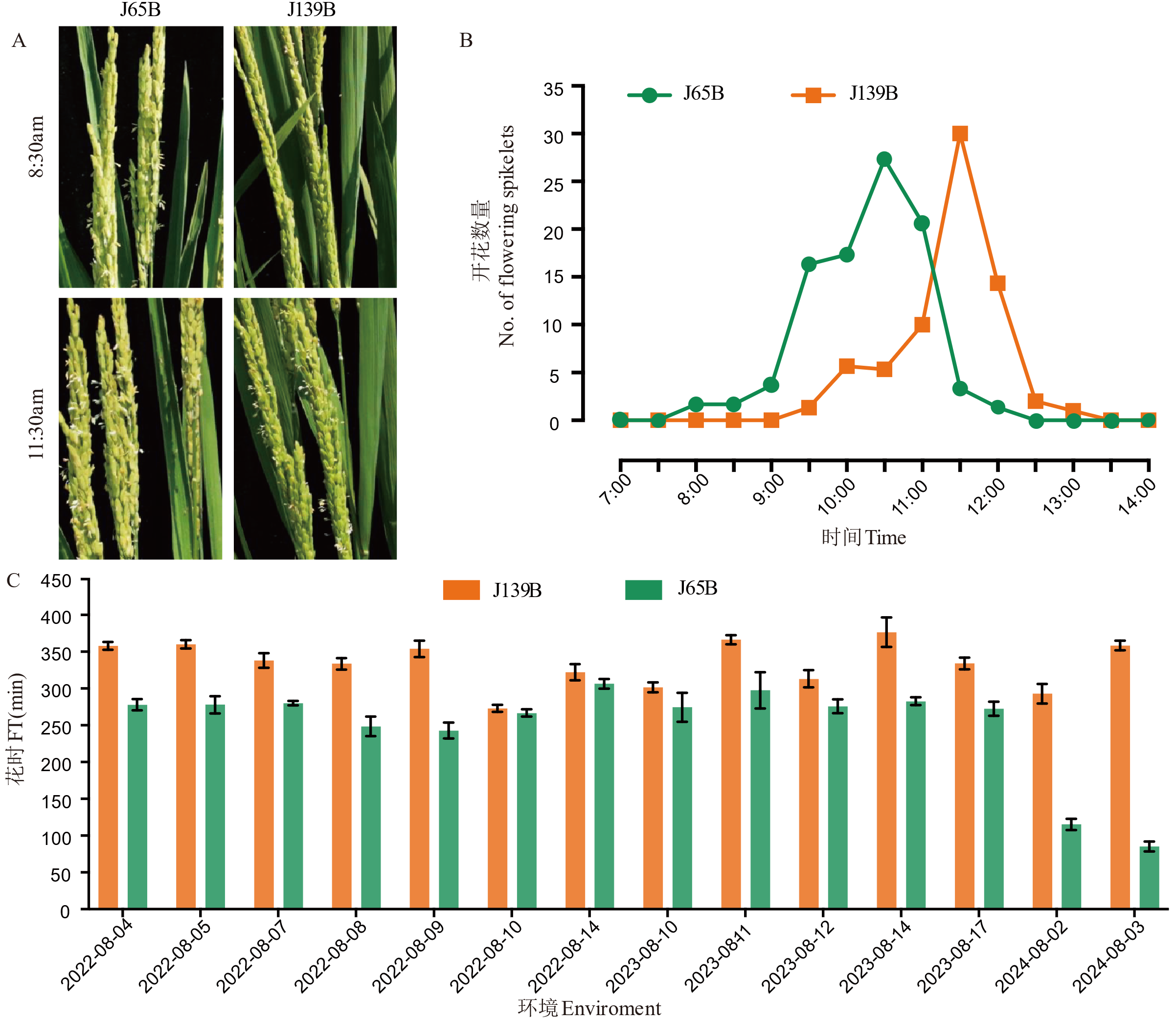
图1 两个亲本花时表现 A:亲本开花动态;B:亲本在14个环境下的花时差异;C:亲本颖花开放情况。
Fig. 1. Floret-opening time performance of the two parents A, Diurnal-floret-opening-time dynamics of the parents;B, Diurnal-floret-opening-time difference between the two parents under 14 environments;C, Floret-opening-time of the two parents.
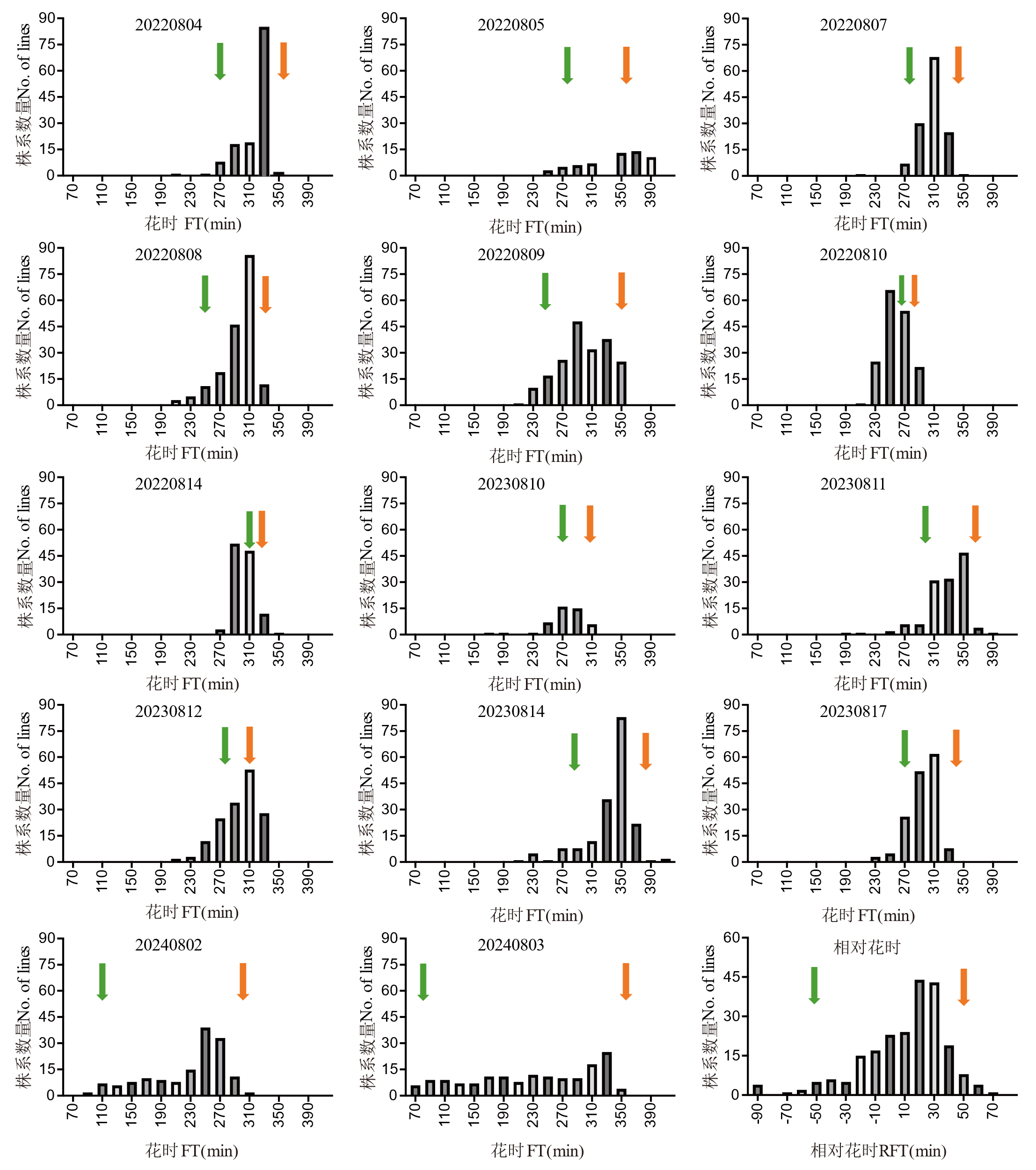
图2 RIL群体在14个环境下花时分布情况
Fig. 2. Distribution of FT in the RIL populations under 14 environments
| 环境 Environment | J139B (min) | J65B (min) | 群体均值 Mean(min) | 幅度 FT difference(min) | 标准误 Standard error | 偏度 Skewness | 峰度 Kurtosis | KS检验 KS-test | P值 P-value |
|---|---|---|---|---|---|---|---|---|---|
| 2022-08-04 | 358 b B | 277.9 bc C | 328.0 | 130.0 | 21.9 | −1.527 | 2.840 | 2.29 | 0.000 |
| 2022-08-05 | 360 b AB | 278 bc C | 348.2 | 141.0 | 43.2 | −0.704 | −0.884 | 1.61 | 0.011 |
| 2022-08-07 | 338 c CD | 280.1 bc BC | 318.0 | 126.0 | 17.1 | −1.524 | 5.989 | 1.91 | 0.001 |
| 2022-08-08 | 333.6 cd D | 248.4 d D | 304.5 | 125.0 | 24.3 | −1.453 | 2.103 | 2.26 | 0.000 |
| 2022-08-09 | 354 b BC | 242.8 d D | 307.8 | 140.0 | 33.4 | −0.349 | −0.699 | 1.07 | 0.203 |
| 2022-08-10 | 272.9 h H | 266.8 c C | 267.5 | 80.0 | 16.9 | 0.109 | −0.552 | 0.83 | 0.489 |
| 2022-08-14 | 322.1 de DE | 306.5 a A | 312.9 | 91.0 | 13.8 | 0.434 | 1.271 | 1.03 | 0.236 |
| 2023-08-10 | 301.4 fg FG | 274.4 bc C | 283.2 | 135.0 | 27.3 | −2.179 | 6.351 | 1.07 | 0.200 |
| 2023-08-11 | 366.4 ab AB | 297.7 a AB | 337.5 | 206.6 | 30.0 | −1.560 | 4.279 | 1.55 | 0.017 |
| 2023-08-12 | 313.1 ef EF | 275.9 bc C | 305.2 | 130.9 | 28.0 | −0.813 | 0.191 | 1.49 | 0.024 |
| 2023-08-14 | 376.6 a A | 282.7 b BC | 344.3 | 192.6 | 32.1 | −1.524 | 2.691 | 2.66 | 0.000 |
| 2023-08-17 | 333.9 cd D | 272.5 bc C | 304.0 | 102.9 | 19.3 | −0.840 | 1.138 | 1.09 | 0.189 |
| 2024-08-02 | 293.1 g G | 115.5 e E | 237.1 | 220.0 | 53.3 | −0.952 | −0.162 | 2.57 | 0.000 |
| 2024-08-03 | 358.3 b B | 85.4 f F | 238.5 | 281.2 | 84.4 | −0.322 | −1.188 | 1.60 | 0.012 |
| 均值Mean | 334.4 | 250.3 | |||||||
| 标准差 SD | 30.6 | 65.8 | |||||||
| 变异系数 CV | 9.1 | 26.3 |
表2 亲本及RIL群体在14个环境下的花时性状表现
Table 2. Performance of FT in two parents and the RIL population under 14 environments
| 环境 Environment | J139B (min) | J65B (min) | 群体均值 Mean(min) | 幅度 FT difference(min) | 标准误 Standard error | 偏度 Skewness | 峰度 Kurtosis | KS检验 KS-test | P值 P-value |
|---|---|---|---|---|---|---|---|---|---|
| 2022-08-04 | 358 b B | 277.9 bc C | 328.0 | 130.0 | 21.9 | −1.527 | 2.840 | 2.29 | 0.000 |
| 2022-08-05 | 360 b AB | 278 bc C | 348.2 | 141.0 | 43.2 | −0.704 | −0.884 | 1.61 | 0.011 |
| 2022-08-07 | 338 c CD | 280.1 bc BC | 318.0 | 126.0 | 17.1 | −1.524 | 5.989 | 1.91 | 0.001 |
| 2022-08-08 | 333.6 cd D | 248.4 d D | 304.5 | 125.0 | 24.3 | −1.453 | 2.103 | 2.26 | 0.000 |
| 2022-08-09 | 354 b BC | 242.8 d D | 307.8 | 140.0 | 33.4 | −0.349 | −0.699 | 1.07 | 0.203 |
| 2022-08-10 | 272.9 h H | 266.8 c C | 267.5 | 80.0 | 16.9 | 0.109 | −0.552 | 0.83 | 0.489 |
| 2022-08-14 | 322.1 de DE | 306.5 a A | 312.9 | 91.0 | 13.8 | 0.434 | 1.271 | 1.03 | 0.236 |
| 2023-08-10 | 301.4 fg FG | 274.4 bc C | 283.2 | 135.0 | 27.3 | −2.179 | 6.351 | 1.07 | 0.200 |
| 2023-08-11 | 366.4 ab AB | 297.7 a AB | 337.5 | 206.6 | 30.0 | −1.560 | 4.279 | 1.55 | 0.017 |
| 2023-08-12 | 313.1 ef EF | 275.9 bc C | 305.2 | 130.9 | 28.0 | −0.813 | 0.191 | 1.49 | 0.024 |
| 2023-08-14 | 376.6 a A | 282.7 b BC | 344.3 | 192.6 | 32.1 | −1.524 | 2.691 | 2.66 | 0.000 |
| 2023-08-17 | 333.9 cd D | 272.5 bc C | 304.0 | 102.9 | 19.3 | −0.840 | 1.138 | 1.09 | 0.189 |
| 2024-08-02 | 293.1 g G | 115.5 e E | 237.1 | 220.0 | 53.3 | −0.952 | −0.162 | 2.57 | 0.000 |
| 2024-08-03 | 358.3 b B | 85.4 f F | 238.5 | 281.2 | 84.4 | −0.322 | −1.188 | 1.60 | 0.012 |
| 均值Mean | 334.4 | 250.3 | |||||||
| 标准差 SD | 30.6 | 65.8 | |||||||
| 变异系数 CV | 9.1 | 26.3 |
| QTL | 环境 Environment | 染色体 Chr. | 位置 Position | 标记区间 Marker interval | LOD | 表型贡献率 Phenotypic variance explained(%) | 加性效应 Additive effect |
|---|---|---|---|---|---|---|---|
| qFT2.1 | 1 | 2 | 32 | 3548115−5120420 | 3.69 | 13.511 | 15.93 |
| qFT2.2 | 1 | 2 | 160 | 5211026−10870893 | 2.50 | 0.721 | 14.08 |
| qFT2.3 | 3 | 2 | 174-181 | 10870893−15640124 | 2.94-7.67 | 1.673-3.905 | 26.8-38.06 |
| qFT3.1 | 2 | 3 | 2-3 | 1276817−6232373 | 4.28-5.10 | 0.993-3.874 | 3.76-6.51 |
| qFT3.2 | 2 | 3 | 66-68 | 11778351−15589648 | 3.11-6.14 | 0.442-1.631 | 10.23-24.27 |
| qFT3.3 | 1 | 3 | 133 | 15589648−15963860 | 3.65 | 3.867 | 35.89 |
| qFT3.4 | 4 | 3 | 157-161 | 15963860−19173865 | 2.56-3.36 | 1.679-3.841 | 15.65-37.13 |
| qFT3.5 | 2 | 3 | 180-180 | 21059861−22120274 | 3.06-3.56 | 0.512-0.672 | 10.78-15.3 |
| qFT4 | 1 | 4 | 96 | 20657255−20765327 | 2.97 | 0.183 | 5.43 |
| qFT5.1 | 1 | 5 | 23 | 1178896−2313820 | 3.48 | 0.895 | 6.13 |
| qFT5.2 | 8 | 5 | 89-102 | 3512365−3770562 | 4.60-16.46 | 0.271-5.459 | 18.09-50.52 |
| qFT5.3 | 10 | 5 | 107-119 | 3770562−5289420 | 3.11-18.94 | 0.271-8.945 | 13.04-50.47 |
| qFT5.4 | 3 | 5 | 211-212 | 10410805−10847593 | 2.87-4.59 | 1.223-3.273 | 20.33-34.22 |
| qFT5.5 | 9 | 5 | 217-232 | 11057325−20726014 | 3.87-13.67 | 0.271-5.636 | 16.81-48.85 |
| qFT6.1 | 1 | 6 | 10 | 1632003−3338507 | 3.00 | 0.449 | 4.09 |
| qFT6.2 | 3 | 6 | 129 | 26902414−29897327 | 3.28-7.15 | 0.555-1.644 | 6.71-24.23 |
| qFT7.1 | 1 | 7 | 84 | 10497568−13804874 | 4.57 | 3.267 | -22.95 |
| qFT7.2 | 2 | 7 | 91-92 | 13804874−17673544 | 5.15-6.00 | 2.731-3.429 | -22.09--17.81 |
| qFT8.1 | 1 | 8 | 161 | 15987810−17697658 | 2.65 | 2.313 | 2.91 |
| qFT8.2 | 1 | 8 | 227 | 21632760−24890652 | 3.03 | 1.061 | 7.32 |
| qFT9.1 | 1 | 9 | 83 | 15336683−16946239 | 10.50 | 1.399 | -10.86 |
| qFT9.2 | 1 | 9 | 94 | 17736891−19018118 | 6.09 | 0.718 | 8.02 |
| qFT10.1 | 1 | 10 | 22 | 2340168−2526630 | 2.95 | 0.566 | 6.72 |
| qFT10.2 | 8 | 10 | 97-108 | 10550006−14355797 | 2.83-12.27 | 0.239-5.465 | 16.27-50.37 |
| qFT10.3 | 8 | 10 | 117-127 | 14355797−17930367 | 2.64-11.99 | 0.236-5.428 | 16.41-50.93 |
| qFT11.1 | 1 | 11 | 1 | 5768520−6510910 | 3.92 | 3.699 | 8.52 |
| qFT11.2 | 1 | 11 | 37 | 8759552−8972803 | 4.16 | 0.594 | 4.73 |
| qFT11.3 | 1 | 11 | 163 | 23361525−23613051 | 9.30 | 1.855 | 8.82 |
| qFT12.1 | 1 | 11 | 81 | 19422618−22520720 | 2.65 | 0.805 | 5.81 |
| qFT12.2 | 2 | 12 | 136-148 | 22520720−25953139 | 4.35-5.47 | 3.854-5.540 | 35.39-46.63 |
表3 在11个环境下花时QTL定位结果
Table 3. Information of FT-related QTLs in RILs under 11 environments
| QTL | 环境 Environment | 染色体 Chr. | 位置 Position | 标记区间 Marker interval | LOD | 表型贡献率 Phenotypic variance explained(%) | 加性效应 Additive effect |
|---|---|---|---|---|---|---|---|
| qFT2.1 | 1 | 2 | 32 | 3548115−5120420 | 3.69 | 13.511 | 15.93 |
| qFT2.2 | 1 | 2 | 160 | 5211026−10870893 | 2.50 | 0.721 | 14.08 |
| qFT2.3 | 3 | 2 | 174-181 | 10870893−15640124 | 2.94-7.67 | 1.673-3.905 | 26.8-38.06 |
| qFT3.1 | 2 | 3 | 2-3 | 1276817−6232373 | 4.28-5.10 | 0.993-3.874 | 3.76-6.51 |
| qFT3.2 | 2 | 3 | 66-68 | 11778351−15589648 | 3.11-6.14 | 0.442-1.631 | 10.23-24.27 |
| qFT3.3 | 1 | 3 | 133 | 15589648−15963860 | 3.65 | 3.867 | 35.89 |
| qFT3.4 | 4 | 3 | 157-161 | 15963860−19173865 | 2.56-3.36 | 1.679-3.841 | 15.65-37.13 |
| qFT3.5 | 2 | 3 | 180-180 | 21059861−22120274 | 3.06-3.56 | 0.512-0.672 | 10.78-15.3 |
| qFT4 | 1 | 4 | 96 | 20657255−20765327 | 2.97 | 0.183 | 5.43 |
| qFT5.1 | 1 | 5 | 23 | 1178896−2313820 | 3.48 | 0.895 | 6.13 |
| qFT5.2 | 8 | 5 | 89-102 | 3512365−3770562 | 4.60-16.46 | 0.271-5.459 | 18.09-50.52 |
| qFT5.3 | 10 | 5 | 107-119 | 3770562−5289420 | 3.11-18.94 | 0.271-8.945 | 13.04-50.47 |
| qFT5.4 | 3 | 5 | 211-212 | 10410805−10847593 | 2.87-4.59 | 1.223-3.273 | 20.33-34.22 |
| qFT5.5 | 9 | 5 | 217-232 | 11057325−20726014 | 3.87-13.67 | 0.271-5.636 | 16.81-48.85 |
| qFT6.1 | 1 | 6 | 10 | 1632003−3338507 | 3.00 | 0.449 | 4.09 |
| qFT6.2 | 3 | 6 | 129 | 26902414−29897327 | 3.28-7.15 | 0.555-1.644 | 6.71-24.23 |
| qFT7.1 | 1 | 7 | 84 | 10497568−13804874 | 4.57 | 3.267 | -22.95 |
| qFT7.2 | 2 | 7 | 91-92 | 13804874−17673544 | 5.15-6.00 | 2.731-3.429 | -22.09--17.81 |
| qFT8.1 | 1 | 8 | 161 | 15987810−17697658 | 2.65 | 2.313 | 2.91 |
| qFT8.2 | 1 | 8 | 227 | 21632760−24890652 | 3.03 | 1.061 | 7.32 |
| qFT9.1 | 1 | 9 | 83 | 15336683−16946239 | 10.50 | 1.399 | -10.86 |
| qFT9.2 | 1 | 9 | 94 | 17736891−19018118 | 6.09 | 0.718 | 8.02 |
| qFT10.1 | 1 | 10 | 22 | 2340168−2526630 | 2.95 | 0.566 | 6.72 |
| qFT10.2 | 8 | 10 | 97-108 | 10550006−14355797 | 2.83-12.27 | 0.239-5.465 | 16.27-50.37 |
| qFT10.3 | 8 | 10 | 117-127 | 14355797−17930367 | 2.64-11.99 | 0.236-5.428 | 16.41-50.93 |
| qFT11.1 | 1 | 11 | 1 | 5768520−6510910 | 3.92 | 3.699 | 8.52 |
| qFT11.2 | 1 | 11 | 37 | 8759552−8972803 | 4.16 | 0.594 | 4.73 |
| qFT11.3 | 1 | 11 | 163 | 23361525−23613051 | 9.30 | 1.855 | 8.82 |
| qFT12.1 | 1 | 11 | 81 | 19422618−22520720 | 2.65 | 0.805 | 5.81 |
| qFT12.2 | 2 | 12 | 136-148 | 22520720−25953139 | 4.35-5.47 | 3.854-5.540 | 35.39-46.63 |
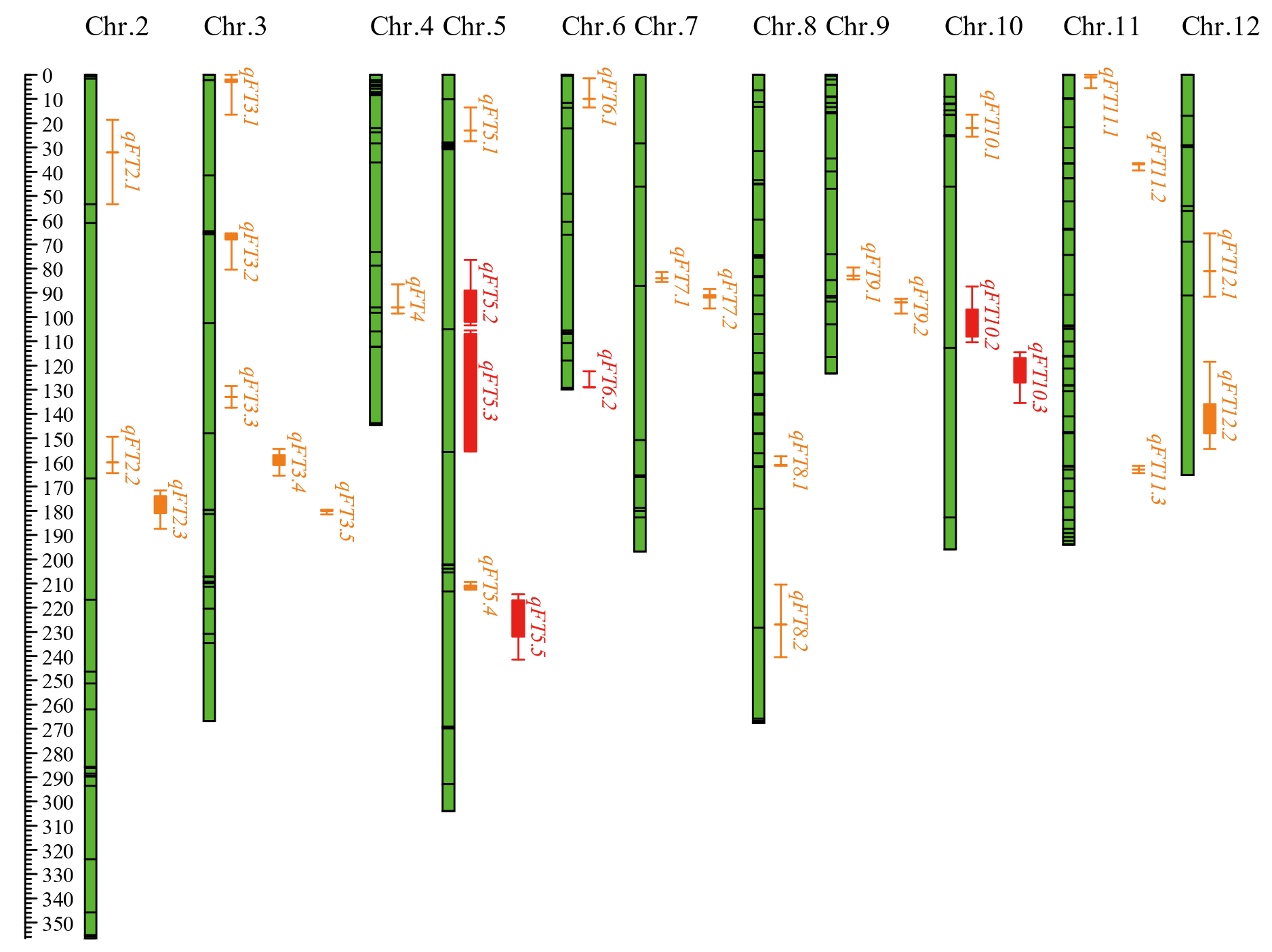
图3 SNP标记和花时QTLs在遗传图谱上的分布
Fig. 3. Distribution of SNP marker and FT-related QTLs on the genetic map

图4 ED关联值在染色体上的分布 A:ED-SNP;B:ED-InDel。横坐标为染色体名称,彩色的点代表每个SNP位点的ED值,黑色的线为拟合后的ED值,红色的虚线代表显著性关联阈值。A图阈值为0.65,B图阈值为1.15,ED值越高,代表该点关联效果越好。
Fig. 4. Distribution of ED-based linkage value on chromosomes A, ED-SNP;B, ED-InDel. The abscissa is the chromosome name. Each coloured dot represents an ED-based linkage value of an SNP/InDel site. Black line represents ED value after fitting. Red dashed line represents linkage threshold. Figure A has a threshold of 0.65 and Figure B has a threshold of 1.15. A larger ED value indicates a stronger linkage of the SNP/InDel site to target trait.

图5 SNP-index和InDel-index在染色体上的分布 A:SNP-index;B:InDel-index。横坐标为染色体名称,彩色的点代表计算出来的SNP-index/InDel-index值,黑色的线为拟合后的SNP index/InDel-index值。红色的线代表置信度为99%的阈值线,蓝色的线代表置信度为95%的阈值线,绿色的线代表置信度为90%的阈值线。
Fig. 5. Distribution of SNP-index and InDel-index on chromosomes A, SNP-index;B, InDel-index. The abscissa is the chromosome name. The coloured dot represents the calculated SNP-index/InDel-index value of each SNP/InDel site. The black line is the fitted SNP index/InDel-index value. The red line is 0.99 threshold, the blue line is 0.95 threshold and the green line is 0.90 threshold.
| 数据 Data | 基因座 QTL | ED | Index | 交集 Intersection | ||||||||
|---|---|---|---|---|---|---|---|---|---|---|---|---|
| 起始 位置 Start | 终止 位置 End | 片段长度 Segment size(Mb) | 起始 位置 Start | 终止 位置 End | 片段长度 Segment size(Mb) | 起始 位置 Start | 终止 位置 End | 片段长度 Segment size(Mb) | ||||
| SNP | 14650000 | 14780000 | 0.13 | |||||||||
| 16790000 | 17840000 | 1.05 | ||||||||||
| qFT3-SNP | 4690000 | 6010000 | 1.32 | 4720000 | 5710000 | 0.99 | 4720000 | 5710000 | 0.99 | |||
| qFT5-SNP | 4880000 | 6390000 | 1.51 | 5050000 | 6420000 | 1.37 | 5050000 | 6390000 | 1.34 | |||
| qFT6-SNP | 28740000 | 31230000 | 2.49 | 28750000 | 31230000 | 2.48 | 28750000 | 31230000 | 2.48 | |||
| qFT8.1-SNP | 19550000 | 19880000 | 0.33 | 19250000 | 20060000 | 0.81 | 19550000 | 19880000 | 0.33 | |||
| qFT8.2-SNP | 19910000 | 20060000 | 0.15 | 19250000 | 20060000 | 0.81 | 19910000 | 20060000 | 0.15 | |||
| 18480000 | 19000000 | 0.52 | ||||||||||
| 10920000 | 10980000 | 0.06 | ||||||||||
| InDel | 4880000 | 4910000 | 0.03 | |||||||||
| 5140000 | 6390000 | 1.25 | ||||||||||
| qFT5-InDel | 18410000 | 19710000 | 1.30 | 19380000 | 19550000 | 0.17 | 19380000 | 19550000 | 0.17 | |||
| qFT6-InDel | 28810000 | 31230000 | 2.42 | 28760000 | 31230000 | 2.47 | 28810000 | 31230000 | 2.42 | |||
| qFT12-InDel | 7010000 | 9000000 | 1.99 | 7770000 | 7860000 | 0.09 | 7770000 | 7860000 | 0.09 | |||
| 19010000 | 19010000 | 0.00 | ||||||||||
| 34530000 | 35140000 | 0.61 | ||||||||||
| 21690000 | 21860000 | 0.17 | ||||||||||
| 22180000 | 22250000 | 0.07 | ||||||||||
| 22740000 | 23810000 | 1.07 | ||||||||||
表4 花时关联区域
Table 4. Association interval of flowering time
| 数据 Data | 基因座 QTL | ED | Index | 交集 Intersection | ||||||||
|---|---|---|---|---|---|---|---|---|---|---|---|---|
| 起始 位置 Start | 终止 位置 End | 片段长度 Segment size(Mb) | 起始 位置 Start | 终止 位置 End | 片段长度 Segment size(Mb) | 起始 位置 Start | 终止 位置 End | 片段长度 Segment size(Mb) | ||||
| SNP | 14650000 | 14780000 | 0.13 | |||||||||
| 16790000 | 17840000 | 1.05 | ||||||||||
| qFT3-SNP | 4690000 | 6010000 | 1.32 | 4720000 | 5710000 | 0.99 | 4720000 | 5710000 | 0.99 | |||
| qFT5-SNP | 4880000 | 6390000 | 1.51 | 5050000 | 6420000 | 1.37 | 5050000 | 6390000 | 1.34 | |||
| qFT6-SNP | 28740000 | 31230000 | 2.49 | 28750000 | 31230000 | 2.48 | 28750000 | 31230000 | 2.48 | |||
| qFT8.1-SNP | 19550000 | 19880000 | 0.33 | 19250000 | 20060000 | 0.81 | 19550000 | 19880000 | 0.33 | |||
| qFT8.2-SNP | 19910000 | 20060000 | 0.15 | 19250000 | 20060000 | 0.81 | 19910000 | 20060000 | 0.15 | |||
| 18480000 | 19000000 | 0.52 | ||||||||||
| 10920000 | 10980000 | 0.06 | ||||||||||
| InDel | 4880000 | 4910000 | 0.03 | |||||||||
| 5140000 | 6390000 | 1.25 | ||||||||||
| qFT5-InDel | 18410000 | 19710000 | 1.30 | 19380000 | 19550000 | 0.17 | 19380000 | 19550000 | 0.17 | |||
| qFT6-InDel | 28810000 | 31230000 | 2.42 | 28760000 | 31230000 | 2.47 | 28810000 | 31230000 | 2.42 | |||
| qFT12-InDel | 7010000 | 9000000 | 1.99 | 7770000 | 7860000 | 0.09 | 7770000 | 7860000 | 0.09 | |||
| 19010000 | 19010000 | 0.00 | ||||||||||
| 34530000 | 35140000 | 0.61 | ||||||||||
| 21690000 | 21860000 | 0.17 | ||||||||||
| 22180000 | 22250000 | 0.07 | ||||||||||
| 22740000 | 23810000 | 1.07 | ||||||||||
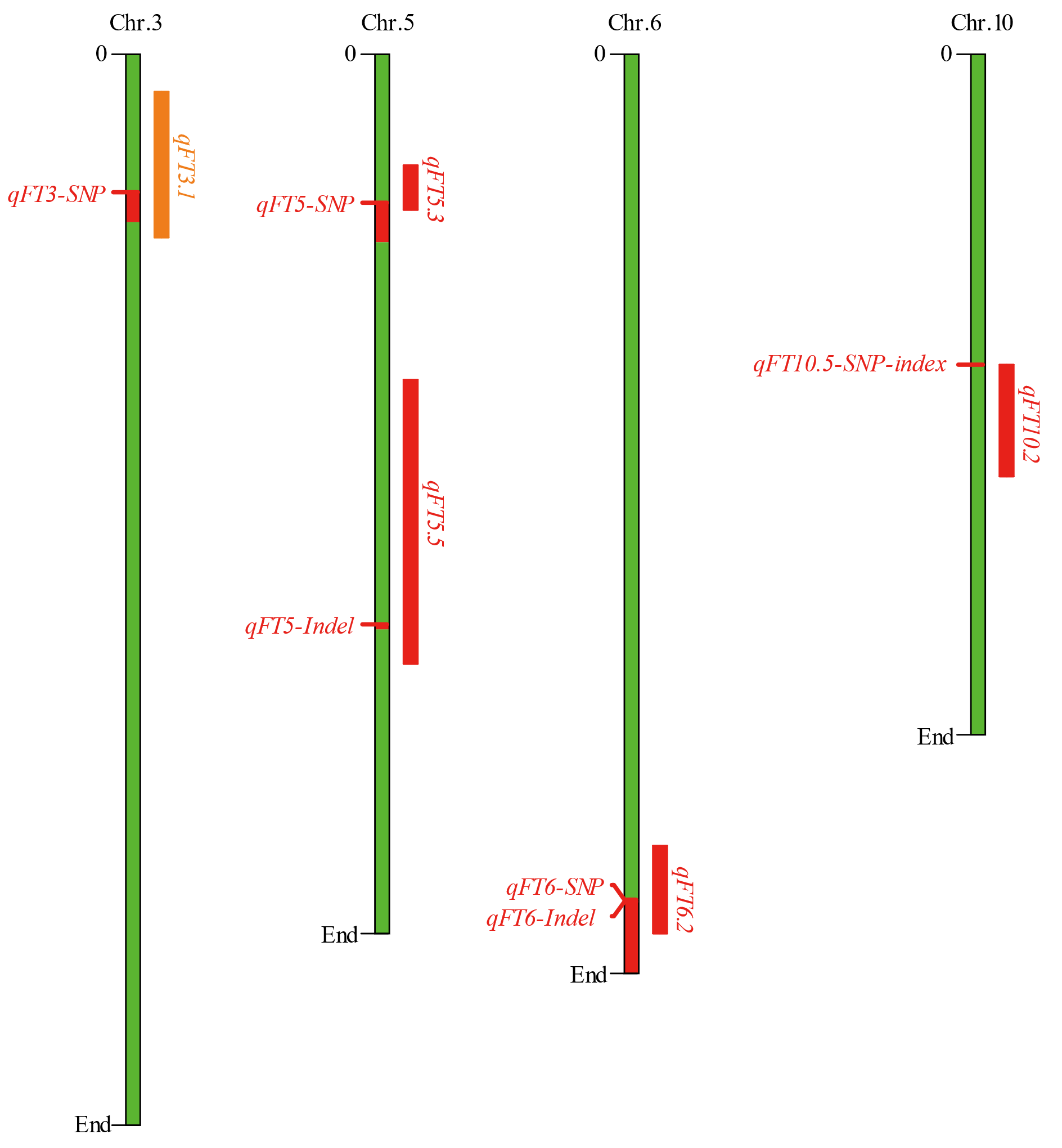
图6 两种方法定位到的位置重叠QTL
Fig. 6. QTLs with overlapping regions under two mapping methods
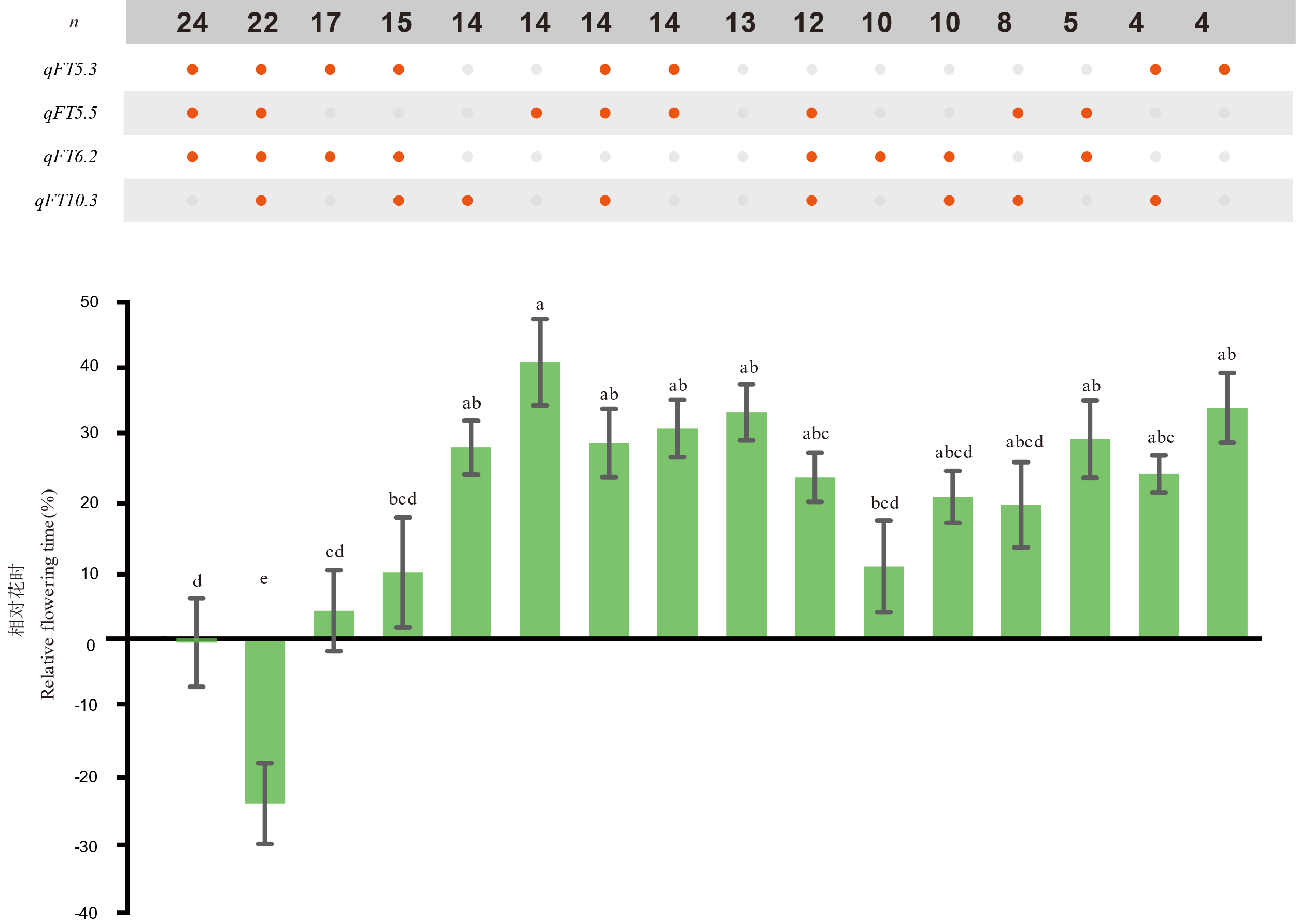
图7 4个稳定表达主效QTL的聚合效应分析 小写字母表示0.05水平显著性差异。
Fig. 7. Pyramiding effect analysis of the four stable main effect QTLs Lowercase letters indicate the difference at 0.05 level.
| [1] | 隋国民. 杂交粳稻研究进展与发展策略[J]. 辽宁农业科学, 2018(1): 51-55+2. |
| Sui G M. Resarch progress and development strategy of japonica hybrid rice[J]. Liaoning Agricultural Sciences, 2018(1): 51-55+2. (in Chinese with English abstract) | |
| [2] | 邓运, 康蓉蓉, 田小海, 林俊城, 陈淑莲. 12个杂交水稻不育系异交性能的测定[J]. 作物杂志, 2008(2): 38-42. |
| Deng Y, Kang R R, Tian X H, Lin J C, Chen S L. Field performance of outcrossing characteristics for twelve male sterile-lines of hybrid rice[J]. Crops, 2008(2): 38-42. (in Chinese with English abstract) | |
| [3] | 田大成, 黄三奎, 段永国, 王友红. 水稻不育系花时和受粉时间与异交结实率的关系[J]. 杂交水稻, 2004(3): 53-57. |
| Tian D C, Huang S K, Duan Y G, Wang Y H. The relationship between flowering and pollination time and outcrossing rate of male sterile lines in hybrid rice seed production[J]. Hybrid Rice, 2004(3): 53-57. (in Chinese with English abstract) | |
| [4] | 张雪, 张城, 王彦荣, 陈亚军, 李春凯, 田书军. 6个水稻三系不育系异交特性研究[J]. 辽宁农业科学, 2021(2): 34-36. |
| Zhang X, Zhang C, Wang Y R, Chen Y J, Li C K, Tian S J. Outcrossing characteristics of 6 rice CMS lines[J]. Liaoning Agricultural Sciences, 2021(2): 34-36. (in Chinese with English abstract) | |
| [5] | Wang M M, Chen M H, Huang Z, Zhou H, Liu Z L. Advances on the study of diurnal flower-opening times of rice[J]. International Journal of Molecular Sciences, 2023, 24(13): 10654. |
| [6] | 白刚. 水稻花时性状的QTL分析[D]. 成都: 四川师范大学, 2010. |
| Bai G. QTL analysis for flowering time in rice[D]. Chengdu: Sichuan Normal University, 2010. (in Chinese with English abstract) | |
| [7] | 马作斌, 詹瞻, 徐海, 徐正进, 毛艇, 朱春杰, 郭艳华. 籼粳稻杂交后代花时性状的QTL分析[J]. 植物生理学报, 2011, 47(8): 799-802. |
| Ma Z B, Zhan Z, Xu H, Xu Z J, Mao T, Zhu C J, Guo Y H. QTL analysis on flowering time in filial generations of cross between indica and japonica rice[J]. Plant Physiology Journal, 2011, 47(8): 799-802. (in Chinese with English abstract) | |
| [8] | 万国, 冯跃, 张凤娇, 徐群, 王一平, 袁筱萍, 余汉勇, 彭锁堂. 水稻花时性状的QTL定位[J]. 核农学报, 2013, 27(5): 562-567. |
| Wan G, Feng Y, Zhang F J, Xu Q, Wang Y P, Yuan X P, Yu H Y, Peng S T. Mapping QTLs for flowering time in rice[J]. Journal of Nuclear Agricultural Sciences, 2013, 27(5): 562-567. (in Chinese with English abstract) | |
| [9] | 张萌. 水稻花时的研究新方法探究及其QTL定位[D]. 北京: 中国农业科学院, 2016. |
| Zhang M. New methods developed and QTL mapping for flowering time in rice[D]. Beijing: Chinese Academy of Agricultural Sciences, 2016. (in Chinese with English abstract) | |
| [10] | Hirabayashi H, Sasaki K, Kambe T, Gannaban R B, Miras M A, Mendioro M S, Simon E V, Lumanglas P D, Fujita D, Takemoto-Kuno Y, Takeuchi Y, Kaji R, Kondo M, Kobayashi N, Ogawa T, Ando I, Jagadish K S V, Ishimaru T. qEMF3, a novel QTL for the early-morning flowering trait from wild rice, Oryza officinalis, to mitigate heat stress damage at flowering in rice, O. sativa[J]. Journal of Experimental Botany, 2015, 66(5): 1227-1236. |
| [11] | Che J, Li X, Ouyang Y. To open early or late: Decoding the mystery of diurnal floret opening time in rice[J]. Plant Communications, 2024, 5(5): 100889. |
| [12] | Xu P Z, Wu T K, Ali A, Zhang H Y, Liao Y X, Chen X Q, Tian Y H, Wang W M, Fu X D, Li Y, Fan J, Wang H, Tian Y F, Liu Y T, Jiang Q S, Sun C H, Zhou H, Wu X J. EARLY MORNING FLOWERING 1 (EMF1) regulates the floret opening time by mediating lodicule cell wall formation in rice[J]. Plant Biotechnology Journal, 2022, 20(8): 1441-1443. |
| [13] | Wang M M, Zhu X P, Peng G Q, Liu M L, Zhang S Q, Chen M H, Liao S T, Wei X Y, Xu P, Tan X Y, Li F P, Li Z C, Deng L, Luo Z L, Zhu L Y, Zhao S, Jiang D G, Li J, Liu Z L, Xie X R, Wang S K, Wu A M, Zhuang C X, Zhou H. Controlling diurnal flower-opening time by manipulating the jasmonate pathway accelerates development of indica-japonica hybrid rice breeding[J]. Molecular Plant, 2022, 15: 956-972. |
| [14] | Liu L, Zou Z S, Qian K, Xia C, He Y, Zeng H, Zhou X, Riemann M, Yin C X. Jasmonic acid deficiency leads to scattered floret opening time in cytoplasmic male sterile rice Zhenshan 97A[J]. Journal of Experimental Botany, 2017, 68(16): 4613-4625. |
| [15] | Wang M M, Zhu X P, Huang Z, Chen M H, Xu P, Liao S T, Zhao Y Z, Gao Y N, He J H, Luo Y T, Chen H X, Wei X Y, Nie S A, Dong J F, Zhu L Y, Zhuang C X, Zhao J L, Liu Z L, Zhou H. Controlling diurnal flower-opening time by manipulating the jasmonate pathway accelerates development of indica-japonica hybrid rice breeding[J]. Plant Biotechnology Journal, 2024, 22(8): 2267-2281. |
| [16] | Zhu X P, Wang M M, Huang Z, Chen M H, Xu P, Liao S T, Gao Y N, Zhao Y Z, Chen H X, He J H, Luo Y T, Wei X Y, Zhu L Y, Liu C H, Huang J L, Zhao X H, Zhao J L, Zhang Z M, Zhuang C X, Liu Z L, Zhou H. The OsMYC2-JA feedback loop regulates diurnal flower-opening time via cell wall loosening in rice[J]. Plant Journal, 2024, 119(6): 2585-2598. |
| [17] | Ding W Y, Gou Y J, Li Y J, Li J J, Fang Y D, Liu X P, Zhu X Y, Ye R J, Heng Y Q, Wang H Y, Shen R X. A jasmonate-mediated regulatory network modulates diurnal floret opening time in rice[J]. The New Phytologist, 2024, 244(1): 176-191. |
| [18] | Ding W, Gou Y, Li Y, Li J, Fang Y, Liu X, Zhu X, Ye R, Heng Y, Wang H, Shen R. A jasmonate-mediated regulatory network modulates diurnal floret opening time in rice[J]. The New Phytologist, 2024, 244(1): 176-191. |
| [19] | Gou Y J, Heng Y Q, Ding W Y, Xu C H, Tan Q S, Li Y J, Fang y d, Li X Q, Zhou D G, Zhu X Y, Zhang M Y, Ye R J, Wang H Y, Shen R X. Natural variation in OsMYB8 confers diurnal floret opening time divergence between indica and japonica subspecies[J]. Nature Communications, 2024, 15(1): 2262. |
| [20] | 孟帅, 徐鹏, 张迎信, 王宏, 曹立勇, 程式华, 沈希宏. 利用CRISPR/Cas9技术编辑粒长基因GS3改善粳稻花时[J]. 中国水稻科学, 2018, 32(2): 119-127. |
| Meng S, Xu P, Zhang Y X, Wang H, Cao L Y, Cheng S H, Shen X H. CRISPR/Cas9-mediated editing of GS3 to improve flowering time in japonica rice[J]. Chinese Journal of Rice Science, 2018, 32(2): 119-127. (in Chinese with English abstract) | |
| [21] | McCouch S R. Gene nomenclature system for rice[J]. Rice, 2008, 1(1): 72-84. |
| [1] | 陈玲, 林文英, 梁丽梅, 欧阳由男, 叶胜海, 季芝娟. 水稻开花习性及其在粳型三系不育系选育中的应用[J]. 中国水稻科学, 2025, 39(6): 731-743. |
| [2] | 王世林, 吴婷, 周诗琪, 宋思铭, 胡标林. 结合BSA-seq和QTL分析鉴定东乡野生稻耐储性QTL[J]. 中国水稻科学, 2025, 39(6): 789-800. |
| [3] | 卞金龙, 任高磊, 裘实, 许方甫, 胡忠磊, 张洪程, 魏海燕. 不同机插方式下控混肥施用方式对淮北地区优质食味粳稻产量及氮素利用的影响[J]. 中国水稻科学, 2025, 39(6): 847-862. |
| [4] | 邵雅芳, 朱大伟, 郑欣, 牟仁祥, 章林平, 陈铭学. 2002−2022长三角地区粳稻品质发展状况和地域差异性分析[J]. 中国水稻科学, 2025, 39(2): 264-276. |
| [5] | 杨传铭, 王立志, 张喜娟, 杨贤莉, 王洋洋, 侯本福, 崔士泽, 李青超, 刘凯, 马瑞, 冯延江, 来永才, 李红宇, 姜树坤. 基于高密度遗传图谱的粳稻苗期耐冷QTL分析[J]. 中国水稻科学, 2025, 39(1): 82-91. |
| [6] | 杜彦修, 孙文玉, 袁泽科, 张倩倩, 李富豪, 李俊周, 孙红正. 利用QTL-Seq结合分子标记定位粳稻垩白粒率控制位点qChalk8[J]. 中国水稻科学, 2024, 38(6): 665-671. |
| [7] | 刘俊峰, 牟静怡, 赵红艳, 郭诗梦, 李漪濛, 梁超, 周婵婵, 王术, 黄元财. 施氮方式与行距配置对不同穗型粳稻品种产量和氮素利用率的影响[J]. 中国水稻科学, 2024, 38(6): 672-684. |
| [8] | 姚姝, 陈涛, 赵春芳, 周丽慧, 赵凌, 梁文化, 赫磊, 路凯, 朱镇, 赵庆勇, 管菊, 王才林, 张亚东. 江淮稻区不同类型粳稻品种外观及蒸煮食味品质特征比较[J]. 中国水稻科学, 2024, 38(6): 709-718. |
| [9] | 丁正权, 潘月云, 施扬, 黄海祥. 基于基因芯片的嘉禾系列长粒优质食味粳稻综合评价与比较[J]. 中国水稻科学, 2024, 38(4): 397-408. |
| [10] | 侯本福, 杨传铭, 张喜娟, 杨贤莉, 王立志, 王嘉宇, 李红宇, 姜树坤. 利用龙稻5号/中优早8号RIL群体定位粒形QTL[J]. 中国水稻科学, 2024, 38(1): 13-24. |
| [11] | 景秀, 周苗, 王晶, 王岩, 王旺, 王开, 郭保卫, 胡雅杰, 邢志鹏, 许轲, 张洪程. 穗分化末期-灌浆初期干旱胁迫对优质食味粳稻根系形态和叶片光合特性的影响[J]. 中国水稻科学, 2024, 38(1): 33-47. |
| [12] | 黄亚茹, 徐鹏, 王乐乐, 贺一哲, 王辉, 柯健, 何海兵, 武立权, 尤翠翠. 外源海藻糖对粳稻品系W1844籽粒灌浆特性及产量形成的影响[J]. 中国水稻科学, 2023, 37(4): 379-391. |
| [13] | 王雨, 孙全翌, 杜海波, 许志文, 吴科霆, 尹力, 冯志明, 胡珂鸣, 陈宗祥, 左示敏. 利用抗稻瘟病基因Pigm和抗纹枯病数量性状基因qSB-9TQ、qSB-11HJX改良南粳9108的抗性[J]. 中国水稻科学, 2023, 37(2): 125-132. |
| [14] | 姚姝, 赵春芳, 陈涛, 路凯, 周丽慧, 赵凌, 朱镇, 赵庆勇, 梁文化, 赫磊, 王才林, 张亚东. 低谷蛋白半糯型粳稻营养品质与蒸煮食味品质特征分析[J]. 中国水稻科学, 2023, 37(2): 178-188. |
| [15] | 裴峰, 王广达, 高鹏, 冯志明, 胡珂鸣, 陈宗祥, 陈红旗, 崔傲, 左示敏. 敲除OsNramp5基因创制低镉优质粳稻新材料的应用评价[J]. 中国水稻科学, 2023, 37(1): 16-28. |
| 阅读次数 | ||||||
|
全文 |
|
|||||
|
摘要 |
|
|||||
