
中国水稻科学 ›› 2026, Vol. 40 ›› Issue (6): 774-785.DOI: 10.16819/j.1001-7216.2026.260412
牛付安, 储黄伟, 张安鹏, 周继华, 孙滨, 代雨婷, 谢开珍, 石凤珍, 尹子辉, 侯聪, 王奕, 李璟, 程灿*( ), 曹黎明*()
收稿日期:2026-04-29
修回日期:2026-07-04
出版日期:2026-11-10
发布日期:2026-11-09
通讯作者:
*email: caoliming@saas.sh.cn;基金资助:
NIU Fuan, CHU Huangwei, ZHANG Anpeng, ZHOU Jihua, SUN Bin, DAI Yuting, XIE Kaizhen, SHI Fengzhen, YIN Zihui, HOU Cong, WANG Yi, LI Jing, CHENG Can*(), CAO Liming*()
Received:2026-04-29
Revised:2026-07-04
Online:2026-11-10
Published:2026-11-09
摘要:
【目的】从基因组水平解析上海地区主要杂交粳稻亲本的遗传特性,为进一步开展杂交粳稻亲本分子改良和新组合测配提供理论依据与种质资源。【方法】利用高密度水稻全基因组SNP芯片对20个上海地区主要杂交粳稻亲本进行遗传背景分析、功能基因鉴定以及利用价值评价。【结果】杂交粳稻不育系粳型成分普遍高于恢复系,其中不育系申68A、申01A、申9A、申10A、申21A、申46A、申武1A、申长A和紫祥A粳型片段比例较高,属于典型粳稻类型。11个不育系和9个恢复系分别检测到控制产量、品质、抗生物和非生物逆境等重要性状功能基因19个和35个。上海地区主要杂交粳稻不育系抗病性好,申68A、申9A、申10A、申21A、申130A、申24A等多个不育系均含有广谱稻瘟病抗性基因组合“Pi2+Pita”。恢复系穗大粒多,含有较多的产量相关基因(OsSPL16、Gn1a和CYP704A3等),但聚合多个广谱抗稻瘟病主效抗性基因的品种较少,需加强恢复系稻瘟病抗性的分子改良。【结论】本研究明确了上海地区主要杂交粳稻亲本的遗传背景和携带的功能基因,为提高杂交粳稻新品种选育效率以及解决杂交粳稻育种的同质化问题奠定了良好基础。
牛付安, 储黄伟, 张安鹏, 周继华, 孙滨, 代雨婷, 谢开珍, 石凤珍, 尹子辉, 侯聪, 王奕, 李璟, 程灿, 曹黎明. 基于高密度基因芯片的上海杂交粳稻亲本基因型鉴定与育种利用[J]. 中国水稻科学, 2026, 40(6): 774-785.
NIU Fuan, CHU Huangwei, ZHANG Anpeng, ZHOU Jihua, SUN Bin, DAI Yuting, XIE Kaizhen, SHI Fengzhen, YIN Zihui, HOU Cong, WANG Yi, LI Jing, CHENG Can, CAO Liming. Genotyping and Breeding Utilization of Parental Lines of japonica Hybrid Rice in Shanghai Based on High-Density SNP Chips[J]. Chinese Journal OF Rice Science, 2026, 40(6): 774-785.
| 序号 Number | 品种 Variety | 籼型片段比例 indica segment ratio(%) | 粳型片段比例 japonica segment ratio(%) | 无法区分片段比例Unclassified segment ratio(%) | 类型 Type |
|---|---|---|---|---|---|
| 1 | 68A | 3.37 | 90.57 | 6.06 | 典型粳稻 Typical japonica rice |
| 2 | N01A | 2.43 | 91.91 | 5.66 | 典型粳稻 Typical japonica rice |
| 3 | S9A | 3.37 | 90.97 | 5.66 | 典型粳稻 Typical japonica rice |
| 4 | N10A | 3.23 | 92.05 | 4.72 | 典型粳稻 Typical japonica rice |
| 5 | S21A | 3.77 | 90.30 | 5.93 | 典型粳稻 Typical japonica rice |
| 6 | N9746A | 2.56 | 93.94 | 3.50 | 典型粳稻 Typical japonica rice |
| 7 | W1A | 3.10 | 92.45 | 4.45 | 典型粳稻 Typical japonica rice |
| 8 | HA62 | 3.10 | 90.57 | 6.33 | 典型粳稻 Typical japonica rice |
| 9 | N87A | 1.21 | 95.15 | 3.64 | 典型粳稻 Typical japonica rice |
| 10 | N04-130A | 4.18 | 89.89 | 5.93 | 粳稻 japonica rice |
| 11 | D3A | 5.39 | 88.01 | 6.60 | 粳稻 japonica rice |
| 12 | F7 | 9.70 | 84.91 | 5.39 | 粳稻 japonica rice |
| 13 | F14 | 12.94 | 78.57 | 8.49 | 粳稻 japonica rice |
| 14 | Th6 | 13.88 | 80.19 | 5.93 | 粳稻 japonica rice |
| 15 | F17 | 13.75 | 80.32 | 5.93 | 粳稻 japonica rice |
| 16 | F42 | 18.33 | 74.53 | 7.14 | 粳稻japonica rice |
| 17 | SCR1 | 15.77 | 75.61 | 8.62 | 粳稻 japonica rice |
| 18 | SH26 | 9.84 | 83.83 | 6.33 | 粳稻 japonica rice |
| 19 | F31 | 54.31 | 27.22 | 18.47 | 偏籼 indica-like rice |
| 20 | KH272 | 62.26 | 17.92 | 19.82 | 籼稻 indica rice |
表1 20个杂交粳稻亲本的籼粳片段分析
Table 1. Analysis of indica and japonica segments in 20 parent lines of japonica hybrid rice
| 序号 Number | 品种 Variety | 籼型片段比例 indica segment ratio(%) | 粳型片段比例 japonica segment ratio(%) | 无法区分片段比例Unclassified segment ratio(%) | 类型 Type |
|---|---|---|---|---|---|
| 1 | 68A | 3.37 | 90.57 | 6.06 | 典型粳稻 Typical japonica rice |
| 2 | N01A | 2.43 | 91.91 | 5.66 | 典型粳稻 Typical japonica rice |
| 3 | S9A | 3.37 | 90.97 | 5.66 | 典型粳稻 Typical japonica rice |
| 4 | N10A | 3.23 | 92.05 | 4.72 | 典型粳稻 Typical japonica rice |
| 5 | S21A | 3.77 | 90.30 | 5.93 | 典型粳稻 Typical japonica rice |
| 6 | N9746A | 2.56 | 93.94 | 3.50 | 典型粳稻 Typical japonica rice |
| 7 | W1A | 3.10 | 92.45 | 4.45 | 典型粳稻 Typical japonica rice |
| 8 | HA62 | 3.10 | 90.57 | 6.33 | 典型粳稻 Typical japonica rice |
| 9 | N87A | 1.21 | 95.15 | 3.64 | 典型粳稻 Typical japonica rice |
| 10 | N04-130A | 4.18 | 89.89 | 5.93 | 粳稻 japonica rice |
| 11 | D3A | 5.39 | 88.01 | 6.60 | 粳稻 japonica rice |
| 12 | F7 | 9.70 | 84.91 | 5.39 | 粳稻 japonica rice |
| 13 | F14 | 12.94 | 78.57 | 8.49 | 粳稻 japonica rice |
| 14 | Th6 | 13.88 | 80.19 | 5.93 | 粳稻 japonica rice |
| 15 | F17 | 13.75 | 80.32 | 5.93 | 粳稻 japonica rice |
| 16 | F42 | 18.33 | 74.53 | 7.14 | 粳稻japonica rice |
| 17 | SCR1 | 15.77 | 75.61 | 8.62 | 粳稻 japonica rice |
| 18 | SH26 | 9.84 | 83.83 | 6.33 | 粳稻 japonica rice |
| 19 | F31 | 54.31 | 27.22 | 18.47 | 偏籼 indica-like rice |
| 20 | KH272 | 62.26 | 17.92 | 19.82 | 籼稻 indica rice |
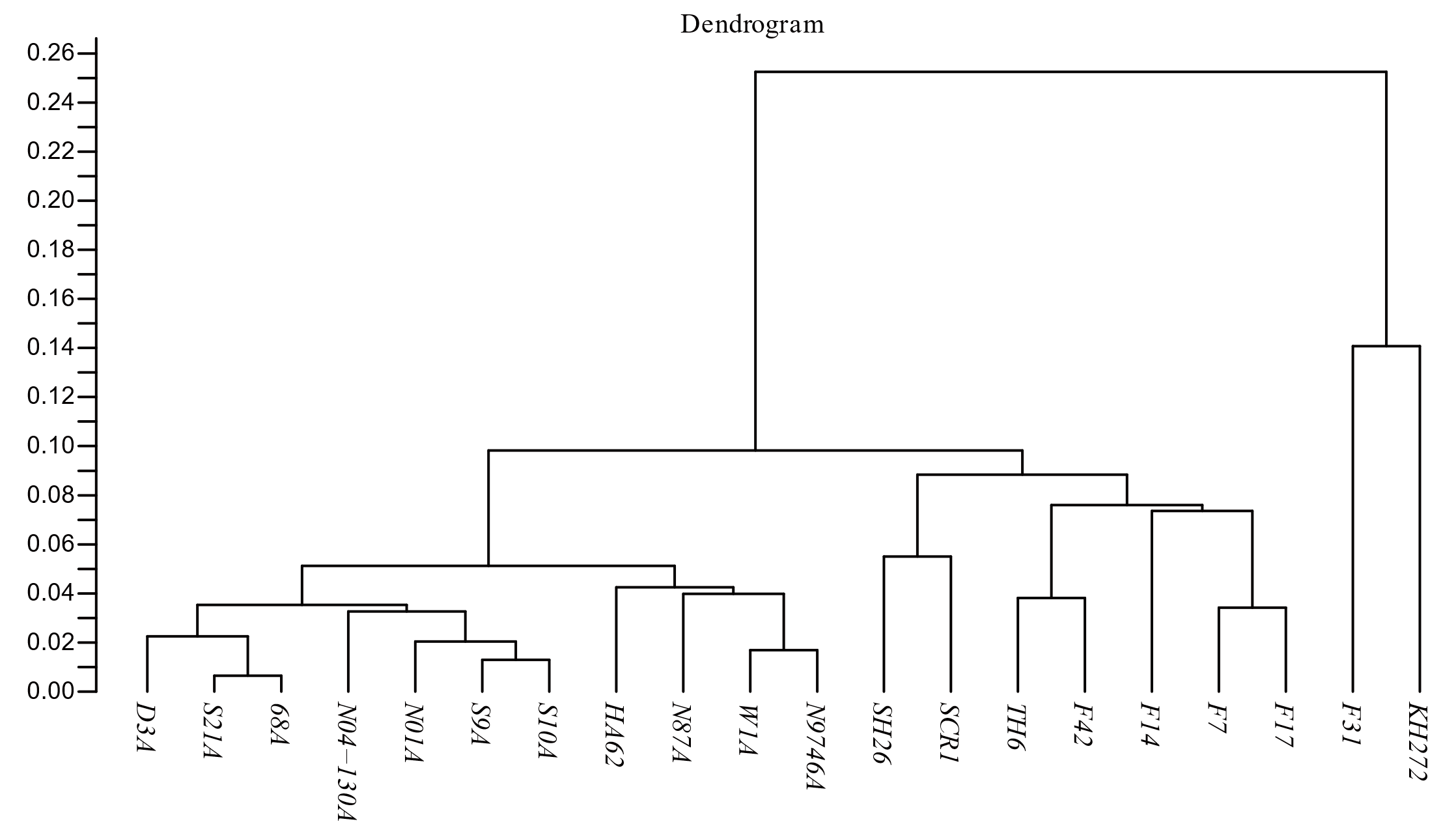
图1 上海地区主要杂交粳稻亲本的聚类分析树状图
Fig. 1. Dendrogram from cluster analysis of major parental lines of japonica hybrid rice in Shanghai
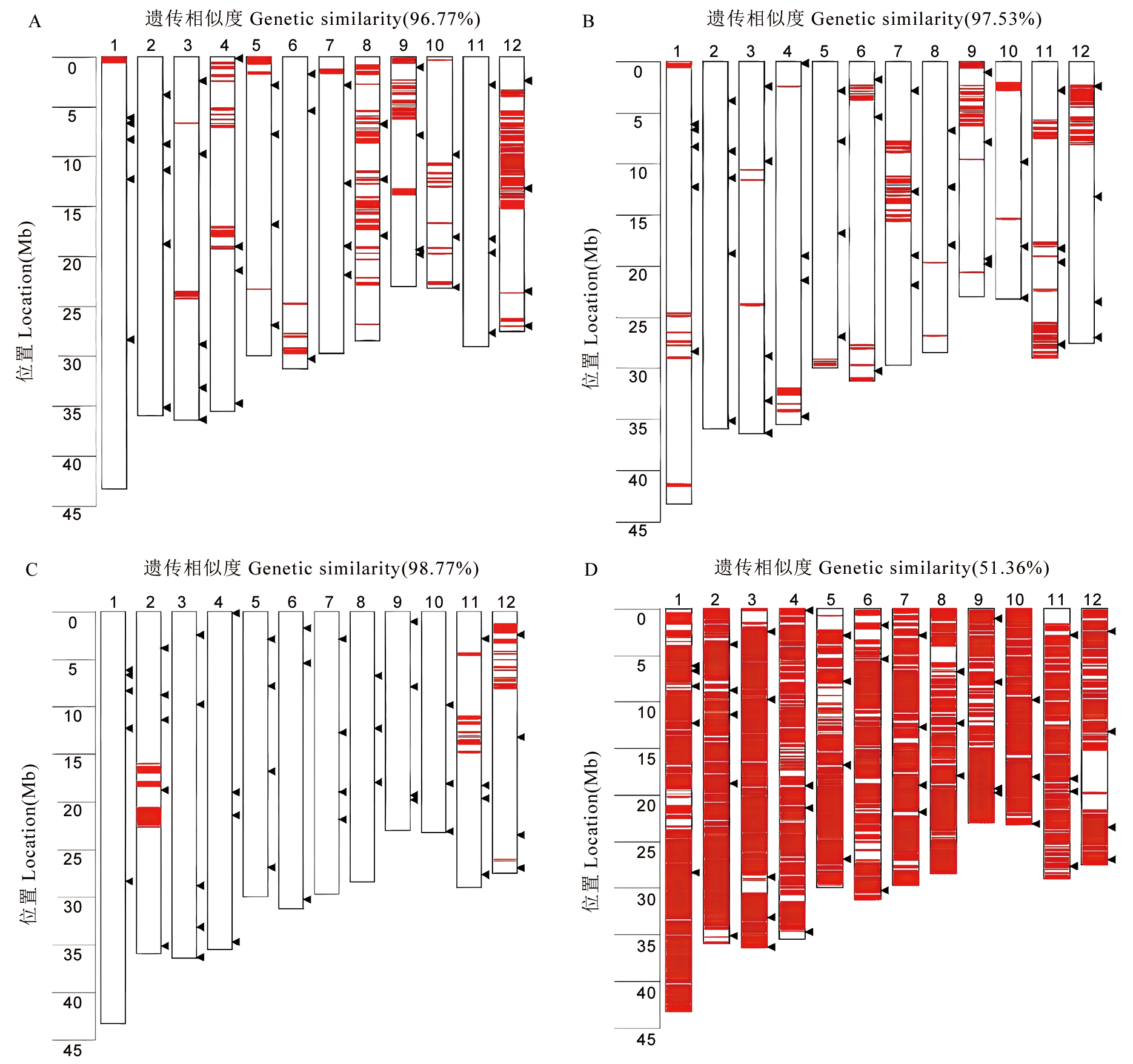
图2 上海地区杂交粳稻亲本的遗传相似度分析 申武1A和申46A(A)、申9A和申10A(B)、申68A和申21A(C)、申68A和繁32(D)之间的遗传相似度。图中红色部分为差异性位点,三角形指示的是《水稻品种鉴定技术规程 SSR标记法》(NY/T 1433−2014)中48个SSR标记的位置。
Fig. 2. Analysis of genetic similarity among parental lines of japonica hybrid rice in Shanghai Genetic similarity between Shenwu 1A and Shen 46 A (A), Shen 9A and Shen 10A (B), Shen 68A and Shen 21A (C), and Shen 68A and Fan 32 (D). Red bars, differential loci. Triangles, Locations of 48 SSR markers specified in the Chinese National Standard Technical Specification for Rice Variety Identification −SSR Marker Method (NY/T 1433−2014).
| 基因名称 Gene name | 表型 Phenotype | 代表品种 Representative variety | 68A | N01A | S9A | N10A | S21A | N9746A | W1A | HA62 | N87A | N04-130A | D3A |
|---|---|---|---|---|---|---|---|---|---|---|---|---|---|
| Wxb | 中等直链淀粉含量 Medium amylose content | 日本晴Nipponbare | √ | √ | √ | √ | √ | √ | √ | √ | √ | √ | √ |
| ALK | 增加中长型支链淀粉含量 Increasing medium and long-chain amylopectin content | 明恢63 Minghui 63 | √ | √ | √ | √ | √ | √ | √ | ||||
| GW5 | 增加粒宽 Enhancing grain width | 日本晴 Nipponbare | N | √ | √ | √ | √ | √ | √ | √ | √ | √ | |
| gs3 | 增加粒长 Increasing grain length | 明恢63 Minghui 63 | √ | ||||||||||
| Pi2 | 增强稻瘟病抗性 Enhancing blast resistance | 99SNP | √ | √ | √ | √ | √ | √ | √ | √ | |||
| Pita | 增强稻瘟病抗性 Enhancing blast resistance | 32SNP | √ | √ | √ | √ | √ | √ | √ | ||||
| Pid3 | 增强稻瘟病抗性 Enhancing blast resistance | 64SNP | √ | ||||||||||
| STV11 | 持久抗水稻条纹叶枯病 Durable resistance to rice stripe virus | 卡萨拉斯 Kasalath | N | √ | √ | √ | √ | ||||||
| Rymv1 | 抗黄色斑驳病毒病 Resistance to yellow mottle virus disease | 日本晴 Nipponbare | √ | √ | √ | √ | √ | √ | √ | √ | √ | √ | √ |
| qLTG3-1 | 提高种子低温下发芽势 Improving seed germination potential under low temperature conditions | 日本晴 Nipponbare | √ | √ | √ | √ | √ | √ | √ | ||||
| OsFRO1 | 铁耐受 Iron tolerance | 茉莉香米 KDML105 | N | √ | √ | √ | √ | √ | √ | √ | √ | √ | √ |
| qUVR-10 | 增强光修复活性 Enhancing photorepair activity | 笹锦 Sasanishiki | √ | √ | √ | √ | √ | √ | √ | √ | √ | √ | |
| OsHESO1 | 延迟抽穗 Late heading | 单倍型B Haplotype B | √ | √ | √ | √ | √ | √ | √ | √ | √ | √ | √ |
| Hd3a | 促进抽穗 Promoting heading | 日本晴 Nipponbare | √ | √ | √ | √ | √ | √ | √ | √ | √ | √ | |
| OsGATA28 | 延迟抽穗 Late heading | 单倍型C Haplotype C | N | √ | √ | √ | √ | √ | √ | √ | |||
| Hd17 | 延迟抽穗 Late heading | 越光 Koshihikari | √ | √ | √ | ||||||||
| SaF | 广亲和(粳稻亲和) Wide compatibility (japonica-compatibility | 日本晴 Nipponbare | N | √ | √ | √ | √ | √ | √ | √ | √ | √ | √ |
| Sdt97 | 半矮秆Semi-dwarf | Y98149 | N | √ | √ | √ | √ | √ | √ | √ | √ | √ | √ |
| sh4 | 非落粒Non-shattering | 日本晴 Nipponbare | N | √ | √ | √ | √ | √ | √ | √ | √ | √ | √ |
表2 11个杂交粳稻不育系携带的重要农艺性状功能基因
Table 2. Functional genes for important agronomic traits in 11 male sterile lines of japonica hybrid rice
| 基因名称 Gene name | 表型 Phenotype | 代表品种 Representative variety | 68A | N01A | S9A | N10A | S21A | N9746A | W1A | HA62 | N87A | N04-130A | D3A |
|---|---|---|---|---|---|---|---|---|---|---|---|---|---|
| Wxb | 中等直链淀粉含量 Medium amylose content | 日本晴Nipponbare | √ | √ | √ | √ | √ | √ | √ | √ | √ | √ | √ |
| ALK | 增加中长型支链淀粉含量 Increasing medium and long-chain amylopectin content | 明恢63 Minghui 63 | √ | √ | √ | √ | √ | √ | √ | ||||
| GW5 | 增加粒宽 Enhancing grain width | 日本晴 Nipponbare | N | √ | √ | √ | √ | √ | √ | √ | √ | √ | |
| gs3 | 增加粒长 Increasing grain length | 明恢63 Minghui 63 | √ | ||||||||||
| Pi2 | 增强稻瘟病抗性 Enhancing blast resistance | 99SNP | √ | √ | √ | √ | √ | √ | √ | √ | |||
| Pita | 增强稻瘟病抗性 Enhancing blast resistance | 32SNP | √ | √ | √ | √ | √ | √ | √ | ||||
| Pid3 | 增强稻瘟病抗性 Enhancing blast resistance | 64SNP | √ | ||||||||||
| STV11 | 持久抗水稻条纹叶枯病 Durable resistance to rice stripe virus | 卡萨拉斯 Kasalath | N | √ | √ | √ | √ | ||||||
| Rymv1 | 抗黄色斑驳病毒病 Resistance to yellow mottle virus disease | 日本晴 Nipponbare | √ | √ | √ | √ | √ | √ | √ | √ | √ | √ | √ |
| qLTG3-1 | 提高种子低温下发芽势 Improving seed germination potential under low temperature conditions | 日本晴 Nipponbare | √ | √ | √ | √ | √ | √ | √ | ||||
| OsFRO1 | 铁耐受 Iron tolerance | 茉莉香米 KDML105 | N | √ | √ | √ | √ | √ | √ | √ | √ | √ | √ |
| qUVR-10 | 增强光修复活性 Enhancing photorepair activity | 笹锦 Sasanishiki | √ | √ | √ | √ | √ | √ | √ | √ | √ | √ | |
| OsHESO1 | 延迟抽穗 Late heading | 单倍型B Haplotype B | √ | √ | √ | √ | √ | √ | √ | √ | √ | √ | √ |
| Hd3a | 促进抽穗 Promoting heading | 日本晴 Nipponbare | √ | √ | √ | √ | √ | √ | √ | √ | √ | √ | |
| OsGATA28 | 延迟抽穗 Late heading | 单倍型C Haplotype C | N | √ | √ | √ | √ | √ | √ | √ | |||
| Hd17 | 延迟抽穗 Late heading | 越光 Koshihikari | √ | √ | √ | ||||||||
| SaF | 广亲和(粳稻亲和) Wide compatibility (japonica-compatibility | 日本晴 Nipponbare | N | √ | √ | √ | √ | √ | √ | √ | √ | √ | √ |
| Sdt97 | 半矮秆Semi-dwarf | Y98149 | N | √ | √ | √ | √ | √ | √ | √ | √ | √ | √ |
| sh4 | 非落粒Non-shattering | 日本晴 Nipponbare | N | √ | √ | √ | √ | √ | √ | √ | √ | √ | √ |
| 基因名称 Gene name | 表型 Phenotype | 代表品种 Representative variety | F7 | F14 | Th6 | F17 | F42 | SCR1 | SH26 | F31 | KH272 | |||||||||||
|---|---|---|---|---|---|---|---|---|---|---|---|---|---|---|---|---|---|---|---|---|---|---|
| GW5 | 增加粒宽 Enhancing grain width | 日本晴 Nipponbare | √ | √ | √ | √ | √ | |||||||||||||||
| OsSPL16 | 高产High yield | 华粳籼74 Huajingxian 74 | √ | √ | √ | |||||||||||||||||
| Gn1a | 增加穗粒数 Increasing grain number per panicle | 哈巴达克, 9311 Habataki, 9311 | √ | √ | ||||||||||||||||||
| CYP704A3 | 增加粒长 Increasing grain length | IR 24 | √ | |||||||||||||||||||
| Wxb | 中等直链淀粉含量 Medium amylose content | 日本晴 Nipponbare Nipponbare | √ | √ | √ | √ | √ | √ | √ | √ | √ | |||||||||||
| ALK | 增加中长型支链淀粉含量 Increasing medium- and long- chain amylopectin content | 明恢63 Minghui 63 | √ | √ | √ | √ | √ | √ | √ | |||||||||||||
| OsAAP6 | 高蛋白 Increasing seed protein content | 9311 | √ | √ | √ | |||||||||||||||||
| BADH2 | 香味Aroma | 苏御糯 Suyunuo | √ | |||||||||||||||||||
| Chalk5 | 低垩白度Low chalkiness | H94 | √ | |||||||||||||||||||
| Pi2 | 增强稻瘟病抗性 Enhancing blast resistance | 99SNP | √ | √ | √ | |||||||||||||||||
| Pi5 | 增强稻瘟病抗性 Enhancing blast resistance | 33SNP | √ | |||||||||||||||||||
| Pia | 增强稻瘟病抗性 Enhancing blast resistance | 13SNP | √ | |||||||||||||||||||
| Pid2 | 增强稻瘟病抗性 Enhancing blast resistance | 66SNP | √ | √ | ||||||||||||||||||
| Pid3 | 增强稻瘟病抗性 Enhancing blast resistance | 64SNP | √ | √ | ||||||||||||||||||
| STV11 | 持久抗水稻条纹叶枯病 Durable resistance to rice stripe | 卡萨拉斯 Kasalath | √ | √ | √ | √ | ||||||||||||||||
| Xa21 | 增强白叶枯病抗性 Enhancing bacterial blight resistance | 12SNP | √ | √ | √ | √ | √ | √ | √ | √ | ||||||||||||
| Rymv1 | 抗黄色斑驳病毒病 Resistance to yellow mottle virus disease | 日本晴 Nipponbare | √ | √ | √ | √ | √ | √ | √ | √ | √ | |||||||||||
| NRT1.1B | 提高氮利用效率 Improving nitrogen use efficiency (NUE) | 9311 | √ | √ | √ | √ | √ | |||||||||||||||
| qLTG3-1 | 提高种子低温下发芽势 Improving seed germination potential under low temperature conditions | 日本晴 Nipponbare | √ | √ | √ | √ | √ | √ | √ | |||||||||||||
| OsFRO1 | 铁耐受Iron tolerance | 茉莉香米KDML105 | √ | √ | √ | √ | √ | √ | √ | √ | ||||||||||||
| qUVR-10 | 增强光修复活性 Enhancing photorepair activity | 笹锦Sasanishiki | √ | √ | √ | √ | ||||||||||||||||
| Cold1 | 冷敏感Cold-sensitive | 9311 | √ | √ | ||||||||||||||||||
| OsHESO1 | 延迟抽穗 Delayed heading | 单倍型B Haplotype B | √ | √ | √ | √ | √ | √ | √ | √ | √ | |||||||||||
| Hd3a | 促进抽穗 Promoting heading | 日本晴 Nipponbare | √ | √ | √ | √ | √ | √ | √ | √ | √ | |||||||||||
| OsGATA28 | 延迟抽穗 Delayed heading | 单倍型C Haplotype C | √ | |||||||||||||||||||
| Hd6 | 延迟水稻抽穗 Delayed heading | 日本晴 Nipponbare | √ | √ | √ | √ | ||||||||||||||||
| Hd17 | 延迟抽穗 Delayed heading | 越光 Koshihikari | √ | √ | √ | √ | √ | |||||||||||||||
| Hd1 | 促进抽穗Promoting heading | 卡萨拉斯Kasalath | √ | √ | ||||||||||||||||||
| Rf2 | 育性恢复Fertility restoration | 卡萨拉斯Kasalath | √ | √ | ||||||||||||||||||
| SaF | 广亲和(粳稻亲和) Wide compatibility (japonica-compatibility) | 日本晴 Nipponbare | √ | √ | √ | √ | √ | √ | √ | √ | ||||||||||||
| S5 | 广亲和(籼稻亲和) Wide compatibility (indica-compatibility) | 南京11, 珍汕97 Nanjing 11, Zhenshan 97 | √ | √ | ||||||||||||||||||
| Sd1 | 半矮秆Semi-dwarf | DGWG-type | √ | √ | √ | |||||||||||||||||
| Sdt97 | 半矮秆Semi-dwarf | Y98149 | √ | √ | √ | √ | ||||||||||||||||
| TAC1 | 分蘖角度增大 Reducing tiller angle | IR24 | √ | √ | ||||||||||||||||||
| sh4 | 非落粒Non-shattering | 日本晴 Nipponbare | √ | √ | √ | √ | √ | √ | √ | √ | √ | |||||||||||
表3 9个杂交粳稻恢复系携带的重要农艺性状功能基因
Table 3. Functional genes for important agronomic traits in 9 restorer lines of japonica hybrid rice
| 基因名称 Gene name | 表型 Phenotype | 代表品种 Representative variety | F7 | F14 | Th6 | F17 | F42 | SCR1 | SH26 | F31 | KH272 | |||||||||||
|---|---|---|---|---|---|---|---|---|---|---|---|---|---|---|---|---|---|---|---|---|---|---|
| GW5 | 增加粒宽 Enhancing grain width | 日本晴 Nipponbare | √ | √ | √ | √ | √ | |||||||||||||||
| OsSPL16 | 高产High yield | 华粳籼74 Huajingxian 74 | √ | √ | √ | |||||||||||||||||
| Gn1a | 增加穗粒数 Increasing grain number per panicle | 哈巴达克, 9311 Habataki, 9311 | √ | √ | ||||||||||||||||||
| CYP704A3 | 增加粒长 Increasing grain length | IR 24 | √ | |||||||||||||||||||
| Wxb | 中等直链淀粉含量 Medium amylose content | 日本晴 Nipponbare Nipponbare | √ | √ | √ | √ | √ | √ | √ | √ | √ | |||||||||||
| ALK | 增加中长型支链淀粉含量 Increasing medium- and long- chain amylopectin content | 明恢63 Minghui 63 | √ | √ | √ | √ | √ | √ | √ | |||||||||||||
| OsAAP6 | 高蛋白 Increasing seed protein content | 9311 | √ | √ | √ | |||||||||||||||||
| BADH2 | 香味Aroma | 苏御糯 Suyunuo | √ | |||||||||||||||||||
| Chalk5 | 低垩白度Low chalkiness | H94 | √ | |||||||||||||||||||
| Pi2 | 增强稻瘟病抗性 Enhancing blast resistance | 99SNP | √ | √ | √ | |||||||||||||||||
| Pi5 | 增强稻瘟病抗性 Enhancing blast resistance | 33SNP | √ | |||||||||||||||||||
| Pia | 增强稻瘟病抗性 Enhancing blast resistance | 13SNP | √ | |||||||||||||||||||
| Pid2 | 增强稻瘟病抗性 Enhancing blast resistance | 66SNP | √ | √ | ||||||||||||||||||
| Pid3 | 增强稻瘟病抗性 Enhancing blast resistance | 64SNP | √ | √ | ||||||||||||||||||
| STV11 | 持久抗水稻条纹叶枯病 Durable resistance to rice stripe | 卡萨拉斯 Kasalath | √ | √ | √ | √ | ||||||||||||||||
| Xa21 | 增强白叶枯病抗性 Enhancing bacterial blight resistance | 12SNP | √ | √ | √ | √ | √ | √ | √ | √ | ||||||||||||
| Rymv1 | 抗黄色斑驳病毒病 Resistance to yellow mottle virus disease | 日本晴 Nipponbare | √ | √ | √ | √ | √ | √ | √ | √ | √ | |||||||||||
| NRT1.1B | 提高氮利用效率 Improving nitrogen use efficiency (NUE) | 9311 | √ | √ | √ | √ | √ | |||||||||||||||
| qLTG3-1 | 提高种子低温下发芽势 Improving seed germination potential under low temperature conditions | 日本晴 Nipponbare | √ | √ | √ | √ | √ | √ | √ | |||||||||||||
| OsFRO1 | 铁耐受Iron tolerance | 茉莉香米KDML105 | √ | √ | √ | √ | √ | √ | √ | √ | ||||||||||||
| qUVR-10 | 增强光修复活性 Enhancing photorepair activity | 笹锦Sasanishiki | √ | √ | √ | √ | ||||||||||||||||
| Cold1 | 冷敏感Cold-sensitive | 9311 | √ | √ | ||||||||||||||||||
| OsHESO1 | 延迟抽穗 Delayed heading | 单倍型B Haplotype B | √ | √ | √ | √ | √ | √ | √ | √ | √ | |||||||||||
| Hd3a | 促进抽穗 Promoting heading | 日本晴 Nipponbare | √ | √ | √ | √ | √ | √ | √ | √ | √ | |||||||||||
| OsGATA28 | 延迟抽穗 Delayed heading | 单倍型C Haplotype C | √ | |||||||||||||||||||
| Hd6 | 延迟水稻抽穗 Delayed heading | 日本晴 Nipponbare | √ | √ | √ | √ | ||||||||||||||||
| Hd17 | 延迟抽穗 Delayed heading | 越光 Koshihikari | √ | √ | √ | √ | √ | |||||||||||||||
| Hd1 | 促进抽穗Promoting heading | 卡萨拉斯Kasalath | √ | √ | ||||||||||||||||||
| Rf2 | 育性恢复Fertility restoration | 卡萨拉斯Kasalath | √ | √ | ||||||||||||||||||
| SaF | 广亲和(粳稻亲和) Wide compatibility (japonica-compatibility) | 日本晴 Nipponbare | √ | √ | √ | √ | √ | √ | √ | √ | ||||||||||||
| S5 | 广亲和(籼稻亲和) Wide compatibility (indica-compatibility) | 南京11, 珍汕97 Nanjing 11, Zhenshan 97 | √ | √ | ||||||||||||||||||
| Sd1 | 半矮秆Semi-dwarf | DGWG-type | √ | √ | √ | |||||||||||||||||
| Sdt97 | 半矮秆Semi-dwarf | Y98149 | √ | √ | √ | √ | ||||||||||||||||
| TAC1 | 分蘖角度增大 Reducing tiller angle | IR24 | √ | √ | ||||||||||||||||||
| sh4 | 非落粒Non-shattering | 日本晴 Nipponbare | √ | √ | √ | √ | √ | √ | √ | √ | √ | |||||||||||
| 品种 Variety | 株高 PH(cm) | 每穗总粒数 TGP | 区试产量 RTY (kg/hm2) | 增幅 IR(%) | 整精米率HRR(%) | 垩白度CD(%) | 透明度 Transparency (Grade) | 胶稠度 GC(mm) | 直链淀粉含量 AC(%) | 米质 Quality (Grade) |
|---|---|---|---|---|---|---|---|---|---|---|
| 申优26 Shenyou 26 | 112.7 | 172.3 | 10 752.0 | 7.5 | 76.0 | 2.2 | 1 | 84 | 16.4 | 2 |
| 申优28 Shenyou 28 | 115.0 | 193.6 | 10 300.5 | 11.7 | 72.4 | 2.7 | 1 | 72 | 17.2 | 2 |
| 申武优26 Shenwuyou 26 | 103.7 | 152.9 | 10 131.0 | 8.5 | 73.9 | 2.2 | 1 | 71 | 15.5 | 2 |
| 紫祥优26 Zixiangyou 26 | 99.5 | 157.9 | 10 068.0 | 10.4 | 71.8 | 2.4 | 1 | 79 | 16.2 | 2 |
表4 申恢26系列杂交粳稻新组合的农艺性状和米质表现
Table 4. Agronomic traits and grain quality performance of new japonica hybrid rice combinations derived from Shenhui 26
| 品种 Variety | 株高 PH(cm) | 每穗总粒数 TGP | 区试产量 RTY (kg/hm2) | 增幅 IR(%) | 整精米率HRR(%) | 垩白度CD(%) | 透明度 Transparency (Grade) | 胶稠度 GC(mm) | 直链淀粉含量 AC(%) | 米质 Quality (Grade) |
|---|---|---|---|---|---|---|---|---|---|---|
| 申优26 Shenyou 26 | 112.7 | 172.3 | 10 752.0 | 7.5 | 76.0 | 2.2 | 1 | 84 | 16.4 | 2 |
| 申优28 Shenyou 28 | 115.0 | 193.6 | 10 300.5 | 11.7 | 72.4 | 2.7 | 1 | 72 | 17.2 | 2 |
| 申武优26 Shenwuyou 26 | 103.7 | 152.9 | 10 131.0 | 8.5 | 73.9 | 2.2 | 1 | 71 | 15.5 | 2 |
| 紫祥优26 Zixiangyou 26 | 99.5 | 157.9 | 10 068.0 | 10.4 | 71.8 | 2.4 | 1 | 79 | 16.2 | 2 |
| [1] | Lu Y Q, Tang Y, Zhang J E, Liu S, Liang X Y, Li M J, Li R H. Variations and trends in rice quality across different types of approved varieties in China, 1978-2022[J]. Agronomy, 2024, 14(6): 1234. |
| [2] | Wu H, Jing W J, Zhang Y J, Zhang Y, Wang W L, Zhu K Y, Zhang W Y, Gu J F, Liu L J, Zhang J H, Zhang H. Optimized application of controlled-release nitrogen improves grain yield, nitrogen use efficiency, and lodging resistance in rice[J]. Journal of Integrative Agriculture, 2026, 25(3): 903-917. |
| [3] | Cao J L, Chen X, Ma Z T, Yu J H, Wang R Z, Zhu Y, Xu F F, Hu Q, Liu G D, Li G Y, Wei H Y. Differences in the appearance quality of soft japonica rice with different grain shapes in the Yangtze River Delta and their relationship with grain-filling[J]. Agronomy, 2024, 14(10): 2377. |
| [4] | Zheng W J, Ma Z B, Zhao M Z, Xiao M G, Zhao J M, Wang C H, Gao H, Bai Y J, Wang H, Sui G M. Research and development strategies for hybrid japonica rice[J]. Rice, 2020, 13(1): 36. |
| [5] | 张洪程, 张军, 龚金龙, 常勇, 李敏, 高辉, 戴其根, 霍中洋, 许轲, 魏海燕. “籼改粳”的生产优势及其形成机理[J]. 中国农业科学, 2013, 46(4): 686-704. |
| Zhang H C, Zhang J, Gong J L, Chang Y, Li M, Gao H, Dai Q G, Huo Z Y, Xu K, Wei H Y. The productive advantages and formation mechanisms of “indica rice to japonica rice”[J]. Scientia Agricultura Sinica, 2013, 46(4): 686-704. (in Chinese with English abstract) | |
| [6] | 牛付安, 程灿, 储黄伟, 周继华, 孙滨, 张建明, 曹黎明. 上海杂交粳稻研究与产业发展对策[J]. 作物研究, 2021, 35(5): 454-458. |
| Niu F A, Cheng C, Chu H W, Zhou J H, Sun B, Zhang J M, Cao L M. Research and industrial development of japonica hybrid rice in Shanghai[J]. Crop Research, 2021, 35(5): 454-458. (in Chinese with English abstract) | |
| [7] | 郑英杰, 夏明, 于亚辉, 王绍林, 陈广红, 张丽丽, 贾慧明, 许竞婕. 第三代杂交水稻研究进展、问题对策与展望[J]. 北方水稻, 2025, 55(6): 59-63. |
| Zheng Y J, Xia M, Yu Y H, Wang S L, Chen G H, Zhang L L, Jia H M, Xu J J. Research progress, problems, countermeasures and prospects of the third generation hybrid rice[J]. Northern Rice, 2025, 55(6): 59-63. (in Chinese with English abstract) | |
| [8] | 张满利, 郑文静. 北方杂交粳稻 50 年发展与展望[J]. 中国稻米, 2026, 32(1): 16-19, 25. |
| Zhang M L, Zheng W J. Development and prospects of hybrid japonica rice in northern China over the past 50 years[J]. China Rice, 2026, 32(1): 16-19, 25. (in Chinese with English abstract) | |
| [9] | 孙滨, 牛付安, 周继华, 储黄伟, 罗忠永, 程灿, 曹黎明. 粳型三系杂交水稻‘申优 26’的选育及其栽培技术[J]. 分子植物育种, 2020, 18(10): 3449-3454. |
| Sun B, Niu F A, Zhou J H, Chu H W, Luo Z Y, Cheng C, Cao L M. Characteristics and key cultivation techniques of new japonica three-line hybrid rice 'Shenyou26'[J]. Molecular Plant Breeding, 2020, 18(10): 3449-3454. (in Chinese with English abstract) | |
| [10] | Wang H X, Bai J J, Zhao Q, Tang J H, Yang R F, Cao L M, Xiong R Y. Changes in rice yield and quality from 1994 to 2023 in Shanghai, China[J]. Agronomy, 2025, 15(3): 670. |
| [11] | Gao H, Ma Z B, Wang Y Z, Zhang M L, Wang X J, Wang C H, Tang Z Q, Zhang L Y, Fu L, He N, Wang H, Yin Y A, Bai Y J, Sui G M, Zheng W J. Analysis of parental genetic diversity and its impact on grain yield and quality of japonica hybrid rice in northern China[J]. The Crop Journal, 2022, 10(3): 904-910. |
| [12] | Lin Z, Qin P, Zhang X, Fu C, Deng X W. Divergent selection and genetic introgression shape the genome landscape of heterosis in hybrid rice[J]. Proceedings of the National Academy of Sciences of the United States of America, 2020, 117(9): 4623-4631. |
| [13] | 邱福林, 庄杰云, 华泽田, 王彦荣, 程式华. 北方杂交粳稻骨干亲本遗传差异的SSR标记检测[J]. 中国水稻科学, 2005, 19(2): 101-104. |
| Qiu F L, Zhuang J Y, Hua Z T, Wang Y R, Cheng S H. Inspect of genetic differentiation of main parents of japonica hybrid rice in the northern china by simple sequence repeats (SSR)[J]. Chinese Journal of Rice Science, 2005, 19(2): 101-104. (in Chinese with English abstract) | |
| [14] | 邱树青, 陆青, 喻辉辉, 倪雪梅, 张耕耘, 何航, 谢为博, 周发松. 水稻全基因组选择育种技术平台构建与应用[J]. 生命科学, 2018, 30(10): 1120-1128. |
| Qiu S Q, Lu Q, Yu H H, Ni X M, Zhang G Y, He H, Xie W B, Zhou F S. The development and application of rice whole genome selection breeding platform[J]. Chinese Bulletin of Life Sciences, 2018, 30(10): 1120-1128. (in Chinese with English abstract) | |
| [15] | Chen H D, Xie W B, He H, Yu H H, Chen W, Li J, Yu R B, Yao Y, Zhang W H, He Y Q, Tang X Y, Zhou F S, Deng X W, Zhang Q F. A high-density SNP genotyping array for rice biology and molecular breeding[J]. Molecular Plant, 2014, 7(3): 541-553. |
| [16] | 丁正权, 潘月云, 施扬, 黄海祥. 基于基因芯片的嘉禾系列长粒优质食味粳稻综合评价与比较[J]. 中国水稻科学, 2024, 38(4): 397-408. |
| Ding Z Q, Pan Y Y, Shi Y, Huang H X. Comprehensive evaluation and comparative analysis of Jiahe series long-grain japonica rice with high eating quality based on gene chip technology[J]. Chinese Journal of Rice Science, 2024, 38(4): 397-408. (in Chinese with English abstract) | |
| [17] | 杨行海, 韦宇, 夏秀忠, 李冬秀, 梁曼玲, 粟学俊, 阎勇. 基于40K基因芯片的326份水稻品种遗传多样性与重要病虫抗性基因鉴定[J]. 分子植物育种, 2022, 20(12): 3974-3987. |
| Yang X H, Wei Y, Xia X Z, Li D X, Liang M L, Su X J, Yan Y. Identifying the genetic diversity and disease-pest resistance of 326 rice varieties based on 40K gene chip[J]. Molecular Plant Breeding, 2022, 20(12): 3974-3987. (in Chinese with English abstract) | |
| [18] | Lu B R, Meng X Z, Cai X X, Jin X. Efficient molecular identification methods for indica and japonica rice and their significance in rice breeding and evolution research[J]. Progress in Natural Science, 2009, 19(6): 628-638. |
| [19] | Wei X, Qiu J, Yong K C, Fan J J, Zhang Q, Hua H, Liu J, Wang Q, Olsen K M, Han B, Huang X H. A quantitative genomics map of rice provides genetic insights and guides breeding[J]. Nature Genetics, 2021, 53(2): 243-253. |
| [20] | Zhou H, Xia D, Zhao D, Li Y H, Li P B, Wu B, Gao G J, Zhang Q L, Wang G W, Xiao J H, Li X H, Yu S B, Lian X M, He Y Q. The origin of Wx la provides new insights into the improvement of grain quality in rice[J]. Journal of Integrative Plant Biology, 2021, 63(5): 878-888. |
| [21] | Shang J J, Tao Y, Chen X W, Zou Y, Lei C L, Wang J, Li X B, Zhao X F, Zhang M J, Lu Z K, Xu J C, Cheng Z K, Wan J M, Zhu L H. Identification of a new rice blast resistance gene, Pid3, by genomewide comparison of paired nucleotide-binding site: Leucine-rich repeat genes and their pseudogene alleles between the two sequenced rice genomes[J]. Genetics, 2009, 182(4): 1303-1311. |
| [22] | Lv Q M, Huang Z Y, Xu X, Tang L, Liu H, Wang C C, Zhou Z Z, Xin Y Y, Xing J J, Peng Z R, Li X B, Zheng T Q, Zhu L H. Allelic variation of the rice blast resistance gene Pid3 in cultivated rice worldwide[J]. Scientific Reports, 2017, 7(1): 10362-10362. |
| [23] | 谢开珍, 张建明, 程灿, 周继华, 牛付安, 孙滨, 张安鹏, 闻伟军, 代雨婷, 胡启琰, 邱越, 曹黎明, 储黄伟. 低直链淀粉含量水稻种质资源的鉴定与QTL定位分析[J]. 中国水稻科学, 2023, 37(6): 609-616. |
| Xie K Z, Zhang J M, Cheng C, Zhou J H, Niu F A, Sun B, Zhang A P, Wen W J, Dai Y T, Hu Q Y, Qiu Y, Cao L M, Chu H W. Identification and QTL mapping of rice germplasm resources with low amylose content[J]. Chinese Journal of Rice Science, 2023, 37(6): 609-616. (in Chinese with English abstract) | |
| [24] | 邓伟, 温雯, 余子嘉, 张海晶. 中国水稻植物新品种权保护现状与分析[J]. 杂交水稻, 2020, 35(4): 1-6. |
| Deng W, Wen W, Yu Z J, Zhang H J. Current situation and analysis on protection of new plant variety rights of rice in China[J]. Hybrid Rice, 2020, 35(4): 1-6. (in Chinese with English abstract) | |
| [25] | 应寿英, 赵颖文, 何鹏. 四川省水稻产业发展现状与对策[J]. 黑龙江农业科学, 2024(12): 73-79. |
| Ying S Y, Zhao Y W, He P. Development status and countermeasures of rice industry in Sichuan Province[J]. Heilongjiang Agricultural Sciences, 2024(12): 73-79. (in Chinese with English abstract) | |
| [26] | Chen Z L, Zhu P W, Kong D Y, Luo L J, Yu X Q, Liu G L. Decoding the genetic mechanism of heterosis in rice: insights from multi-omics and systems approaches[J]. Annals of Botany, 2026, 138(1): 7-19. |
| [27] | Yao W, Ku L X, Wang B B, Ren Z Z, Su H H, Li C W, Liu H F, Zeng H X, Liu Z X, Zhang D L, Wang Y Z, Zhu X L, Zhao Q N, Hu X M, Sun C Y, Han S B, Chen J F, Bao M M, Li T Y, Wang H Y, Chen Y H. Breeding ideotype maize with enhanced yield through genomics-guided pyramiding of favorable alleles[J]. Nature Genetics, 2026, 58: 916-927. |
| [28] | 牛付安, 程灿, 周继华, 储黄伟, 曹黎明. 利用配合力分析研究杂交粳稻的产量稳定性[J]. 上海农业学报, 2019, 35(3): 1-6. |
| Niu F A, Cheng C, Zhou J H, Chu H W, Cao L M. Study on the yield stability of japonica hybrid rice by combining ability analysis[J]. Acta Agriculturae Shanghai, 2019, 35(3): 1-6. (in Chinese with English abstract) | |
| [29] | 朱永生, 蔡秋华, 官华忠, 魏毅东, 陈丽萍, 谢华安, 陈志伟, 张建福. 多基因聚合改良杂交稻恢复系福恢 676的稻瘟病抗性[J]. 科学通报, 2023, 68(21): 2812-2823. |
| Zhu Y S, Cai Q H, Guan H Z, Wei Y D, Chen L P, Xie H A, Chen Z W, Zhang J F. Improving blast resistance of hybrid rice restorer line Fuhui 676 by pyramiding multiple resistance genes[J]. Chinese Science Bulletin, 2023, 68(21): 2812-2823. (in Chinese with English abstract) | |
| [30] | Chen H L, Chen B T, Zhang D P, Xie Y F, Zhang Q F. Pathotypes of Pyricularia grisea in rice fields of central and southern China[J]. Plant Disease, 2001, 85(8): 843-850. |
| [31] | Bryan G T, Wu K S, Farrall L, Jia Y L, Hershey H P, McAdams S A, Faulk K N, Donaldson G K, Tarchini R, Valent B. A single amino acid difference distinguishes resistant and susceptible alleles of the rice blast resistance gene Pi-ta[J]. The Plant Cell, 2000, 12(11): 2033-2046. |
| [32] | 闫影, 王凯, 周锋利, 张丽霞, 胡泽军, 曹黎明, 吴书俊. 长三角地区粳稻种质的稻瘟病抗性基因鉴定及其抗性评价[J]. 核农学报, 2022, 36 (1): 14-23. |
| Yan Y, Wang K, Zhou F L, Zhang L X, Hu Z J, Cao L M, Wu S J. Identification and resistance evaluation of rice blast resistance genes in japonica rice germplasm in Yangtze River Delta[J]. Journal of Nuclear Agricultural Sciences, 2022, 36(1): 14-23. (in Chinese with English abstract) | |
| [33] | 牛付安, 程灿, 孙滨, 储黄伟, 周继华, 邓宏中, 钟其全, 曹黎明. 优质、抗病、高配合力粳型不育系申21A的选育与利用[J]. 上海农业学报, 2022, 38(5): 32-36. |
| Niu F A, Cheng C, Sun B, Chu H W, Zhou J H, Deng H Z, Zhong Q Q, Cao L M. Breeding and utilization of Japonica male sterile line Shen 21A with high quality, disease resistance and high combining ability[J]. Acta Agriculturae Shanghai, 2022, 38(5): 32-36. (in Chinese with English abstract) | |
| [34] | Niu F A, Chu H W, Sun B, Zhou J H, Zhang A P, Huang Y W, Li Y, Yao Y, Cheng C, Cao L M. Molecular marker assisted breeding of a new japonica hybrid rice ‘Shenyou 28’ with good quality and disease resistance[J]. Molecular Plant Breeding, 2023, 21(1): 198-204. |
| [35] | Huang W, Zhou T H, Yang Y, Fu Z W, Yan H D, Ouyang R, Khatab A, Li J Y, Xing Y Z. Decoding heterosis in rice: from classical theories to modern omics insights[J]. Journal of Genetics and Genomics, 2026, 53(6): 1000-1011. |
| [1] | 李洪洲, 陈家乐, Muhammad ZUBAIR, 张健, 杨隆维, 应杰政. 水稻穗粒数的遗传基础和育种利用[J]. 中国水稻科学, 2026, 40(6): 726-741. |
| [2] | 童毅, 钱前, 高振宇. 水稻分子设计育种研究进展[J]. 中国水稻科学, 2026, 40(5): 569-583. |
| [3] | 刘庆, 顾清, 朱怡航, 娄卫东, 黄福灯, 朱英, 张小斌. 基于稻穗检测与机器学习的水稻始穗期预测[J]. 中国水稻科学, 2026, 40(4): 560-568. |
| [4] | 杨大兵, 杜雪树, 李进波, 夏明元, 胡亮, 石桓, 万丙良. 水稻抽穗期调控的分子机理及育种应用进展[J]. 中国水稻科学, 2026, 40(2): 145-154. |
| [5] | 罗肖郧, 郑兴飞, 彭宣国, 余启芝, 董华林, 殷得所, 王红波, 胡建林, 薛莲, 胡鹏, 徐得泽. 水稻抗倒伏研究:现状、挑战与未来方向[J]. 中国水稻科学, 2026, 40(2): 181-195. |
| [6] | 苗哲宁, 陈积金, 李自明, 刘毅, 罗利军. 华南稻区抗白叶枯病育种研究现状与展望[J]. 中国水稻科学, 2026, 40(1): 18-26. |
| [7] | 程朝平, 何旎清, 白康呈, 林少俊, 黄凤凰, 刘军化, 程祖锌, 黄成志, 杨德卫. 聚合稻瘟病抗性基因Pigm-1和Pid2的水稻三系不育系福梦A的选育与利用[J]. 中国水稻科学, 2026, 40(1): 72-84. |
| [8] | 宋安琪, 吴松权, 马秋月, 班宛宁, 刘相国, 金永梅. 植物引导编辑技术——作物育种的新方向[J]. 中国水稻科学, 2025, 39(6): 711-730. |
| [9] | 韶也, 胡远艺, 彭彦, 毛毕刚, 刘慧敏, 唐婵娟, 雷斌, 唐丽, 余丽霞, 李文建, 罗武中, 罗治斌, 袁远涛, 李曜魁, 张丹, 周利斌, 柏连阳, 唐文帮, 赵炳然. 基于M1TDS靶向筛选技术的重离子束诱变定向改良杂交水稻卓两优1126性状的研究[J]. 中国水稻科学, 2025, 39(5): 624-634. |
| [10] | 张彬涛, 刘聪聪, 郭明亮, 杨绍华, 吴世强, 郭龙彪, 朱义旺. 水稻OsDR8基因的稻瘟病抗性评价及优异单倍型鉴定[J]. 中国水稻科学, 2025, 39(3): 343-351. |
| [11] | 李文奇, 许扬, 王芳权, 朱建平, 陶亚军, 李霞, 范方军, 蒋彦婕, 陈智慧, 杨杰. 广谱抗稻瘟病基因PigmR的KASP标记开发及应用[J]. 中国水稻科学, 2025, 39(3): 365-372. |
| [12] | 闫影, 王凯, 张丽霞, 胡泽军, 叶俊华, 杨航, 顾春军, 吴书俊. 利用分子聚合育种培育优质多抗粳稻新品种沪香粳216[J]. 中国水稻科学, 2025, 39(2): 209-219. |
| [13] | 任宁宁, 孙永建, 申聪聪, 朱双兵, 李慧菊, 张志远, 陈凯. 水稻中胚轴研究进展[J]. 中国水稻科学, 2025, 39(1): 11-23. |
| [14] | 张丰勇, 应晓平, 张健, 杨隆维, 应杰政. 半矮秆基因sd1调控水稻重要农艺性状的研究进展[J]. 中国水稻科学, 2025, 39(1): 24-32. |
| [15] | 杨婕, 杨长登, 曾宇翔, 侯雨萱, 陈天晓, 梁燕. 水稻稻瘟病抗性基因挖掘与利用研究进展[J]. 中国水稻科学, 2024, 38(6): 591-603. |
| 阅读次数 | ||||||
|
全文 |
|
|||||
|
摘要 |
|
|||||
