
中国水稻科学 ›› 2026, Vol. 40 ›› Issue (2): 253-263.DOI: 10.16819/j.1001-7216.2026.241013
沈智达1, 马世浩1, 黄思远1, 张洋洋1, 廖世鹏1, 李小坤1,2,*( )
)
收稿日期:2024-10-31
修回日期:2024-11-28
出版日期:2026-03-10
发布日期:2026-03-16
通讯作者:
* email: lixiaokun@mail.hzau.edu.cn基金资助:
SHEN Zhida1, MA Shihao1, HUANG Siyuan1, ZHANG Yangyang1, LIAO Shipeng1, LI Xiaokun1,2,*()
Received:2024-10-31
Revised:2024-11-28
Online:2026-03-10
Published:2026-03-16
Contact:
* email: lixiaokun@mail.hzau.edu.cn摘要:
【目的】明确种植方式和施肥对水稻根系形态、生长发育及产量形成的影响,为水稻的种植及科学施肥提供理论依据。【方法】以杂交稻和两优332(HLY332)和常规稻黄华占(HHZ)为材料,采用双因素试验设计,即种植方式(直播和移栽)和施肥(不施肥和施肥),研究水稻的根系分布、根系形态、根系活力和抗倒伏能力等对种植方式和施肥的响应。【结果】1)与不施肥处理相比,HLY332在直播和移栽条件下,施肥处理的产量分别提高了15.3%和15.0%;HHZ分别提高了18.6%和22.1%。HLY332和HHZ在不同种植方式下的产量均无显著差异。2)直播的根系主要分布在0~5 cm的土层,直播条件下,HLY332不施肥和施肥处理在0~5 cm土层的平均根系生物量占比分别为50.1%和56.8%,HHZ分别为63.5%和67.0%;而移栽水稻的根系则主要分布在5~10 cm的土层,HLY332不施肥和施肥处理在5~10 cm土层的平均根系生物量占比分别为42.9%和41.9%,HHZ分别为53.2%和49.1%。与不施肥处理相比,HLY332直播和移栽条件下,施肥处理的根系生物量分别增加了46.9%和45.9%;HHZ分别增加了64.9%和56.9%。与不施肥处理相比,HLY332直播和移栽条件下,施肥处理的根伤流强度分别增加了113.3%和110.6%;HHZ分别增加了46.1%和60.8%。3)相比于直播,移栽时水稻具有较强的抗折力,与直播处理相比,HLY332不施肥和施肥条件下,移栽处理的抗折力分别增加了23.9%和15.2%;HHZ分别增加了12.5%和17.0%。与不施肥处理相比,HLY332直播和移栽条件下,施肥处理的抗折力分别增加了25.5%和16.8%;HHZ分别增加了23.7%和28.6%。【结论】水稻根系在土层中的分布不同是直播和移栽水稻根系性状差异的显著特征。在本研究条件下,直播或移栽的种植方式下,施肥均能够显著改善根系形态,提高水稻产量,且直播和移栽之间无显著差异。因此,在当前人们对轻简化种植迫切需求的形势下,采用直播种植方式和科学施肥技术相结合是可行的。
沈智达, 马世浩, 黄思远, 张洋洋, 廖世鹏, 李小坤. 种植方式和施肥对水稻根系形态、抗倒伏特性与产量的影响[J]. 中国水稻科学, 2026, 40(2): 253-263.
SHEN Zhida, MA Shihao, HUANG Siyuan, ZHANG Yangyang, LIAO Shipeng, LI Xiaokun. Effects of Planting Methods and Fertilization on Root Morphology Lodging Resistance and Yield in Rice[J]. Chinese Journal OF Rice Science, 2026, 40(2): 253-263.
| 品种 Variety | 种植方式 Planting practices | 处理 Treatment | 穗数 Number of panicles (×104·hm-2) | 每穗粒数 Spikelets per panicle | 结实率 Seed setting rate(%) | 千粒重 1000-grain weight (g) | 产量 Grain yield (t·hm−2) |
|---|---|---|---|---|---|---|---|
| HLY332 | 直播 Direct-seeding | DCK | 248.9±10.2 b | 219.1±7.8 a | 80.0±1.0 c | 22.8±0.6 b | 10.8±0.1 b |
| DF | 288.9±7.7 a | 240.7±17.5 a | 83.5±2.4 b | 23.6±0.4 a | 12.4±0.5 a | ||
| 移栽Transplanting | TCK | 190.4±21.6 c | 236.6±22.6 a | 86.7±0.9 a | 24.1±0.2 a | 11.0±0.7 b | |
| TF | 241.6±34.1 b | 259.6±48.8 a | 87.8±0.8 a | 24.1±0.3 a | 12.7±1.1 a | ||
| 方差分析(F值) ANOVA analysis (F value) | |||||||
| 种植方式Planting method(P) 施肥Fertilization(F) 种植方式×施肥(P×F) | 18.7** | 1.2ns | 37.9** | 14.7* | 0.4 ns | ||
| 13.9* | 1.9ns | 2.4ns | 3.3ns | 16.8* | |||
| 0.2ns | 0.0ns | 7.3ns | 2.7* | 0.0ns | |||
| HHZ | 直播 Direct-seeding | DCK | 303.8±14.9 b | 107.8±6.8 c | 89.9±0.6 b | 20.0±0.3 a | 7.7±0.2 b |
| DF | 405.0±11.3 a | 120.1±5.5 c | 93.4±1.1 a | 20.7±0.1 a | 9.1±0.2 a | ||
| 移栽 Transplanting | TCK | 272.2±12.0 c | 142.1±9.3 b | 93.3±1.8 a | 20.6±1.4 a | 7.6±0.3 b | |
| TF | 323.7±6.2 b | 156.3±7.7 a | 93.3±0.7 a | 20.3±0.2 a | 9.3±0.3 a | ||
| 方差分析(F值) ANOVA analysis (F value) | |||||||
| 种植方式Planting method (P) 施肥Fertilization (F) 种植方式×施肥P×F | 72.08** | 67.1** | 4.3ns | 0.1ns | 0.0ns | ||
| 132.07** | 0.1ns | 6.4ns | 0.2ns | 105.1** | |||
| 14.02ns | 9.5ns | 4.3ns | 1.4ns | 0.7ns | |||
表1 施肥和种植方式对水稻产量及产量构成因子的影响
Table 1. Effects of fertilization and planting methods on rice yield and yield components
| 品种 Variety | 种植方式 Planting practices | 处理 Treatment | 穗数 Number of panicles (×104·hm-2) | 每穗粒数 Spikelets per panicle | 结实率 Seed setting rate(%) | 千粒重 1000-grain weight (g) | 产量 Grain yield (t·hm−2) |
|---|---|---|---|---|---|---|---|
| HLY332 | 直播 Direct-seeding | DCK | 248.9±10.2 b | 219.1±7.8 a | 80.0±1.0 c | 22.8±0.6 b | 10.8±0.1 b |
| DF | 288.9±7.7 a | 240.7±17.5 a | 83.5±2.4 b | 23.6±0.4 a | 12.4±0.5 a | ||
| 移栽Transplanting | TCK | 190.4±21.6 c | 236.6±22.6 a | 86.7±0.9 a | 24.1±0.2 a | 11.0±0.7 b | |
| TF | 241.6±34.1 b | 259.6±48.8 a | 87.8±0.8 a | 24.1±0.3 a | 12.7±1.1 a | ||
| 方差分析(F值) ANOVA analysis (F value) | |||||||
| 种植方式Planting method(P) 施肥Fertilization(F) 种植方式×施肥(P×F) | 18.7** | 1.2ns | 37.9** | 14.7* | 0.4 ns | ||
| 13.9* | 1.9ns | 2.4ns | 3.3ns | 16.8* | |||
| 0.2ns | 0.0ns | 7.3ns | 2.7* | 0.0ns | |||
| HHZ | 直播 Direct-seeding | DCK | 303.8±14.9 b | 107.8±6.8 c | 89.9±0.6 b | 20.0±0.3 a | 7.7±0.2 b |
| DF | 405.0±11.3 a | 120.1±5.5 c | 93.4±1.1 a | 20.7±0.1 a | 9.1±0.2 a | ||
| 移栽 Transplanting | TCK | 272.2±12.0 c | 142.1±9.3 b | 93.3±1.8 a | 20.6±1.4 a | 7.6±0.3 b | |
| TF | 323.7±6.2 b | 156.3±7.7 a | 93.3±0.7 a | 20.3±0.2 a | 9.3±0.3 a | ||
| 方差分析(F值) ANOVA analysis (F value) | |||||||
| 种植方式Planting method (P) 施肥Fertilization (F) 种植方式×施肥P×F | 72.08** | 67.1** | 4.3ns | 0.1ns | 0.0ns | ||
| 132.07** | 0.1ns | 6.4ns | 0.2ns | 105.1** | |||
| 14.02ns | 9.5ns | 4.3ns | 1.4ns | 0.7ns | |||
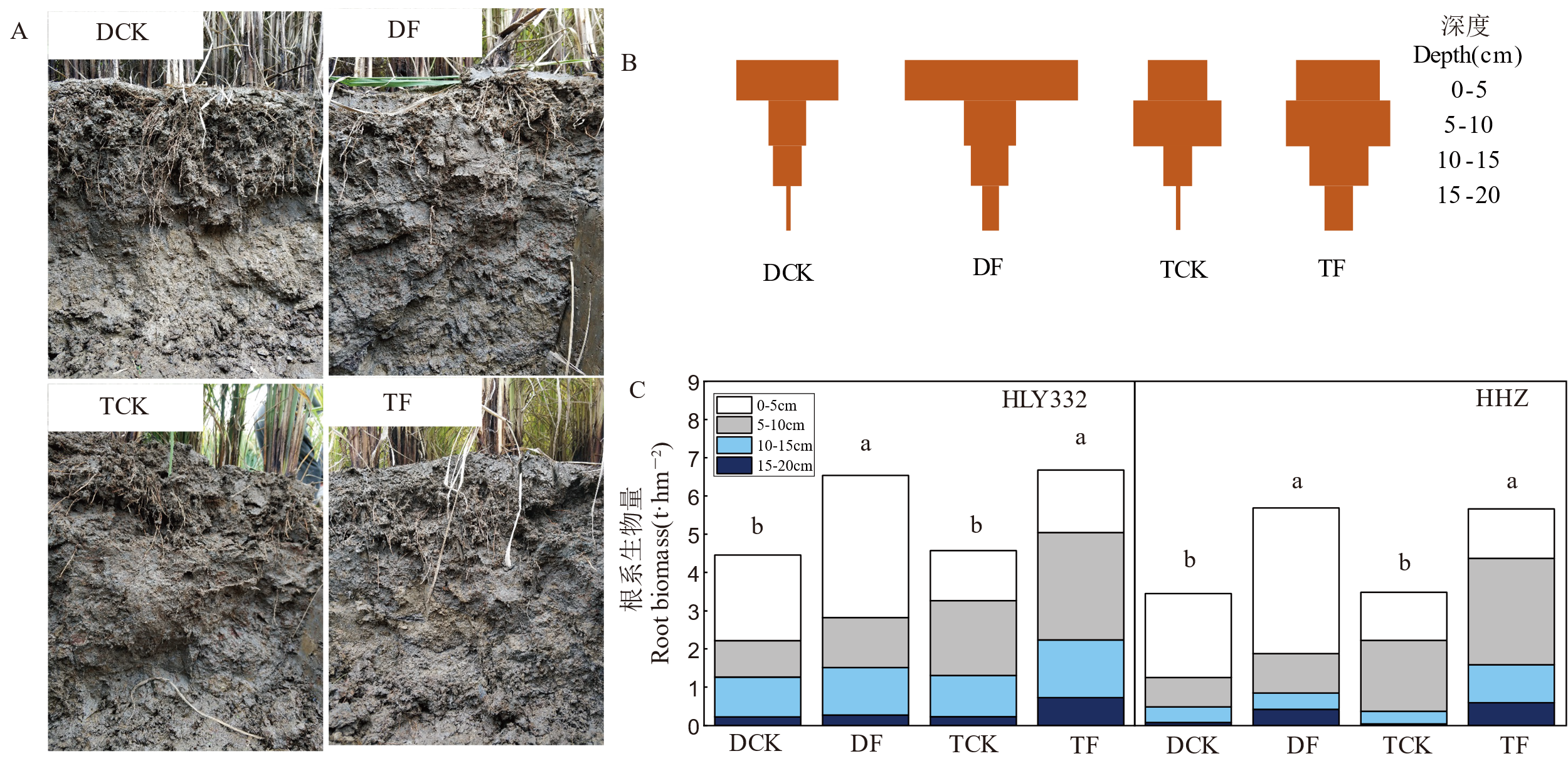
图1 施肥和种植方式对水稻根系分布和根系生物量的影响 A图为水稻根系剖面;B图为根系分布; C图为0−20 cm耕层根系生物量。DCK、DF、TCK和TF分别为直播不施肥、直播施肥、移栽不施肥和移栽施肥(n=3);柱上不同小写字母表示不同处理间0−20 cm根系生物量差异显著。HLY332: 和两优332; HHZ: 黄华占。
Fig. 1. Effects of fertilization and planting methods on root distribution and root biomass of rice A, Rice root profiles; B, Schematic diagram of root distribution; C, Root biomass in the 0−20 cm tillage layer. DCK, DF, TCK and TF are direct-seeding without fertilizer, direct-seeding with fertilizer, transplanting without fertilizer and transplanting with fertilizer, respectively(n=3); Different lowercase letters on the columns indicate significant differences (Duncan) in root biomass from 0-20 cm between treatments. HLY332, Heliangyou 332; HHZ, Huanghuazhan.
| 品种 Variety | 种植方式 Planting method | 处理 Treatment | 总根长 Total root length(m) | 根表面积 Root surface area(dm2) | 平均根直径 Root diameter(mm) | 根系总体积 Root volume(cm3) |
|---|---|---|---|---|---|---|
| HLY332 | 直播 Direct-seeding | DCK | 14.9±0.8 c | 21.4±2.2 c | 7.8±0.2 c | 182.0±33.6 c |
| DF | 18.7±2.4 b | 25.8±2.4 b | 11.4±0.5 b | 342.2±57.5 b | ||
| 移栽 Transplanting | TCK | 21.2±2.4 b | 21.8±1.6 c | 11.8±1.7 b | 238.2±29.4 c | |
| TF | 35.2±1.9 a | 49.1±1.8 a | 25.2±3.1 a | 639.4±25.8 a | ||
| 方差分析(F值) ANOVA analysis (F value) | ||||||
| 种植方式Planting method (P) 施肥Fertilization (F) 种植方式×施肥P×F | 105.7** | 102.1** | 75.9** | 62.7** | ||
| 64.3** | 183.9** | 70.1** | 156.2** | |||
| 20.9* | 96.2** | 23.2* | 29.1** | |||
| HHZ | 直播 Direct-seeding | DCK | 9.2±1.6 c | 14.7±1.1 c | 5.6±0.7 b | 174.9±28.5 b |
| DF | 19.6±2.2 b | 25.4±2.2 ab | 12.7±1.4 a | 279.8±21.9 a | ||
| 移栽 Transplanting | TCK | 18.7±2.7 b | 20.2±4.1 b | 6.9±0.9 b | 176.5±37.8 b | |
| TF | 26.9±5.7 a | 29.7±3.0 a | 11.2±1.5 a | 316.7±24.6 a | ||
| 方差分析(F值) ANOVA analysis (F value) | ||||||
| 种植方式Planting method(P) 施肥Fertilization (F) 种植方式×施肥P×F | 17.6** | 8.7* | 0.0ns | 1.3ns | ||
| 21.4** | 37.9** | 69.1** | 53.9** | |||
| 0.3ns | 0.1ns | 4.4ns | 1.1ns | |||
表2 施肥和种植方式对水稻根系形态的影响
Table 2. Effects of fertilization and planting methods on rice root morphology
| 品种 Variety | 种植方式 Planting method | 处理 Treatment | 总根长 Total root length(m) | 根表面积 Root surface area(dm2) | 平均根直径 Root diameter(mm) | 根系总体积 Root volume(cm3) |
|---|---|---|---|---|---|---|
| HLY332 | 直播 Direct-seeding | DCK | 14.9±0.8 c | 21.4±2.2 c | 7.8±0.2 c | 182.0±33.6 c |
| DF | 18.7±2.4 b | 25.8±2.4 b | 11.4±0.5 b | 342.2±57.5 b | ||
| 移栽 Transplanting | TCK | 21.2±2.4 b | 21.8±1.6 c | 11.8±1.7 b | 238.2±29.4 c | |
| TF | 35.2±1.9 a | 49.1±1.8 a | 25.2±3.1 a | 639.4±25.8 a | ||
| 方差分析(F值) ANOVA analysis (F value) | ||||||
| 种植方式Planting method (P) 施肥Fertilization (F) 种植方式×施肥P×F | 105.7** | 102.1** | 75.9** | 62.7** | ||
| 64.3** | 183.9** | 70.1** | 156.2** | |||
| 20.9* | 96.2** | 23.2* | 29.1** | |||
| HHZ | 直播 Direct-seeding | DCK | 9.2±1.6 c | 14.7±1.1 c | 5.6±0.7 b | 174.9±28.5 b |
| DF | 19.6±2.2 b | 25.4±2.2 ab | 12.7±1.4 a | 279.8±21.9 a | ||
| 移栽 Transplanting | TCK | 18.7±2.7 b | 20.2±4.1 b | 6.9±0.9 b | 176.5±37.8 b | |
| TF | 26.9±5.7 a | 29.7±3.0 a | 11.2±1.5 a | 316.7±24.6 a | ||
| 方差分析(F值) ANOVA analysis (F value) | ||||||
| 种植方式Planting method(P) 施肥Fertilization (F) 种植方式×施肥P×F | 17.6** | 8.7* | 0.0ns | 1.3ns | ||
| 21.4** | 37.9** | 69.1** | 53.9** | |||
| 0.3ns | 0.1ns | 4.4ns | 1.1ns | |||
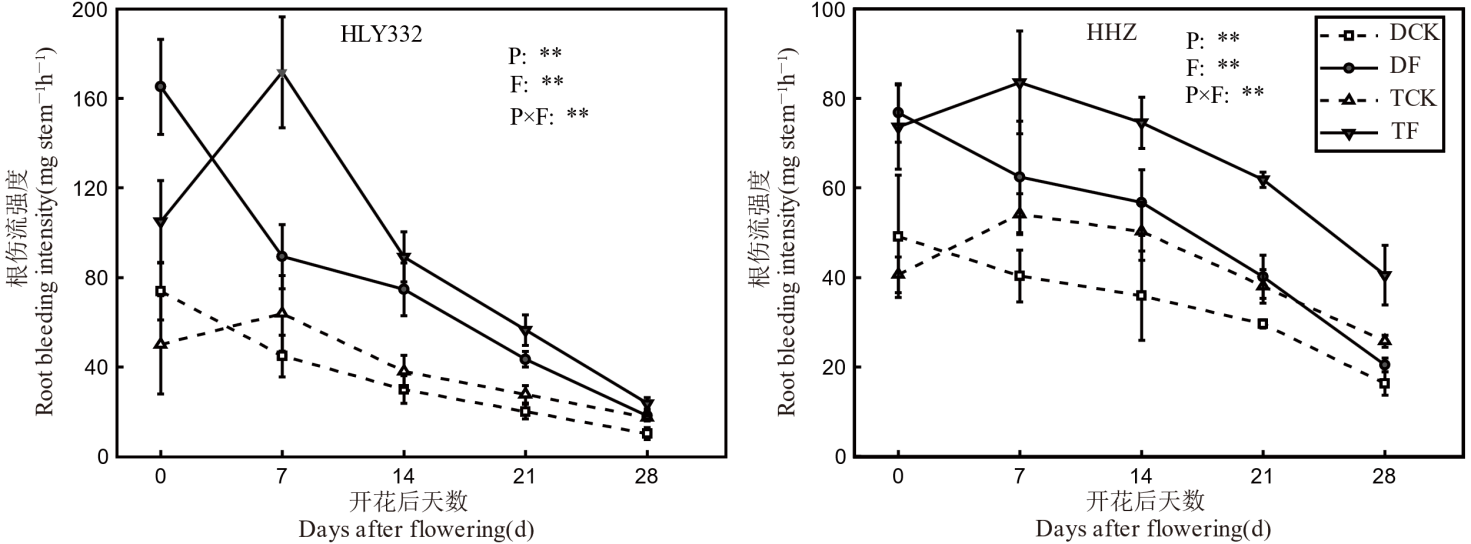
图2 施肥和种植方式对水稻根系伤流强度的影响 DCK、DF、TCK和TF分别为直播不施肥、直播施肥、移栽不施肥和移栽施肥。图中P和F分别表示种植方式和施肥(n=3); **表示在0.01水平差异显著,ns表示差异不显著(Duncan)。
Fig. 2. Effects of fertilization and planting methods on root bleeding intensity DCK, DF, TCK and TF are direct-seeding without fertilizer, direct-seeding with fertilizer, transplanting without fertilizer and transplanting with fertilizer, respectively. P and F indicate planting method and fertilization, respectively(n=3); ** indicate significant difference at the 0.01 level, and ns indicates no significant difference(Duncan).
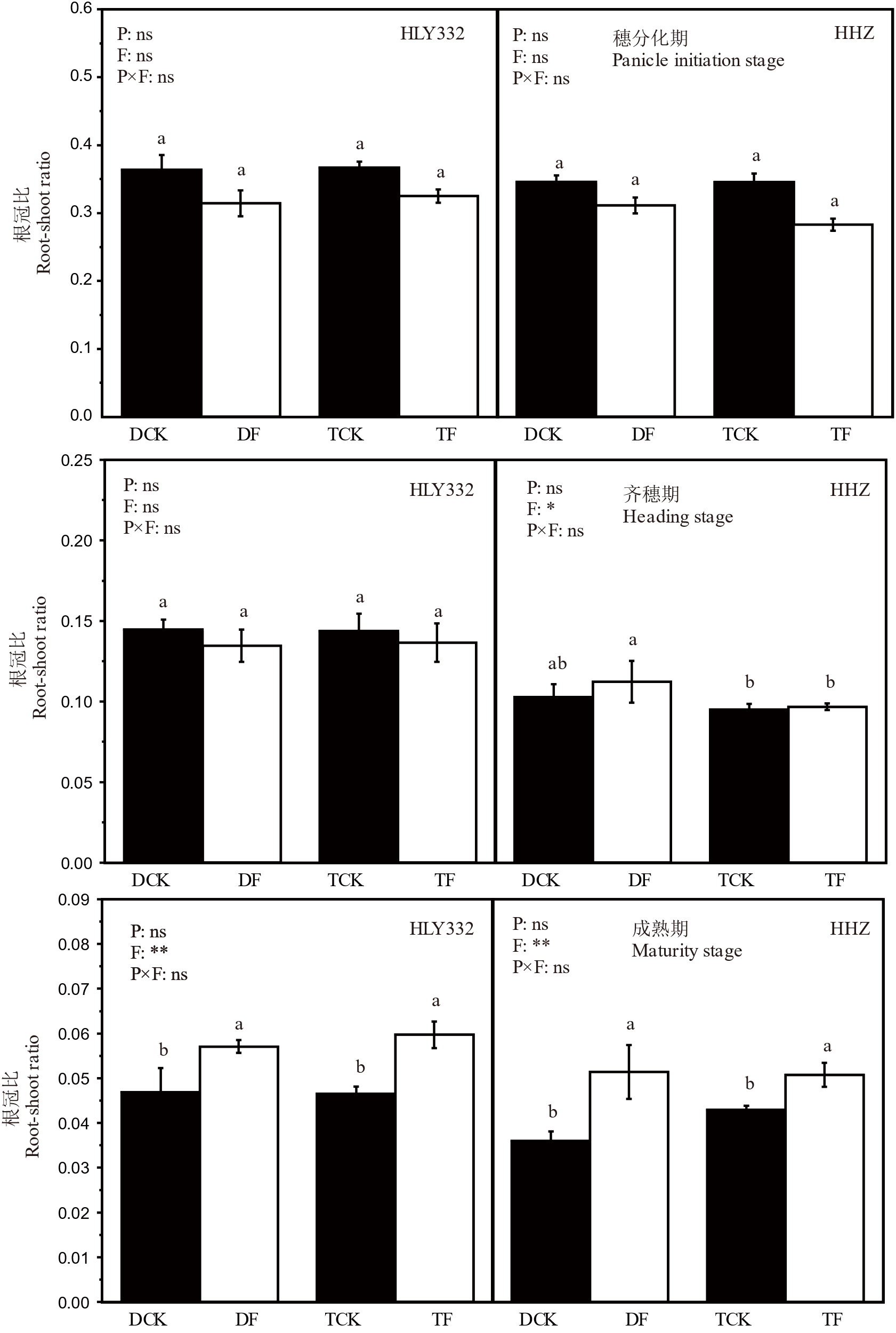
图3 施肥和种植方式对不同生育期水稻根冠比的影响 DCK、DF、TCK和TF分别为直播不施肥、直播施肥、移栽不施肥和移栽施肥(n=3)。柱上不同小写字母表示不同处理间差异显著(Duncan)。图中P和F分别表示种植方式和施肥;*、**分别表示在0.05、0.01水平差异显著,ns表示差异不显著。
Fig. 3. Effects of fertilization and planting methods on the root-shoot ratio of rice at different growth stages DCK, DF, TCK and TF are direct-seeding without fertilizer, direct-seeding with fertilizer, transplanting without fertilizer and transplanting with fertilizer, respectively(n=3). Different lowercase letters on the columns indicate significant differences between treatments (Duncan). P and F in the figure indicate planting method and fertilization, respectively; * and ** indicate significant difference at the 0.05 and 0.01 levels, respectively, and ns indicates no significant difference.
| 品种 Variety | 种植方式 Planting method | 处理 Treatment | 重心高度 Height of center of gravity(cm) | 茎秆直径 Stem diameter (mm) | 茎壁厚度 Thickness of stem wall(mm) | 抗折力 Bending resistance(N) | 倒伏指数 Lodging index |
|---|---|---|---|---|---|---|---|
| HLY332 | 直播 Direct-seeding | DCK | 53.3±2.3 a | 6.6±0.5 a | 1.3±0.3 a | 13.0±1.3 c | 222.8±16.3 a |
| DF | 54.0±3.6 a | 6.6±0.9 a | 1.6±0.9 a | 16.3±1.1 b | 131.9±5.9 b | ||
| 移栽 Transplanting | TCK | 53.0±2.0 a | 6.6±0.2 a | 1.6±0.6 a | 16.1±0.3 b | 154.7±19.3 b | |
| TF | 54.0±2.0 a | 6.9±0.8 a | 1.4±0.4 a | 18.8±0.7 a | 98.1±12.9 c | ||
| 方差分析(F值) ANOVA analysis (F value) | |||||||
| 种植方式Planting method (P) | 0.0ns | 0.1ns | 0.1ns | 15.3* | 37.1** | ||
| 施肥Fertilization (F) | 0.3ns | 0.2ns | 0.0ns | 24.0* | 77.1** | ||
| 种植方式×施肥P×F | 0.0ns | 0.2ns | 0.3ns | 0.6ns | 4.2ns | ||
| HHZ | 直播 Direct-seeding | DCK | 47.4±2.1 a | 4.6±0.6 b | 1.3±0.1 a | 14.3±0.4 c | 168.5±12.3 a |
| DF | 51.5±4.2 a | 5.8±0.7 ab | 1.2±0.2 a | 17.7±1.0 b | 113.6±5.1 b | ||
| 移栽 Transplanting | TCK | 49.0±1.9 a | 5.6±0.8 ab | 1.5±0.2 a | 16.1±1.3 b | 111.5±10.2 b | |
| TF | 50.4±2.7 a | 6.4±0.6 a | 1.3±0.2 a | 20.7±0.8 a | 80.2±4.6 c | ||
| 方差分析(F值) ANOVA analysis (F value) | |||||||
| 种植方式Planting method (P) | 0.0ns | 4.7ns | 1.3ns | 20.6* | 80.5** | ||
| 施肥Fertilization (F) | 2.6ns | 6.7* | 3.8ns | 56.9* | 73.3** | ||
| 种植方式×施肥P×F | 0.6ns | 0.2ns | 0.0ns | 1.3ns | 5.4ns | ||
表3 施肥和种植方式对水稻抗倒伏特性的影响
Table 3. Effects of fertilization and planting method on rice resistance to lodging
| 品种 Variety | 种植方式 Planting method | 处理 Treatment | 重心高度 Height of center of gravity(cm) | 茎秆直径 Stem diameter (mm) | 茎壁厚度 Thickness of stem wall(mm) | 抗折力 Bending resistance(N) | 倒伏指数 Lodging index |
|---|---|---|---|---|---|---|---|
| HLY332 | 直播 Direct-seeding | DCK | 53.3±2.3 a | 6.6±0.5 a | 1.3±0.3 a | 13.0±1.3 c | 222.8±16.3 a |
| DF | 54.0±3.6 a | 6.6±0.9 a | 1.6±0.9 a | 16.3±1.1 b | 131.9±5.9 b | ||
| 移栽 Transplanting | TCK | 53.0±2.0 a | 6.6±0.2 a | 1.6±0.6 a | 16.1±0.3 b | 154.7±19.3 b | |
| TF | 54.0±2.0 a | 6.9±0.8 a | 1.4±0.4 a | 18.8±0.7 a | 98.1±12.9 c | ||
| 方差分析(F值) ANOVA analysis (F value) | |||||||
| 种植方式Planting method (P) | 0.0ns | 0.1ns | 0.1ns | 15.3* | 37.1** | ||
| 施肥Fertilization (F) | 0.3ns | 0.2ns | 0.0ns | 24.0* | 77.1** | ||
| 种植方式×施肥P×F | 0.0ns | 0.2ns | 0.3ns | 0.6ns | 4.2ns | ||
| HHZ | 直播 Direct-seeding | DCK | 47.4±2.1 a | 4.6±0.6 b | 1.3±0.1 a | 14.3±0.4 c | 168.5±12.3 a |
| DF | 51.5±4.2 a | 5.8±0.7 ab | 1.2±0.2 a | 17.7±1.0 b | 113.6±5.1 b | ||
| 移栽 Transplanting | TCK | 49.0±1.9 a | 5.6±0.8 ab | 1.5±0.2 a | 16.1±1.3 b | 111.5±10.2 b | |
| TF | 50.4±2.7 a | 6.4±0.6 a | 1.3±0.2 a | 20.7±0.8 a | 80.2±4.6 c | ||
| 方差分析(F值) ANOVA analysis (F value) | |||||||
| 种植方式Planting method (P) | 0.0ns | 4.7ns | 1.3ns | 20.6* | 80.5** | ||
| 施肥Fertilization (F) | 2.6ns | 6.7* | 3.8ns | 56.9* | 73.3** | ||
| 种植方式×施肥P×F | 0.6ns | 0.2ns | 0.0ns | 1.3ns | 5.4ns | ||
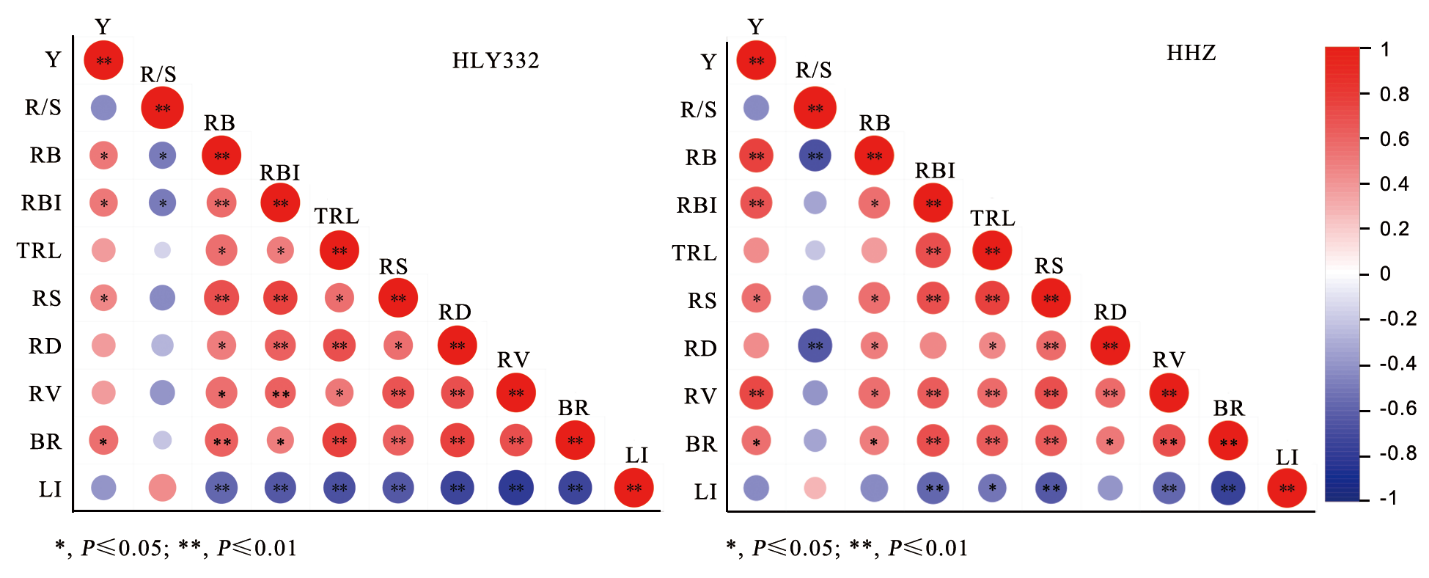
图4 根系指标与产量的相关分析 Y: 产量;R/S: 根冠比;RB: 根系生物量;RBI: 根伤流强度;TRL: 总根长;RS: 根表面积;RD: 根直径;RV: 根体积;BR: 抗折力;LI: 倒伏指数。*、**表示5%、1%水平效果显著(Duncan)。
Fig. 4. Correlation analysis of root system indicators and yield Y, Yield; R/S, Root-shoot ratio; RB, Root biomass; RBI, Root bleeding intensity; TRL, Total root length; RS, Root surface area; RD, Root diameter; RV, Root volume; BR, Bending resistance; LI, Lodging index. * and ** indicate significant effects at the 5% and 1% levels, respectively (Duncan).
| [1] | Hou W F, Khan M R, Zhang J L, Lu J W, Ren T, Cong R H, Li X K. Nitrogen rate and plant density interaction enhances radiation interception, yield and nitrogen use efficiency of mechanically transplanted rice[J]. Agriculture, Ecosystems & Environment, 2019, 269: 183-192. |
| [2] | Kumar V, Ladha J K. Direct seeding of rice[M]//Advances in Agronomy. Amsterdam: Elsevier, 2011: 297-413. |
| [3] | Sagare D B, Abbai R, Jain A, Jayadevappa P K, Dixit S, Singh A K, Challa V, Alam S, Singh U M, Yadav S, Sandhu N, Kabade P G, Singh V K, Kumar A. More and more of less and less: Is genomics-based breeding of dry direct-seeded rice (DDSR) varieties the need of hour?[J]. Plant Biotechnology Journal, 2020, 18(11): 2173-2186. |
| [4] | Wang W Q, Peng S B, Liu H Y, Tao Y, Huang J L, Cui K H, Nie L X. The possibility of replacing puddled transplanted flooded rice with dry seeded rice in Central China: A review[J]. Field Crops Research, 2017, 214: 310-320. |
| [5] | Ishfaq M, Akbar N, Anjum S A, Anwar-Ijl-Haq M. Growth, yield and water productivity of dry direct seeded rice and transplanted aromatic rice under different irrigation management regimes[J]. Journal of Integrative Agriculture, 2020, 19(11): 2656-2673. |
| [6] | Li L, Tian H, Zhang M H, Fan P S, Ashraf U, Liu H D, Chen X F, Duan M Y, Tang X R, Wang Z M, Zhang Z, Pan S G. Deep placement of nitrogen fertilizer increases rice yield and nitrogen use efficiency with fewer greenhouse gas emissions in a mechanical direct-seeded cropping system[J]. The Crop Journal, 2021, 9(6): 1386-1396. |
| [7] | Li L, Wu T Y, Li Y S, Hu X, Wang Z X, Liu J F, Qin W, Ashraf U. Deep fertilization improves rice productivity and reduces ammonia emissions from rice fields in China: A meta-analysis[J]. Field Crops Research, 2022, 289: 108704. |
| [8] | 代贵金, 岩石真嗣, 三木孝昭, 华泽田, 王彦荣. 不同耕作与施肥方法对水稻根系生长分布和活性的影响[J]. 沈阳农业大学学报, 2008, 39(3): 274-278. |
| Dai G J, Yan S, San M, Hua Z T, Wang Y R. Effects of root distribution, growth and vigor of japonica rice with different cultivations and fertilizations[J]. Journal of Shenyang Agricultural University, 2008, 39(3): 274-278. (in Chinese with English abstract) | |
| [9] | 李杰, 张洪程, 常勇, 龚金龙, 胡雅杰, 龙厚元, 戴其根, 霍中洋, 许轲, 魏海燕, 高辉. 高产栽培条件下种植方式对超级稻根系形态生理特征的影响[J]. 作物学报, 2011, 37(12): 2208-2220. |
| Li J, Zhang H C, Chang Y, Gong J L, Hu Y J, Long H Y, Dai Q G, Huo Z Y, Xu K, Wei H Y, Gao H. Influence of planting methods on root system morphological and physiological characteristics of super rice under high-yielding cultivation condition[J]. Acta Agronomica Sinica, 2011, 37(12): 2208-2220. (in Chinese with English abstract) | |
| [10] | 李杰, 张洪程, 龚金龙, 常勇, 吴桂成, 郭振华, 戴其根, 霍中洋, 许轲, 魏海燕. 稻麦两熟地区不同栽培方式超级稻分蘖特性及其与群体生产力的关系[J]. 作物学报, 2011, 37(2): 309-320. |
| Li J, Zhang H C, Gong J L, Chang Y, Wu G C, Guo Z H, Dai Q G, Huo Z Y, Xu K, Wei H Y. Tillering characteristics and its relationships with population productivity of super rice under different cultivation methods in rice-wheat cropping areas[J]. Acta Agronomica Sinica, 2011, 37(2): 309-320. (in Chinese with English abstract) | |
| [11] | 雷小龙, 刘利, 苟文, 马荣朝, 任万军. 种植方式对杂交籼稻植株抗倒伏特性的影响[J]. 作物学报, 2013, 39(10): 1814-1825. |
| Lei X L, Liu L, Gou W, Ma R C, Ren W J. Effects of planting methods on culm lodging resistance of indica hybrid rice (Oryza sativa L.)[J]. Acta Agronomica Sinica, 2013, 39(10): 1814-1825. (in Chinese with English abstract) | |
| [12] | 张福锁, 崔振岭, 王激清, 李春俭, 陈新平. 中国土壤和植物养分管理现状与改进策略[J]. 植物学通报, 2007, 42(6): 687-694. |
| Zhang F S, Cui Z L, Wang J Q, Li C J, Chen X P. Current status of soil and plant nutrient management in China and improvement strategies[J]. Chinese Bulletin of Botany, 2007, 42(6): 687-694. (in Chinese with English abstract) | |
| [13] | 张洋洋, 鲁剑巍, 王友珠, 王振, 李小坤, 任涛, 丛日环. 钾肥施用方式对直播和移栽水稻产量和钾肥利用效率的影响[J]. 作物杂志, 2016(1): 110-114. |
| Zhang Y Y, Lu J W, Wang Y Z, Wang Z, Li X K, Ren T, Cong R H. Effects of potassium fertilizer application method on yield and potassium apparent efficiency of direct-sowing rice and transplanting rice[J]. Crops, 2016(1): 110-114. (in Chinese with English abstract) | |
| [14] | 肖小军, 彭小松, 刘小三, 叶川, 贺晓鹏, 李亚贞, 郑伟, 余跑兰, 黄天宝. 施氮量和直播量对超级杂交稻五丰优T025产量及养分利用率的影响[J]. 杂交水稻, 2016, 31(3): 58-63. |
| Xiao X J, Peng X S, Liu X S, Ye C, He X P, Li Y Z, Zheng W, Yu P L, Huang T B. Effects of nitrogen rate and direct-seeding rate on yield and nutrient use efficiency of super hybrid rice Wufengyou T025[J]. Hybrid Rice, 2016, 31(3): 58-63. (in Chinese with English abstract) | |
| [15] | Farooq M, Siddique K H M, Rehman H, Aziz T, Lee D J, Wahid A. Rice direct seeding: Experiences, challenges and opportunities[J]. Soil and Tillage Research, 2011, 111(2): 87-98. |
| [16] | 程建平, 罗锡文, 樊启洲, 张集文, 吴建平, 王在满, 臧英. 不同种植方式对水稻生育特性和产量的影响[J]. 华中农业大学学报, 2010, 29(1): 1-5. |
| Cheng J P, Luo X W, Fan Q Z, Zhang J W, Wu J P, Wang Z M, Zang Y. Influence of different planting methods on growth and development characteristics and yield of rice[J]. Journal of Huazhong Agricultural University, 2010, 29(1): 1-5. (in Chinese with English abstract) | |
| [17] | 许炜, 孙志贵, 田贺培, 张运波, 卢碧林. 播种和施肥方式对直播稻分蘖特性和产量的影响[J]. 华中农业大学学报, 2018, 37(3): 1-9. |
| Xu W, Sun Z G, Tian H P, Zhang Y B, Lu B L. Effects of sowing and fertilization on tiller characteristics and yield of direct-seeded rice[J]. Journal of Huazhong Agricultural University, 2018, 37(3): 1-9. (in Chinese with English abstract) | |
| [18] | Chen S, Cai S G, Chen X, Zhang G P. Genotypic differences in growth and physiological responses to transplanting and direct seeding cultivation in rice[J]. Rice Science, 2009, 16(2): 143-150. |
| [19] | Xu G W, Lu D K, Wang H Z, Li Y. Morphological and physiological traits of rice roots and their relationships to yield and nitrogen utilization as influenced by irrigation regime and nitrogen rate[J]. Agricultural Water Management, 2018, 203: 385-394. |
| [20] | Liu H, Hussain S, Zheng M, Peng S, Huang J, Cui K, Nie L. Dry direct-seeded rice as an alternative to transplanted-flooded rice in Central China[J]. Agronomy for Sustainable Development, 2015, 35(1): 285-294. |
| [21] | Chu G, Chen T, Wang Z, Yang J, Zhang J. Morphological and physiological traits of roots and their relationships with water productivity in water-saving and drought-resistant rice[J]. Field Crops Research, 2014, 162: 108-119. |
| [22] | Yoshida S, Yoshida S, Yoshida T, Yoshida Y. Fundamentals of rice crop science[J]. International Rice Research Institute, 1981, 269. |
| [23] | Dingkuhn M, Schnier H F, De Datta S K, Dorffling K, Javellana C. Relationships between ripening-phase productivity and crop duration, canopy photosynthesis and senescence in transplanted and direct-seeded lowland rice[J]. Field Crops Research, 1991, 26(3/4): 327-345. |
| [24] | Inukai Y, Ashikari M, Kitano H. Function of the root system and molecular mechanism of crown root formation in rice[J]. Plant and Cell Physiology, 2004, 45:17. |
| [25] | Gowda V R P, Henry A, Yamauchi A, Shashidhar H E, Serraj R. Root biology and genetic improvement for drought avoidance in rice[J]. Field Crops Research, 2011, 122(1): 1-13. |
| [26] | Liu K, He A, Ye C, Liu S, Lu J, Gao M, Fan Y, Lu B, Tian X, Zhang Y. Root morphological traits and spatial distribution under different nitrogen treatments and their relationship with grain yield in super hybrid rice[J]. Scientific Reports, 2018, 8(1): 131. |
| [27] | Kato Y, Okami M. Root growth dynamics and stomatal behaviour of rice (Oryza sativa L.) grown under aerobic and flooded conditions[J]. Field Crops Research, 2010, 117(1): 9-17. |
| [28] | Fageria N K, Carvalho M C S, dos Santos F C. Root growth of upland rice genotypes as influenced by nitrogen fertilization[J]. Journal of Plant Nutrition, 2014, 37(1): 95-106. |
| [29] | Xu L, Li X, Wang X, Xiong D, Wang F. Comparing the grain yields of direct-seeded and transplanted rice: A meta-analysis[J]. Agronomy, 2019, 9(11): 767. |
| [30] | Xu L, Yuan S, Wang X, Chen Z, Li X, Cao J, Wang F, Huang J, Peng S. Comparison of yield performance between direct-seeded and transplanted double-season rice using ultrashort-duration varieties in Central China[J]. The Crop Journal, 2022, 10(2): 515-523. |
| [31] | Abdul Halim N S, Abdullah R, Karsani S A, Osman N, Ali Panhwar Q, Ishak C F. Influence of soil amendments on the growth and yield of rice in acidic soil[J]. Agronomy, 2018, 8(9): 165. |
| [32] | Mori A, Fukuda T, Vejchasarn P, Nestler J, Pariasca-Tanaka J, Wissuwa M. The role of root size versus root efficiency in phosphorus acquisition in rice[J]. Journal of Experimental Botany, 2016, 67(4): 1179-1189. |
| [1] | 李兴沂, 陈玲, 邵建韬, 肖素勤, 李金璐, 付惠仙, 殷富有, 张建红, 程在全, 刘丽. 水稻产量与淀粉品质协同调控的分子遗传研究进展[J]. 中国水稻科学, 2026, 40(1): 1-17. |
| [2] | 王轶欣, 林参, 马刘洋, 陈龙, 奉保华, 倪深, 魏祥进, 贺记外, 陈天晓. 谷丙转氨酶基因OsAlaAT4调控水稻氮素吸收和产量[J]. 中国水稻科学, 2026, 40(1): 51-60. |
| [3] | 肖无为, 张雨晴, 朱辰光, 田贵生, 蔡岳宏, 王飞, 熊栋梁, 黄见良, 彭少兵, 崔克辉. 促芽肥施用时期和施用量对再生稻产量和头季稻米品质的影响[J]. 中国水稻科学, 2026, 40(1): 118-130. |
| [4] | 陈玲, 林文英, 梁丽梅, 欧阳由男, 叶胜海, 季芝娟. 水稻开花习性及其在粳型三系不育系选育中的应用[J]. 中国水稻科学, 2025, 39(6): 731-743. |
| [5] | 卞金龙, 任高磊, 裘实, 许方甫, 胡忠磊, 张洪程, 魏海燕. 不同机插方式下控混肥施用方式对淮北地区优质食味粳稻产量及氮素利用的影响[J]. 中国水稻科学, 2025, 39(6): 847-862. |
| [6] | 黎星, 张瑞春, 陈鸽, 解嘉鑫, 肖正午, 曹放波, 陈佳娜, 黄敏. 机插短生育期晚稻产量形成特点与光合特性研究[J]. 中国水稻科学, 2025, 39(6): 863-872. |
| [7] | 陆婷婷, 闫文惠, 苏新全, 曾罗华, 华丽琴, 谌江华, 奉保华, 王跃星, 胡江, 符冠富. 多年生稻产量品质抗逆响应形成的生理生态机制及其调控途径研究进展[J]. 中国水稻科学, 2025, 39(5): 586-600. |
| [8] | 林逸, 孙良, 陈东顺, 朱广飞, 孔子阳, 俞高红. 水田侧深施肥末端分流式加速装置的设计与优化[J]. 中国水稻科学, 2025, 39(4): 451-464. |
| [9] | 曹云, 陈雪芳, 黄兴海, 何咨霆, 汤菁莎, 陈坤, 汪爱羚, 罗贯洲, 廖琴, 孙园园, 郭翔, 杨志远, 马均, 孙永健. 播种量和取秧量对精量条播机插杂交稻高产群体构建及能效的影响[J]. 中国水稻科学, 2025, 39(4): 477-490. |
| [10] | 朱鹏, 凌溪铁, 王金彦, 张保龙, 杨郁文, 许轲, 裘实. 机直播条件下不同控草方式对抗除草剂水稻产量和品质差异性研究[J]. 中国水稻科学, 2025, 39(4): 501-515. |
| [11] | 韦还和, 汪璐璐, 马唯一, 张翔, 左博源, 耿孝宇, 朱旺, 朱济邹, 孟天瑶, 陈英龙, 高平磊, 许轲, 戴其根. 盐−旱复合胁迫下粳稻品种南粳9108籽粒灌浆特性及其与产量形成的关系[J]. 中国水稻科学, 2025, 39(3): 373-386. |
| [12] | 沈智达, 余秋华, 张斌, 曹玉东, 王少华, 王红飞, 伍永清, 戴志刚, 李小坤. 磷肥施用量对湖北省直播水稻产量、磷素积累及利用率的影响[J]. 中国水稻科学, 2025, 39(3): 399-411. |
| [13] | 徐月梅, 彭诗燕, 孙志伟, 王志琴, 朱宽宇, 杨建昌. 不同耐低磷水稻品种的内源激素水平差异及其与产量和磷利用率的关系[J]. 中国水稻科学, 2025, 39(2): 231-244. |
| [14] | 唐承翰, 王晶卿, 陈惠哲, 张玉屏, 向镜, 张义凯, 王志刚, 怀燕, 陈佳峰, 王亚梁. 杂交稻条播育秧机插秧苗素质对产量的影响[J]. 中国水稻科学, 2025, 39(2): 245-254. |
| [15] | 舒傲, 解嘉鑫, 曹威, 周传名, 李蓓蕾, 陈嘉馨, 李莉, 曹放波, 陈佳娜, 黄敏. 氮肥运筹对优质杂交中稻产量和品质的影响[J]. 中国水稻科学, 2025, 39(2): 255-263. |
| 阅读次数 | ||||||
|
全文 |
|
|||||
|
摘要 |
|
|||||
