
中国水稻科学 ›› 2026, Vol. 40 ›› Issue (2): 155-170.DOI: 10.16819/j.1001-7216.2026.241121
倪晨1,2,3, 张家豪1,2,3, 朱昌进1,2,3, 徐继伟1,2,3, 胡秋倩1,4, 霍中洋1,2,3, 戴其根1,2,3, 许轲1,2,3, 李国辉1,2,3,*( )
)
收稿日期:2024-11-29
修回日期:2025-02-21
出版日期:2026-03-10
发布日期:2026-03-16
通讯作者:
* email: lgh@yzu.edu.cn基金资助:
NI Chen1,2,3, ZHANG Jiahao1,2,3, ZHU Changjin1,2,3, XU Jiwei1,2,3, HU Qiuqian1,4, HUO Zhongyang1,2,3, DAI Qigen1,2,3, XU Ke1,2,3, LI Guohui1,2,3,*()
Received:2024-11-29
Revised:2025-02-21
Online:2026-03-10
Published:2026-03-16
Contact:
* email: lgh@yzu.edu.cn摘要:
水稻产量形成依赖于源器官(叶)的光合生产能力、库器官(籽粒)的同化产物储存能力和流(维管束系统)的转运能力以及三者的协调,其调控受内在与环境因子的共同作用。近年来,随着生理生化、遗传和分子生物学研究手段的革新,研究者已逐步揭示水稻源器官发育、库容量构建及同化物转运的分子调控和互作机制及其对环境和栽培因素的响应机理。本文重点综述了源-流-库系统的形成及调控的生理和分子机理,总结了环境因子、激素信号转导和栽培技术对源-流-库的协同调控作用及产量形成的影响。最后指出了通过遗传改造、重要基因和蛋白挖掘及功能解析、激素互作机制和源-流-库动态协调网络解析等策略优化源流库关系来提高水稻产量的研究方向。
倪晨, 张家豪, 朱昌进, 徐继伟, 胡秋倩, 霍中洋, 戴其根, 许轲, 李国辉. 水稻源流库形成与调控及其影响因素研究进展[J]. 中国水稻科学, 2026, 40(2): 155-170.
NI Chen, ZHANG Jiahao, ZHU Changjin, XU Jiwei, HU Qiuqian, HUO Zhongyang, DAI Qigen, XU Ke, LI Guohui. Research Progress on the Formation and Regulation of Rice Source, Flow and Sink and Their Influencing Factors[J]. Chinese Journal OF Rice Science, 2026, 40(2): 155-170.
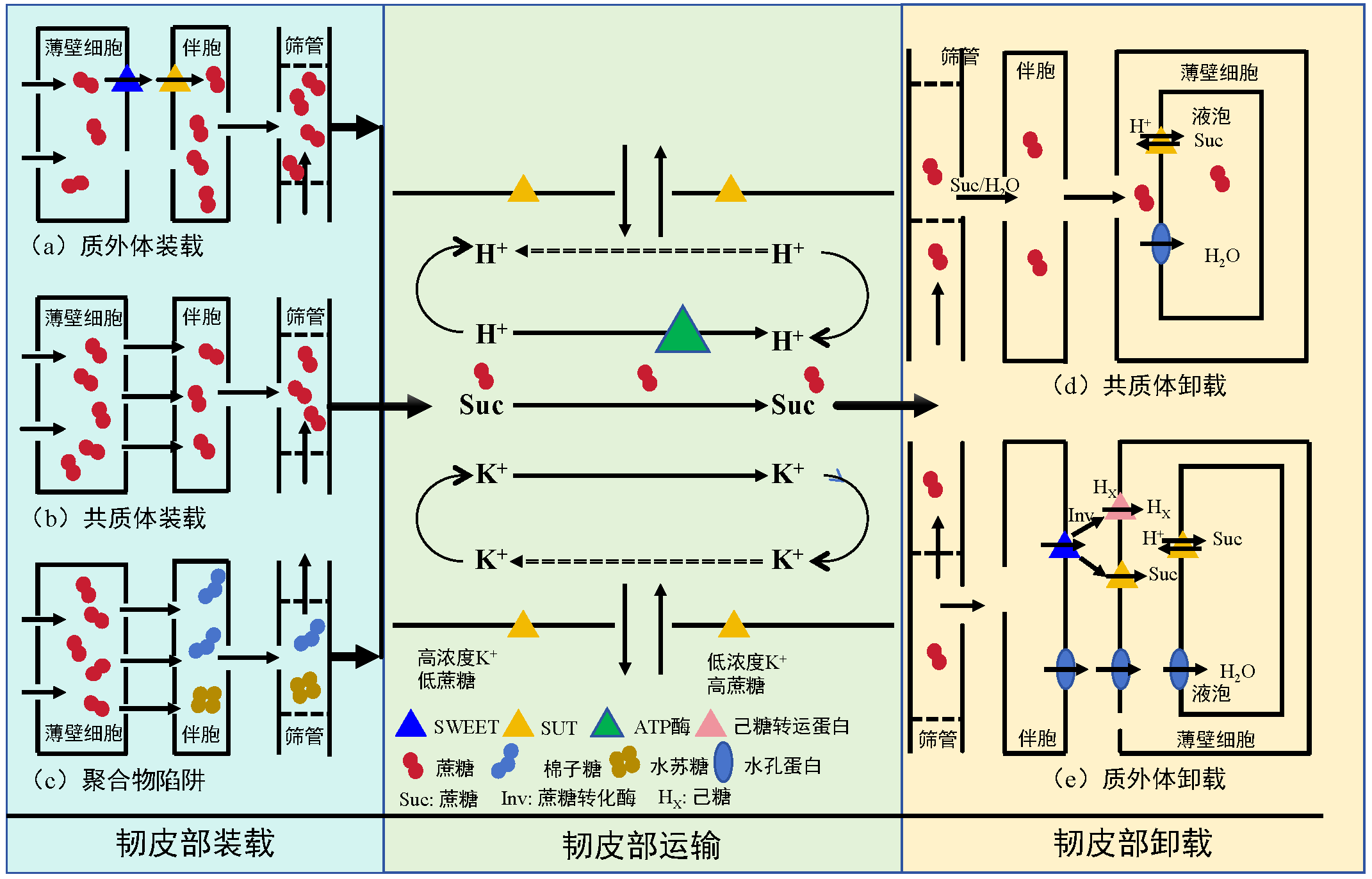
图1 水稻韧皮部转运途径[45,75]
Fig. 1. Phloem transport pathway in rice[45,75]
| [1] | Li P, Chang T, Chang S, Ouyang X, Qu M, Song Q, Xiao L, Xia S, Deng Q, Zhu X G. Systems model-guided rice yield improvements based on genes controlling source, sink, and flow[J]. Journal of Integrative Plant Biology, 2018, 60(12): 1154-1180. |
| [2] | Ma B, Zhang L, He Z. Understanding the regulation of cereal grain filling: The way forward[J]. Journal of Integrative Plant Biology, 2023, 65(2): 526-547. |
| [3] | Zhu K Y, Yan J Q, Shen Y, Zhang W Y, Xu Y J, Wang Z Q, Yang J C. Deciphering the morpho-physiological traits for high yield potential in nitrogen efficient varieties (NEVs): A Japonica rice case study[J]. Journal of Integrative Agriculture, 2022, 21(4): 947-963. |
| [4] | Li G H, Zhang Y, Zhou C, Xu J W, Zhu C J, Ni C, Huo Z Y, Dai Q G, Xu K. Agronomic and physiological characteristics of high yield and nitrogen use efficient varieties of rice: Comparison between two near-isogenic lines[J]. Food and Energy Security, 2024, 13: e539. |
| [5] | Ruan Y L. Sucrose metabolism: Gateway to diverse carbon use and sugar signaling[J]. Annual Review of Plant Biology, 2014, 65: 33-67. |
| [6] | Li G H, Zhou C Y, Yang Z J, Zhang C H, Dai Q G, Huo Z Y, Xu K. Low nitrogen enhances apoplastic phloem loading and improves the translocation of photo assimilates in rice leaves and stems[J]. Plant and Cell Physiology, 2022, 63: 991-1007. |
| [7] | Wang H, Kong F, Zhou C. From genes to networks: The genetic control of leaf development[J]. Journal of Integrative Plant Biology, 2021, 63(7): 1181-1196. |
| [8] | You J, Xiao W, Zhou Y, Shen W, Ye L, Yu P, Yu G, Duan Q, Zhang X, He Z, Xiang Y, Sang X, Li Y, Zhao F, Ling Y, He G, Zhang T. The apc/ctad1-wide leaf 1-narrow leaf 1 pathway controls leaf width in rice[J]. The Plant Cell, 2022, 34(11): 4313-4328. |
| [9] | Zou L P, Sun X H, Zhang Z G, Liu P, Wu J X, Tian C J, Qiu J L, Lu T G. Leaf rolling controlled by the homeodomain leucine zipper class IV gene Roc5 in rice[J]. Plant Physiology, 2011, 156(3): 1589-1602. |
| [10] | Li L, Shi Z Y, Li L, Shen G Z, Wang X Q, An L S, Zhang J L. Overexpression of ACL1 (abaxially curled leaf 1) increased Bulliform cells and induced Abaxial curling of leaf blades in rice[J]. Molecular Plant, 2010, 3(5): 807-817. |
| [11] | Xiang J J, Zhang G H, Qian Q, Xue H W. Semi-rolled leaf1 encodes a putative glycosylphosphatidylinositol-anchored protein and modulates rice leaf rolling by regulating the formation of bulliform cells[J]. Plant Physiology, 2012, 159(4): 1488-1500. |
| [12] | Jathar V, Saini K, Chauhan A, Rani R, Ichihashi Y, Ranjan A. Spatial control of cell division by GA-OsGRF7/8 module in a leaf explaining the leaf length variation between cultivated and wild rice[J]. The New Phytologist, 2022, 234(3): 867-883. |
| [13] | Antonietta M, Martinez D, Guiamet J J. Delayed senescence and crop performance under stress: Always a functional couple?[J]. Journal of Experimental Botany, 2024, 75(14): 4244-4257. |
| [14] | Kusaba M, Tanaka A, Tanaka R. Stay-green plants: What do they tell us about the molecular mechanism of leaf senescence[J]. Photosynthesis Research, 2013, 117: 221-234. |
| [15] | Kim H J, Nam H G, Lim P O. Regulatory network of NAC transcription factors in leaf senescence[J]. Current Opinion in Plant Biology, 2016, 33: 48-56. |
| [16] | Zhu X, Chen J, Xie Z, Gao J, Ren G, Gao S, Zhou X, Kuai B. Jasmonic acid promotes degreening via MYC2/3/4- and ANAC019/055/072-mediated regulation of major chlorophyll catabolic genes[J]. The Plant Journal, 2015, 84(3): 597-610. |
| [17] | Mao C, Lu S, Lv B, Zhang B, Shen J, He J, Luo L, Xi D, Chen X, Ming F. A rice NAC transcription factor promotes leaf senescence via ABA biosynthesis[J]. Plant Physiology, 2017, 174(3): 1747-1763. |
| [18] | Sakuraba Y, Kim D, Han S H, Kim S H, Piao W, Yanagisawa S, An G, Paek N C. Multilayered regulation of membrane-bound ONAC054 is essential for abscisic acid-induced leaf senescence in rice[J]. The Plant Cell, 2020, 32(3): 630-649. |
| [19] | Lim C, Kang K, Lim J, Lee H, Cho S H, Paek N C. RICE LONG GRAIN 3 delays dark-induced senescence by downregulating abscisic acid signaling and upregulating reactive oxygen species scavenging activity[J]. The Plant Journal, 2024, 120(4): 1474-1487. |
| [20] | Gi E, Cho S H, Kim S H, Kang K, Paek N C. Rice ONAC016 promotes leaf senescence through abscisic acid signaling pathway involving OsNAP[J]. The Crop Journal, 2024, 12(3): 709-720. |
| [21] | Guo Y, Ren G, Zhang K, Li Z, Miao Y, Guo H. Leaf senescence: Progression, regulation, and application[J]. Molecular Horticulture, 2021, 1(1): 5. |
| [22] | Zhou W, Lv T, Yang Z, Wang T, Fu Y, Chen Y, Hu B, Ren W. Morphophysiological mechanism of rice yield increase in response to optimized nitrogen management[J]. Scientific Reports, 2017, 7(1): 17226. |
| [23] | Smith E N, van Aalst M, Tosens T, Niinemets Ü, Stich B, Morosinotto T, Alboresi A, Erb T J, Gómez-Coronado P A, Tolleter D, Finazzi G, Curien G, Heinemann M, Ebenhöh O, Hibberd J M, Schlüter U, Sun T, Weber A P M. Improving photosynthetic efficiency toward food security: Strategies, advances, and perspectives[J]. Molecular Plant, 2023, 16(10): 1547-1563. |
| [24] | Li C, Zou X, Zhang C, Shao Q, Liu J, Liu B, Li H, Zhao T. OsLBD3-7 overexpression induced adaxially rolled leaves in rice[J]. PLoS One, 2016, 11(6): e0156413. |
| [25] | Yan Y, Duan F, Li X, Zhao R, Hou P, Zhao M, Li S, Wang Y, Dai T, Zhou W. Photosynthetic capacity and assimilate transport of the lower canopy influence maize yield under high planting density[J]. Plant Physiology, 2024, 195(4): 2652-2667. |
| [26] | Xing M Q, Wang W, Fang X, Xue H W. Rice OsIAA6 interacts with OsARF1 and regulates leaf inclination[J]. The Crop Journal, 2022, 10: 1580-1588. |
| [27] | Song Q, van Rie J, Den Boer B, Galle A, Zhao H, Chang T, He Z, Zhu X G. Diurnal and seasonal variations of photosynthetic energy conversion efficiency of field grown wheat[J]. Frontiers in Plant Science, 2022, 13: 817654. |
| [28] | Cheng Y X, Xiao F, Huang D Y, Yang Y, Cheng W D, Jin S C, Li G H, Ding Y F, Paul M J, Liu Z H. High canopy photosynthesis before anthesis explains the outstanding yield performance of rice cultivars with ideal plant architecture[J]. Field Crops Research, 2024, 306: 109223. |
| [29] | Croce R, Carmo-Silva E, Cho Y B, Ermakova M, Harbinson J, Lawson T, McCormick A J, Niyogi K K, Ort D R, Patel-Tupper D, Pesaresi P, Raines C, Weber A P M, Zhu X G. Perspectives on improving photosynthesis to increase crop yield[J]. The Plant Cell, 2024, 36(10): 3944-3973. |
| [30] | Li C, Du X, Liu C. Enhancing crop yields to ensure food security by optimizing photosynthesis[J]. Journal of Genetics and Genomics, 2025, 52(9): 1082-1095. |
| [31] | Wang X L, Li L, Wang C Y, Wang Z K, Li M L, Tan X Q, Zhang L, Wang T Y, Zhou Y W, Xie X Z, Qiu S, Liao Y T, Kuai J, Wang B, Wang J, Xu Z H, Zhao J, Zhou G S. Micro-ridge-furrow planting increases rapeseed yield and resource utilization efficiency through optimizing field microenvironment and light-nitrogen matching[J]. The Crop Journal, 2025, 13(2): 587-596. |
| [32] | Blankenship R E, Chen M. Spectral expansion and antenna reduction can enhance photosynthesis for energy production[J]. Current Opinion in Chemical Biology, 2013, 17(3): 457-461. |
| [33] | Ermakova M, Woodford R, Taylor Z, Furbank R T, Belide S, von Caemmerer S. Faster induction of photosynthesis increases biomass and grain yield in glasshouse-grown transgenic Sorghum bicolor overexpressing Rieske FeS[J]. Plant Biotechnology Journal, 2023, 21(6): 1206-1216. |
| [34] | Shen B R, Wang L M, Lin X L, Yao Z, Xu H W, Zhu C H, Teng H Y, Cui L L, Liu E E, Zhang J J, He Z H, Peng X X. Engineering a new chloroplastic photorespiratory bypass to increase photosynthetic efficiency and productivity in rice[J]. Molecular Plant, 2019, 12(2): 199-214. |
| [35] | Salesse-Smith C E, Wang Y, Long S P. Increasing Rubisco as a simple means to enhance photosynthesis and productivity now without lowering nitrogen use efficiency[J]. The New Phytologist, 2025, 245(3): 951-965. |
| [36] | Matsumura H, Shiomi K, Yamamoto A, Taketani Y, Kobayashi N, Yoshizawa T, Tanaka S I, Yoshikawa H, Endo M, Fukayama H. Hybrid rubisco with complete replacement of rice rubisco small subunits by sorghum counterparts confers C(4) plant-like high catalytic activity[J]. Molecular Plant, 2020, 13(11): 1570-1581. |
| [37] | Ermakova M, Arrivault S, Giuliani R, Danila F, Alonso-Cantabrana H, Vlad D, Ishihara H, Feil R, Guenther M, Borghi G L, Covshoff S, Ludwig M, Cousins A B, Langdale J A, Kelly S, Lunn J E, Stitt M, von Caemmerer S, Furbank R T. Installation of C(4) photosynthetic pathway enzymes in rice using a single construct[J]. Plant Biotechnology Journal, 2021, 19(3): 575-588. |
| [38] | Swift J, Luginbuehl L H, Hua L, Schreier T B, Donald R M, Stanley S, Wang N, Lee T A, Nery J R, Ecker J R, Hibberd J M. Exaptation of ancestral cell-identity networks enables C(4) photosynthesis[J]. Nature, 2024, 636(8041): 143-150. |
| [39] | Liu G L, Mei H W, Yu X Q, Zou G H, Liu H Y, Hu S P, Li M S, Wu J H, Chen L, Luo L J. QTL analysis of panicle neck diameter, a trait highly correlated with panicle size, under well-watered and drought conditions in rice (Oryza sativa L.)[J]. Plant Science, 2008, 174(1): 71-77. |
| [40] | 李国辉. 水稻茎鞘非结构性碳水化合物积累转运和颖果韧皮部卸载机理[D]. 武汉: 华中农业大学, 2018. |
| Li G H. Mechanisms of accumulation and translocation of stem non-structural carbohydrates and phloem unloading of caryopsis in rice (Oryza sativa L.)[D]. Wuhan: Huazhong Agricultural University, 2018. (in Chinese with English abstract) | |
| [41] | 周红英. 超大穗水稻品种R1126及所配组合形态、生理及产量构成研究[D]. 长沙: 湖南农业大学, 2014. |
| Zhou H Y. Study on yield components and the characteristics of morphology and physiology of supper large panicle restore Line1126and its combinations[D]. Changsha: Hunan Agricultural University, 2014. (in Chinese with English abstract) | |
| [42] | Zhai L Y, Yan A, Shao K T, Wang S, Wang Y, Chen Z H, Xu J L. Large vascular bundle phloem area 4 enhances grain yield and quality in rice via source-sink-flow[J]. Plant Physiology, 2023, 191: 317-334. |
| [43] | Scofield G N, Hirose T, Aoki N, Furbank R T. Involvement of the sucrose transporter, OsSUT1, in the long-distance pathway for assimilate transport in rice[J]. Journal of Experimental Botany, 2007, 58(12): 3155-3169. |
| [44] | Patrick J, Botha F C, Brich R G. Metabolic engineering of sugars and simple sugar derivatives in plants[J]. Plant Biotechnology Journal, 2013, 11: 142-156. |
| [45] | Zhang C, Turgeon R. Mechanisms of phloem loading[J]. Current Opinion in Plant Biology, 2018, 43: 71-75. |
| [46] | Lalonde S, Tegeder M, THRONE-HOLST M, Frommer W B, Patrick J W. Phloem loading and unloading of sugars and amino acids[J]. Plant, Cell & Environment, 2003, 26(1): 37-56. |
| [47] | Giavalisco P, Kapitza K, Kolasa A, Buhtz A, Kehr J. Towards the proteome of Brassica napus phloem sap[J]. Proteomics, 2006, 6(3): 896-909. |
| [48] | Reidel E J, Rennie E A, Amiard V, Cheng L, Turgeon R. Phloem loading strategies in three plant species that transport sugar alcohols[J]. Plant Physiology, 2009, 149(3): 1601-1608. |
| [49] | Chen L Q, Qu X Q, Hou B H, Sosso D, Osorio S, Fernie A R, Frommer W B. Sucrose efflux mediated by SWEET proteins as a key step for phloem transport[J]. Science, 2012, 335(6065): 207-211. |
| [50] | Engels C, Kirkby E, White P. Mineral nutrition, yield and source-sink relationships[M]//Marschner H. Mineral Nutrition of Higher Plants. 3ed. San Diego: Academic Press, 2012: 85-133. |
| [51] | Wang G P, Wu Y, Ma L, Lin Y, Hu Y X, Li M Z, Li W W, Ding Y F, Chen L. Phloem loading in rice leaves depends strongly on the apoplastic pathway[J]. Journal of Experimental Botany, 2021, 72(10): 3723-3738. |
| [52] | Singh J, Das S, Gupta K J, Ranjan A, Foyer C H, Thakur J K. Physiological implications of SWEETs in plants and their potential applications in improving source-sink relationships for enhanced yield[J]. Plant Biotechnology Journal, 2023, 21: 1528-1541. |
| [53] | Wu Y F, Lee S K, Yoo Y C, Wei J H, Kwon S Y, Lee S W, Jeon J S, An G H. Rice transcription factor OsDOF11 modulates sugar transport by promoting expression of sucrose transporter and SWEET genes[J]. Molecular Plant, 2018, 11: 833-845. |
| [54] | Chu Z H, Fu B Y, Yang H, Xu C G, Li Z K, Sanchez A, Park Y J, Bennetzen J L, Zhang Q F, Wang S P. Targeting xa13, a recessive gene for bacterial blight resistance in rice[J]. Theoretical and Applied Genetics, 2006, 112(3): 455-461. |
| [55] | Aoki K, Suzui N, Fujimaki S, Dohmae N, Yonekura-Sakakibara K, Fujiwara T, Hayashi H, Yamaya T, Sakakibara H. Destination-selective long-distance movement of phloem proteins[J]. The Plant Cell, 2005, 17(6): 1801-1814. |
| [56] | Sun Y, Huang D, Chen X. Dynamic regulation of plasmodesmatal permeability and its application to horticultural research[J]. Horticulture Research, 2019, 6: 47. |
| [57] | Scofield G N, Hirose T, Gaudron J A, Furbank R T, Upadhyaya N M, Ohsugi R. Antisense suppression of the rice transporter gene, OsSUT1, leads to impaired grain filling and germination but does not affect photosynthesis[J]. Functional Plant Biology, 2002, 29(7): 815-826. |
| [58] | Zhao Z, Wang C, Yu X, Tian Y, Wang W, Zhang Y, Bai W, Yang N, Zhang T, Zheng H, Wang Q, Lu J, Lei D, He X, Chen K, Gao J, Liu X, Liu S, Jiang L, Wang H, Wan J. Auxin regulates source-sink carbohydrate partitioning and reproductive organ development in rice[J]. Proceedings of the National Academy of Sciences of the United States of America, 2022, 119(36): e2121671119. |
| [59] | Jeena G S, Kumar S, Shukla R K. Structure, evolution and diverse physiological roles of SWEET sugar transporters in plants[J]. Plant Molecular Biology, 2019, 100(4): 351-365. |
| [60] | Braun D M. Phloem loading and unloading of sucrose: What a long, strange trip from source to sink[J]. Annual Review of Plant Biology, 2022, 73: 553-584. |
| [61] | Stanfield R C, Schulte P J, Randolph K E, Hacke U G. Computational models evaluating the impact of sieve plates and radial water exchange on phloem pressure gradients[J]. Plant, Cell & Environment, 2019, 42(2): 466-479. |
| [62] | Ahmad I, Maathuis F J M. Cellular and tissue distribution of potassium: Physiological relevance, mechanisms and regulation[J]. Journal of Plant Physiology, 2014, 171(9): 708-714. |
| [63] | Yu Y C, Xu X M, Hu Y X, Ding Y F, Chen L. Indole-3-acetic acid (IAA) and sugar mediate endosperm development in rice (Oryza sativa L.)[J]. Rice, 2024, 17: 66. |
| [64] | Sun C H, Wang Y, Yang X R, Tang L, Wan C M, Liu J Q, Chen C P, Zhang H S, He C C, Liu C Q. MATE transporter GFD1 cooperates with sugar transporters, mediates carbohydrate partitioning and controls grain-filling duration, grain size and number in rice[J]. Plant Biotechnology Journal, 2023, 21: 621-634. |
| [65] | Turgeon R, Wolf S. Phloem transport: Cellular pathways and molecular trafficking[J]. Annual Review of Plant Biology, 2009, 60: 207-221. |
| [66] | Stadler R, Lauterbach C, Sauer N. Cell-to-cell movement of green fluorescent protein reveals post-phloem transport in the outer integument and identifies symplastic domains in Arabidopsis seeds and embryos[J]. Plant Physiology, 2005, 139(2): 701-712. |
| [67] | Li H, Li L X, Zhong ML, Guo C J, Li H Y, Sun Z H, Liu B H, Kong F J. Phloem development and function in plants: implications for flowering, nitrogen fixation, and crop yield[J]. Plant Cell and Environment, 2025, 49(1): 489-513. |
| [68] | Wang E, Wang J, Zhu X, Hao W, Wang L, Li Q, Zhang L, He W, Lu B, Lin H, Ma H, Zhang G, He Z. Control of rice grain-filling and yield by a gene with a potential signature of domestication[J]. Nature Genetics, 2008, 40(11): 1370-1374. |
| [69] | Chen G, Zhang Y, Ruan B, Guo L, Zeng D, Gao Z, Zhu L, Hu J, Ren D, Yu L, Xu G, Qian Q. OsHAK1 controls the vegetative growth and panicle fertility of rice by its effect on potassium-mediated sugar metabolism[J]. Plant Science, 2018, 274: 261-270. |
| [70] | Fei H, Yang Z, Lu Q, Wen X, Zhang Y, Zhang A, Lu C. OsSWEET14 cooperates with OsSWEET11 to contribute to grain filling in rice[J]. Plant Science, 2021, 306: 110851. |
| [71] | Yang J, Luo D, Yang B, Frommer W B, Eom J S. SWEET11 and 15 as key players in seed filling in rice[J]. New Phytologist, 2018, 218(2): 604-615. |
| [72] | Wu X, Liu J, Li D, Liu C M. Rice caryopsis development I: Dynamic changes in different cell layers[J]. Journal of Integrative Plant Biology, 2016, 58(9): 772-785. |
| [73] | Furbank R T, Scofield G N, Hirose T, Wang X D, Patrick J W, Offler C E. Cellular localisation and function of a sucrose transporterOsSUT1in developing rice grains[J]. Australian Journal of Plant Physiology, 2001, 28(12): 1187-1196. |
| [74] | Li G H, Cui K H, Hu Q Q, Wang W C, Pan J F, Zhang G, Shi Y G, Nie L X, Huang J L, Peng S B. Phloem unloading in developing rice caryopses and its contribution to non-structural carbohydrate translocation from stems and grain yield formation[J]. Plant and Cell Physiology, 2022, 63(10): 1510-1525. |
| [75] | Liu J X, Wu M W, Liu C M. Cereal endosperms: Development and storage product accumulation[J]. Annual Reviews of Plant Biology, 2022, 73: 255-291. |
| [76] | Tao Y, An L, Xiao F, Li G H, Ding Y F, Paul M J, Liu Z H. Integration of embryo-endosperm interaction into a holistic and dynamic picture of seed development using a rice mutant with notched-belly kernels[J]. The Crop Journal, 2022, 10: 729-742. |
| [77] | Ji C, Li H, Ding J, Yu L, Jiang C, Wang C, Wang S, Ding G, Shi L, Xu F, Cai H. Rice transcription factor OsWRKY37 positively regulates flowering time and grain fertility under copper deficiency[J]. Plant Physiology, 2024, 195(3): 2195-2212. |
| [78] | Duan E C, Lin Q B, Wang Y H, Ren Y L, Xu H, Zhang Y Y, Wang Y L, Teng X, Dong H, Wang Y P, Jiang X K, Chen X L, Lei J, Yang H, Chen R B, Jiang L, Wang H Y, Wan J M. The transcriptional hub SHORT INTERNODES1 integrates hormone signals to orchestrate rice growth and development[J]. The Plant Cell, 2023, 35(8): 2871-2886. |
| [79] | 陈雅玲, 包劲松. 水稻胚乳淀粉合成相关酶的结构、功能及其互作研究进展[J]. 中国水稻科学, 2017, 31(1): 1-12. |
| Chen Y L, Bao J S. Progress in structures, functions and interactions of starch synthesis related enzymes in rice endosperm[J]. Chinese Journal of Rice Science, 2017, 31(1): 1-12. (in Chinese with English abstract) | |
| [80] | 曹转勤. 水稻几个突变体的籽粒灌浆特征及其与内源激素的关系[D]. 扬州: 扬州大学, 2014. |
| Cao Z Q. Grain filling characteristics and their relations with endogenous hormones in several rice mutants[D]. Yangzhou: Yangzhou University, 2014. (in Chinese with English abstract) | |
| [81] | 杨建昌, 王志琴, 朱庆森. 脱落酸对亚种间杂交稻籽粒充实的调节作用[J]. 江苏农学院学报, 1995, 16(4): 1-6. |
| Yang J C, Wang Z Q, Zhu Q S. Regulation of abxcisic acid to the grainf filing ofindica-Japonica hybrid rice[J]. Journal of Yangzhou University (Agricultural and Life Science Edition), 1995, 16(4): 1-6. (in Chinese) | |
| [82] | 杨建昌, 王志琴, 朱庆森, 苏宝林. ABA与GA对水稻籽粒灌浆的调控[J]. 作物学报, 1999, 25(3): 341-348. |
| Yang J C, Wang Z Q, Zhu Q S, Su B L. Regulation of ABA and GA to the grain filling of rice[J]. Acta Agronomica Sinica, 1999, 25(3): 341-348. (in Chinese with English abstract) | |
| [83] | 王静超. 多胺与乙烯对水稻籽粒灌浆的调控作用[D]. 扬州: 扬州大学, 2013. |
| Wang J C. Regulation of polyamines and ethylene to the grain filling of rice[D]. Yangzhou: Yangzhou University, 2013. (in Chinese with English abstract) | |
| [84] | Wang G Q, Zhang J H. Carbohydrate, hormone and enzyme regulations of rice grain filling under post-anthesis soil drying[J]. Environmental and Experimental Botany, 2020, 178: 104165. |
| [85] | 张国英. 不同氮素水平处理对水稻碳氮代谢关键酶GS和GDH活性及表达的影响[D]. 福州: 福建农林大学, 2012. |
| Zhang G Y. Effect of different nitrogen levels treatment on activity and expression of key enzyme of carbon and nitrogen[D]. Fuzhou: Fujian Agriculture and Forestry University, 2012. (in Chinese with English abstract) | |
| [86] | 许光利, 刘佳, 梁成刚, 汪燕, 丁春邦, 李天. 灌浆结实期弱光对水稻籽粒氮代谢酶及蛋白质含量的影响[J]. 浙江大学学报: 农业与生命科学版, 2016, 42(1): 53-62. |
| Xu G L, Liu J, Liang C G, Wang Y, Ding C B, Li T. Changes of nitrogen metabolism enzyme activities and protein content in response to low light during the seed filling stage in rice[J]. Journal of Zhejiang University: Agriculture and Life Sciences, 2016, 42(1): 53-62. (in Chinese with English abstract) | |
| [87] | Giordano N, Sadras V O, Correndo A A, Lollato R P. Cultivar-specific phenotypic plasticity of yield and grain protein concentration in response to nitrogen in winter wheat[J]. Field Crops Research, 2024, 306: 109202. |
| [88] | Lou H, Li S, Shi Z, Zou Y, Zhang Y, Huang X, Yang D, Yang Y, Li Z, Xu C. Engineering source-sink relations by prime editing confers heat-stress resilience in tomato and rice[J]. Cell, 2025, 188(2): 530-549.e20. |
| [89] | Fan F F, Liu M M, Li N N, Guo Y, Yuan H R, Si F F, Cheng M X, Chen G L, Cai M, Li N W, Zhang Y X, Yu Y, Pi L M, Yang H C, Yang F, Wang K, Li S Q. Gain-of-function allele of HPY1 coordinates source and sink to increase grain yield in rice[J]. Science Bulletin, 2023, 68(19): 2155-2159. |
| [90] | 刘钰婷, 周星, 何辰延, 李秋萍. 不同光照条件下减穴稳苗配置对水稻茎鞘干物质积累转运特性的影响[J]. 中国水稻科学, 2025, 39(5): 665-678. |
| Liu Y T, Zhou X, He C Y, Li Q P. Effects of reducing hill density while maintaining plant population on dry matter accumulation and transport in rice stem and sheath under different light conditions[J]. Chinese Journal of Rice Science, 2025, 39(5): 665-678. (in Chinese with English abstract) | |
| [91] | 刘立军, 周沈琪, 刘昆, 张伟杨, 杨建昌. 水稻大穗形成及其调控的研究进展[J]. 作物学报, 2023, 49(3): 585-596. |
| Liu L J, Zhou S Q, Liu K, Zhang W Y, Yang J C. Research progress on the formation of large panicles in rice and its regulation[J]. Acta Agronomica Sinica, 2023, 49(3): 585-596. (in Chinese) | |
| [92] | Li J, Yokosho K, Liu S, Cao H R, Yamaji N, Zhu X G, Liao H, Ma J F, Chen Z C. Diel magnesium fluctuations in chloroplasts contribute to photosynthesis in rice[J]. Nature Plants, 2020, 6(7): 848-859. |
| [93] | Deng F, Zeng Y, Li Q, He C, Li B, Zhu Y, Zhou X, Yang F, Zhong X, Wang L, Chen H, Zhou W, Ren W. Decreased anther dehiscence contributes to a lower fertilization rate of rice subjected to shading stress[J]. Field Crops Research, 2021, 273: 108291. |
| [94] | Li G H, Liang Y W, Li W, Guo J, Lu W P, Lu D L. Weak-light stress at different grain filling stages affects yield by reducing leaf carbon and nitrogen metabolism in fresh waxy maize[J]. European Journal of Agronomy, 2024, 158: 127216. |
| [95] | Chen G P, Chen H, Shi K, Raza M A, Bawa G, Sun X, Pu T, Yong T W, Liu W G, Liu J, Du J B, Yang F, Yang W Y, Wang X C. Heterogeneous light conditions reduce the assimilate translocation towards maize ears[J]. Plants, 2020, 9(8): 987. |
| [96] | Shao L P, Liu Z J, Li H Z, Zhang Y L, Dong M M, Guo X H, Zhang H, Huang B W, Ni R B, Li G, Cai C, Chen W P, Luo W H, Yin X Y. The impact of global dimming on crop yields is determined by the source-sink imbalance of carbon during grain filling[J]. Global Change Biology, 2021, 27(3): 689-708. |
| [97] | Chen L, Hänninen H, Rossi S, Smith N G, Pau S, Liu Z, Feng G, Gao J, Liu J. Leaf senescence exhibits stronger climatic responses during warm than during cold autumns[J]. Nature Climate Change, 2020, 10(8): 777-780. |
| [98] | Moore C E, Meacham-Hensold K, Lemonnier P, Slattery R A, Benjamin C, Bernacchi C J, Lawson T, Cavanagh A P. The effect of increasing temperature on crop photosynthesis: From enzymes to ecosystems[J]. Journal of Experimental Botany, 2021, 72(8): 2822-2844. |
| [99] | Vara Prasad P V, Bheemanahalli R, Krishna Jagadish S V. Field crops and the fear of heat stress: Opportunities, challenges and future directions[J]. Field Crops Research, 2017, 200: 114-121. |
| [100] | Ferguson J N, Tidy A C, Murchie E H, Wilson Z A. The potential of resilient carbon dynamics for stabilizing crop reproductive development and productivity during heat stress[J]. Plant, Cell & Environment, 2021, 44(7): 2066-2089. |
| [101] | Zhen F, Zhou J, Mahmood A, Wang W, Chang X, Liu B, Liu L, Cao W, Zhu Y, Tang L. Quantifying the effects of short-term heat stress at booting stage on nonstructural carbohydrates remobilization in rice[J]. The Crop Journal, 2020, 8(2): 194-212. |
| [102] | Azim M F, Burch-Smith T M. Organelles-nucleus-plasmodesmata signaling (ONPS): An update on its roles in plant physiology, metabolism and stress responses[J]. Current Opinion in Plant Biology, 2020, 58: 48-59. |
| [103] | Bilska A, Sowinski P. Closure of plasmodesmata in maize (Zea mays) at low temperature: A new mechanism for inhibition of photosynthesis[J]. Annals of Botany, 2010, 106(5): 675-686. |
| [104] | Wei H B, Song Z, Xie Y R, Cheng H L, Yan H T, Sun F, Liu H J, Shen J L, Li L G, He X H, Wang H Y, Luo K M. High temperature inhibits vascular development via the PIF4-miR166-HB15 module in Arabidopsis[J]. Current Biology, 2023, 33(15): 3203-3214.e4. |
| [105] | 徐鹏, 贺一哲, 尤翠翠, 黄亚茹, 何海兵, 柯健, 武立权. 高温胁迫导致水稻颖花败育的机理及其防御措施研究进展[J]. 江苏农业学报, 2023, 39(1): 255-265. |
| Xu P, He Y Z, You C C, Huang Y R, He H B, Ke J, Wu L Q. Research progress on the mechanism and defense measures of rice spikelet abortion caused by high temperature stress[J]. Jiangsu Journal of Agricultural Sciences, 2023, 39(1): 255-265. (in Chinese) | |
| [106] | Sun T, Liu B, Hasegawa T, Liao Z, Tang L, Liu L, Cao W, Zhu Y. Sink-source unbalance leads to abnormal partitioning of biomass and nitrogen in rice under extreme heat stress: An experimental and modeling study[J]. European Journal of Agronomy, 2023, 142: 126678. |
| [107] | 张桂莲, 廖斌, 武小金, 肖应辉, 肖浪涛, 陈立云. 高温对水稻胚乳淀粉合成关键酶活性及内源激素含量的影响[J]. 植物生理学报, 2014, 50(12): 1840-1844. |
| Zhang G L, Liao B, Wu X J, Xiao Y H, Xiao L T, Chen L Y. Effect of high temperature on activities of enzymes associated with starch synthesis and hormones contents in endosperm of rice[J]. Plant Physiology Communications, 2014, 50(12): 1840-1844. (in Chinese with English abstract) | |
| [108] | Harris P J, Burrell M M, Emes M J, Tetlow I J. Effects of post-anthesis high-temperature stress on carbon partitioning and starch biosynthesis in a spring wheat (Triticum aestivum L.) adapted to moderate growth temperatures[J]. Plant & Cell Physiology, 2023, 64(7): 729-745. |
| [109] | Hu Q Q, Yan N, Cui K H, Li G H, Wang W W, Huang J L, Peng S B. Increased panicle nitrogen application improves rice yield by alleviating high-temperature damage during panicle initiation to anther development[J]. Physiologia Plantarum, 2024, 176(2): e14230. |
| [110] | Gao Y B, Li Y, Huang L, Zhao J S, Li S M, Lu J X, Li X H, Yang T W. Identification of the effects of low temperature on grain-setting rate of different types of late-season rice (Oryza sativa) during heading[J]. Field Crops Research, 2024, 318: 109584. |
| [111] | Liu Y L, Zhang S Y, Qian H Y, Shen C B, Hu S J, Zhang W J, Wang Y, Huang S, Wang S H, Liu Z H, Li G H, Fu X D, Ding Y F, Li S, van Groenigen K J, Jiang Y. Variation in a single allele drives divergent yield responses to elevated CO2 between rice subspecies[J]. Nature Communications, 2025, 376: 1-12. |
| [112] | Wang J Y, Wang C, Chen N N, Xiong Z Q, Wolfe D, Zou J W. Response of rice production to elevated [CO2] and its interaction with rising temperature or nitrogen supply: a meta-analysis[J]. Climatic Change, 2015, 130: 529-543. |
| [113] | Long S P, Ainsworth E A, Leakey A D B, Nösberger J, Ort D R. Food for thought: Lower-than-expected crop yield stimulation with rising CO2 concentrations[J]. Science, 2006, 312(5782): 1918-1921. |
| [114] | Ainsworth E A, Long S P. 30 years of free-air carbon dioxide enrichment (FACE): What have we learned about future crop productivity and its potential for adaptation?[J]. Global Change Biology, 2021, 27(1): 27-49. |
| [115] | 邵在胜. 臭氧胁迫对不同水稻品种产量形成的影响及其生理机制[D]. 扬州: 扬州大学, 2020. |
| Shao Z S. Effects of ozone stress on yield formation of different rice cultivars and its physiological mechanism[D]. Yangzhou: Yangzhou University, 2020. (in Chinese with English abstract) | |
| [116] | Fabre D, Dingkuhn M, Yin X, Clément-Vidal A, Roques S, Soutiras A, Luquet D. Genotypic variation in source and sink traits affects the response of photosynthesis and growth to elevated atmospheric CO2[J]. Plant, Cell & Environment, 2020, 43(3): 579-593. |
| [117] | 徐云姬, 许阳东, 李银银, 钱希旸, 王志琴, 杨建昌. 干湿交替灌溉对水稻花后同化物转运和籽粒灌浆的影响[J]. 作物学报, 2018, 44(4): 554-568. |
| Xu Y J, Xu Y D, Li Y Y, Qian X Y, Wang Z Q, Yang J C. Effect of alternate wetting and drying irrigation on post-anthesis remobiliza-tion of assimilates and grain filling of rice[J]. Acta Agronomica Sinica, 2018, 44(4): 554-568. (in Chinese with English abstract) | |
| [118] | Zhang H, Yu C, Kong X, Hou D, Gu J, Liu L, Wang Z, Yang J. Progressive integrative crop managements increase grain yield, nitrogen use efficiency and irrigation water productivity in rice[J]. Field Crops Research, 2018, 215: 1-11. |
| [119] | 杨建昌, 袁莉民, 唐成, 王志琴, 刘立军, 朱庆森. 结实期干湿交替灌溉对稻米品质及籽粒中一些酶活性的影响[J]. 作物学报, 2005, 31(8): 1052-1057. |
| Yang J C, Yuan L M, Tang C, Wang Z Q, Liu L J, Zhu Q S. Effect of dry-wet alternate irrigation on rice quality and activities of some enzymes in grains during the filling[J]. Acta Agronomica Sinica, 2005, 31(8): 1052-1057. (in Chinese with English abstract) | |
| [120] | 唐树鹏, 刘洋, 简超群, 徐云姬, 张伟杨, 王志琴, 杨建昌. 干湿交替灌溉对水稻产量、水氮利用效率和稻米品质影响的研究进展[J]. 华中农业大学学报, 2022, 41(4): 184-192. |
| Tang S P, Liu Y, Jian C Q, Xu Y J, Zhang W Y, Wang Z Q, Yang J C. Progress on effects of alternating wet and dry irrigation on use efficiency of water and nitrogen, yield and quality of rice[J]. Journal of Huazhong Agricultural University, 2022, 41(4): 184-192. (in Chinese with English abstract) | |
| [121] | Yang J, Zhang J, Wang Z, Zhu Q, Wang W. Hormonal changes in the grains of rice subjected to water stress during grain filling[J]. Plant Physiology, 2001, 127(1): 315-323. |
| [122] | Wang G Q, Li H X, Feng L, Chen M X, Meng S, Ye N H, Zhang J. Transcriptomic analysis of grain filling in rice inferior grains under moderate soil drying[J]. Journal of Experimental Botany, 2019, 70(5): 1597-1611. |
| [123] | 张彩霞, 符冠富, 奉保华, 陈婷婷, 陶龙兴. 水稻同化物转运及其对逆境胁迫响应的机理[J]. 中国农业气象, 2018, 39(2): 73-83. |
| Zhang C X, Fu G F, Feng B H, Chen T T, Tao L X. Mechanisms of assimilation transport in phloem of rice and its response to abiotic stress[J]. Chinese Journal of Agrometeorology, 2018, 39(2): 73-83. (in Chinese with English abstract) | |
| [124] | 刘彦卓, 梁开明, 潘俊峰, 黄农荣, 钟旭华. 氮肥后移和栽插规格对华南晚稻产量和氮肥利用率的影响[J]. 广东农业科学, 2022, 49(9): 141-150. |
| Liu Y Z, Liang K M, Pan J F, Huang N R, Zhong X H. Grain yield and nitrogen use efficiency of late-cropping rice in response to delayed application of nitrogen and altered plant spacing in South China[J]. Guangdong Agricultural Sciences, 2022, 49(9): 141-150. (in Chinese) | |
| [125] | Yang X, Yang G, Wei X, Huang W, Fang Z. OsAAP15, an amino acid transporter in response to nitrogen concentration, mediates panicle branching and grain yield in rice[J]. Plant Science, 2023, 330: 111640. |
| [126] | Fu J, Huang Z, Wang Z, Yang J, Zhang J. Pre-anthesis non-structural carbohydrate reserve in the stem enhances the sink strength of inferior spikelets during grain filling of rice[J]. Field Crops Research, 2011, 123(2): 170-182. |
| [127] | Deng F, Wang L, Mei X F, Li S X, Pu S L, Ren W J. Polyaspartate urea and nitrogen management affect nonstructural carbohydrates and yield of rice[J]. Crop Science, 2016, 56(6): 3272-3285. |
| [128] | Zheng Y M, Ding Y F, Liu Z H, Wang S H. Effects of panicle nitrogen fertilization on non-structural carbohydrate and grain filling in indica rice[J]. Agricultural Sciences in China, 2010, 9(11): 1630-1640. |
| [129] | Zhang Z, Chu G, Liu L, Wang Z, Wang X, Zhang H, Yang J, Zhang J. Mid-season nitrogen application strategies for rice varieties differing in panicle size[J]. Field Crops Research, 2013, 150: 9-18. |
| [130] | Yang J, Zhang J. Grain filling of cereals under soil drying[J]. New Phytologist, 2006, 169(2): 223-236. |
| [131] | Hu Q, Liu H, He Y, Hao Y, Yan J, Liu S, Huang X, Yan Z, Zhang D, Ban X, Zhang H, Li Q, Zhang J, Xin P, Jing Y, Kou L, Sang D, Wang Y, Wang Y, Meng X, Fu X, Chu J, Wang B, Li J. Regulatory mechanisms of strigolactone perception in rice[J]. Cell, 2024, 187(26): 7551-7567.e17. |
| [132] | Wang D R, Han R, Wolfrum E J, McCouch S R. The buffering capacity of stems: Genetic architecture of nonstructural carbohydrates in cultivated Asian rice, Oryza sativa[J]. The New Phytologist, 2017, 215(2): 658-671. |
| [133] | Yoshida T, Christmann A, Yamaguchi-Shinozaki K, Grill E, Fernie A R. Revisiting the basal role of ABA - roles outside of stress[J]. Trends in Plant Science, 2019, 24(7): 625-635. |
| [134] | 叶菀, 齐智伟, 李晓静, 饶玉春. 各种植物激素对水稻籽粒灌浆的影响及其机制[J]. 安徽农业科学, 2013, 41(1): 9-11. |
| Ye W /Y, Qi Z W, Li X J, Rao Y C. Influence and mechanism of each kind of plant hormones on rice grain filling[J]. Journal of Anhui Agricultural Sciences, 2013, 41(1): 9-11. (in Chinese) | |
| [135] | Wu C Y, Trieu A, Radhakrishnan P, Kwok S F, Harris S, Zhang K, Wang J, Wan J, Zhai H, Takatsuto S, Matsumoto S, Fujioka S, Feldmann K A, Pennell R I. Brassinosteroids regulate grain filling in rice[J]. The Plant Cell, 2008, 20(8): 2130-2145. |
| [136] | 庄文锋, 杨文月, 王全芳, 杨猛, 徐正进. 种植密度和施N时期对不同穗型水稻源库关系的影响[J]. 北方水稻, 2013, 43(2): 5-13. |
| Zhuang W F, Yang W Y, Wang Q F, Yang M, Xu Z J. Plant density and nitrogen application time on source-sink relationship of rice with different panicle type[J]. North Rice, 2013, 43(2): 5-13. (in Chinese with English abstract) | |
| [137] | Zhou Z, Struik P C, van der Putten P E L, Wang Z, Yang J, Yin X. Quantifying source-sink relationships in leaf-color modified rice genotypes during grain filling[J]. Journal of Integrative Agriculture, 2024, 23(9): 2923-2940. |
| [138] | 李伟娟, 张喜娟, 李红娇, 徐正进. 不同田间配置方式对超级稻穗颈维管束数的影响[J]. 北方水稻, 2008, 38(3): 58-61. |
| Li W J, Zhang X J, Li H J, Xu Z J. Effects on neck vascular bundles of super rice in different field collocation patterns[J]. North Rice, 2008, 38(3): 58-61. (in Chinese) | |
| [139] | Deng F, Li B, Yuan Y, He C, Zhou X, Li Q, Zhu Y, Huang X, He Y, Ai X, Tao Y, Zhou W, Wang L, Cheng H, Chen Y, Wang M, Ren W. Increasing the number of seedlings per hill with reduced number of hills improves rice grain quality by optimizing canopy structure and light utilization under shading stress[J]. Field Crops Research, 2022, 287: 108668. |
| [140] | 袁继超, 丁志勇, 俄胜哲, 姚凤娟, 李俊青, 朱庆森, 杨建昌. 源库关系对水稻籽粒灌浆特性的影响[J]. 西南农业学报, 2005, 18(1): 15-19. |
| Yuan J C, Ding Z Y, (E/ei) S Z, Yao F J, Li J Q, Zhu Q S, Yang J C. Effect of source-sink relation on grain filling properties of rice[J]. Southwest China Journal of Agricultural Sciences, 2005, 18(1): 15-19. (in Chinese) | |
| [141] | He A, Jiang M, Nie L, Man J, Peng S. Effects of source-sink regulation and nodal position of the main crop on the sprouting of regenerated buds and grain yield of ratoon rice[J]. Frontiers in Plant Science, 2023, 14: 1043354. |
| [142] | 丁志勇. 高海拔地区遮光、剪叶和疏花对水稻产量及米质的影响[D]. 雅安: 四川农业大学, 2005. |
| Ding Z Y. Effects of sunshine-shading, leaf-cutting and spikelet-thinning on yield and quality of rice in high altitude region[D]. Yaan: Sichuan Agricultural University, 2005. (in Chinese with English abstract) | |
| [143] | 许蓓蓓, 尤翠翠, 丁艳锋, 王绍华. 源库调节对常规粳稻花后营养器官碳水化合物及氮磷钾转运的影响[J]. 中国农业科学, 2016, 49(4): 643-656. |
| Xu B B, You C C, Ding Y F, Wang S H. Effect of source-sink manipulation on translocation of carbohydrate and nitrogen, phosphors, potassium in vegetative organs of conventional Japonica rice after anthesis[J]. Scientia Agricultura Sinica, 2016, 49(4): 643-656. (in Chinese with English abstract) | |
| [144] | Ambavaram M M R, Basu S, Krishnan A, Ramegowda V, Batlang U, Rahman L, Baisakh N, Pereira A. Coordinated regulation of photosynthesis in rice increases yield and tolerance to environmental stress[J]. Nature Communications, 2014, 5: 5302. |
| [145] | South P F, Cavanagh A P, Liu H W, Ort D R. Synthetic glycolate metabolism pathways stimulate crop growth and productivity in the field[J]. Science, 2019, 363(6422): eaat9077. |
| [1] | 刘地斌, 陈雄飞, 方鹏, 余佳佳, 肖丽萍, 刘木华, 曾博涵, 陈晨晨. 粉状有机物料同步覆盖水稻直播机设计与试验[J]. 中国水稻科学, 2026, 40(3): 414-424. |
| [2] | 贾梅杰, 陈浩田, 钟笑涵, 王伟露, 张伟杨. 植物根鞘的建成机制与功能及其在水稻生产中的应用[J]. 中国水稻科学, 2026, 40(3): 292-301. |
| [3] | 易浩昆, 罗堰木, 黄敏, 杜何为, 李曼菲. 水稻侧根发育突变体lrp1鉴定及表达分析[J]. 中国水稻科学, 2026, 40(3): 302-311. |
| [4] | 王洋洋, 杨传铭, 张喜娟, 杨贤莉, 王立志, 崔士泽, 许鑫凯, 李红宇, 姜树坤. 水稻苗期耐冷性Meta-QTL分析及候选基因预测[J]. 中国水稻科学, 2026, 40(3): 312-326. |
| [5] | 许扬, 王芳权, 李文奇, 陶亚军, 范方军, 陈智慧, 蒋彦婕, 朱建平, 李霞, 杨杰. 水稻黄叶转绿突变体818-6-8的目标基因定位与转录组分析[J]. 中国水稻科学, 2026, 40(3): 327-340. |
| [6] | 王召君, 何雨宣, 刘浚蓉, 徐群, 章孟臣, 王珊, 孙燕飞, 魏兴华, 杨窑龙, 郭晓红, 冯跃. 基于高密度遗传图谱的水稻分蘖角度QTL定位与分析[J]. 中国水稻科学, 2026, 40(3): 341-350. |
| [7] | 杨青青, 何进宇, 杨海林, 李欣欣, 温鑫雨, 鲍宪远, 张登毓, 杨佳鹤, 崔烜玮. 旱作水稻在水分胁迫下的光合生理响应与优化灌溉策略[J]. 中国水稻科学, 2026, 40(3): 360-374. |
| [8] | 陈雪芳, 曹云, 汤菁莎, 黄兴海, 何咨霆, 王岚芃, 李瑞杰, 陆焘, 孙园园, 廖琴, 王仲林, 杨志远, 马均, 孙永健. 无人机飞行速度与氮肥农药减施模式对机插稻产量形成和能效的影响[J]. 中国水稻科学, 2026, 40(3): 386-402. |
| [9] | 薛炮, 王友霜, 何弯弯, 黄晨博, 张涵, 丁震乾, 陈秋丽, 范运新, 丁成伟, 孙廉平, 胡婷婷. 水稻颖壳不闭合基因SG5的鉴定与克隆[J]. 中国水稻科学, 2026, 40(2): 210-222. |
| [10] | 杨大兵, 杜雪树, 李进波, 夏明元, 胡亮, 石桓, 万丙良. 水稻抽穗期调控的分子机理及育种应用进展[J]. 中国水稻科学, 2026, 40(2): 145-154. |
| [11] | 王梦宁, 谢可冉, 高逖, 王真梅, 熊栋梁, 崔克辉. 高温对水稻粒重形成的影响及其栽培调控研究进展[J]. 中国水稻科学, 2026, 40(2): 171-180. |
| [12] | 罗肖郧, 郑兴飞, 彭宣国, 余启芝, 董华林, 殷得所, 王红波, 胡建林, 薛莲, 胡鹏, 徐得泽. 水稻抗倒伏研究:现状、挑战与未来方向[J]. 中国水稻科学, 2026, 40(2): 181-195. |
| [13] | 段敏, 谢留杰, 岳雅妮, 黄善军. 基于CRISPR/Cas9技术创制优质香味粳稻品系[J]. 中国水稻科学, 2026, 40(2): 235-243. |
| [14] | 张梦柯, 陆佳雨, 何金, 许学, 吴爽, 王沛然, 陈若凡, 金青, 汪秀峰. 水稻野败型三系杂交种纯度检测功能标记的开发与应用[J]. 中国水稻科学, 2026, 40(2): 244-252. |
| [15] | 李兴沂, 陈玲, 邵建韬, 肖素勤, 李金璐, 付惠仙, 殷富有, 张建红, 程在全, 刘丽. 水稻产量与淀粉品质协同调控的分子遗传研究进展[J]. 中国水稻科学, 2026, 40(1): 1-17. |
| 阅读次数 | ||||||
|
全文 |
|
|||||
|
摘要 |
|
|||||
