
中国水稻科学 ›› 2026, Vol. 40 ›› Issue (1): 72-84.DOI: 10.16819/j.1001-7216.2026.241209
程朝平1, 何旎清1, 白康呈1,2, 林少俊1, 黄凤凰1, 刘军化3, 程祖锌2, 黄成志3, 杨德卫1,*( )
)
收稿日期:2024-12-20
修回日期:2025-03-25
出版日期:2026-01-10
发布日期:2026-01-21
通讯作者:
*email:dewei-y@163.com基金资助:
CHENG Zhaoping1, HE Niqing1, BAI Kangcheng1,2, LIN Shaojun1, HUANG Fenghuang1, LIU Junhua3, CHENG Zuxin2, HUANG Chengzhi3, YANG Dewei1,*()
Received:2024-12-20
Revised:2025-03-25
Online:2026-01-10
Published:2026-01-21
摘要:
【目的】水稻稻瘟病是水稻生产上最主要的病害之一,对全球水稻生产构成严重威胁。大规模和长期种植具有单一抗性基因的水稻品种通常会导致抗性的丧失。通过分子标记辅助选择技术,选育抗病品种是防治稻瘟病最有效的方法之一。【方法】首先,以泰丰B为受体,分别以携带Pigm-1的双抗77009和携带Pid2的地谷B为供体,通过杂交、回交和复交的方法,并借助于分子标记辅助育种技术,对各世代单株基因型进行分析与鉴定。其次,利用不同来源的12个稻瘟病菌和田间自然鉴定的方法对选育的福梦A及组合进行抗性鉴定。最后,通过田间种植与调查,对不育系福梦A的育性、主要农艺性状以及配合力与杂种优势进行系统的分析,并对其抑制恢复系感光的特性进行了分析。【结果】培育一个同时含有稻瘟病抗性基因Pigm-1和Pid2新的三系不育系福梦A,室内与田间接菌显示该不育系抗稻瘟病;育性鉴定结果显示福梦A不育株率和不育度均为100%,柱头外露率达57.39%;遗传背景与农艺性状分析显示福梦A遗传了轮回亲本的主要农艺性状,具有更好的丰产性;杂种优势分析显示,福梦A配制组合其产量有一半高于对照天优华占,具有较好的生产应用潜力。【结论】通过分子标记辅助育种技术,育成1个高抗稻瘟病、不育性稳定、柱头外露率高、农艺性状和产量性状优良的新三系不育系福梦A(B),实现了不育系稻瘟病抗性的定向改良,为三系杂交水稻育种应用创制了新的亲本材料。
程朝平, 何旎清, 白康呈, 林少俊, 黄凤凰, 刘军化, 程祖锌, 黄成志, 杨德卫. 聚合稻瘟病抗性基因Pigm-1和Pid2的水稻三系不育系福梦A的选育与利用[J]. 中国水稻科学, 2026, 40(1): 72-84.
CHENG Zhaoping, HE Niqing, BAI Kangcheng, LIN Shaojun, HUANG Fenghuang, LIU Junhua, CHENG Zuxin, HUANG Chengzhi, YANG Dewei. Breeding and Utilization of the Three-Line Male Sterile Line Fumeng A with Pyramided Rice Blast Resistance Genes Pigm-1 and Pid2[J]. Chinese Journal OF Rice Science, 2026, 40(1): 72-84.
| 标记 Markers | 引物序列 Forward primer (5'-3') | 连锁的抗病基因 Target gene | 目的片段 Fragment size(bp) |
|---|---|---|---|
| Pigm-1 | TTATTTCGTTTGCTATGC(F) | Pigm-1 | 164, 132 |
| GGACTATGTGATCGGTTA(R) | |||
| M-Pid2 | TGTGAAGCAAATGATCACCА(F) | Pid2 | 1009, 629 |
| GGCAGTCGTATTGCTGTGAA(R) |
表1 目标基因及其紧密连锁标记
Table 1. Target genes and closely linked molecular markers
| 标记 Markers | 引物序列 Forward primer (5'-3') | 连锁的抗病基因 Target gene | 目的片段 Fragment size(bp) |
|---|---|---|---|
| Pigm-1 | TTATTTCGTTTGCTATGC(F) | Pigm-1 | 164, 132 |
| GGACTATGTGATCGGTTA(R) | |||
| M-Pid2 | TGTGAAGCAAATGATCACCА(F) | Pid2 | 1009, 629 |
| GGCAGTCGTATTGCTGTGAA(R) |

图1 携有Pigm-1和Pid2基因不育系福梦A的分子标记聚合育种程序
Fig. 1. Breeding procedure of a new CMS line Fumeng A with Pigm-1 and Pid2 resistance genes by MAS

图2 不育系福梦A及组合稻瘟病抗性鉴定 A:田间抗性鉴定结果,泰丰A感稻瘟病,福梦A、地谷B、双抗77009及组合福梦A/ST23-89抗稻瘟病; B:室内抗性鉴定结果,泰丰A感稻瘟病,福梦A、地谷B、双抗77009及组合福梦A/ST23-89抗稻瘟病; C:室内接种稻瘟病菌后,水稻叶片上每 1 cm2的损伤数(平均值±标准差,n>10)如图B。
Fig. 2. Resistance identification of the sterile line Fumeng A and its combination to rice blast A, Field resistance test results showed that Taifeng A was susceptible to rice blast, Fumeng A, Digu B, Shuangkang 77009 and combination Fumeng A/ST23-89 were resistant to rice blast; B, Indoor resistance test results showed that Taifeng A was susceptible to rice blast, Fumeng A, Digu B, Shuangkang 77009 and combination Fumeng A/ST23-89 were resistant to rice blast; C, Lesion numbers per cm2 on rice leaves (mean±SD, n>10) after indoor inoculation with blast fungus as in (B).
| 稻瘟病菌 Blast fungus | 双抗77009 Shuangkang 77009 | 地谷B Digu B | 泰丰A Taifeng A | 福梦A Fumeng A | CO39 |
|---|---|---|---|---|---|
| 18SH-D527 | R | R | S | R | S |
| FJ2011 | R | R | S | R | S |
| 95085AZB | R | R | − | R | S |
| 18NH-16-3 | R | R | S | R | S |
| FJ81278 | R | R | R | R | S |
| KJ201 | R | R | S | R | S |
| 501-3 | R | R | S | R | S |
| RB22 | R | R | S | R | S |
| 20-15 | R | R | − | R | S |
| MH86-1 | R | R | S | R | S |
| MH86-3 | R | R | S | R | S |
| M409 | R | R | S | R | S |
表2 不育系福梦A和泰丰A等抗谱分析
Table 2. Resistance spectrum analysis of sterile line Fumeng A and Taifeng A
| 稻瘟病菌 Blast fungus | 双抗77009 Shuangkang 77009 | 地谷B Digu B | 泰丰A Taifeng A | 福梦A Fumeng A | CO39 |
|---|---|---|---|---|---|
| 18SH-D527 | R | R | S | R | S |
| FJ2011 | R | R | S | R | S |
| 95085AZB | R | R | − | R | S |
| 18NH-16-3 | R | R | S | R | S |
| FJ81278 | R | R | R | R | S |
| KJ201 | R | R | S | R | S |
| 501-3 | R | R | S | R | S |
| RB22 | R | R | S | R | S |
| 20-15 | R | R | − | R | S |
| MH86-1 | R | R | S | R | S |
| MH86-3 | R | R | S | R | S |
| M409 | R | R | S | R | S |
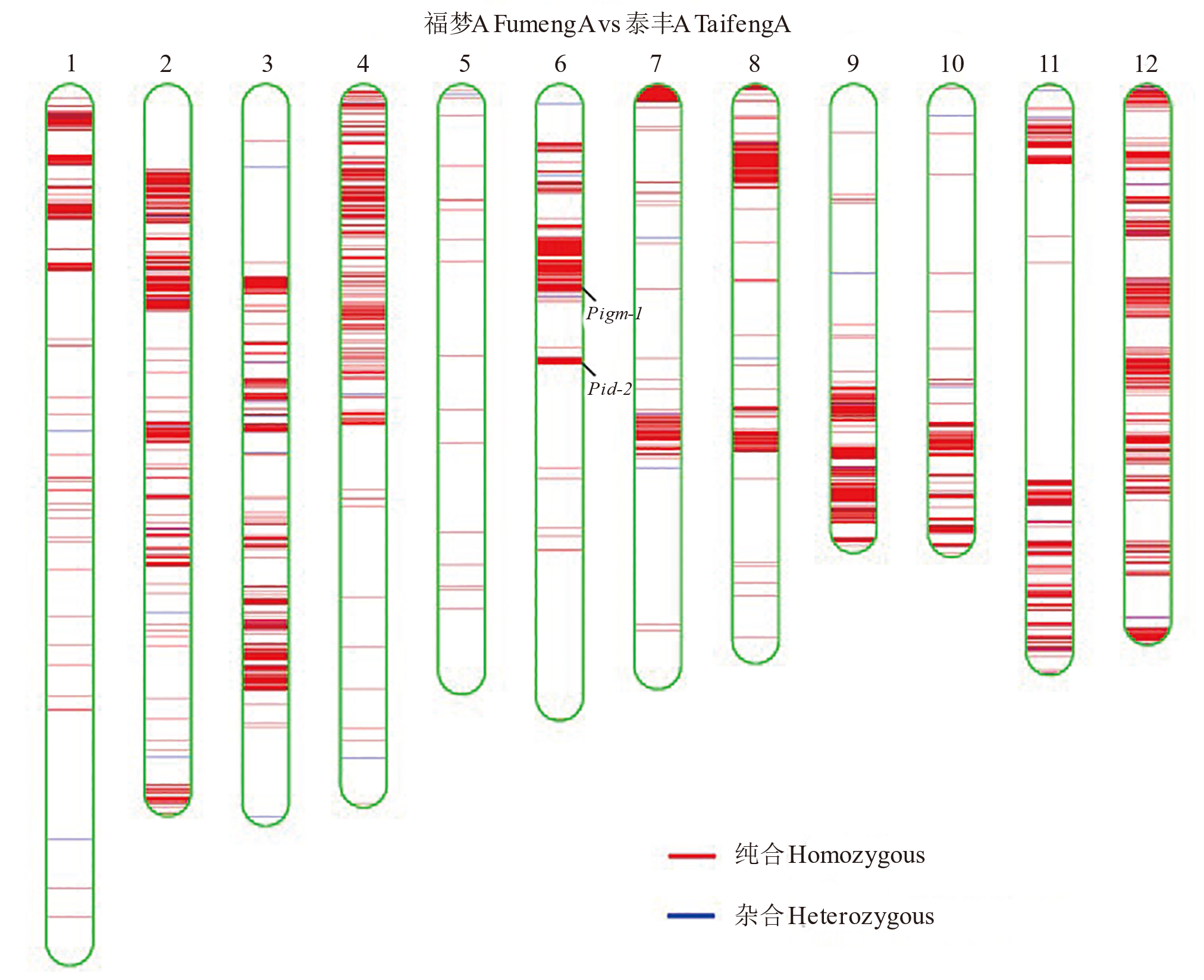
图3 福梦A遗传背景分析 白色底纹为泰丰A纯合背景,红色底纹为外源片段地谷A或双抗77009的纯合背景,而蓝色底纹为外源片段泰丰A与地谷A或泰丰A与双抗77009或地谷A与双抗77009的杂合背景。
Fig. 3. Genetic background analysis of Fumeng A The white background is the homozygous background of Taifeng A, the red background is the homozygous background of exogenous Digu A or Shuangkang 77009, and the blue background is the heterozygous background of Taifeng A and Digu A or Taifeng A and Shuangkang 77009 or Digu A and Shuangkang 77009.
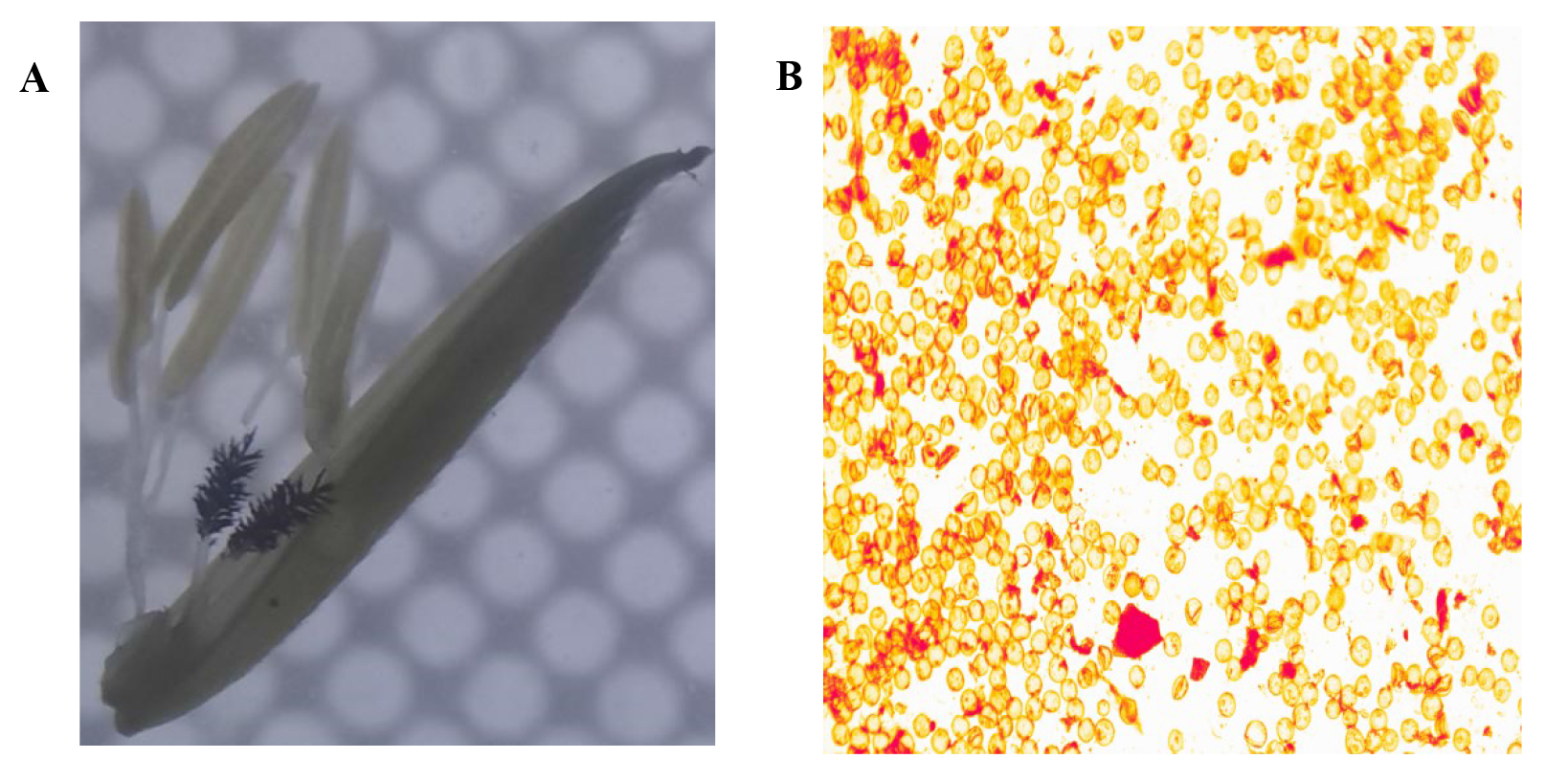
图4 不育系福梦A的育性特征 A:花药和柱头形态;B:花粉镜检。
Fig. 4. Pollen fertility of Fumeng A A, Pollen fertility; B, Microscopic observation of pollen.
| 品系 Line | 碘染反应花粉率 I2-KI staining reaction pollen rate(%) | 套袋自交结实率 Percentage of bagged seed setting rate(%) | 柱头外露率 Stigma exsertion rate(%) | |||||||||
|---|---|---|---|---|---|---|---|---|---|---|---|---|
| 典败 Typical abortion | 圆败 Spherical abortion | 染败 Stained abortion | 正常可育Fertile | 总颖花数Total spikelets | 总结实粒数 Filled spikelets | 自交结实率 Self- pollinate rate | 单边外露 Unilateral | 双边外露 Bilateral | 总外露 Total | |||
| 泰丰A Taifeng A | 99.68 | 0.32 | 0 | 0 | 8100 | 7 | 0.086 | 30.06 | 29.85 | 59.91 | ||
| 福梦A Fumeng A | 99.99 | 0.01 | 0 | 0 | 9250 | 0 | 0 | 27.67 | 26.12 | 53.79 | ||
| 泰丰B Taifeng B | 0 | 0 | 0 | 100 | 9125 | 8508 | 93.24 | 0 | 0 | 0 | ||
| 福梦B Fumeng B | 0 | 0 | 0 | 100 | 9832 | 8907 | 90.59 | 0 | 0 | 0 | ||
表3 不育系福梦A育性鉴定
Table 3. Identification of sterility from the improved CMS lines Fumeng A
| 品系 Line | 碘染反应花粉率 I2-KI staining reaction pollen rate(%) | 套袋自交结实率 Percentage of bagged seed setting rate(%) | 柱头外露率 Stigma exsertion rate(%) | |||||||||
|---|---|---|---|---|---|---|---|---|---|---|---|---|
| 典败 Typical abortion | 圆败 Spherical abortion | 染败 Stained abortion | 正常可育Fertile | 总颖花数Total spikelets | 总结实粒数 Filled spikelets | 自交结实率 Self- pollinate rate | 单边外露 Unilateral | 双边外露 Bilateral | 总外露 Total | |||
| 泰丰A Taifeng A | 99.68 | 0.32 | 0 | 0 | 8100 | 7 | 0.086 | 30.06 | 29.85 | 59.91 | ||
| 福梦A Fumeng A | 99.99 | 0.01 | 0 | 0 | 9250 | 0 | 0 | 27.67 | 26.12 | 53.79 | ||
| 泰丰B Taifeng B | 0 | 0 | 0 | 100 | 9125 | 8508 | 93.24 | 0 | 0 | 0 | ||
| 福梦B Fumeng B | 0 | 0 | 0 | 100 | 9832 | 8907 | 90.59 | 0 | 0 | 0 | ||
| 性状 Trait | 福梦A Fumeng A | 泰丰A Taifeng A | 福梦B Fumeng B | 泰丰B Taifeng B |
|---|---|---|---|---|
| 株高Plant height(cm) | 83.44±1.82** | 73.04±1.19 | 106.58±2.15** | 92.66±1.27 |
| 播始历期Sowing heading duration(d) | 90 | 79 | 91 | 78 |
| 剑叶长Flag leaf length(cm) | 31.42±1.66** | 24.64±1.23 | 41.24±1.59** | 25.06±0.59 |
| 剑叶宽Flag leaf width(cm) | 1.23±0.02** | 0.97±0.02 | 1.31±0.04** | 1.08±0.03 |
| 有效穗数Effective panicle number | 14.2±0.66** | 22.6±5.81 | 13.6±1.08** | 23.4±1.78 |
| 主穗长Main panicle length(cm) | 21.09±0.63 | 20.74±0.24 | 23.33±0.45** | 20.17±0.23 |
| 主穗总颖花数Spikelets number per plant | 160.22±15.09 | 133.22±6.57 | 233.33±8.91** | 131.56±5.7 |
| 穗实粒数Filled grains per panicle | - | - | 181.11±9.24** | 103.11±6.08 |
| 结实率Seed setting rate(%) | - | - | 77.62±2.86 | 78.1±2.06 |
| 粒长Grain length(mm) | - | - | 8.98±0.06** | 10.95±0.03 |
| 粒宽Grain width(mm) | - | - | 2.47±0.02 | 2.45±0.03 |
| 千粒重1000-grain weight(g) | - | - | 18.64±0.24** | 21.88±0.04 |
| 单株产量Yield per plant(g) | - | - | 45.91±2.34 | 52.79±3.11 |
表4 福梦A及其保持系福梦B主要农艺性状
Table 4. Major agronomic traits of Fumeng A and Fumeng B
| 性状 Trait | 福梦A Fumeng A | 泰丰A Taifeng A | 福梦B Fumeng B | 泰丰B Taifeng B |
|---|---|---|---|---|
| 株高Plant height(cm) | 83.44±1.82** | 73.04±1.19 | 106.58±2.15** | 92.66±1.27 |
| 播始历期Sowing heading duration(d) | 90 | 79 | 91 | 78 |
| 剑叶长Flag leaf length(cm) | 31.42±1.66** | 24.64±1.23 | 41.24±1.59** | 25.06±0.59 |
| 剑叶宽Flag leaf width(cm) | 1.23±0.02** | 0.97±0.02 | 1.31±0.04** | 1.08±0.03 |
| 有效穗数Effective panicle number | 14.2±0.66** | 22.6±5.81 | 13.6±1.08** | 23.4±1.78 |
| 主穗长Main panicle length(cm) | 21.09±0.63 | 20.74±0.24 | 23.33±0.45** | 20.17±0.23 |
| 主穗总颖花数Spikelets number per plant | 160.22±15.09 | 133.22±6.57 | 233.33±8.91** | 131.56±5.7 |
| 穗实粒数Filled grains per panicle | - | - | 181.11±9.24** | 103.11±6.08 |
| 结实率Seed setting rate(%) | - | - | 77.62±2.86 | 78.1±2.06 |
| 粒长Grain length(mm) | - | - | 8.98±0.06** | 10.95±0.03 |
| 粒宽Grain width(mm) | - | - | 2.47±0.02 | 2.45±0.03 |
| 千粒重1000-grain weight(g) | - | - | 18.64±0.24** | 21.88±0.04 |
| 单株产量Yield per plant(g) | - | - | 45.91±2.34 | 52.79±3.11 |
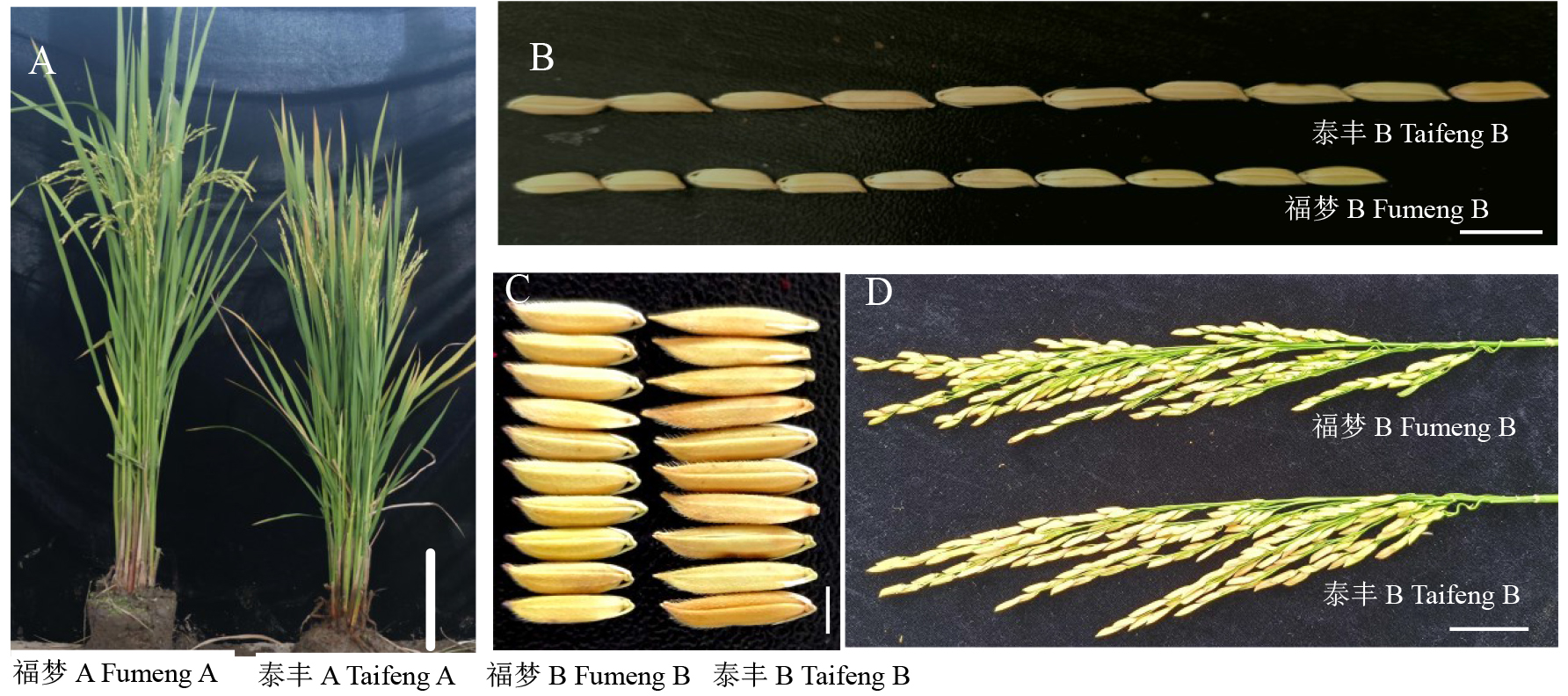
图5 泰丰A(B)和福梦A(B)的主要农艺性状比较 A:植株形态,标尺为15 cm;B:粒长,标尺为1 cm;C:粒宽,标尺为5 mm;D:穗型,标尺为3 cm。
Fig. 5. Comparison of major agronomic traits between recurrent Taifeng B and improved line Fumeng B A, Plant morphology, bar=15 cm; B, Grain length, bar=1 cm; C, Grain width, bar=5 mm; D, Panicle traits, bar=3 cm.
| 杂交组合 Hybrid rice combination | 播始历期 Sowing- heading duration(d) | 株高 Plant height(cm) | 分蘖数Panicle number per plant | 穗长 Panicle length(cm) | 穗粒数 Grain number per panicle | 穗实粒 Filled grains per panicle | 结实率 Seed-setting rate(%) | 千粒重 1000-grain weight(g) | 单株产量 Yield per plant(g) | 稻瘟病抗性 (叶瘟) Blast resistance |
|---|---|---|---|---|---|---|---|---|---|---|
| 天优华占 Tianyouhuazhan | 94 | 106.40±0.91 | 15.67±0.33 | 19.77±1.69 | 176.33±10.35 | 148.37±9.89 | 84.16±3.91 | 24.17±0.78 | 55.0 | MR |
| 福梦AHT102 Fumeng A/HT102 | 89 | 102.00±3.25 | 12.67±0.33 | 24.43±0.46** | 258.00±14.73 | 216.00±23.18 | 83.24±4.42 | 18.79±0.21** | 52.0 | R |
| 福梦A/HT100 Fumeng A/HT100 | 91 | 114.17±1.29 | 10.67±1.76 | 26.30±0.92** | 276.67±11.20* | 248.33±5.81* | 89.90±2.01 | 18.01±0.16** | 63.0 | R |
| 福梦A/HT89 Fumeng A/HT89 | 89 | 110.23±1.90 | 9.33±0.33** | 24.57±0.55** | 267.67±31.80* | 234.00±33.08 | 87.04±2.70 | 18.36±0.25** | 55.0 | R |
| 福梦A/HT82 Fumeng A/HT82 | 91 | 119.67±0.33** | 11.00±0.58 | 25.63±0.41** | 274.33±27.91* | 239.33±19.10* | 87.63±2.56 | 17.01±0.19** | 59.0 | R |
| 福梦A/HT80 Fumeng A/HT80 | 88 | 113.43±4.28 | 13.00±2.08 | 25.37±0.50** | 243.67±6.06 | 211.67±7.31 | 86.94±3.21 | 18.36±0.21** | 52.0 | R |
| 福梦A/HT78 Fumeng A/HT78 | 90 | 118.37±1.05** | 10.67±0.33 | 25.70±0.82** | 286.33±19.68** | 258.67±19.89** | 90.23±0.84 | 18.59±0.13** | 63.0 | R |
| 福梦A/HT71 Fumeng A/HT71 | 89 | 123.10±3.16** | 9.67±0.33* | 27.40±0.66** | 305.00±44.28** | 288.67±44.56** | 94.33±1.33 | 19.35±0.28** | 51.0 | R |
| 福梦A/HT67 Fumeng A/HT67 | 89 | 107.73±1.83 | 8.67±0.33** | 25.43±0.20** | 264.67±7.62* | 242.33±6.33* | 91.63±2.23 | 19.38±0.13** | 55.0 | MS |
| 福梦A/HT66 Fumeng A/HT66 | 91 | 115.17±1.80 | 11.33±1.20 | 23.97±0.88** | 233.33±9.53 | 207.00±21.66 | 88.25±5.72 | 19.73±0.24** | 54.0 | R |
| 福梦A/HT64 Fumeng A/HT64 | 90 | 115.73±1.19 | 11.67±0.88 | 25.20±1.47** | 252.67±24.77 | 229.33±21.18 | 90.88±1.26 | 19.49±0.22** | 65.0 | R |
| 福梦A/HT56 Fumeng A/H56 | 90 | 113.57±0.66 | 13.00±2.31 | 24.73±0.15** | 294.00±31.34** | 261.00±33.51** | 88.44±2.61 | 19.65±0.05** | 69.0 | R |
| 福梦A/HT43 Fumeng A/HT43 | 92 | 115.43±2.10 | 12.33±0.88 | 24.57±0.43** | 246.00±20.79 | 222.67±20.17 | 90.46±2.79 | 19.84±0.13** | 43.0 | R |
| 福梦A/HT32 Fumeng A/HT32 | 89 | 106.60±2.65 | 9.33±0.67** | 25.83±0.38** | 225.33±11.20 | 206.67±11.35 | 77.48±13.85 | 20.82±0.15** | 47.0 | R |
| 福梦A/HT31 Fumeng A/HT31 | 92 | 107.30±1.94 | 11.00±1.15 | 24.07±0.58** | 207.67±24.73 | 184.33±23.24 | 88.64±1.59 | 18.71±0.36** | 51.0 | R |
| 福梦A/HT28 Fumeng A/HT28 | 88 | 115.97±4.94 | 13.33±2.6 | 25.93±0.33** | 250.67±5.36 | 232.00±3.61 | 92.58±1.02 | 19.64±0.20** | 66.0 | R |
| 福梦A/HT16 Fumeng A/HT16 | 90 | 119.33±0.58** | 11.33±1.76 | 25.60±0.23** | 234.00±9.87 | 215.33±10.93 | 91.98±1.43 | 18.66±0.13** | 72.0 | R |
| 福梦A/HT15 Fumeng A/HT15 | 91 | 116.37±1.11* | 11.00±1.00 | 24.90±1.46** | 243.67±21.09 | 221.33±22.64 | 90.58±2.07 | 19.72±0.53** | 43.0 | R |
| 福梦A/HT9 Fumeng A/HT9 | 91 | 110.43±2.11 | 10.67±0.33 | 26.20±0.46** | 227.00±18.77 | 193.33±16.02 | 85.34±3.30 | 17.32±0.43** | 48.0 | R |
| 福梦A/HT8 Fumeng A/HT8 | 91 | 99.17±1.73 | 11.67±0.33 | 25.30±0.81** | 190.67±14.33 | 177.33±14.24 | 92.94±1.27 | 20.72±0.75** | 58.0 | R |
| 福梦A/HT5 Fumeng A/HT5 | 90 | 107.90±1.32 | 11.33±0.33 | 26.03±0.68** | 211.67±5.81 | 187.33±2.03 | 88.59±1.53 | 20.52±0.15** | 54.0 | R |
表5 福梦A的测交后代综合农艺性状比较分析
Table 5. Comparative analysis of agronomic traits between hybrid progeny of Fumeng A
| 杂交组合 Hybrid rice combination | 播始历期 Sowing- heading duration(d) | 株高 Plant height(cm) | 分蘖数Panicle number per plant | 穗长 Panicle length(cm) | 穗粒数 Grain number per panicle | 穗实粒 Filled grains per panicle | 结实率 Seed-setting rate(%) | 千粒重 1000-grain weight(g) | 单株产量 Yield per plant(g) | 稻瘟病抗性 (叶瘟) Blast resistance |
|---|---|---|---|---|---|---|---|---|---|---|
| 天优华占 Tianyouhuazhan | 94 | 106.40±0.91 | 15.67±0.33 | 19.77±1.69 | 176.33±10.35 | 148.37±9.89 | 84.16±3.91 | 24.17±0.78 | 55.0 | MR |
| 福梦AHT102 Fumeng A/HT102 | 89 | 102.00±3.25 | 12.67±0.33 | 24.43±0.46** | 258.00±14.73 | 216.00±23.18 | 83.24±4.42 | 18.79±0.21** | 52.0 | R |
| 福梦A/HT100 Fumeng A/HT100 | 91 | 114.17±1.29 | 10.67±1.76 | 26.30±0.92** | 276.67±11.20* | 248.33±5.81* | 89.90±2.01 | 18.01±0.16** | 63.0 | R |
| 福梦A/HT89 Fumeng A/HT89 | 89 | 110.23±1.90 | 9.33±0.33** | 24.57±0.55** | 267.67±31.80* | 234.00±33.08 | 87.04±2.70 | 18.36±0.25** | 55.0 | R |
| 福梦A/HT82 Fumeng A/HT82 | 91 | 119.67±0.33** | 11.00±0.58 | 25.63±0.41** | 274.33±27.91* | 239.33±19.10* | 87.63±2.56 | 17.01±0.19** | 59.0 | R |
| 福梦A/HT80 Fumeng A/HT80 | 88 | 113.43±4.28 | 13.00±2.08 | 25.37±0.50** | 243.67±6.06 | 211.67±7.31 | 86.94±3.21 | 18.36±0.21** | 52.0 | R |
| 福梦A/HT78 Fumeng A/HT78 | 90 | 118.37±1.05** | 10.67±0.33 | 25.70±0.82** | 286.33±19.68** | 258.67±19.89** | 90.23±0.84 | 18.59±0.13** | 63.0 | R |
| 福梦A/HT71 Fumeng A/HT71 | 89 | 123.10±3.16** | 9.67±0.33* | 27.40±0.66** | 305.00±44.28** | 288.67±44.56** | 94.33±1.33 | 19.35±0.28** | 51.0 | R |
| 福梦A/HT67 Fumeng A/HT67 | 89 | 107.73±1.83 | 8.67±0.33** | 25.43±0.20** | 264.67±7.62* | 242.33±6.33* | 91.63±2.23 | 19.38±0.13** | 55.0 | MS |
| 福梦A/HT66 Fumeng A/HT66 | 91 | 115.17±1.80 | 11.33±1.20 | 23.97±0.88** | 233.33±9.53 | 207.00±21.66 | 88.25±5.72 | 19.73±0.24** | 54.0 | R |
| 福梦A/HT64 Fumeng A/HT64 | 90 | 115.73±1.19 | 11.67±0.88 | 25.20±1.47** | 252.67±24.77 | 229.33±21.18 | 90.88±1.26 | 19.49±0.22** | 65.0 | R |
| 福梦A/HT56 Fumeng A/H56 | 90 | 113.57±0.66 | 13.00±2.31 | 24.73±0.15** | 294.00±31.34** | 261.00±33.51** | 88.44±2.61 | 19.65±0.05** | 69.0 | R |
| 福梦A/HT43 Fumeng A/HT43 | 92 | 115.43±2.10 | 12.33±0.88 | 24.57±0.43** | 246.00±20.79 | 222.67±20.17 | 90.46±2.79 | 19.84±0.13** | 43.0 | R |
| 福梦A/HT32 Fumeng A/HT32 | 89 | 106.60±2.65 | 9.33±0.67** | 25.83±0.38** | 225.33±11.20 | 206.67±11.35 | 77.48±13.85 | 20.82±0.15** | 47.0 | R |
| 福梦A/HT31 Fumeng A/HT31 | 92 | 107.30±1.94 | 11.00±1.15 | 24.07±0.58** | 207.67±24.73 | 184.33±23.24 | 88.64±1.59 | 18.71±0.36** | 51.0 | R |
| 福梦A/HT28 Fumeng A/HT28 | 88 | 115.97±4.94 | 13.33±2.6 | 25.93±0.33** | 250.67±5.36 | 232.00±3.61 | 92.58±1.02 | 19.64±0.20** | 66.0 | R |
| 福梦A/HT16 Fumeng A/HT16 | 90 | 119.33±0.58** | 11.33±1.76 | 25.60±0.23** | 234.00±9.87 | 215.33±10.93 | 91.98±1.43 | 18.66±0.13** | 72.0 | R |
| 福梦A/HT15 Fumeng A/HT15 | 91 | 116.37±1.11* | 11.00±1.00 | 24.90±1.46** | 243.67±21.09 | 221.33±22.64 | 90.58±2.07 | 19.72±0.53** | 43.0 | R |
| 福梦A/HT9 Fumeng A/HT9 | 91 | 110.43±2.11 | 10.67±0.33 | 26.20±0.46** | 227.00±18.77 | 193.33±16.02 | 85.34±3.30 | 17.32±0.43** | 48.0 | R |
| 福梦A/HT8 Fumeng A/HT8 | 91 | 99.17±1.73 | 11.67±0.33 | 25.30±0.81** | 190.67±14.33 | 177.33±14.24 | 92.94±1.27 | 20.72±0.75** | 58.0 | R |
| 福梦A/HT5 Fumeng A/HT5 | 90 | 107.90±1.32 | 11.33±0.33 | 26.03±0.68** | 211.67±5.81 | 187.33±2.03 | 88.59±1.53 | 20.52±0.15** | 54.0 | R |
| 组合 Hybrid | 播抽日期(海南三亚) Sowing date(Sanya, Hainan) (d) | 播抽日期(南平吴屯) Sowing date(Wutun, Nanping, Fujian) (d) | |||
|---|---|---|---|---|---|
| 05-10 | 05-20 | 05-30 | 06-10 | ||
| 福梦A/H310 Fumeng A/H310 | 89 | 88 | 87 | 88 | 82 |
| 福梦A/H366 Fumeng A/H366 | 91 | 88 | 83 | 83 | 80 |
| 福梦A/H389 Fumeng A/H389 | 92 | 91 | 90 | 89 | 85 |
| 泰丰A/H310 Taifeng A/H310 | 83 | 138 | 145 | 139 | 144 |
| 泰丰A/H366 Taifeng A/H366 | 85 | 145 | 148 | 144 | 148 |
| 泰丰A/H389 Taifeng A/H389 | 87 | 144 | 150 | 143 | 141 |
| 永兴A/H310 Yongxing A/H310 | 90 | 149 | >150 | >150 | >150 |
| 永兴A/H366 Yongxing A/H366 | 97 | 148 | >150 | >150 | >150 |
| 永兴A/H389 Yongxing A/H389 | 99 | 145 | >150 | >150 | >150 |
表6 福梦A和其他不育系所配组合在海南省三亚市和福建省南平市吴屯基地的播抽期比较
Table 6. Comparison of heading date among the hybrids derived from Fumeng A and other CMS lines at Sanya, Hainan Province and Nanping, Fujian Province
| 组合 Hybrid | 播抽日期(海南三亚) Sowing date(Sanya, Hainan) (d) | 播抽日期(南平吴屯) Sowing date(Wutun, Nanping, Fujian) (d) | |||
|---|---|---|---|---|---|
| 05-10 | 05-20 | 05-30 | 06-10 | ||
| 福梦A/H310 Fumeng A/H310 | 89 | 88 | 87 | 88 | 82 |
| 福梦A/H366 Fumeng A/H366 | 91 | 88 | 83 | 83 | 80 |
| 福梦A/H389 Fumeng A/H389 | 92 | 91 | 90 | 89 | 85 |
| 泰丰A/H310 Taifeng A/H310 | 83 | 138 | 145 | 139 | 144 |
| 泰丰A/H366 Taifeng A/H366 | 85 | 145 | 148 | 144 | 148 |
| 泰丰A/H389 Taifeng A/H389 | 87 | 144 | 150 | 143 | 141 |
| 永兴A/H310 Yongxing A/H310 | 90 | 149 | >150 | >150 | >150 |
| 永兴A/H366 Yongxing A/H366 | 97 | 148 | >150 | >150 | >150 |
| 永兴A/H389 Yongxing A/H389 | 99 | 145 | >150 | >150 | >150 |
| [1] | Skamnioti P, Gurr S J. Against the grain: Safeguarding rice from rice blast disease[J]. Trends in Biotechnology, 2009, 27(3): 141-150. |
| [2] | Deng Y W, Zhai K R, Xie Z, Yang D Y, Zhu X D, Liu J Z, Wang X, Qin P, Yang Y Z, Zhang G M, Li Q, Zhang J F, Wu S Q, Milazzo J, Mao B Z, Wang E T, Xie H A, Tharreau D, He Z H. Epigenetic regulation of antagonistic receptors confers rice blast resistance with yield balance[J]. Science, 2017, 355(6328): 962-965. |
| [3] | 谢华安. 杂交水稻抗病虫育种实践与思考[J]. 中国稻米, 2020, 26(1): 1-5. |
| Xie H A. Practice and thinking of hybrid rice breeding with disease-resistant and insect-resistance[J]. China Rice, 2020, 26(1): 1-5. (in Chinese with English abstract) | |
| [4] | 王如意, 刘杰, 冯琴, 张熠玚, 肖宁, 吴俊, 郑文静, 李爱宏, 宁约瑟. 稻瘟病抗性分子机制及抗病育种策略研究进展[J]. 植物保护, 2023, 49(5): 32-42. |
| Wang R Y, Liu J, Feng Q, Zhang Y Y, Xiao N, Wu J, Zheng W J, Li A H, Ning Y S. Deciphering the molecular mechanism of rice blast resistance and research progress of resistance breeding strategy[J]. Plant Protection, 2023, 49(5): 32-42. (in Chinese with English abstract) | |
| [5] | 吴俊, 刘雄伦, 戴良英, 王国梁. 水稻广谱抗稻瘟病基因研究进展[J]. 生命科学, 2007, 19(2): 233-238. |
| Wu J, Liu X L, Dai L Y, Wang G L. Advances on the identification and characterization of broad-spectrum blast resistance genes in rice[J]. Chinese Bulletin of Life Sciences, 2007, 19(2): 233-238. (in Chinese with English abstract) | |
| [6] | 危文亮, 赵应忠. 分子标记在作物育种中的应用[J]. 生物技术通报, 2000(2): 12-16. |
| Wei W L, Zhao Y Z. Applications of molecular markers in crop[J]. Biotechnology Bulletin, 2000(2): 12-16. (in Chinese with English abstract) | |
| [7] | 孙富, 唐梅, 何聪, 卢宏琮. 分子标记辅助聚合基因Pi1和Pi2改良红色特种籼稻稻瘟病抗性研究[J]. 湖北农业科学, 2018, 57(18): 23-27. |
| Sun F, Tang M, He C, Lu H C. Improvement of rice blast resistance in red rice by pyramiding of Pi1 and Pi2 through molecular marker-assisted selection[J]. Hubei Agricultural Sciences, 2018, 57(18): 23-27. (in Chinese with English abstract) | |
| [8] | 柳武革, 王丰, 李金华, 朱满山, 廖亦龙, 付崇允, 刘迪林, 曾学勤, 马晓智, 霍兴, 孔乐. 水稻三系不育系的分子设计改良与应用[J]. 广东农业科学, 2021, 48(10): 69-77. |
| Liu W G, Wang F, Li J H, Zhu M S, Liao Y L, Fu C Y, Liu D L, Zeng X Q, Ma X Z, Huo X, Kong L. Improvement of three-line rice male sterile lines by molecular design and their application[J]. Guangdong Agricultural Sciences, 2021, 48(10): 69-77. (in Chinese with English abstract) | |
| [9] | 陈学伟, 李仕贵, 马玉清, 黎汉云, 周开达, 朱立煌. 水稻抗稻瘟病基因Pi-d(t)1、Pi-b、Pi-ta2的聚合及分子标记选择[J]. 生物工程学报, 2004, 20(5): 708-714. |
| Chen X W, Li S G, Ma Y Q, Li H Y, Zhou K D, Zhu L H. Marker-assisted Selection and Pyramiding for three blast resistance genes, Pi-d(t)1, Pi-b, Pi-ta2, in rice[J]. Chinese Journal of Biotechnology, 2004, 20(5): 708-714. (in Chinese with English abstract) | |
| [10] | 楼珏, 杨文清, 李仲惺, 罗天宽, 谢永楚, 郑国楚, 岳高红, 徐建龙, 卢华金. 聚合稻瘟病、白叶枯病和褐飞虱抗性基因的三系恢复系改良效果的评价[J]. 作物学报, 2016, 42(1): 31-42. |
| Lou J, Yang W Q, Li Z X, Luo T K, Xie Y C, Zheng G C, Yue G H, Xu J L, Lu H J. Evaluation of improvement effect of restorer lines on pyramiding genes resistant to rice blast, bacterial leaf blight and brown planthopper[J]. Acta Agronomica Sinica, 2016, 42(1): 31-42. (in Chinese with English abstract) | |
| [11] | 杨德卫, 何旎清, 黄凤凰. 利用分子标记辅助选择聚合水稻抗病基因Pigm-1和Xa23[J]. 西北农林科技大学学报: 自然科学版, 2023, 51(11): 37-45. |
| Yang D W, He N Q, Huang F H. Pyramiding Pigm-1 and Xa23 genes in rice (Oryza sativa L.) by marker-assisted selection[J]. Journal of Northwest A&F University: Natural Science Edition, 2023, 51(11): 37-45. (in Chinese with English abstract) | |
| [12] | 陈志伟, 官华忠, 王宗华, 周元昌, 潘润森, 毛大梅, 段远霖, 吴为人. 利用基因聚合技术改良一个优质水稻不育系的稻瘟病抗性[J]. 福建农林大学学报: 自然科学版, 2012, 41(5): 449-455. |
| Chen Z W, Guan H Z, Wang Z H, Zhou Y C, Pan R S, Mao D M, Duan Y L, Wu W R. Improvement of the resistance to rice blast in a high quality rice CMS line by gene pyramiding[J]. Journal of Fujian Agriculture and Forestry University: Natural Science Edition, 2012, 41(5): 449-455. (in Chinese with English abstract) | |
| [13] | 陈志伟, 官华忠, 毛大梅, 潘润森, 周元昌, 吴为人. 抗稻瘟病和抗白叶枯病两系水稻不育系的选育及其初步应用[J]. 植物遗传资源学报, 2020, 21(5): 1078-1088. |
| Chen Z W, Guan H Z, Mao D M, Pan R S, Zhou Y C, Wu W R. Development and preliminary application of a two-line rice male sterile line with resistance to rice blast and bacterial blight[J]. Journal of Plant Genetic Resources, 2020, 21(5): 1078-1088. (in Chinese with English abstract) | |
| [14] | Yang D W, Li S P, Lu L, Fang J B, Wang W, Cui H T, Tang D Z. Identification and application of the Pigm-1 gene in rice disease-resistance breeding[J]. Plant Biology, 2020, 22(6): 1022-1029. |
| [15] | 朱满山, 黄慧君, 王丰, 刘振荣, 柳武革, 廖亦龙, 李金华, 陈建伟. 优质抗稻瘟病弱感光型杂交晚稻新组合泰丰优55[J]. 杂交水稻, 2013, 28(6): 76-77. |
| Zhu M S, Huang H J, Wang F, Liu Z R, Liu W G, Liao Y L, Li J H, Chen J W. Taifengyou 55, a new indica hybrid rice combination with weak photosensitivity, fine grain quality and blast resistance[J]. Hybrid Rice, 2013, 28(6): 76-77. (in Chinese with English abstract) | |
| [16] | Li J B, Sun Y D, Liu H, Wang Y Y, Jia Y L, Xu M H. Natural variation of rice blast resistance gene Pi-d2[J]. Genetics and Molecular Research, 2015, 14(1): 1235-1249. |
| [17] | 涂诗航, 周鹏, 郑轶, 张水金, 董瑞霞, 王洪飞, 王晓方, 游晴如, 黄庭旭, 郑家团. 优质不育系泰丰A系列杂交组合的恢复系选育杂交水稻[J]. 杂交水稻, 2018, 33(4): 13-16. |
| Tu S H, Zhou P, Zheng Y, Zhang S J, Dong R X, Wang H F, Wang X F, You Q R, Huang T X, Zheng J T. Breeding of restorer lines for high quality CMS line Taifeng A[J]. Hybrid Rice, 2018, 33(4): 13-16. (in Chinese with English abstract) | |
| [18] | 高利军, 邓国富, 高汉亮, 高国庆, 周萌, 周维永, 颜群, 张晋, 戴高兴. 水稻抗稻瘟病基因Pi-d2基因标签的建立与应用[J]. 西南农业学报, 2010, 23(1): 77-82. |
| Gao L J, Deng G F, Gao H L, Gao G Q, Zhou M, Zhou W Y, Yan Q, Zhang J, Dai G X. Establishment and application of gene tagging linked to rice blast resistance gene Pi-d2[J]. Southwest China Journal of Agriculture Sciences, 2010, 23(1): 77-82. (in Chinese with English abstract) | |
| [19] | Yang D W, Ye X F, Zheng X H, Cheng C P, Ye N, Huang F H. Development and evaluation of chromosome segment substitution lines carrying overlapping chromosome segments of the whole wild rice genome[J]. Frontiers in Plant Science, 2016, 7: 1737. |
| [20] | Yang D W, Li S P, Xiao Y P, Lu L, Zheng Z C, Tang D Z, Cui H T. Transcriptome analysis of rice response to blast fungus identified core genes involved in immunity[J]. Plant, Cell&Environment, 2021, 44(9): 3103-3121. |
| [21] | 邓一文, 刘裕强, 王静, 陈学伟, 何祖华. 农作物抗病虫研究的战略思考[J]. 中国科学: 生命科学, 2021, 51(10): 1435-1446. |
| Deng Y W, Liu Y Q, Wang J, Chen X W, He Z H. Strategic thinking and research on crop disease and pest resistance in China[J]. Scientia Sinica Vitae, 2021, 51(10): 1435-1446. (in Chinese with English abstract) | |
| [22] | 刘潮, 韩利红, 褚洪龙, 王海波, 高永, 唐利洲. 植物抗病研究进展与展望[J]. 植物保护, 2018, 44(4): 1-8. |
| Liu C, Han L H, Chu H L, Wang H B, Gao Y, Tang L Z. Progresses in and prospects for plant disease resistance research[J]. Plant Protection, 2018, 44(4): 1-8. (in Chinese with English abstract) | |
| [23] | 鲁秀梅, 张宁, 陈劲枫, 钱春桃. 作物基因聚合育种的研究进展[J]. 分子植物育种, 2017, 15(4): 1445-1454. |
| Lu X M, Zhang N, Chen J F, Qian C T. The research progress in crops pyramiding breeding[J]. Molecular Plant Breeding, 2017, 15(4): 1445-1454. (in Chinese with English abstract) | |
| [24] | Yang D B, Xiong L Z, Mou T M, Mi J M. Improving the resistance of the rice PTGMS line Feng 39S by pyramiding blast, bacterial blight, and brown planthopper resistance genes[J]. The Crop Journal, 2022, 10(4): 1187-1197. |
| [25] | 张世玺, 姚坚, 杨海龙, 王蕾, 李白. 聚合抗稻瘟病基因Pia和抗白叶枯病基因Xa23的广亲和恢复系选育[J]. 江苏农业科学, 2024, 52(11): 111-115. |
| Zhang S X, Yao J, Yang H L, Wang L, Li B. The selection of broadly compatible restorer lines with resistance to rice blast disease gene Pia and bacterial blight disease gene Xa23[J]. Jiangsu Agricultural Sciences, 2024, 52(11): 111-115. (in Chinese with English abstract) | |
| [26] | 何旎清, 杨德卫, 郑向华, 黄凤凰, 程朝平, 叶宁. 分子标记辅助选择Pigm-1基因改良恢复系R20稻瘟病抗性[J]. 核农学报, 2022, 36(2): 0245-0250. |
| He N Q, Yang D W, Zheng X H, Huang F H, Cheng C P, YE N. Improving blast resistance of R20 by molecular marker-assisted selection of Pigm-1 gene[J]. Journal of Nuclear Agricultural Sciences, 2022, 36(2): 0245-0250. (in Chinese with English abstract) | |
| [27] | Gao H, Jin M N, Zheng X M, Chen J, Yuan D Y, Xin Y Y, Wang M Q, Huang D Y, Zhang Z, Zhou K N, Sheng P K, Ma J, Ma W W, Deng H F, Jiang L, Liu S J, Wang H Y, Wu C Y, Yuan L P, Wan J M. Days to heading 7, a major quantitative locus determining photoperiod sensitivity and regional adaptation in rice[J]. Proceedings of the National Academy of Sciences of the United States of America, 2014, 11(46): 16337-42. |
| [28] | Li X, Zhang R C, Chen G, Xie J X, Xiao Z W, Cao F B, Ali I, Lqbal A, Wahab A, Huang M, Chen J N. Increasing grain weight and yield stability by increasing pre-heading non-structural carbohydrate reserves per spikelet in short-growth duration rice[J]. The Crop Journal, 2023, 11(6): 1912-1920. |
| [29] | 周振玲, 孙志广, 徐卫平, 徐艳, 杨波, 刘艳, 王宝祥, 江玲, 徐大勇. 水稻显性感光抑制基因Su-E1(t)的定位及遗传分析[J]. 植物遗传资源学报, 2020, 21(4): 945-953. |
| Zhou Z L, Sun Z G, Xu W P, Xu Y, Yang B, Liu Y, Wang B X, Jiang L, Xu D Y. Genetic mapping of a dominant photosensitive suppresser gene, Su-E1(t) in Oryza sativa[J]. Journal of Plant Genetic Resources, 2020, 21(4): 945-953. (in Chinese with English abstract) |
| [1] | 杨大兵, 杜雪树, 李进波, 夏明元, 胡亮, 石桓, 万丙良. 水稻抽穗期调控的分子机理及育种应用进展[J]. 中国水稻科学, 2026, 40(2): 145-154. |
| [2] | 倪晨, 张家豪, 朱昌进, 徐继伟, 胡秋倩, 霍中洋, 戴其根, 许轲, 李国辉. 水稻源流库形成与调控及其影响因素研究进展[J]. 中国水稻科学, 2026, 40(2): 155-170. |
| [3] | 王梦宁, 谢可冉, 高逖, 王真梅, 熊栋梁, 崔克辉. 高温对水稻粒重形成的影响及其栽培调控研究进展[J]. 中国水稻科学, 2026, 40(2): 171-180. |
| [4] | 罗肖郧, 郑兴飞, 彭宣国, 余启芝, 董华林, 殷得所, 王红波, 胡建林, 薛莲, 胡鹏, 徐得泽. 水稻抗倒伏研究:现状、挑战与未来方向[J]. 中国水稻科学, 2026, 40(2): 181-195. |
| [5] | 薛炮, 王友霜, 何弯弯, 黄晨博, 张涵, 丁震乾, 陈秋丽, 范运新, 丁成伟, 孙廉平, 胡婷婷. 水稻颖壳不闭合基因SG5的鉴定与克隆[J]. 中国水稻科学, 2026, 40(2): 210-222. |
| [6] | 段敏, 谢留杰, 岳雅妮, 黄善军. 基于CRISPR/Cas9技术创制优质香味粳稻品系[J]. 中国水稻科学, 2026, 40(2): 235-243. |
| [7] | 张梦柯, 陆佳雨, 何金, 许学, 吴爽, 王沛然, 陈若凡, 金青, 汪秀峰. 水稻野败型三系杂交种纯度检测功能标记的开发与应用[J]. 中国水稻科学, 2026, 40(2): 244-252. |
| [8] | 李兴沂, 陈玲, 邵建韬, 肖素勤, 李金璐, 付惠仙, 殷富有, 张建红, 程在全, 刘丽. 水稻产量与淀粉品质协同调控的分子遗传研究进展[J]. 中国水稻科学, 2026, 40(1): 1-17. |
| [9] | 岳轩宇, 谢文亚, 冯志明, 陈宗祥, 胡珂鸣, 左示敏. OsERF93参与调控水稻纹枯病抗性的研究[J]. 中国水稻科学, 2026, 40(1): 37-50. |
| [10] | 王轶欣, 林参, 马刘洋, 陈龙, 奉保华, 倪深, 魏祥进, 贺记外, 陈天晓. 谷丙转氨酶基因OsAlaAT4调控水稻氮素吸收和产量[J]. 中国水稻科学, 2026, 40(1): 51-60. |
| [11] | 黄奇娜, 姜鸿瑞, 杨婕, 于坤宇, 杨长登, 梁燕. 种子休眠基因Sdr4的生物信息学分析与分子标记开发和应用[J]. 中国水稻科学, 2026, 40(1): 61-71. |
| [12] | 刘亚萍, 董译词, 郑君妍, 邱绚, 刘鹏程, 叶亚峰, 刘斌美, 陈析丰, 马伯军. 水稻类病变早衰突变体lmes7的鉴定与基因精细定位[J]. 中国水稻科学, 2026, 40(1): 85-94. |
| [13] | 谢世民, 周誉株, 薛晓迪, 朱广飞, 孙良, 陈建能. 水稻钵苗取栽协同作业式移栽机构设计与试验[J]. 中国水稻科学, 2026, 40(1): 131-144. |
| [14] | 陈玲, 林文英, 梁丽梅, 欧阳由男, 叶胜海, 季芝娟. 水稻开花习性及其在粳型三系不育系选育中的应用[J]. 中国水稻科学, 2025, 39(6): 731-743. |
| [15] | 王娟, 吴丽娟, 洪海波, 姚志文, 王磊, 鄂志国. 水稻泛素结合酶E2的生物学功能研究进展[J]. 中国水稻科学, 2025, 39(6): 744-750. |
| 阅读次数 | ||||||
|
全文 |
|
|||||
|
摘要 |
|
|||||
