
中国水稻科学 ›› 2026, Vol. 40 ›› Issue (6): 796-807.DOI: 10.16819/j.1001-7216.2026.251001
郭锦涛1, 孔艳红2, 李连祥1, 周艳1, 于雪飞1, 黄光福1, 张石来1, 张静1, 胡凤益1, 张玉娇1,*( )
收稿日期:2025-10-04
修回日期:2025-11-21
出版日期:2026-11-10
发布日期:2026-11-09
通讯作者:
*email: yujiaozhang@ynu.edu.cn基金资助:
GUO Jintao1, KONG Yanhong2, LI Lianxiang1, ZHOU Yan1, YU Xuefei1, HUANG Guangfu1, ZHANG Shilai1, ZHANG Jing1, HU Fengyi1, ZHANG Yujiao1,*()
Received:2025-10-04
Revised:2025-11-21
Online:2026-11-10
Published:2026-11-09
摘要:
【目的】多年生稻是一种一次播种连续多年收获的稻作新类型,第二季开始省去传统水稻生产中的播种、育苗、翻耕与移栽等环节,实现轻简化栽培。氮素是影响水稻产量和稻米品质的关键元素,氮肥配施有机肥已被证实可协同提高水稻的产量与品质。目前针对氮肥配施有机肥对多年生稻产量和品质协同提升的系统性研究仍相对匮乏。为此,本研究以多年生稻品种“云大26”为试验材料,于2023年1月至2024年12月在云南省勐海县开展田间试验,旨在探究不同氮肥配施有机肥方案对多年生稻产量及稻米品质的影响,以期为多年生稻的优质可持续栽培提供理论支撑。【方法】试验采用双因素随机区组设计,设3个氮肥水平[0 (N0)、120 (N1)和180 kg/hm2 (N2)]和3种有机肥处理[不施有机肥(F0)、禾力旺有机肥(F1)和元江农庄有机肥(F2)]共9个处理组合。【结果】1)氮肥配施有机肥显著提高云大26有效穗数、每穗粒数和结实率,以N2F1处理最高,平均值分别为304.94穗/m2、116.06粒/穗和83.21%,较N0F0处理有效穗数和每穗粒数分别提高17.04%和21.05%,结实率提高18.28个百分点。2)云大26产量在N2F1处理下最优,四季平均产量为6.93 t/hm2;施氮量是影响产量的主导因素,N2平均产量较N0和N1分别提高66.26%和19.26%;而有机肥增产效应表现为F1 > F2 > F0,F1较F0和F2分别增产7.77%和3.64%。3)不同施肥处理云大26光合特性和多年生性差异显著,N2F1处理成熟期净光合速率、干物质积累量和根系伤流量显著高于其他处理,平均值分别为19.76 μmol/(m2·s)、24.42 t/hm2和0.54 g/h。4)随施氮量增加,植株含氮量和氮收获指数均显著提高,其中N2F1处理氮素利用效率最高,植株含氮量和氮收获指数分别为3.07%和52.80%。5)氮肥配施有机肥可协同改善多年生稻云大26的加工品质、营养品质和食味品质。其中N2F2处理在出糙率、精米率和氨基酸含量上表现最优,其出糙率、精米率和整精米率分别为87.96%、77.35%和53.73%,谷蛋白和氨基酸含量分别为5.21%和353.33 µmol/g。【结论】氮肥配施有机肥通过协同增强光合性能、促进干物质积累与氮素吸收,优化产量构成因子,从而提升多年生稻产量。该模式同时提高了稻桩成活率与根系活力,维持其多年生特性,并同步改善稻米加工、营养与食味品质。
郭锦涛, 孔艳红, 李连祥, 周艳, 于雪飞, 黄光福, 张石来, 张静, 胡凤益, 张玉娇. 氮肥配施有机肥对多年生稻云大26产量及稻米品质的影响[J]. 中国水稻科学, 2026, 40(6): 796-807.
GUO Jintao, KONG Yanhong, LI Lianxiang, ZHOU Yan, YU Xuefei, HUANG Guangfu, ZHANG Shilai, ZHANG Jing, HU Fengyi, ZHANG Yujiao. Effects of Nitrogen Fertilizer Combined with Organic Fertilizer Application on the Yield and Grain Quality of Perennial Rice 26[J]. Chinese Journal OF Rice Science, 2026, 40(6): 796-807.
| 处理 Treatment | 氮肥用量 Nitrogen application level(as N) | 有机肥用量 Organic fertilizer application level | 磷肥 P fertilizer application rate(as P2O5) | 钾肥 K fertilizer application rate(as K2O) |
|---|---|---|---|---|
| N0F0 | 0 | 0 | 90 | 180 |
| N0F1 | 0 | 1800 | 90 | 180 |
| N0F2 | 0 | 1800 | 90 | 180 |
| N1F0 | 120 | 0 | 90 | 180 |
| N1F1 | 120 | 1800 | 90 | 180 |
| N1F2 | 120 | 1800 | 90 | 180 |
| N2F0 | 180 | 0 | 90 | 180 |
| N2F1 | 180 | 1800 | 90 | 180 |
| N2F2 | 180 | 1800 | 90 | 180 |
表1 试验处理与肥料配比
Table 1. Experimental treatments and fertilizer application rates kg/hm2
| 处理 Treatment | 氮肥用量 Nitrogen application level(as N) | 有机肥用量 Organic fertilizer application level | 磷肥 P fertilizer application rate(as P2O5) | 钾肥 K fertilizer application rate(as K2O) |
|---|---|---|---|---|
| N0F0 | 0 | 0 | 90 | 180 |
| N0F1 | 0 | 1800 | 90 | 180 |
| N0F2 | 0 | 1800 | 90 | 180 |
| N1F0 | 120 | 0 | 90 | 180 |
| N1F1 | 120 | 1800 | 90 | 180 |
| N1F2 | 120 | 1800 | 90 | 180 |
| N2F0 | 180 | 0 | 90 | 180 |
| N2F1 | 180 | 1800 | 90 | 180 |
| N2F2 | 180 | 1800 | 90 | 180 |
| 处理 Treatment | 产量 Grain yield (t/hm2) | 有效穗 Effective panicles per m2 | 每穗粒数 Grains per panicle | 结实率 Seed setting rate (%) | 千粒重 Thousand-grain weight (g) |
|---|---|---|---|---|---|
| N0F0 | 4.00±1.22 h | 260.54±42.14 e | 95.88±6.58 g | 64.93±7.18 | 27.27±0.11 |
| N0F1 | 4.21±1.05 g | 280.59±17.70 d | 98.28±6.92 f | 66.59±9.46 | 27.28±0.08 |
| N0F2 | 3.95±1.05 h | 260.89±27.54 e | 97.45±5.37 fg | 65.35±7.19 | 27.24±0.09 |
| N1F0 | 5.34±1.59 f | 294.68±33.26 c | 101.86±6.22 e | 78.22±8.40 | 27.28±0.10 |
| N1F1 | 5.93±1.09 d | 304.24±19.26 a | 104.77±6.99 d | 78.94±9.14 | 27.23±0.08 |
| N1F2 | 5.71±1.35 e | 301.71±27.75 ab | 103.67±5.31 d | 78.41±8.91 | 27.22±0.12 |
| N2F0 | 6.50±0.90 c | 297.91±23.90 bc | 111.17±7.81 c | 82.58±7.03 | 27.27±0.07 |
| N2F1 | 6.93±0.92 a | 304.94±20.80 a | 116.06±8.92 a | 83.21±8.08 | 27.28±0.11 |
| N2F2 | 6.81±0.97 b | 301.37±22.58 ab | 114.13±6.53 b | 82.93±8.13 | 27.26±0.09 |
| 生长季节 Growing season | |||||
| S1 | 6.58±1.02 a | 318.78±14.84 a | 111.37±7.87 a | 84.65±6.79 a | 27.24±0.10 |
| S2 | 4.86±1.44 c | 286.59±35.71 b | 105.52±7.01 c | 71.94±9.37 c | 27.25±0.09 |
| S3 | 6.43±1.12 b | 289.44±18.29 b | 108.26±7.77 b | 81.03±8.13 b | 27.27±0.09 |
| S4 | 4.07±1.09 d | 263.70±23.89 c | 94.48±6.28 d | 65.12±6.14 d | 27.25±0.10 |
| 氮肥水平 N level | |||||
| N0 | 4.06±1.08 c | 267.25±31.37 b | 97.31±6.23 c | 65.62±7.82 c | 27.26±0.09 |
| N1 | 5.66±1.34 b | 300.31±26.90 a | 103.58±6.15 b | 78.52±8.57 b | 27.24±0.10 |
| N2 | 6.75±0.92 a | 301.41±22.01 a | 113.83±7.86 a | 82.91±7.54 a | 27.27±0.09 |
| 有机肥类别 Organic fertilizer type | |||||
| F0 | 5.28±1.61 c | 284.36±37.14 c | 103.06±9.26 c | 75.24±10.69 b | 27.27±0.09 |
| F1 | 5.69±1.51 a | 296.50±22.00 a | 106.50±10.52 a | 76.25±11.22 a | 27.26±0.09 |
| F2 | 5.49±1.63 b | 288.03±31.95 b | 105.17±8.88 b | 75.56±10.92 b | 27.24±0.10 |
| ANOVA F值 F value | |||||
| S(df=3) | 4183.17*** | 386.33*** | 1079.04*** | 3329.32*** | 0.58(ns) |
| N(df=2) | 6821.33*** | 379.41*** | 1853.64*** | 4581.76*** | 0.84(ns) |
| F(df=2) | 159.68*** | 39.12*** | 80.33** | 15.03*** | 1.21(ns) |
| S×N(df=6) | 92.21*** | 67.50*** | 6.57*** | 56.90*** | 1.50(ns) |
| S×F(df=6) | 22.73*** | 31.78*** | 8.30*** | 11.39*** | 2.83* |
| N×F(df=4) | 19.03*** | 8.54*** | 3.71** | 1.87(ns) | 0.43(ns) |
| S×N×F(df=12) | 12.51*** | 17.60*** | 0.87(ns) | 4.98*** | 1.62(ns) |
表2 不同施肥处理下云大26的产量及产量构成因素变化
Table 2. Grain yield and yield components of PR26 under different fertilization treatments
| 处理 Treatment | 产量 Grain yield (t/hm2) | 有效穗 Effective panicles per m2 | 每穗粒数 Grains per panicle | 结实率 Seed setting rate (%) | 千粒重 Thousand-grain weight (g) |
|---|---|---|---|---|---|
| N0F0 | 4.00±1.22 h | 260.54±42.14 e | 95.88±6.58 g | 64.93±7.18 | 27.27±0.11 |
| N0F1 | 4.21±1.05 g | 280.59±17.70 d | 98.28±6.92 f | 66.59±9.46 | 27.28±0.08 |
| N0F2 | 3.95±1.05 h | 260.89±27.54 e | 97.45±5.37 fg | 65.35±7.19 | 27.24±0.09 |
| N1F0 | 5.34±1.59 f | 294.68±33.26 c | 101.86±6.22 e | 78.22±8.40 | 27.28±0.10 |
| N1F1 | 5.93±1.09 d | 304.24±19.26 a | 104.77±6.99 d | 78.94±9.14 | 27.23±0.08 |
| N1F2 | 5.71±1.35 e | 301.71±27.75 ab | 103.67±5.31 d | 78.41±8.91 | 27.22±0.12 |
| N2F0 | 6.50±0.90 c | 297.91±23.90 bc | 111.17±7.81 c | 82.58±7.03 | 27.27±0.07 |
| N2F1 | 6.93±0.92 a | 304.94±20.80 a | 116.06±8.92 a | 83.21±8.08 | 27.28±0.11 |
| N2F2 | 6.81±0.97 b | 301.37±22.58 ab | 114.13±6.53 b | 82.93±8.13 | 27.26±0.09 |
| 生长季节 Growing season | |||||
| S1 | 6.58±1.02 a | 318.78±14.84 a | 111.37±7.87 a | 84.65±6.79 a | 27.24±0.10 |
| S2 | 4.86±1.44 c | 286.59±35.71 b | 105.52±7.01 c | 71.94±9.37 c | 27.25±0.09 |
| S3 | 6.43±1.12 b | 289.44±18.29 b | 108.26±7.77 b | 81.03±8.13 b | 27.27±0.09 |
| S4 | 4.07±1.09 d | 263.70±23.89 c | 94.48±6.28 d | 65.12±6.14 d | 27.25±0.10 |
| 氮肥水平 N level | |||||
| N0 | 4.06±1.08 c | 267.25±31.37 b | 97.31±6.23 c | 65.62±7.82 c | 27.26±0.09 |
| N1 | 5.66±1.34 b | 300.31±26.90 a | 103.58±6.15 b | 78.52±8.57 b | 27.24±0.10 |
| N2 | 6.75±0.92 a | 301.41±22.01 a | 113.83±7.86 a | 82.91±7.54 a | 27.27±0.09 |
| 有机肥类别 Organic fertilizer type | |||||
| F0 | 5.28±1.61 c | 284.36±37.14 c | 103.06±9.26 c | 75.24±10.69 b | 27.27±0.09 |
| F1 | 5.69±1.51 a | 296.50±22.00 a | 106.50±10.52 a | 76.25±11.22 a | 27.26±0.09 |
| F2 | 5.49±1.63 b | 288.03±31.95 b | 105.17±8.88 b | 75.56±10.92 b | 27.24±0.10 |
| ANOVA F值 F value | |||||
| S(df=3) | 4183.17*** | 386.33*** | 1079.04*** | 3329.32*** | 0.58(ns) |
| N(df=2) | 6821.33*** | 379.41*** | 1853.64*** | 4581.76*** | 0.84(ns) |
| F(df=2) | 159.68*** | 39.12*** | 80.33** | 15.03*** | 1.21(ns) |
| S×N(df=6) | 92.21*** | 67.50*** | 6.57*** | 56.90*** | 1.50(ns) |
| S×F(df=6) | 22.73*** | 31.78*** | 8.30*** | 11.39*** | 2.83* |
| N×F(df=4) | 19.03*** | 8.54*** | 3.71** | 1.87(ns) | 0.43(ns) |
| S×N×F(df=12) | 12.51*** | 17.60*** | 0.87(ns) | 4.98*** | 1.62(ns) |
| 处理 Treatment | 净光合速率 Net photosynthetic rate [μmol/(m2·s)] | 干物质积累量 Dry matter accumulation (t/hm2) | 稻桩成活率 Stubble survival rate (%) | 根系伤流量 Root bleeding sap (g/h) | |
|---|---|---|---|---|---|
| N0F0 | 9.43±0.36 g | 10.99±1.59 h | 88.38±7.67 i | 0.31±0.07 f | |
| N0F1 | 11.49±0.43 f | 12.79±1.17 g | 89.03±7.45 h | 0.36±0.09 e | |
| N0F2 | 11.55±0.47 f | 13.11±1.72 g | 89.55±7.20 g | 0.35±0.09 e | |
| N1F0 | 12.60±0.62 e | 16.63±1.36 f | 91.08±6.21 f | 0.38±0.10 d | |
| N1F1 | 16.33±0.67 d | 17.71±1.70 e | 92.29±5.39 e | 0.44±0.15 c | |
| N1F2 | 16.09±1.06 d | 19.10±1.63 d | 92.78±5.07 d | 0.45±0.15 c | |
| N2F0 | 18.64±0.76 c | 21.07±1.33 c | 94.12±4.28 c | 0.44±0.14 c | |
| N2F1 | 19.76±0.86 a | 24.42±1.80 a | 94.70±3.93 b | 0.54±0.20 a | |
| N2F2 | 19.12±0.80 b | 22.13±2.02 b | 95.55±3.30 a | 0.49±0.19 b | |
| 生长季节 Growing season | |||||
| S1 | 14.75±3.45 c | 18.01±4.89 b | 99.50±0.44 a | 0.55±0.12 a | |
| S2 | 15.51±3.84 a | 16.52±4.71 c | 92.13±1.94 b | 0.30±0.03 c | |
| S3 | 14.62±3.77 c | 19.54±4.46 a | 91.77±3.10 c | 0.53±0.11 b | |
| S4 | 15.12±3.81 b | 16.16±3.76 d | 84.37±4.59 d | 0.29±0.03 d | |
| 氮肥水平 N level | |||||
| N0 | 10.82±1.08 c | 12.32±1.72 c | 88.98±7.24 c | 0.34±0.09 c | |
| N1 | 15.00±1.90 b | 17.81±1.84 b | 92.05±5.46 b | 0.43±0.14 b | |
| N2 | 19.17±0.91 a | 22.54±2.20 a | 94.79±3.79 a | 0.49±0.18 a | |
| 有机肥类别 Organic fertilizer | |||||
| F0 | 13.55±3.92 b | 16.25±4.34 c | 91.19±6.48 c | 0.38±0.12 c | |
| F1 | 15.80±3.50 a | 18.88±5.00 a | 92.01±6.08 b | 0.45±0.17 a | |
| F2 | 15.65±3.26 a | 17.54±4.20 b | 92.63±5.83 a | 0.43±0.16 b | |
| ANOVA F值 F value | |||||
| S(df=3) | 22.32*** | 426.59*** | 15 227.22*** | 3 947 556.59*** | |
| N(df=2) | 3231.03*** | 6222.55*** | 486.40*** | 1 465 594.13*** | |
| F(df=2) | 291.79*** | 409.86*** | 274.85*** | 331 938.08*** | |
| S×N(df=6) | 2.61* | 20.88*** | 575.96*** | 169 552.28*** | |
| S×F(df=6) | 6.64*** | 27.75*** | 31.18*** | 9 332.80*** | |
| N×F(df=4) | 44.06*** | 20.30*** | 6.64*** | 19 217.28*** | |
| S×N×F(df=12) | 4.77*** | 3.23** | 2.78** | 14 084.13*** | |
表3 不同施肥处理下云大26光合特性与多年生特性变化
Table 3. Photosynthetic and perennial trait responses of PR26 to different fertilization treatments
| 处理 Treatment | 净光合速率 Net photosynthetic rate [μmol/(m2·s)] | 干物质积累量 Dry matter accumulation (t/hm2) | 稻桩成活率 Stubble survival rate (%) | 根系伤流量 Root bleeding sap (g/h) | |
|---|---|---|---|---|---|
| N0F0 | 9.43±0.36 g | 10.99±1.59 h | 88.38±7.67 i | 0.31±0.07 f | |
| N0F1 | 11.49±0.43 f | 12.79±1.17 g | 89.03±7.45 h | 0.36±0.09 e | |
| N0F2 | 11.55±0.47 f | 13.11±1.72 g | 89.55±7.20 g | 0.35±0.09 e | |
| N1F0 | 12.60±0.62 e | 16.63±1.36 f | 91.08±6.21 f | 0.38±0.10 d | |
| N1F1 | 16.33±0.67 d | 17.71±1.70 e | 92.29±5.39 e | 0.44±0.15 c | |
| N1F2 | 16.09±1.06 d | 19.10±1.63 d | 92.78±5.07 d | 0.45±0.15 c | |
| N2F0 | 18.64±0.76 c | 21.07±1.33 c | 94.12±4.28 c | 0.44±0.14 c | |
| N2F1 | 19.76±0.86 a | 24.42±1.80 a | 94.70±3.93 b | 0.54±0.20 a | |
| N2F2 | 19.12±0.80 b | 22.13±2.02 b | 95.55±3.30 a | 0.49±0.19 b | |
| 生长季节 Growing season | |||||
| S1 | 14.75±3.45 c | 18.01±4.89 b | 99.50±0.44 a | 0.55±0.12 a | |
| S2 | 15.51±3.84 a | 16.52±4.71 c | 92.13±1.94 b | 0.30±0.03 c | |
| S3 | 14.62±3.77 c | 19.54±4.46 a | 91.77±3.10 c | 0.53±0.11 b | |
| S4 | 15.12±3.81 b | 16.16±3.76 d | 84.37±4.59 d | 0.29±0.03 d | |
| 氮肥水平 N level | |||||
| N0 | 10.82±1.08 c | 12.32±1.72 c | 88.98±7.24 c | 0.34±0.09 c | |
| N1 | 15.00±1.90 b | 17.81±1.84 b | 92.05±5.46 b | 0.43±0.14 b | |
| N2 | 19.17±0.91 a | 22.54±2.20 a | 94.79±3.79 a | 0.49±0.18 a | |
| 有机肥类别 Organic fertilizer | |||||
| F0 | 13.55±3.92 b | 16.25±4.34 c | 91.19±6.48 c | 0.38±0.12 c | |
| F1 | 15.80±3.50 a | 18.88±5.00 a | 92.01±6.08 b | 0.45±0.17 a | |
| F2 | 15.65±3.26 a | 17.54±4.20 b | 92.63±5.83 a | 0.43±0.16 b | |
| ANOVA F值 F value | |||||
| S(df=3) | 22.32*** | 426.59*** | 15 227.22*** | 3 947 556.59*** | |
| N(df=2) | 3231.03*** | 6222.55*** | 486.40*** | 1 465 594.13*** | |
| F(df=2) | 291.79*** | 409.86*** | 274.85*** | 331 938.08*** | |
| S×N(df=6) | 2.61* | 20.88*** | 575.96*** | 169 552.28*** | |
| S×F(df=6) | 6.64*** | 27.75*** | 31.18*** | 9 332.80*** | |
| N×F(df=4) | 44.06*** | 20.30*** | 6.64*** | 19 217.28*** | |
| S×N×F(df=12) | 4.77*** | 3.23** | 2.78** | 14 084.13*** | |
| 处理 Treatment | 植株含氮量 Plant nitrogen content(%) | 氮收获指数 NHI(%) |
|---|---|---|
| N0F0 | 1.44±0.18 | 51.39±0.46 e |
| N0F1 | 1.73±0.16 | 51.64±0.42 de |
| N0F2 | 1.63±0.19 | 51.66±0.36 de |
| N1F0 | 2.54±0.20 | 51.42±0.42 e |
| N1F1 | 2.83±0.24 | 52.39±0.43 abc |
| N1F2 | 2.75±0.28 | 52.00±0.65 c |
| N2F0 | 2.78±0.28 | 52.12±0.25 bc |
| N2F1 | 3.07±0.20 | 52.80±0.38 a |
| N2F2 | 2.99±0.30 | 52.50±0.28 ab |
| 生长季节 Growing season | ||
| S1 | 2.32±0.60 c | 51.68±0.64 c |
| S2 | 2.20±0.60 d | 51.90±0.54 bc |
| S3 | 2.73±0.68 a | 52.09±0.57 ab |
| S4 | 2.42±0.64 b | 52.30±0.59 a |
| 氮肥水平 N level | ||
| N0 | 1.60±0.21 c | 51.56±0.42 c |
| N1 | 2.71±0.26 b | 51.93±0.64 b |
| N2 | 2.95±0.29 a | 52.47±0.41 a |
| 有机肥类别 Organic fertilizer | ||
| F0 | 2.25±0.63 c | 51.64±0.51 c |
| F1 | 2.54±0.62 a | 52.28±0.63 a |
| F2 | 2.46±0.65 b | 52.05±0.57 b |
| ANOVA F值 F value | ||
| S(df=3) | 108.95*** | 12.08*** |
| N(df=2) | 1503.29*** | 48.42*** |
| F(df=2) | 62.99*** | 24.25*** |
| S×N(df=6) | 2.14(ns) | 0.05(ns) |
| S×F(df=6) | 0.48(ns) | 0.08(ns) |
| N×F(df=4) | 0.02(ns) | 2.54* |
| S×N×F(df=12) | 0.86(ns) | 0.19(ns) |
表4 不同施肥处理下云大26植株含氮量及氮收获指数的变化
Table 4. Plant nitrogen content and NHI of PR26 under different fertilization treatments
| 处理 Treatment | 植株含氮量 Plant nitrogen content(%) | 氮收获指数 NHI(%) |
|---|---|---|
| N0F0 | 1.44±0.18 | 51.39±0.46 e |
| N0F1 | 1.73±0.16 | 51.64±0.42 de |
| N0F2 | 1.63±0.19 | 51.66±0.36 de |
| N1F0 | 2.54±0.20 | 51.42±0.42 e |
| N1F1 | 2.83±0.24 | 52.39±0.43 abc |
| N1F2 | 2.75±0.28 | 52.00±0.65 c |
| N2F0 | 2.78±0.28 | 52.12±0.25 bc |
| N2F1 | 3.07±0.20 | 52.80±0.38 a |
| N2F2 | 2.99±0.30 | 52.50±0.28 ab |
| 生长季节 Growing season | ||
| S1 | 2.32±0.60 c | 51.68±0.64 c |
| S2 | 2.20±0.60 d | 51.90±0.54 bc |
| S3 | 2.73±0.68 a | 52.09±0.57 ab |
| S4 | 2.42±0.64 b | 52.30±0.59 a |
| 氮肥水平 N level | ||
| N0 | 1.60±0.21 c | 51.56±0.42 c |
| N1 | 2.71±0.26 b | 51.93±0.64 b |
| N2 | 2.95±0.29 a | 52.47±0.41 a |
| 有机肥类别 Organic fertilizer | ||
| F0 | 2.25±0.63 c | 51.64±0.51 c |
| F1 | 2.54±0.62 a | 52.28±0.63 a |
| F2 | 2.46±0.65 b | 52.05±0.57 b |
| ANOVA F值 F value | ||
| S(df=3) | 108.95*** | 12.08*** |
| N(df=2) | 1503.29*** | 48.42*** |
| F(df=2) | 62.99*** | 24.25*** |
| S×N(df=6) | 2.14(ns) | 0.05(ns) |
| S×F(df=6) | 0.48(ns) | 0.08(ns) |
| N×F(df=4) | 0.02(ns) | 2.54* |
| S×N×F(df=12) | 0.86(ns) | 0.19(ns) |
| 处理 Treatment | 出糙率 Brown rice rate(%) | 精米率 Milled rice rate(%) | 整精米率 Head milled rice rate(%) |
|---|---|---|---|
| N0F0 | 82.00±12.38 | 73.71±10.87 | 52.46±6.86 ab |
| N0F1 | 82.12±13.93 | 72.51±10.70 | 46.75±12.20 d |
| N0F2 | 82.58±11.52 | 74.45±9.33 | 49.43±10.73 c |
| N1F0 | 84.00±11.23 | 76.15±8.86 | 53.26±10.50 a |
| N1F1 | 84.07±11.48 | 75.40±6.96 | 53.07±11.93 a |
| N1F2 | 82.34±9.82 | 73.77±6.43 | 50.99±15.43 b |
| N2F0 | 85.63±10.44 | 77.05±6.12 | 53.33±12.90 a |
| N2F1 | 86.46±11.10 | 77.10±6.35 | 53.79±11.34 a |
| N2F2 | 87.96±11.50 | 77.35±6.43 | 53.73±12.57 a |
| 生长季节 Growing season | |||
| S1 | 96.03±4.84 a | 86.37±7.19 a | 34.40±6.68 d |
| S2 | 76.33±3.21 c | 71.07±4.20 c | 54.53±6.97 c |
| S3 | 93.15±2.86 b | 74.44±2.61 b | 61.80±0.91 a |
| S4 | 71.00±2.86 d | 69.23±2.70 c | 56.73±2.60 b |
| 氮肥水平 N level | |||
| N0 | 82.23±12.29 c | 73.55±10.06 b | 49.54±10.17 b |
| N1 | 83.47±10.58 b | 75.11±7.34 b | 52.44±12.46 a |
| N2 | 86.68±10.75 a | 77.17±6.12 a | 53.61±11.94 a |
| 有机肥类别 Organic fertilizer | |||
| F0 | 83.88±11.15 | 75.64±8.70 | 53.02±10.10 |
| F1 | 84.22±12.01 | 75.00±8.22 | 51.20±11.92 |
| F2 | 84.29±10.98 | 75.19±7.47 | 51.38±12.81 |
| ANOVA F值 F value | |||
| S(df=3) | 686.06*** | 95.24*** | 282.62*** |
| N(df=2) | 31.72*** | 7.038** | 11.42*** |
| F(df=2) | 0.29(ns) | 0.23(ns) | 2.607(ns) |
| S×N(df=6) | 6.08*** | 4.63*** | 7.44*** |
| S×F(df=6) | 2.35* | 1.21(ns) | 2.80* |
| N×F(df=4) | 2.30(ns) | 0.77(ns) | 2.96* |
| S×N×F(df=12) | 1.83(ns) | 0.37(ns) | 1.34(ns) |
表5 不同施肥处理下云大26的稻米加工品质变化
Table 5. Rice processing quality of PR26 under different fertilization treatments
| 处理 Treatment | 出糙率 Brown rice rate(%) | 精米率 Milled rice rate(%) | 整精米率 Head milled rice rate(%) |
|---|---|---|---|
| N0F0 | 82.00±12.38 | 73.71±10.87 | 52.46±6.86 ab |
| N0F1 | 82.12±13.93 | 72.51±10.70 | 46.75±12.20 d |
| N0F2 | 82.58±11.52 | 74.45±9.33 | 49.43±10.73 c |
| N1F0 | 84.00±11.23 | 76.15±8.86 | 53.26±10.50 a |
| N1F1 | 84.07±11.48 | 75.40±6.96 | 53.07±11.93 a |
| N1F2 | 82.34±9.82 | 73.77±6.43 | 50.99±15.43 b |
| N2F0 | 85.63±10.44 | 77.05±6.12 | 53.33±12.90 a |
| N2F1 | 86.46±11.10 | 77.10±6.35 | 53.79±11.34 a |
| N2F2 | 87.96±11.50 | 77.35±6.43 | 53.73±12.57 a |
| 生长季节 Growing season | |||
| S1 | 96.03±4.84 a | 86.37±7.19 a | 34.40±6.68 d |
| S2 | 76.33±3.21 c | 71.07±4.20 c | 54.53±6.97 c |
| S3 | 93.15±2.86 b | 74.44±2.61 b | 61.80±0.91 a |
| S4 | 71.00±2.86 d | 69.23±2.70 c | 56.73±2.60 b |
| 氮肥水平 N level | |||
| N0 | 82.23±12.29 c | 73.55±10.06 b | 49.54±10.17 b |
| N1 | 83.47±10.58 b | 75.11±7.34 b | 52.44±12.46 a |
| N2 | 86.68±10.75 a | 77.17±6.12 a | 53.61±11.94 a |
| 有机肥类别 Organic fertilizer | |||
| F0 | 83.88±11.15 | 75.64±8.70 | 53.02±10.10 |
| F1 | 84.22±12.01 | 75.00±8.22 | 51.20±11.92 |
| F2 | 84.29±10.98 | 75.19±7.47 | 51.38±12.81 |
| ANOVA F值 F value | |||
| S(df=3) | 686.06*** | 95.24*** | 282.62*** |
| N(df=2) | 31.72*** | 7.038** | 11.42*** |
| F(df=2) | 0.29(ns) | 0.23(ns) | 2.607(ns) |
| S×N(df=6) | 6.08*** | 4.63*** | 7.44*** |
| S×F(df=6) | 2.35* | 1.21(ns) | 2.80* |
| N×F(df=4) | 2.30(ns) | 0.77(ns) | 2.96* |
| S×N×F(df=12) | 1.83(ns) | 0.37(ns) | 1.34(ns) |
| 处理 Treatment | 谷蛋白含量 Gluten content(%) | 氨基酸含量 Amino acid content(µmol/g) | 衰减值 Breakdown viscosity | 回升值 Setback viscosity |
|---|---|---|---|---|
| N0F0 | 5.13±0.40 bc | 163.82±59.46 i | 57.66±7.97 e | 54.97±22.28 c |
| N0F1 | 5.10±0.33 cd | 225.15±87.66 h | 69.92±15.73 a | 60.43±22.61 a |
| N0F2 | 5.07±0.36 d | 254.50±113.32 f | 56.85±8.71 f | 55.31±19.43 ab |
| N1F0 | 5.09±0.34 cd | 235.73±83.90 g | 68.15±8.01 b | 55.78±26.58 b |
| N1F1 | 5.12±0.32 cd | 281.15±106.61 e | 58.27±12.87 d | 50.96±21.69 e |
| N1F2 | 5.18±0.39 ab | 293.49±102.73 d | 52.64±22.32 g | 53.29±21.34 d |
| N2F0 | 5.18±0.34 ab | 308.51±90.42 c | 50.44±14.22 h | 45.48±20.41 g |
| N2F1 | 5.23±0.35 a | 344.38±87.82 b | 59.84±23.99 c | 47.68±20.41 f |
| N2F2 | 5.21±0.36 b | 353.33±93.37 a | 46.80±15.76 i | 51.23±21.04 e |
| 生长季节 Growing season | ||||
| S1 | 4.86±0.09 c | 299.58±56.70 b | 71.81±10.75 a | 83.68±6.13 a |
| S2 | 4.82±0.07 d | 151.96±44.42 d | 64.14±11.64 b | 58.32±7.78 b |
| S3 | 5.65±0.09 a | 387.59±70.29 a | 46.07±9.86 c | 37.98±5.59 c |
| S4 | 5.25±0.09 b | 254.23±79.10 c | 49.35±17.55 d | 31.18±5.27 d |
| 氮肥水平 N level | ||||
| N0 | 5.10±0.35 c | 214.49±95.03 c | 61.47±12.58 a | 56.90±21.02 a |
| N1 | 5.13±0.35 b | 270.12±98.67 b | 59.69±16.47 b | 53.34±22.74 b |
| N2 | 5.20±0.34 a | 335.41±90.11 a | 52.36±18.80 c | 48.13±20.17 c |
| 有机肥类别 Organic fertilizer | ||||
| F0 | 5.14±0.35 | 236.02±97.38 c | 58.75±12.57 b | 52.08±23.05 b |
| F1 | 5.15±0.33 | 283.56±104.17 b | 62.68±18.39 a | 53.02±21.67 a |
| F2 | 5.15±0.37 | 300.44±108.59 a | 52.09±16.61 c | 53.27±20.10 a |
| ANOVA F值 F value | ||||
| S(df=3) | 2271.20*** | 5874.81*** | 8451.27*** | 36398.44*** |
| N(df=2) | 57.85*** | 2984.15*** | 1771.02*** | 1697.14*** |
| F(df=2) | 1.62(ns) | 908.97*** | 2171.96*** | 34.73*** |
| S×N(df=6) | 17.50*** | 136.30*** | 1602.60*** | 200.91*** |
| S×F(df=6) | 7.03*** | 92.23*** | 525.54*** | 372.59*** |
| N×F(df=4) | 10.61*** | 38.21*** | 945.39*** | 324.91*** |
| S×N×F(df=12) | 5.03*** | 21.50*** | 954.21*** | 134.32*** |
表6 不同施肥处理下云大26稻米的营养品质及RVA淀粉特征值变化
Table 6. Rice nutritional quality and RVA profile parameters of PR26 under different fertilization treatments
| 处理 Treatment | 谷蛋白含量 Gluten content(%) | 氨基酸含量 Amino acid content(µmol/g) | 衰减值 Breakdown viscosity | 回升值 Setback viscosity |
|---|---|---|---|---|
| N0F0 | 5.13±0.40 bc | 163.82±59.46 i | 57.66±7.97 e | 54.97±22.28 c |
| N0F1 | 5.10±0.33 cd | 225.15±87.66 h | 69.92±15.73 a | 60.43±22.61 a |
| N0F2 | 5.07±0.36 d | 254.50±113.32 f | 56.85±8.71 f | 55.31±19.43 ab |
| N1F0 | 5.09±0.34 cd | 235.73±83.90 g | 68.15±8.01 b | 55.78±26.58 b |
| N1F1 | 5.12±0.32 cd | 281.15±106.61 e | 58.27±12.87 d | 50.96±21.69 e |
| N1F2 | 5.18±0.39 ab | 293.49±102.73 d | 52.64±22.32 g | 53.29±21.34 d |
| N2F0 | 5.18±0.34 ab | 308.51±90.42 c | 50.44±14.22 h | 45.48±20.41 g |
| N2F1 | 5.23±0.35 a | 344.38±87.82 b | 59.84±23.99 c | 47.68±20.41 f |
| N2F2 | 5.21±0.36 b | 353.33±93.37 a | 46.80±15.76 i | 51.23±21.04 e |
| 生长季节 Growing season | ||||
| S1 | 4.86±0.09 c | 299.58±56.70 b | 71.81±10.75 a | 83.68±6.13 a |
| S2 | 4.82±0.07 d | 151.96±44.42 d | 64.14±11.64 b | 58.32±7.78 b |
| S3 | 5.65±0.09 a | 387.59±70.29 a | 46.07±9.86 c | 37.98±5.59 c |
| S4 | 5.25±0.09 b | 254.23±79.10 c | 49.35±17.55 d | 31.18±5.27 d |
| 氮肥水平 N level | ||||
| N0 | 5.10±0.35 c | 214.49±95.03 c | 61.47±12.58 a | 56.90±21.02 a |
| N1 | 5.13±0.35 b | 270.12±98.67 b | 59.69±16.47 b | 53.34±22.74 b |
| N2 | 5.20±0.34 a | 335.41±90.11 a | 52.36±18.80 c | 48.13±20.17 c |
| 有机肥类别 Organic fertilizer | ||||
| F0 | 5.14±0.35 | 236.02±97.38 c | 58.75±12.57 b | 52.08±23.05 b |
| F1 | 5.15±0.33 | 283.56±104.17 b | 62.68±18.39 a | 53.02±21.67 a |
| F2 | 5.15±0.37 | 300.44±108.59 a | 52.09±16.61 c | 53.27±20.10 a |
| ANOVA F值 F value | ||||
| S(df=3) | 2271.20*** | 5874.81*** | 8451.27*** | 36398.44*** |
| N(df=2) | 57.85*** | 2984.15*** | 1771.02*** | 1697.14*** |
| F(df=2) | 1.62(ns) | 908.97*** | 2171.96*** | 34.73*** |
| S×N(df=6) | 17.50*** | 136.30*** | 1602.60*** | 200.91*** |
| S×F(df=6) | 7.03*** | 92.23*** | 525.54*** | 372.59*** |
| N×F(df=4) | 10.61*** | 38.21*** | 945.39*** | 324.91*** |
| S×N×F(df=12) | 5.03*** | 21.50*** | 954.21*** | 134.32*** |
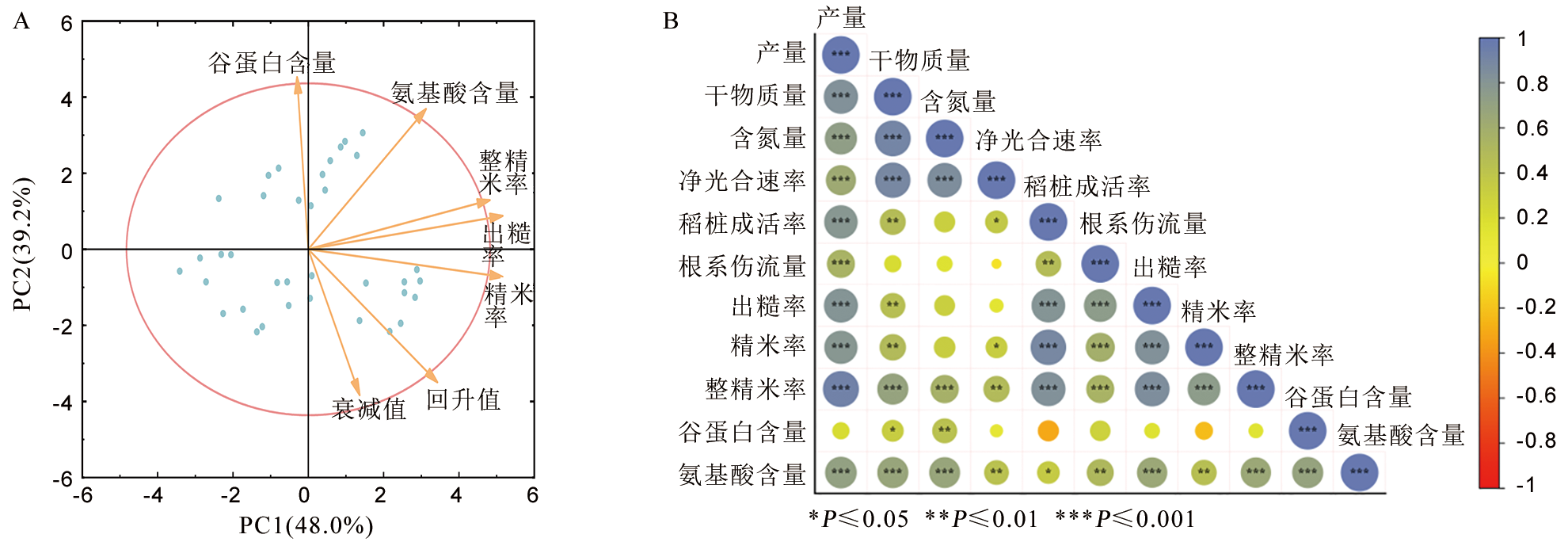
图1 云大26稻米品质的主成分分析及相关性分析 A: 基于稻米品质指标的主成分分析双标图。PC1和PC2的方差贡献率分别为48.0%和39.2%。箭头方向与长度分别表示品质指标的增长方向及其对主成分的贡献大小。B: 基于云大26产量、多年生特性及稻米品质间的Pearson相关性热图。*、**、*** 分别表示在 P < 0.05, P < 0.01和P < 0.001 水平上相关性显著。
Fig. 1. Principal component analysis and correlation analysis of the rice quality of PR26 A, Biplot of principal component analysis based on rice quality indicators. PC1 and PC2 explain 48.0% and 39.2% of the total variance, respectively. The direction and length of the arrows indicate the increasing trends of the quality traits and their relative contributions to the principal components. B, Heatmap showing Pearson correlation coefficients among grain yield, perennial traits, and rice quality attributes in PR26. *, **, and *** denote statistically significant correlations at P < 0.05, P < 0.01, and P < 0.001, respectively.
| [1] | Zhang Y, Huang G, Zhang S, Zhang J, Gan S, Cheng M, Hu J, Huang L, Hu F. An innovated crop management scheme for perennial rice cropping system and its impacts on sustainable rice production[J]. European Journal of Agronomy, 2021, 122: 126186. |
| [2] | 张石来, 黄光福, 张玉娇, 廉小平, 张静, 陈蕊, 胡凤益. 多年生稻育种进展及展望[J]. 中国稻米, 2022, 28(5): 39-43. |
| Zhang S L, Huang G F, Zhang Y J, Lian X P, Zhang J, Chen R, Hu F Y. Breeding progress and prospect of perennial rice[J]. China Rice, 2022, 28(5): 39-43. (in Chinese with English abstract) | |
| [3] | Huang G F, Zhang Y J, Zhang S L, Zhang J, Hu F Y, Li F M. Density-dependent fertilization of nitrogen for optimal yield of perennial rice[J]. Agronomy, 2022, 12(7): 1698. |
| [4] | Zhang S L, Huang G F, Zhang Y J, Lü X T, Wan K J, Liang J, Feng Y P, Dao J R, Wu S K, Zhang L, Yang X, Lian X P, Huang L Y, Shao L, Zhang J, Qin S W, Tao D Y, Crews T E, Sacks E J, Wade L J, Hu F Y. Sustained productivity and agronomic potential of perennial rice[J]. Nature Sustainability, 2022, 6(1): 28-38. |
| [5] | 汪本福, 余振渊, 程建平, 李阳, 张枝盛, 杨晓龙. 氮素对水稻产量和品质形成的影响研究进展[J]. 华中农业大学学报, 2022, 41(1): 76-83. |
| Wang B F, Yu Z Y, Cheng J P, Li Y, Zhang Z S, Yang X L. Research progress of effects of nitrogen on yield and quality of rice[J]. Journal of Huazhong Agricultural University, 2022, 41(1): 76-83. (in Chinese with English abstract) | |
| [6] | 刘宇, 曹家林, 肖正午, 张鸣宇, 陈佳娜, 曹放波, 黄敏. 施氮量对超级杂交稻Y两优900产量与氮肥利用率的影响[J]. 作物杂志, 2023(2): 126-130. |
| Liu Y, Cao J L, Xiao Z W, Zhang M Y, Chen J N, Cao F B, Huang M. Effects of nitrogen application rates on yield and nitrogen use efficiency of super hybrid rice Y-liangyou 900[J]. Crops, 2023(2): 126-130. (in Chinese with English abstract) | |
| [7] | Zhang X, Fang Q, Zhang T, Ma W, Velthof G L, Hou Y, Oenema O, Zhang F. Benefits and trade-offs of replacing synthetic fertilizers by animal manures in crop production in China: A meta-analysis[J]. Global Change Biology, 2020, 26(2): 888-900. |
| [8] | 王婷, 丁宁平, 李利利, 周海燕, 尚来贵. 化肥与有机肥或秸秆配施提高陇东旱塬黑垆土上作物产量的稳定性和可持续性[J]. 植物营养与肥料学报, 2019, 25(11): 1817-1826. |
| Wang T, Ding N P, Li L L, Zhou H Y, Shang L G. Combining chemical fertilizer with organic manure or straw increase the yield stability and sustainability of maize and wheat in Loess Plateau of east Gansu Province[J]. Plant Nutrition and Fertilizer Science, 2019, 25(11): 1817-1826. (in Chinese with English abstract) | |
| [9] | 王艳群, 彭正萍, 薛世川, 杨云马, 周亚鹏, 赵立宾. 过量施肥对设施农田土壤生态环境的影响[J]. 农业环境科学学报, 2005, 24(S1): 81-84. |
| Wang Y Q, Peng Z P, Xue S C, Yang Y M, Zhou Y P, Zhao L B. Effect of excessive fertilization on soil ecological environment in the facility farmland[J]. Journal of Agro-Environment Science, 2005, 24(S1): 81-84. (in Chinese with English abstract) | |
| [10] | 李燕青. 不同类型有机肥与化肥配施的农学和环境效应研究[D]. 北京: 中国农业科学院, 2016. |
| Li Y Q. Research on the agronomic and environmental effects of combined application of different types of organic fertilizers and chemical fertilizers[D]. Beijing: Chinese Academy of Agricultural Sciences, 2016. (in Chinese with English abstract) | |
| [11] | 陈盈, 宫殿凯, 李睿, 代贵金, 刘宪平, 于广星. 有机肥部分替代化学氮肥对水稻产量和品质的影响[J]. 农业科技通讯, 2024(11): 91-94. |
| Chen Y, Gong D K, Li R, Dai G J, Liu X P, Yu G X. Effect of partial substitution of organic fertilizer for chemical nitrogen fertilizer on rice yield and quality[J]. Bulletin of Agricultural Science and Technology, 2024(11): 91-94. (in Chinese) | |
| [12] | 刘敏, 吴敬芳, 黄星瑜, 熊清华, 李乐林, 李文强, 黄艳娟, 汪咏, 张亚, 刘淑娟. 有机肥替代氮肥对水稻产量、品质及土壤肥力的影响[J]. 江西农业学报, 2024, 36(7): 1-6. |
| Liu M, Wu J F, Huang X Y, Xiong Q H, Li L L, Li W Q, Huang Y J, Wang Y, Zhang Y, Liu S J. Effects of organic fertilizer replacing nitrogen fertilizer on rice yield, quality and soil fertility[J]. Acta Agriculturae Jiangxi, 2024, 36(7): 1-6. (in Chinese with English abstract) | |
| [13] | 李合生. 植物生理生化实验原理和技术[M]. 北京: 高等教育出版社, 2000. |
| Li H S. Principles and Techniques of Plant physiological Biochemical Experiment[M]. Beijing: Higher Education Press, 2000. (in Chinese) | |
| [14] | 高菊生, 黄晶, 董春华, 徐明岗, 曾希柏, 文石林. 长期有机无机肥配施对水稻产量及土壤有效养分影响[J]. 土壤学报, 2014, 51(2): 314-324. |
| Gao J S, Huang J, Dong C H, Xu M G, Zeng X B, Wen S L. Effects of long-term combined application of organic and chemical fertilizers on rice yield and soil available nutrients[J]. Acta Pedologica Sinica, 2014, 51(2): 314-324. (in Chinese with English abstract) | |
| [15] | Subedi K D, Ma B L. Effects of N-deficiency and timing of N supply on the recovery and distribution of labeled 15N in contrasting maize hybrids[J]. Plant and Soil, 2005, 273(1): 189-202. |
| [16] | Liu J, Shu A, Song W, Shi W, Li M, Zhang W, Li Z, Liu G, Yuan F, Zhang S, Liu Z, Gao Z. Long-term organic fertilizer substitution increases rice yield by improving soil properties and regulating soil bacteria[J]. Geoderma, 2021, 404: 115287. |
| [17] | 周江明. 有机-无机肥配施对水稻产量、品质及氮素吸收的影响[J]. 植物营养与肥料学报, 2012, 18(1): 234-240. |
| Zhou J M. Effect of combined application of organic and mineral fertilizers on yield, quality and nitrogen uptake of rice[J]. Journal of Plant Nutrition and Fertilizers, 2012, 18(1): 234-240. (in Chinese with English abstract) | |
| [18] | 石鑫蕊, 任彬彬, 江琳琳, 范淑秀, 曹英丽, 马殿荣. 有机肥替代部分化肥对水稻光合速率、氮素利用率和产量的影响[J]. 应用生态学报, 2021, 32(1): 154-162. |
| Shi X R, Ren B B, Jiang L L, Fan S X, Cao Y L, Ma D R. Effects of organic manure partial substitution for chemical fertilizer on the photosynthetic rate, nitrogen use efficiency and yield of rice[J]. Chinese Journal of Applied Ecology, 2021, 32(1): 154-162. (in Chinese with English abstract) | |
| [19] | 吕海英, 张东升, 郭文婵, 刘清瑞. 减施化肥增施有机肥对水稻产量的影响[J]. 种业导刊, 2022(5): 14-16. |
| Lü H Y, Zhang D S, Guo W C, Liu Q R. Effect of reducing chemical fertilizer and increasing organic fertilizer on rice yield[J]. Journal of Seed Industry Guide, 2022(5): 14-16. (in Chinese) | |
| [20] | 马蓓. 有机肥替代部分氮肥对亚热带稻田土壤肥力与产量的影响[D]. 长沙: 湖南农业大学, 2017. |
| Ma B. The Influence of organic fertilizer replacing part of nitrogen fertilizer on soil fertility and yield in subtropical paddy fields[D]. Changsha: Hunan Agricultural University, 2017. (in Chinese with English abstract) | |
| [21] | 何颖, 韩瑞才, 杨宙, 朱珊, 汤国平, 黄仁良, 胡水秀. 不同头季施氮水平下菌根共生稻的再生能力与产量形成特征[J]. 杂交水稻, 2024, 39(3): 133-138. |
| He Y, Han R C, Yang Z, Zhu S, Tang G P, Huang R L, Hu S X. Regeneration capacity and yield formation characteristics of mycorrhizal symbiotic rice under different first-season nitrogen application levels[J]. Hybrid Rice, 2024, 39(3): 133-138. (in Chinese with English abstract) | |
| [22] | 隋世江, 包红静, 曲航, 李波, 金丹丹, 赵颖. 有机无机肥配施对水稻产量和氮素利用的影响[J]. 辽宁农业科学, 2021(5): 48-51. |
| Sui S J, Bao H J, Qu H, Li B, Jin D D, Zhao Y. Effects of the combination of organic and inorganic fertilizers on rice yield and nitrogen utilization[J]. Liaoning Agricultural Sciences, 2021(5): 48-51. (in Chinese with English abstract) | |
| [23] | 黄光福. 花后施氮对多年生稻产量与多年生性的影响及其碳氮代谢机制研究[D]. 兰州: 兰州大学, 2024. |
| Huang G F. Study on the effects of nitrogen application after flowering on the yield and perennial nature of perennial rice and its carbon and nitrogen metabolism mechanism[D]. Lanzhou: Lanzhou University, 2024. (in Chinese with English abstract) | |
| [24] | 李超, 刘思超, 杨晶, 王元元, 唐利忠, 屠乃美, 易镇邪. 不同有机肥部分替代基施化学氮肥对双季稻生长发育及产量的影响[J]. 南方农业学报, 2018, 49(6): 1102-1110. |
| Li C, Liu S C, Yang J, Wang Y Y, Tang L Z, Tu N M, Yi Z X. Impacts of partial substitution of chemical nitrogen fertilizer with different organic fertilizers on double cropping rice growth and yield[J]. Journal of Southern Agriculture, 2018, 49(6): 1102-1110. (in Chinese with English abstract) | |
| [25] | 廖育林, 鲁艳红, 谢坚, 周兴, 聂军, 汤文光, 杨曾平. 紫云英配施控释氮肥对早稻产量及氮素吸收利用的影响[J]. 水土保持学报, 2015, 29(3): 190-195, 201. |
| Liao Y L, Lu Y H, Xie J, Zhou X, Nie J, Tang W G, Yang Z P. Effects of combined application of controlled release nitrogen fertilizer and Chinese milk vetch on yield and nitrogen nutrient uptake of early rice[J]. Journal of Soil and Water Conservation, 2015, 29(3): 190-195, 201. (in Chinese with English abstract) | |
| [26] | 冯涛, 余庆, 丁紫娟, 柯娜, 朱杰, 聂江文, 朱波, 蒋梦蝶, 刘章勇. 侧深施肥下有机肥替代减氮对再生稻田氮素损失与氮肥利用率的影响[J]. 农业环境科学学报, 2025(6): 1600-1610. |
| Feng T, Yu Q, Ding Z J, Ke N, Zhu J, Nie J W, Zhu B, Jiang M D, Liu Z Y. Effects of nitrogen reduction by organic manure substitution under side-deep fertilization on nitrogen loss and nitrogen fertilizer use efficiency in ratoon rice paddy field[J]. Journal of Agro-Environment Science, 2025(6): 1600-1610. (in Chinese with English abstract) | |
| [27] | 王站付, 石磊, 杨业凤, 陆利民, 黄璐璐, 林天杰. 无机有机肥配施对水稻产量及氮肥利用率的影响[J]. 安徽农业科学, 2020, 48(1): 163-166. |
| Wang Z F, Shi L, Yang Y F, Lu L M, Huang L L, Lin T J. Influence of organic-inorganic compound fertilizers on yield and nitrogen use efficiency in rice[J]. Journal of Anhui Agricultural Sciences, 2020, 48(1): 163-166. (in Chinese with English abstract) | |
| [28] | 文春燕, 熊运华, 王萍, 张志英, 姚晓云, 彭志勤, 陈金, 吴延寿. 减施化肥配施不同有机肥对优质籼稻产量和品质的影响[J]. 土壤, 2023, 55(2): 280-287. |
| Wen C Y, Xiong Y H, Wang P, Zhang Z Y, Yao X Y, Peng Z Q, Chen J, Wu Y S. Effects of reduced chemical fertilizer with organic fertilizer application on yield and quality of high-quality indica rice[J]. Soils, 2023, 55(2): 280-287. (in Chinese with English abstract) | |
| [29] | 章日亮, 钟水美, 章哲, 杨佳佳, 褚光. 减氮配施有机肥对华浙优210产量与米质的影响[J]. 作物研究, 2024, 38(2): 84-90. |
| Zhang R L, Zhong S M, Zhang Z, Yang J J, Chu G. Effects of reduced nitrogen application combined with organic fertilizer application on yield and quality of Huazheyou 210[J]. Crop Research, 2024, 38(2): 84-90. (in Chinese with English abstract) | |
| [30] | Hu Y, Li L, Tian J, Zhang C, Wang J, Yu E, Xing Z, Guo B, Wei H, Huo Z, Zhang H. Effects of dynamic low temperature during the grain filling stage on starch morphological structure, physicochemical properties, and eating quality of soft Japonica rice[J]. Cereal Chemistry, 2020, 97(2): 540-550. |
| [31] | 高鹏, 雷星宇, 鲁耀雄, 彭福元, 崔新卫. 有机氮肥替代部分化学氮肥对水稻产量及稻米品质的影响[J]. 中国农学通报, 2024, 40(13): 1-6. |
| Gao P, Lei X Y, Lu Y X, Peng F Y, Cui X W. Effects of partial substitution of organic nitrogen fertilizer for chemical nitrogen fertilizer on rice yield and quality[J]. Chinese Agricultural Science Bulletin, 2024, 40(13): 1-6. (in Chinese with English abstract) | |
| [32] | 王恒祥, 高树文. 不同有机肥氮替代化肥氮比例对水稻生产的影响[J]. 农业与技术, 2018, 38(2): 3-4, 16. |
| Wang H X, Gao S W. Effects of different ratio of organic fertilizer nitrogen to chemical fertilizer nitrogen on rice production[J]. Agriculture & Technology, 2018, 38(2): 3-4, 16. (in Chinese) |
| [1] | 高凌霄, 叶凡, 李帅, 陈云, 刘立军. 干湿交替灌溉对黑龙江稻区水稻产量和品质的影响[J]. 中国水稻科学, 2026, 40(6): 786-795. |
| [2] | 于冰洁, 王浩宇, 葛语桐, 崔格格, 张海鹏, 魏海燕, 张洪程, 许方甫. 油菜秸秆还田下增苗减氮对中熟晚粳稻产量和品质的影响[J]. 中国水稻科学, 2026, 40(5): 618-631. |
| [3] | 杨昌南, 何子欣, 谈亚文, 张学智, 张业诚, 田浩然, 危常州, 张新疆. 滴灌配施不同形态氮肥管理对水稻根际氮转化过程及产量形成的影响[J]. 中国水稻科学, 2026, 40(5): 632-647. |
| [4] | 王新雅, 何卓婷, 李潇, 尤赛雅, 朱练峰, 孔亚丽, 朱春权, 田文昊, 张均华, 金千瑜, 曹小闯. 秸秆分层还田耦合腐解菌剂通过调控土壤有机碳转化和微生物群落结构提高水稻产量[J]. 中国水稻科学, 2026, 40(5): 648-662. |
| [5] | 廖萍, 刘若彤, 孟轶, 翁文安, 都晗萌, 李骏, 高辉, 张洪程. 一次性基施控释掺混肥对水稻产量和倒伏性状的影响[J]. 中国水稻科学, 2026, 40(4): 469-475. |
| [6] | 钟晓媛, 王众, 陈雷, 张晓丽, 黄严, 朱德峰, 王亚梁, 覃勇, 高国庆, 张隆葵, 唐茂艳, 梁天锋. 精准条播育秧对广西机插水稻栽插质量、干物质生产及产量的影响[J]. 中国水稻科学, 2026, 40(4): 487-501. |
| [7] | 马义虎, 周翠, 朱练峰, 余山红. 关键栽培措施对优质超级稻华浙优261产量、品质形成及生育特性的影响[J]. 中国水稻科学, 2026, 40(4): 502-518. |
| [8] | 赵春芳, 罗磊, 赵庆勇, 庄丽华, 管菊, 陈涛, 朱镇, 张亚东, 王才林. 节水灌溉对优良食味粳稻产量形成及根系形态的影响[J]. 中国水稻科学, 2026, 40(4): 519-530. |
| [9] | 郑林娜, 凌霄霞, 杨显轲, 彭少兵, 黄见良, 熊栋梁. 春玉米-晚稻轮作模式的综合效益研究:现状、挑战与展望[J]. 中国水稻科学, 2026, 40(3): 281-291. |
| [10] | 陈子方, 周泽源, 钱嘉潞, 马孝卫, 李锦涛, 曹玉贤, 侯俊. 头季机收后叶面氮肥施用时间对再生季稻米产量及品质的影响[J]. 中国水稻科学, 2026, 40(3): 375-385. |
| [11] | 陈雪芳, 曹云, 汤菁莎, 黄兴海, 何咨霆, 王岚芃, 李瑞杰, 陆焘, 孙园园, 廖琴, 王仲林, 杨志远, 马均, 孙永健. 无人机飞行速度与氮肥农药减施模式对机插稻产量形成和能效的影响[J]. 中国水稻科学, 2026, 40(3): 386-402. |
| [12] | 沈智达, 马世浩, 黄思远, 张洋洋, 廖世鹏, 李小坤. 种植方式和施肥对水稻根系形态、抗倒伏特性与产量的影响[J]. 中国水稻科学, 2026, 40(2): 253-263. |
| [13] | 李兴沂, 陈玲, 邵建韬, 肖素勤, 李金璐, 付惠仙, 殷富有, 张建红, 程在全, 刘丽. 水稻产量与淀粉品质协同调控的分子遗传研究进展[J]. 中国水稻科学, 2026, 40(1): 1-17. |
| [14] | 王轶欣, 林参, 马刘洋, 陈龙, 奉保华, 倪深, 魏祥进, 贺记外, 陈天晓. 谷丙转氨酶基因OsAlaAT4调控水稻氮素吸收和产量[J]. 中国水稻科学, 2026, 40(1): 51-60. |
| [15] | 肖无为, 张雨晴, 朱辰光, 田贵生, 蔡岳宏, 王飞, 熊栋梁, 黄见良, 彭少兵, 崔克辉. 促芽肥施用时期和施用量对再生稻产量和头季稻米品质的影响[J]. 中国水稻科学, 2026, 40(1): 118-130. |
| 阅读次数 | ||||||
|
全文 |
|
|||||
|
摘要 |
|
|||||
