
中国水稻科学 ›› 2026, Vol. 40 ›› Issue (6): 808-820.DOI: 10.16819/j.1001-7216.2026.250615
汤洪伟1,#, 吴岳2,#, 朱新霞1, 刘雪梅3, 杨晴3, 王丹英1,*( ), 刘元辉1,*()
收稿日期:2025-06-24
修回日期:2025-08-03
出版日期:2026-11-10
发布日期:2026-11-09
通讯作者:
*email: liuyuanhui@caas.cn; wangdanying@caas.cn作者简介:第一联系人:# 共同第一作者
基金资助:
TANG Hongwei1,#, WU Yue2,#, ZHU Xinxia1, LIU Xuemei3, YANG Qing3, WANG Danying1,*(), LIU Yuanhui1,*()
Received:2025-06-24
Revised:2025-08-03
Online:2026-11-10
Published:2026-11-09
About author:First author contact:# These authors contributed equally to the work
摘要:
【目的】探究微生物菌剂对水稻吸收富集镉及根系微生物群落的影响,为应用绿色高效的微生物菌剂减少水稻籽粒镉积累提供理论依据。【方法】以镉污染稻田为试验地,微生物菌剂施用设置直播水稻(拌种)和移栽水稻(移栽前喷施秧苗、拌种+移栽后15 d喷施)处理,以不施用微生物菌剂为对照。分析成熟期稻田不同处理下土壤、水稻根、茎叶和籽粒镉含量,并通过高通量扩增子16S rRNA测序分析不同处理下非根际土、根际土和根内微生物群落结构的变化。【结果】微生物菌剂显著降低了水稻对镉的吸收与富集,其中移栽处理(拌种+移栽后喷施)的吸收系数和富集系数较对照分别降低41%和69%,直播拌种处理的富集系数降幅达80%,但对转运系数无显著影响。微生3+物组分析显示,微生物菌剂处理显著提高了水稻根内微生物群落的多样性,尤其在移栽稻中更为明显。且菌剂处理下水稻根内显著富集的微生物类群相对丰度增加。【结论】微生物菌剂通过增加根内微生物群落多样性,竞争植物根系吸收位点来降低对镉的吸收;此外,根内富集的微生物类群可能通过氧化还原、吸附或生物积累等机制抑制根系对镉的吸收。
汤洪伟, 吴岳, 朱新霞, 刘雪梅, 杨晴, 王丹英, 刘元辉. 微生物菌剂对水稻吸收富集镉及根系微生物群落的影响[J]. 中国水稻科学, 2026, 40(6): 808-820.
TANG Hongwei, WU Yue, ZHU Xinxia, LIU Xuemei, YANG Qing, WANG Danying, LIU Yuanhui. Effects of Microbial Inoculants on Cadmium Uptake, Accumulation, and Root Microbial Community in Rice[J]. Chinese Journal OF Rice Science, 2026, 40(6): 808-820.
| 处理 Treatment | 镉含量 Cd content(mg/kg) | 迁移系数Migration coefficient | |||||||
|---|---|---|---|---|---|---|---|---|---|
| 茎叶 Stem and leaf | 根 Root | 籽粒 Grain | 土壤 Soil | 吸收系数Absorption coefficient | 转运系数Transfer coefficient | 富集系数Enrichment factor | |||
| 移栽农户对照 FTP | 2.34 a | 4.58 a | 0.48 a | 0.39 a | 11.74 | 0.51 | 1.24 | ||
| 移栽拌种+15 d后喷施 SC+FS | 1.86 a | 2.70 b | 0.15 b | 0.39 a | 6.92 | 0.69 | 0.38 | ||
| 移栽前1 d喷施 FSBT | 1.58 a | 3.36 ab | 0.19 b | 0.40 a | 8.40 | 0.47 | 0.49 | ||
| 直播农户对照 FDSP | 2.62 a | 5.00 a | 0.60 a | 0.37 a | 13.51 | 0.52 | 1.62 | ||
| 直播-拌种 DS+SC | 2.13 a | 4.14 a | 0.14 b | 0.44 a | 9.40 | 0.51 | 0.31 | ||
表1 微生物菌剂处理下水稻各部位镉含量
Table 1. Cadmium (Cd) content in rice tissues under different microbial inoculant treatments
| 处理 Treatment | 镉含量 Cd content(mg/kg) | 迁移系数Migration coefficient | |||||||
|---|---|---|---|---|---|---|---|---|---|
| 茎叶 Stem and leaf | 根 Root | 籽粒 Grain | 土壤 Soil | 吸收系数Absorption coefficient | 转运系数Transfer coefficient | 富集系数Enrichment factor | |||
| 移栽农户对照 FTP | 2.34 a | 4.58 a | 0.48 a | 0.39 a | 11.74 | 0.51 | 1.24 | ||
| 移栽拌种+15 d后喷施 SC+FS | 1.86 a | 2.70 b | 0.15 b | 0.39 a | 6.92 | 0.69 | 0.38 | ||
| 移栽前1 d喷施 FSBT | 1.58 a | 3.36 ab | 0.19 b | 0.40 a | 8.40 | 0.47 | 0.49 | ||
| 直播农户对照 FDSP | 2.62 a | 5.00 a | 0.60 a | 0.37 a | 13.51 | 0.52 | 1.62 | ||
| 直播-拌种 DS+SC | 2.13 a | 4.14 a | 0.14 b | 0.44 a | 9.40 | 0.51 | 0.31 | ||
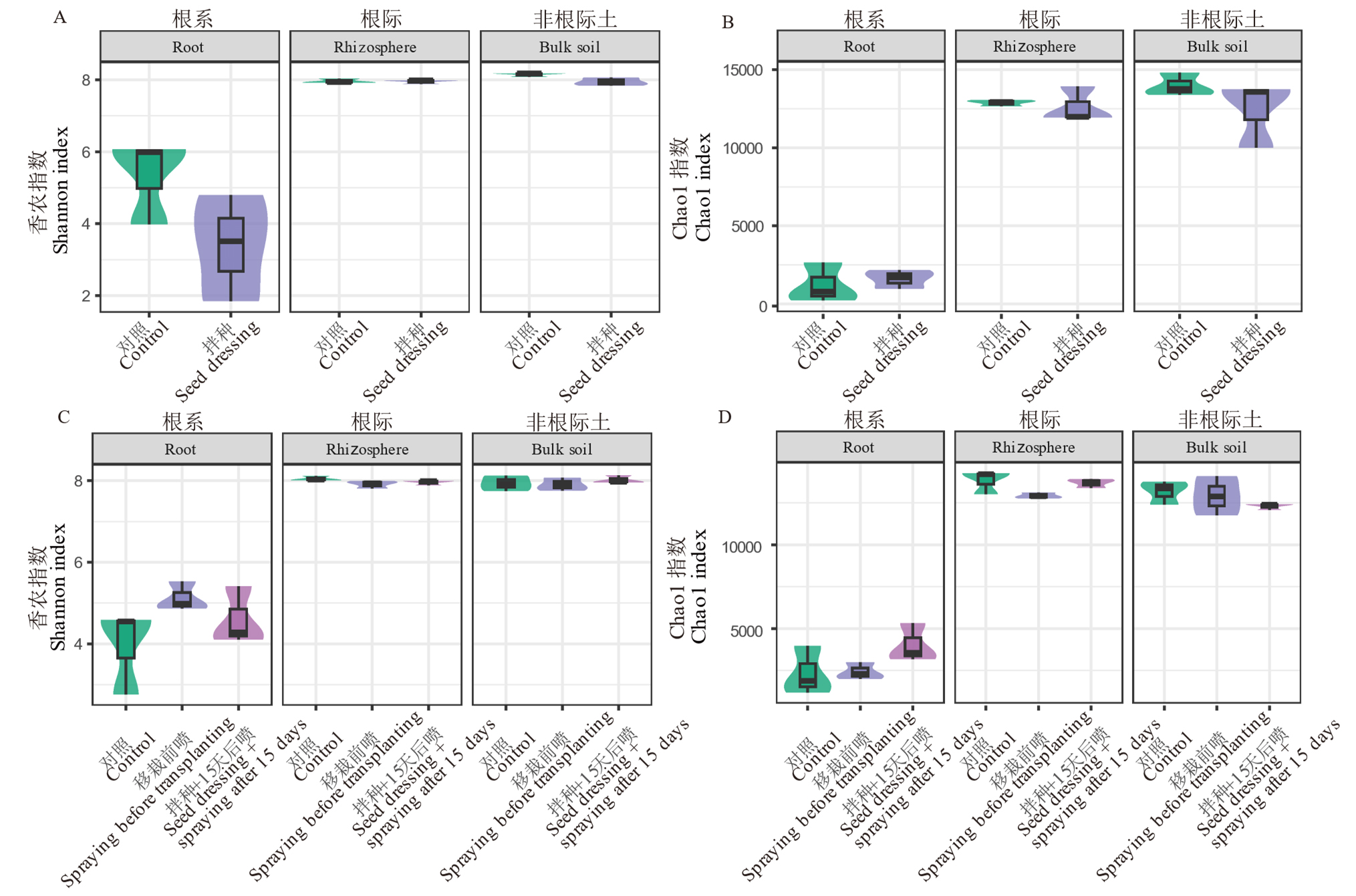
图1 微生物菌剂处理下水稻各部位微生物群落Alpha多样性 A, B为直播稻; C, D为移栽稻。
Fig. 1. Alpha diversity of microbial communities in rice tissues under microbial inoculant treatments A and B, Direct-seeded rice; C and D, Transplanted rice.
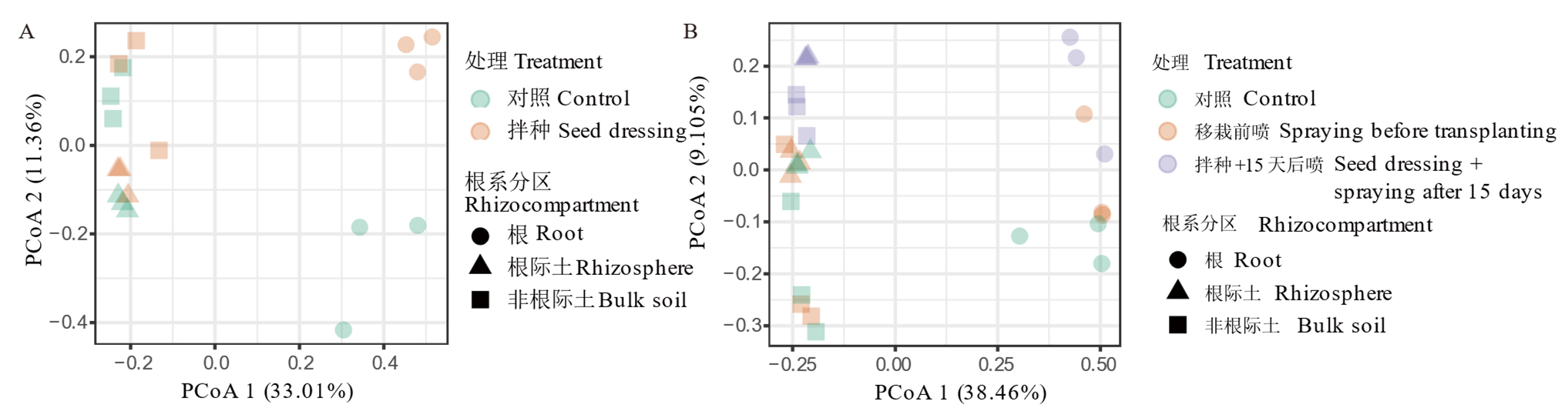
图2 微生物菌剂处理下水稻各部位微生物群落Beta多样性
Fig. 2. Beta diversity of microbial communities in rice tissues under microbial inoculant treatments
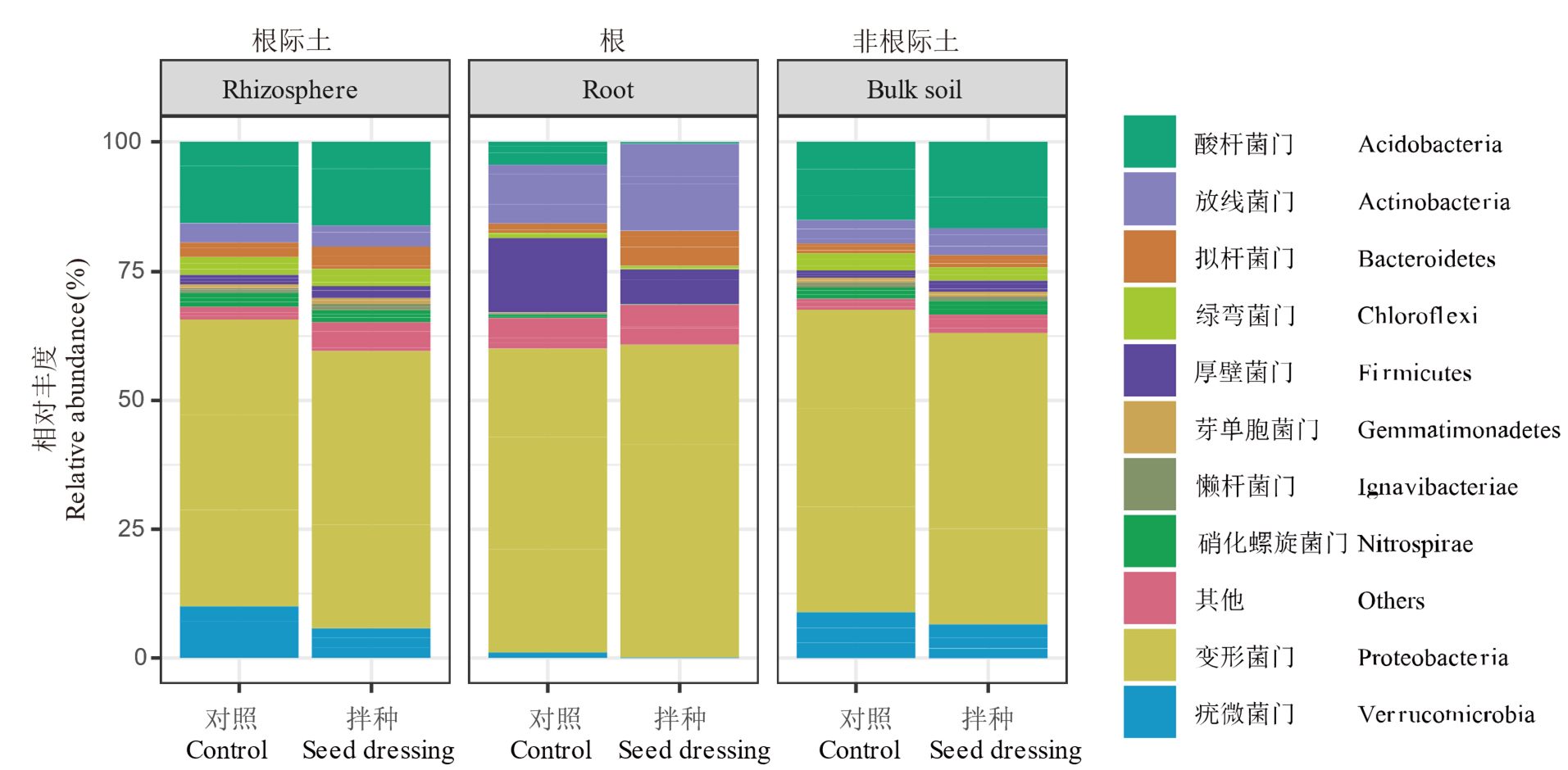
图3 微生物菌剂处理下直播水稻各部位微生物群落组成
Fig. 3. Composition of microbial communities in tissues of direct-seeded rice under microbial inoculant treatments
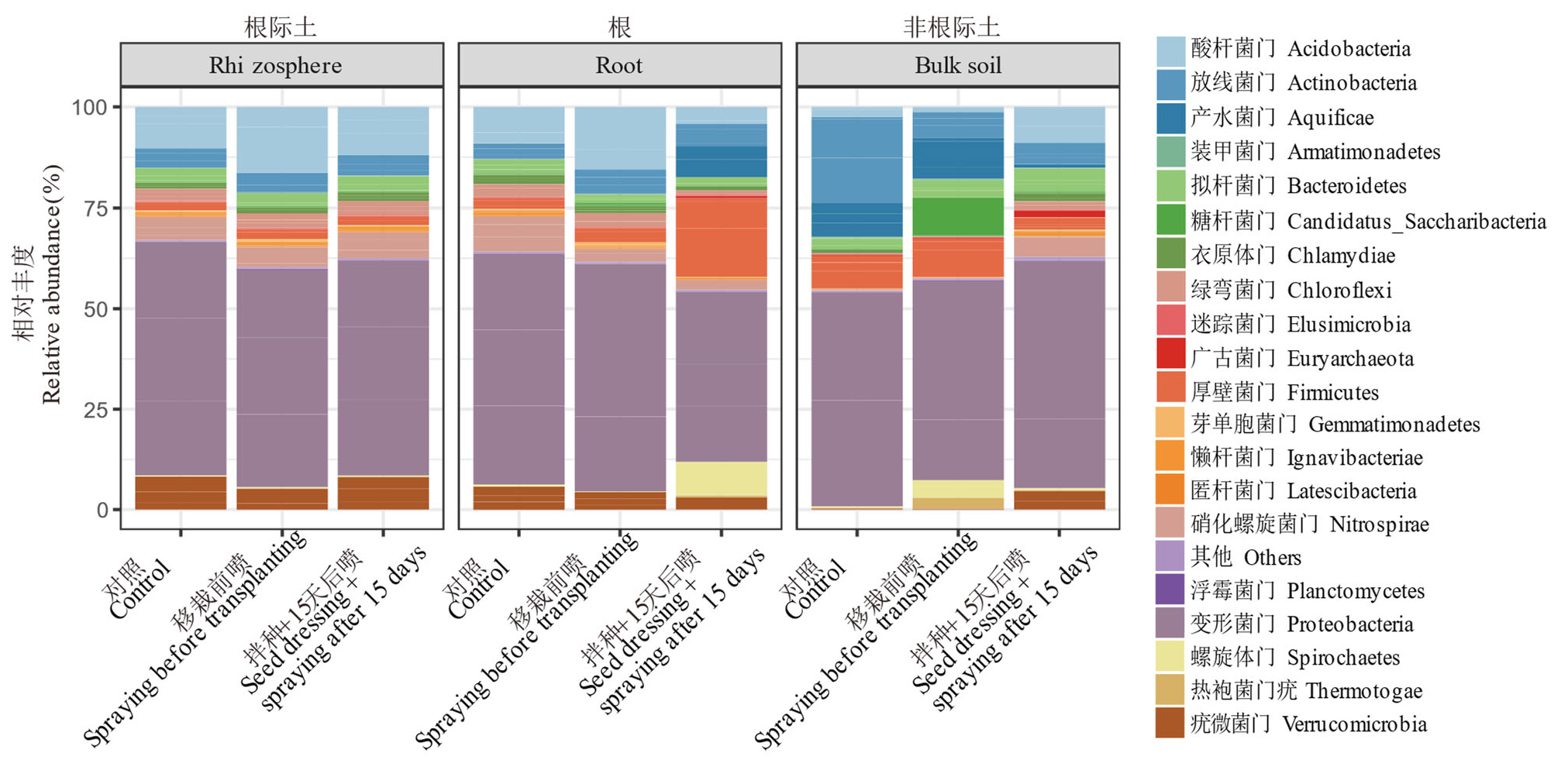
图4 微生物菌剂处理下移栽水稻各部位微生物群落组成
Fig. 4. Composition of microbial communities in tissues of transplanted rice under microbial inoculant treatments
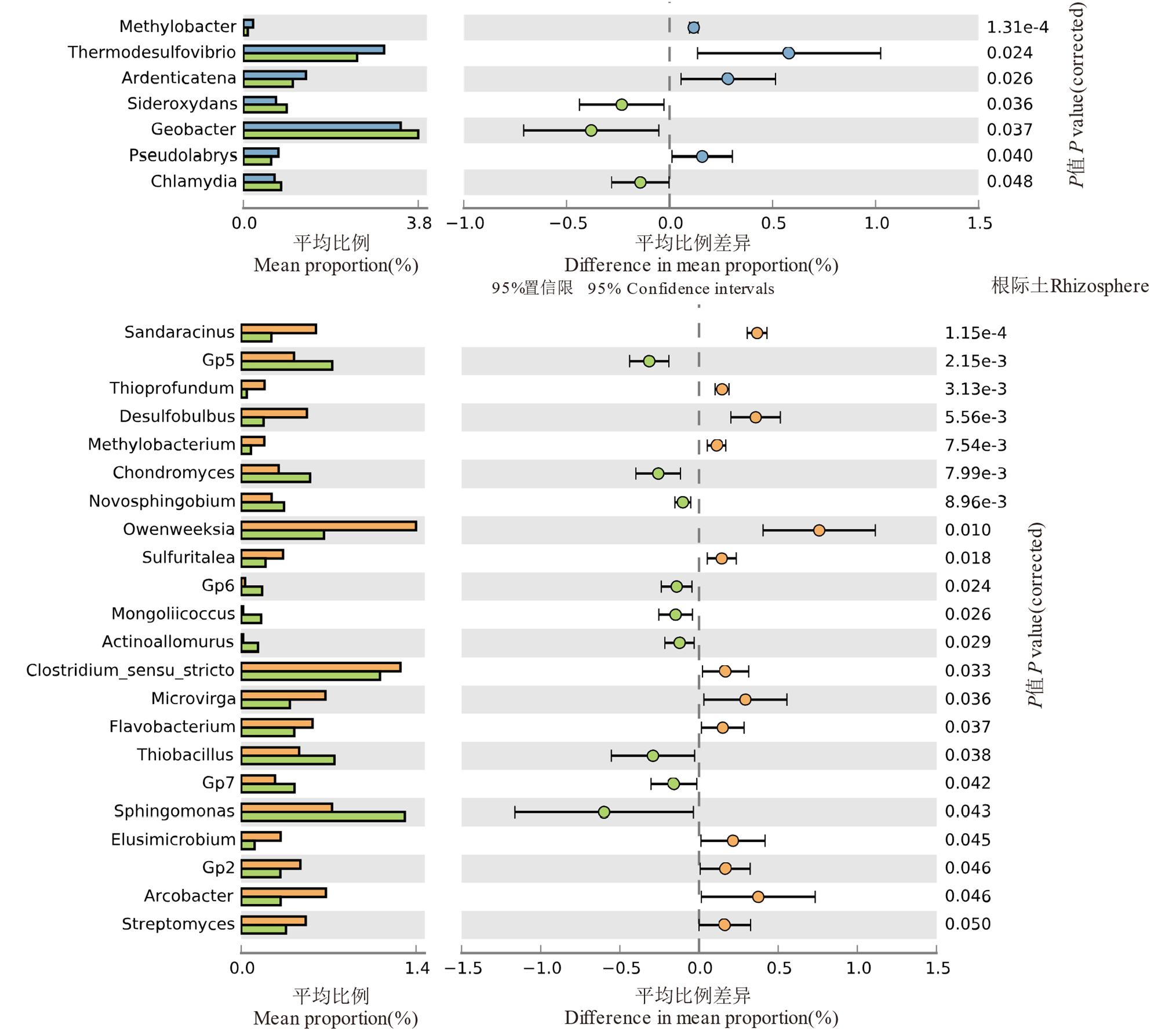
图5 STAMP分析移栽水稻微生物菌剂处理下的根际差异微生物类群
Fig. 5. STAMP analysis of differential microbial taxa in the rhizosphere of transplanted rice under microbial inoculant treatments
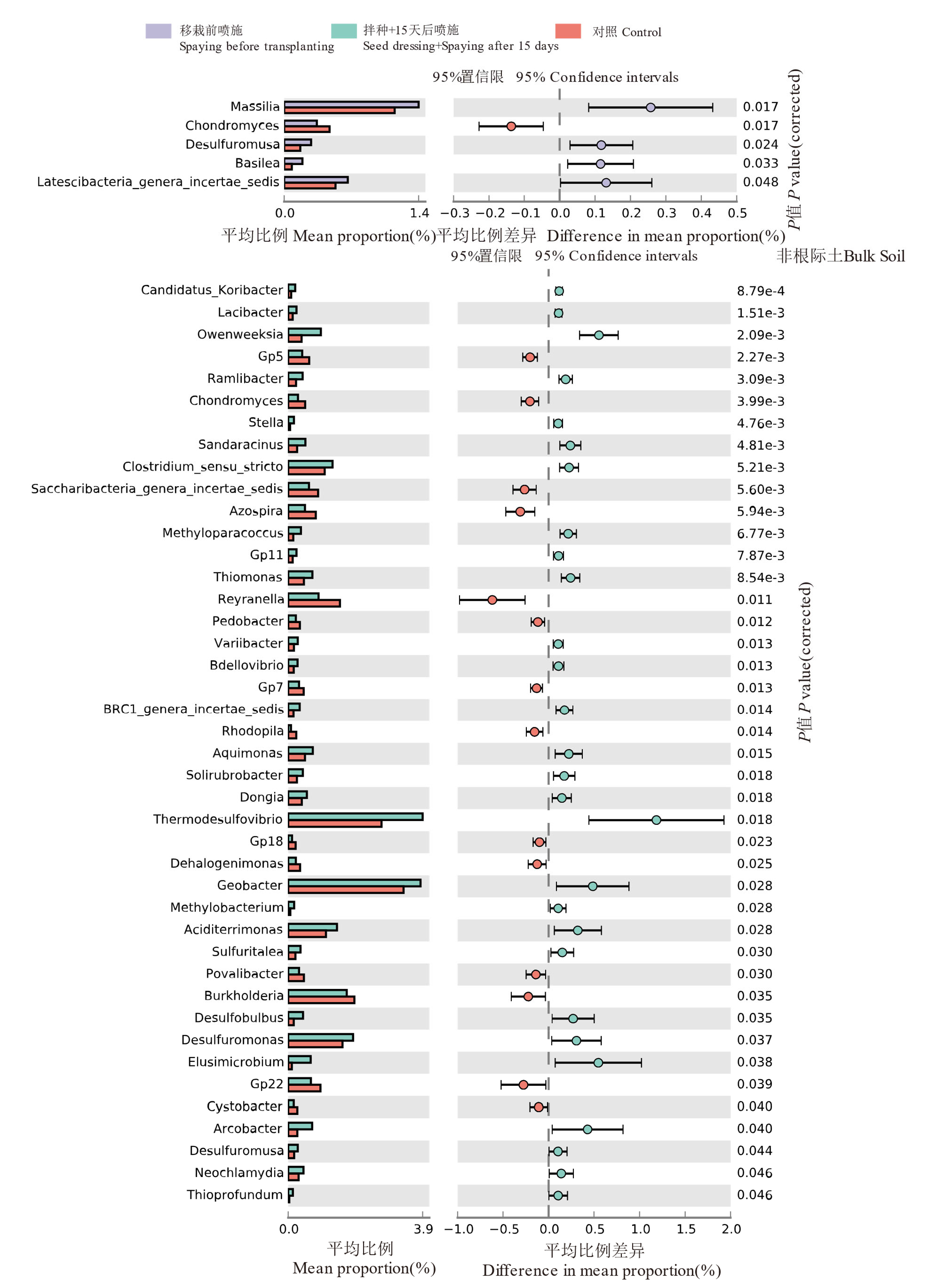
图6 STAMP分析移栽水稻微生物菌剂处理下的非根际差异微生物类群
Fig. 6. STAMP analysis of differential microbial taxa in bulk soil of transplanted rice under microbial inoculant treatments
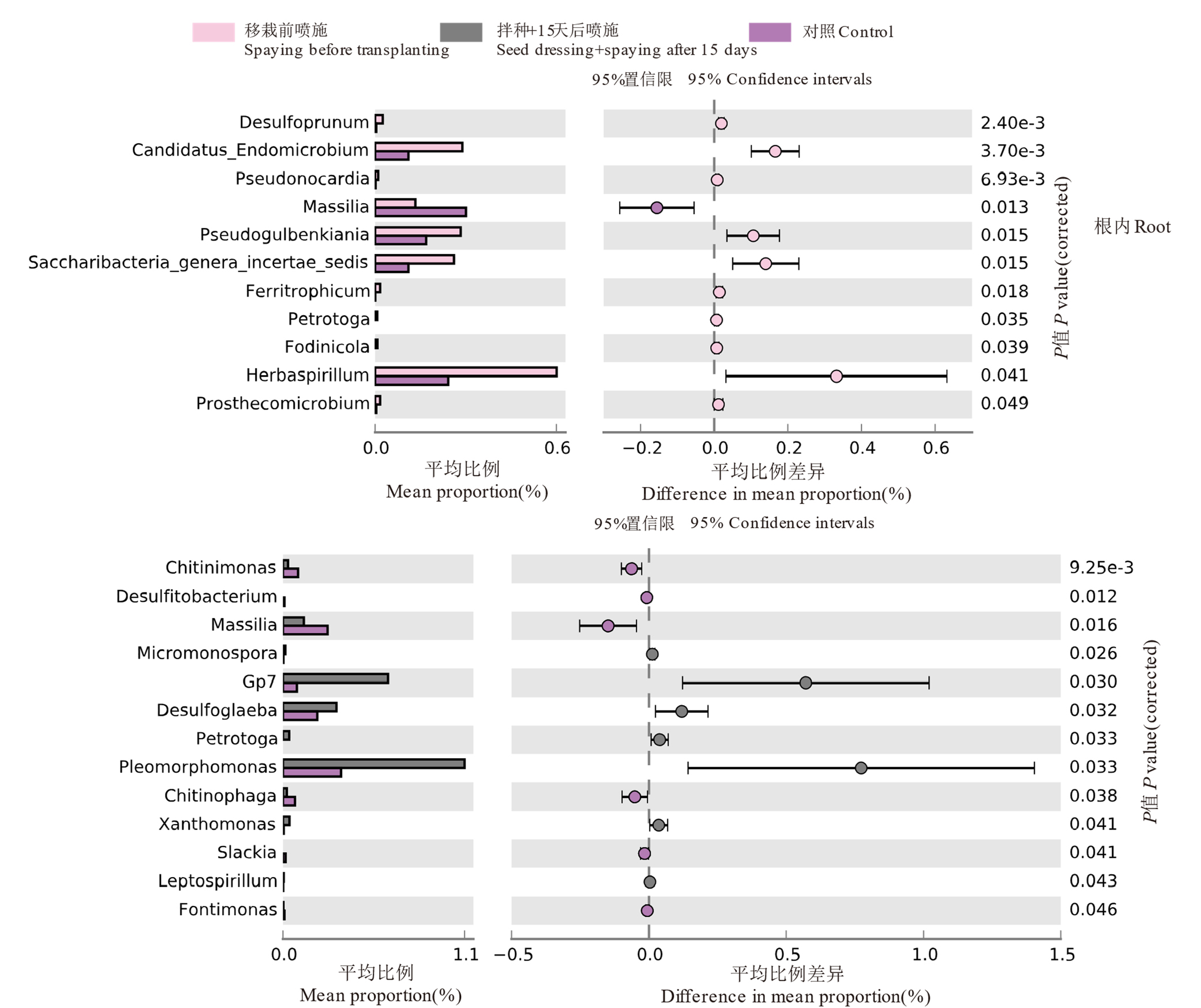
图7 STAMP分析移栽水稻微生物菌剂处理下的根内差异微生物类群
Fig. 7. STAMP analysis of differential microbial taxa in the root endosphere of transplanted rice under microbial inoculant treatments
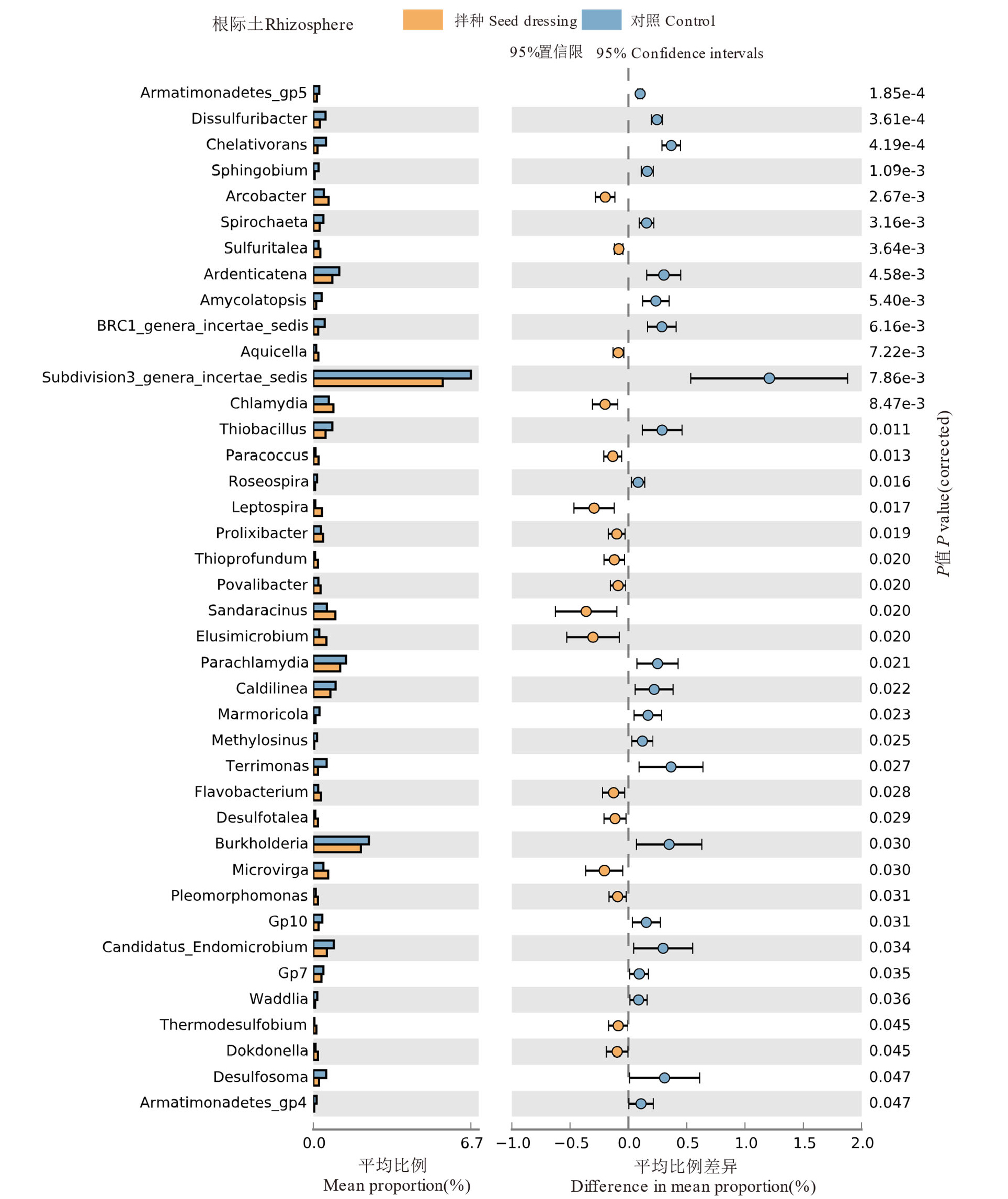
图8 STAMP分析直播水稻微生物菌剂处理下的根际差异微生物类群
Fig. 8. STAMP analysis of differential microbial taxa in the rhizosphere of direct-seeded rice under microbial inoculant treatments
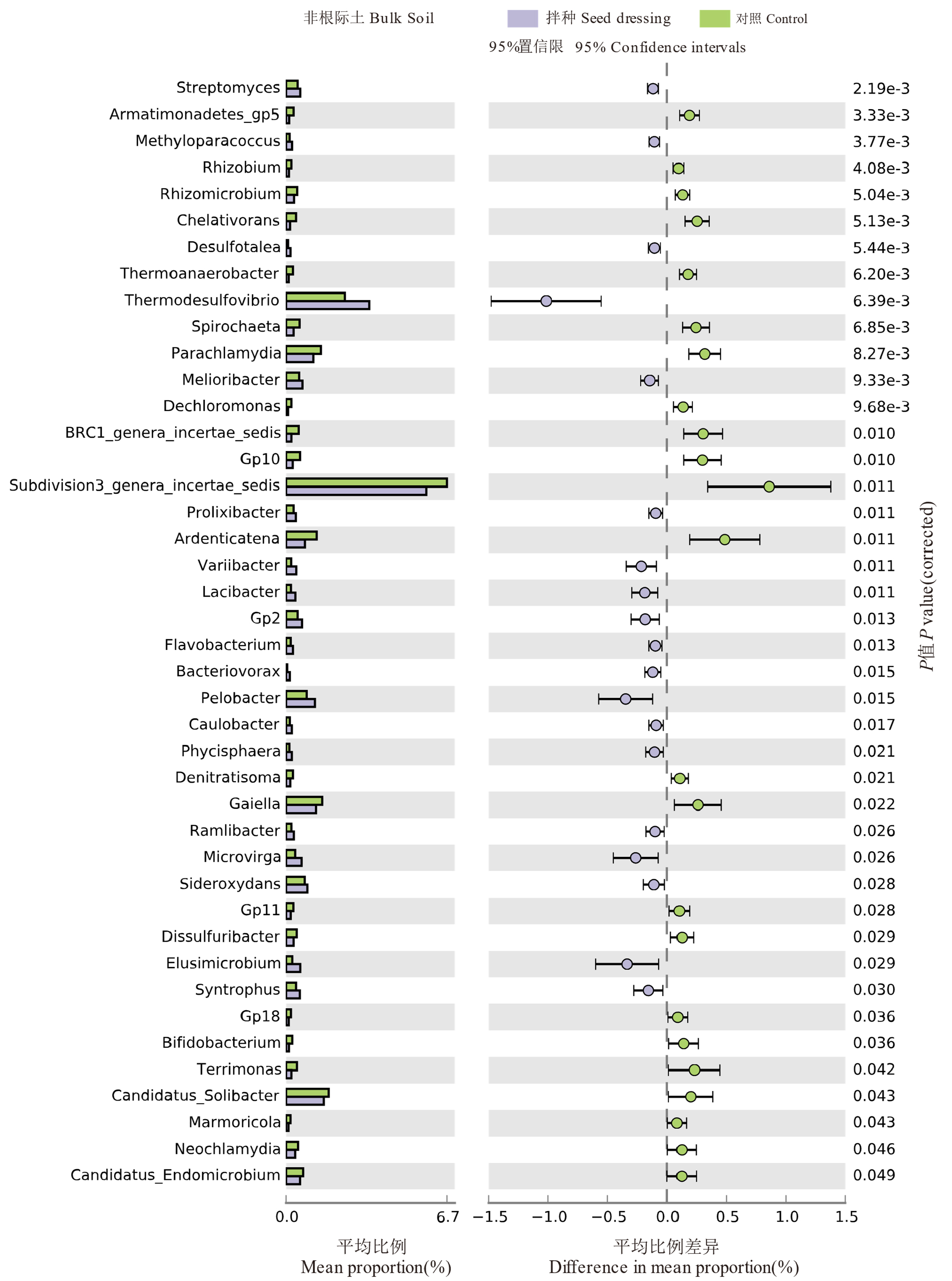
图9 STAMP分析直播水稻微生物菌剂处理下的非根际差异微生物类群
Fig. 9. STAMP analysis of differential microbial taxa in bulk soil of direct-seeded rice under microbial inoculant treatments
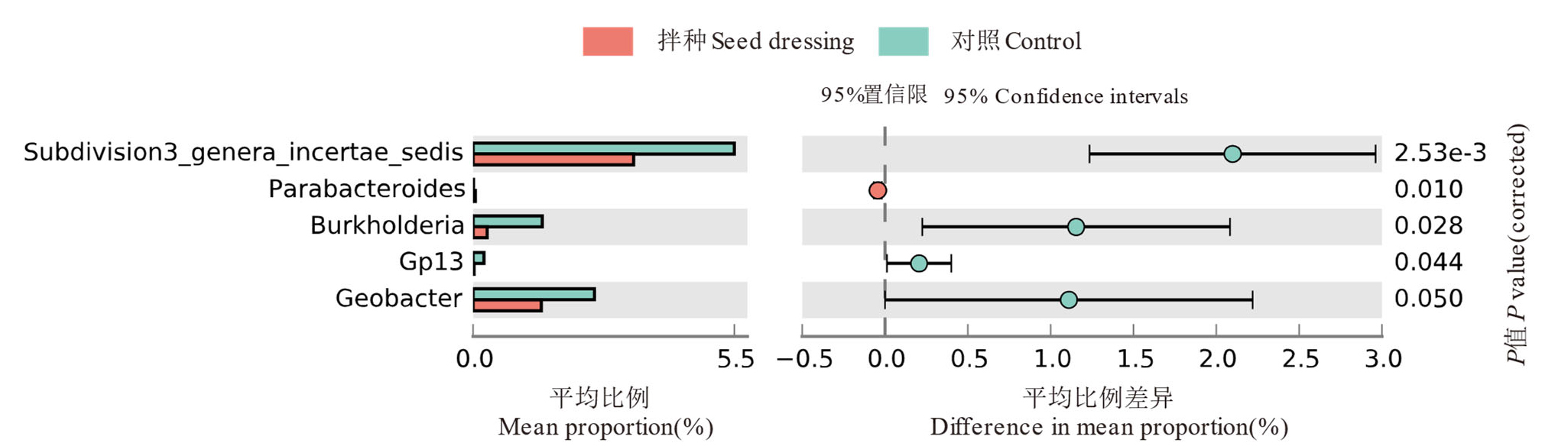
图10 STAMP分析直播水稻微生物菌剂处理下的根内差异微生物类群
Fig. 10. STAMP analysis of differential microbial taxa in the root endosphere of direct-seeded rice under microbial inoculant treatments
| [1] | Wang W, Cang L, Zhou D M, Yu Y C. Exogenous amino acids increase antioxidant enzyme activities and tolerance of rice seedlings to cadmium stress[J]. Environmental Progress & Sustainable Energy, 2017, 36(1): 155-161. |
| [2] | 凌启鸿, 张洪程, 戴其根, 丁艳锋, 凌励, 苏祖芳, 徐茂, 阙金华, 王绍华. 水稻精确定量施氮研究[J]. 中国农业科学, 2005, 38(12): 2457-2467. |
| Ling Q H, Zhang H C, Dai Q G, Ding Y F, Ling L, Su Z F, Xu M, Que J H, Wang S H. Study on precise and quantitative N application in rice[J]. Scientia Agricultura Sinica, 2005, 38(12): 2457-2467. (in Chinese with English abstract) | |
| [3] | 何俊瑜, 任艳芳, 严玉萍, 朱诚, 蒋德安. 镉胁迫对水稻幼苗生长和根尖细胞分裂的影响[J]. 土壤学报, 2010, 47(1): 138-144. |
| He J Y, Ren Y F, Yan Y P, Zhu C, Jiang D A. Impacts of cadmium stress on the growth of rice seedlings and division of their root tip cells[J]. Acta Pedologica Sinica, 2010, 47(1): 138-144. (in Chinese with English abstract) | |
| [4] | 孙亚莉, 刘红梅, 徐庆国. 镉胁迫对不同水稻品种苗期光合特性与生理生化特性的影响[J]. 华北农学报, 2017, 32(4): 176-181. |
| Sun Y L, Liu H M, Xu Q G. Effect of cadmium stress on photosynthetic characteristics and physiological and biochemical traits during seedling stage of different rice cultivars[J]. Acta Agriculturae Boreali-Sinica, 2017, 32(4): 176-181. (in Chinese with English abstract) | |
| [5] | Luo Y, Wei Y, Sun S, Wang J, Wang W, Han D, Shao H, Jia H, Fu Y. Selenium modulates the level of auxin to alleviate the toxicity of cadmium in tobacco[J]. International Journal of Molecular Sciences, 2019, 20(15): 3772. |
| [6] | 鄂志国, 张玉屏, 王磊. 水稻镉胁迫应答分子机制研究进展[J]. 中国水稻科学, 2013, 27(5): 539-544. |
| Zhang Y P, Wang L. Molecular mechanism of rice responses to cadmium stress[J]. Chinese Journal of Rice Science, 2013, 27(5): 539-544. (in Chinese with English abstract) | |
| [7] | Wu S, Zhou Z, Zhu L, Zhong L, Dong Y, Wang G, Shi K. Cd immobilization mechanisms in a Pseudomonas strain and its application in soil Cd remediation[J]. Journal of Hazardous Materials, 2022, 425: 127919. |
| [8] | Han H, Sheng X, Hu J, He L, Wang Q. Metal-immobilizing Serratia liquefaciens CL-1 and Bacillus thuringiensis X30 increase biomass and reduce heavy metal accumulation of radish under field conditions[J]. Ecotoxicology and Environmental Safety, 2018, 161: 526-533. |
| [9] | 李娜, 王剑峰, 龚记熠, 陈兰兰, 陈显磊, 王丽, 张晶, 刘杰, 乙引. 植物响应镉胁迫的生理、分子和根际微生态机制研究进展[J]. 江苏农业科学, 2024, 52(24): 1-11. |
| Li N, Wang J F, Gong J Y, Chen L L, Chen X L, Wang L, Zhang J, Liu J, Yi Y. Research progress on physiological, molecular and rhizosphere microecological mechanisms of plant response to cadmium stress[J]. Jiangsu Agricultural Sciences, 2024, 52(24): 1-11. (in Chinese with English abstract) | |
| [10] | Wang X, Fang L, Beiyuan J, Cui Y, Peng Q, Zhu S, Wang M, Zhang X. Improvement of alfalfa resistance against Cd stress through rhizobia and arbuscular mycorrhiza fungi co-inoculation in Cd-contaminated soil[J]. Environmental Pollution, 2021, 277: 116758. |
| [11] | 鲁如坤. 土壤农业化学分析方法[M]. 北京: 中国农业科学技术出版社, 2000. |
| Lu R K. Methods of Soil Agrochemical Analysis[M]. Beijing: China Agricultural Science and Technology Press, 2000. (in Chinese) | |
| [12] | Liu Y, Ma B, Chen W, Schlaeppi K, Erb M, Stirling E, Hu L, Wang E, Zhang Y, Zhao K, Lu Z, Ye S, Xu J. Rhizobium symbiotic capacity shapes root-associated microbiomes in soybean[J]. Frontiers in Microbiology, 2021, 12: 709012. |
| [13] | Edgar R C. UPARSE: Highly accurate OTU sequences from microbial amplicon reads[J]. Nature Methods, 2013, 10(10): 996-998. |
| [14] | Rognes T, Flouri T, Nichols B, Quince C, Mahé F. VSEARCH: A versatile open source tool for metagenomics[J]. PeerJ, 2016, 4: e2584. |
| [15] | McMurdie P J, Holmes S. Waste not, want not: Why rarefying microbiome data is inadmissible[J]. PLoS Computational Biology, 2014, 10(4): e1003531. |
| [16] | Lozupone C, Knight R. UniFrac: A new phylogenetic method for comparing microbial communities[J]. Applied and Environmental Microbiology, 2005, 71(12): 8228-8235. |
| [17] | Parks D H, Tyson G W, Hugenholtz P, Beiko R G. STAMP: Statistical analysis of taxonomic and functional profiles[J]. Bioinformatics, 2014, 30(21): 3123-3124. |
| [18] | Wickham H. ggplot2: Elegant Graphics for Data Analysis[M]. 2nd ed. NewYork, NY: Springer New York, 2009. |
| [19] | Liu R, Wang Y, Hong Y, Wang F, Mao X, Yi J. Controlled-release urea application and optimized nitrogen applied strategy reduced nitrogen leaching and maintained grain yield of paddy fields in Northwest China[J]. Frontiers in Plant Science, 2023, 14: 1033506. |
| [20] | Li R, Yu Y. Impacts of green production behaviors on the income effect of rice farmers from the perspective of outsourcing services: Evidence from the rice region in northwest China[J]. Agriculture, 2022, 12(10): 1682. |
| [21] | Song W E, Chen S B, Liu J F, Chen L, Song N N, Li N, Liu B. Variation of Cd concentration in various rice cultivars and derivation of cadmium toxicity thresholds for paddy soil by species-sensitivity distribution[J]. Journal of Integrative Agriculture, 2015, 14(9): 1845-1854. |
| [22] | Chen B, Stein A F, Castell N, Gonzalez-Castanedo Y, Sanchez de la Campa A M, de la Rosa J D. Modeling and evaluation of urban pollution events of atmospheric heavy metals from a large Cu-smelter[J]. Science of the Total Environment, 2016, 539: 17-25. |
| [23] | Wang L, Liao J, Tang Y. Effect of intercropping of Solanum nigrum L., tomato and eggplant on phosphorus uptake under cadmium stress[J]. IOP Conference Series: Earth and Environmental Science, 2019, 233: 042023. |
| [24] | Wang T, Xu J, Chen J, Liu P, Hou X, Yang L, Zhang L. Progress in microbial fertilizer regulation of crop growth and soil remediation research[J]. Plants, 2024, 13(3): 346. |
| [25] | Mohammadzadeh A, Tavakoli M, Motesharezadeh B, Chaichi M R. Effects of plant growth-promoting bacteria on the phytoremediation of cadmium-contaminated soil by sunflower[J]. Archives of Agronomy and Soil Science, 2017, 63(6): 807-816. |
| [26] | Xu T, Xi J, Ke J, Wang Y, Chen X, Zhang Z, Lin Y. Deciphering soil amendments and actinomycetes for remediation of cadmium (Cd) contaminated farmland[J]. Ecotoxicology and Environmental Safety, 2023, 249: 114388. |
| [27] | Wei X, Cao P, Wang G, Han J. Microbial inoculant and garbage enzyme reduced cadmium (Cd) uptake in Salvia miltiorrhiza (Bge.) under Cd stress. Ecotoxicology and Environmental Safety, 2020, 192: 110311. |
| [28] | 张华香, 徐晓婷, 郑云婷, 肖春桥. 溶磷微生物在钝化和植物修复重金属污染土壤中的作用[J]. 生物技术通报, 2023, 39(3): 52-58. |
| Zhang H X, Xu X T, Zheng Y T, Xiao C Q. Roles of phosphate-solubilizing microorganisms in the passivation and phytoremediation of heavy metal contaminated soil[J]. Biotechnology Bulletin, 2023, 39(3): 52-58. (in Chinese with English abstract) | |
| [29] | Guo J, Chi J. Effect of Cd-tolerant plant growth-promoting Rhizobium on plant growth and Cd uptake by Lolium multiflorum Lam. and Glycine max (L.) Merr. in Cd-contaminated soil[J]. Plant and Soil, 2014, 375(1): 205-214. |
| [30] | 卓晨, 陈琪, 苏增强, 黎华寿, 陈桂葵, 贺鸿志. 微生物缓解镉对水稻的毒害研究进展[J]. 应用与环境生物学报, 2020, 26(5): 1154-1160. |
| Zhuo C, Chen Q, Su Z Q, Li H S, Chen G K, He H Z. Advances in microbial mitigation of cadmium toxicity in rice[J]. Chinese Journal of Applied and Environmental Biology, 2020, 26(5): 1154-1160. (in Chinese with English abstract) | |
| [31] | 王杏, 王革娇, 史凯祥. 微生物镉解毒机制及微生物-植物互作修复研究进展[J]. 微生物学通报, 2023, 50(4): 1666-1680. |
| Wang X, Wang G J, Shi K X. Research progress in microbial detoxification of cadmium and bioremediation based on microorganism-plant interaction[J]. Microbiology China, 2023, 50(4): 1666-1680. (in Chinese with English abstract) | |
| [32] | Gallardo-Benavente C, Carrión O, Todd J D, Pieretti J C, Seabra A B, Durán N, Rubilar O, Pérez-Donoso J M, Quiroz A. Biosynthesis of CdS quantum dots mediated by volatile sulfur compounds released by Antarctic Pseudomonas fragi[J]. Frontiers in Microbiology, 2019, 10: 1866. |
| [33] | Wang X, Hu K, Xu Q, Lu L F, Liao S J, Wang G J. Immobilization of Cd using mixed Enterobacter and Comamonas bacterial reagents in pot experiments with Brassica rapa L[J]. Environmental Science & Technology, 2020, 54(24): 15731-15741. |
| [34] | Zhao X, Wang M, Wang H, Tang D, Huang J, Sun Y. Study on the remediation of Cd pollution by the biomineralization of urease-producing bacteria[J]. International Journal of Environmental Research and Public Health, 2019, 16(2): 268. |
| [1] | 郝栖贤, 周坤能, 云鹏, 张彩娟, 夏加发, 李泽福. 水稻E3泛素连接酶的功能研究进展[J]. 中国水稻科学, 2026, 40(6): 705-725. |
| [2] | 李洪洲, 陈家乐, Muhammad ZUBAIR, 张健, 杨隆维, 应杰政. 水稻穗粒数的遗传基础和育种利用[J]. 中国水稻科学, 2026, 40(6): 726-741. |
| [3] | 侯鹰翔, 费思恬, 陈海波, 孙清, 王伟平, 张超. 水稻耐淹的适应机制及分子调控研究进展[J]. 中国水稻科学, 2026, 40(6): 742-755. |
| [4] | 赵冬生, 李羽帆, 赵贝贝, 张涛, 李钱峰, 刘巧泉. 水稻短圆粒突变体srg10的基因克隆及其功能分析[J]. 中国水稻科学, 2026, 40(6): 756-766. |
| [5] | 魏松红, 王奕鸣, 罗杭, 张良坤, 王梦雨, 王妍. 水稻OsPAL6与OsPetc蛋白互作响应纹枯菌侵染的机制研究[J]. 中国水稻科学, 2026, 40(6): 767-773. |
| [6] | 高凌霄, 叶凡, 李帅, 陈云, 刘立军. 干湿交替灌溉对黑龙江稻区水稻产量和品质的影响[J]. 中国水稻科学, 2026, 40(6): 786-795. |
| [7] | 童毅, 钱前, 高振宇. 水稻分子设计育种研究进展[J]. 中国水稻科学, 2026, 40(5): 569-583. |
| [8] | 柴炳泽, 王俊格, 吴凯雄, 刘嘉龙, 吴越, 王荟森, 谭霖, 任德勇, 高振宇, 朱丽, 张强, 张光恒, 钱前, 胡江. 水稻粒形和穗粒数基因GSN4的克隆与单倍型分析[J]. 中国水稻科学, 2026, 40(5): 584-597. |
| [9] | 冯莆淋, 杨绮文, 吴佳益, 范鸣谦, 程艳双, 邱忠华, 郭然, 陈温福, 王嘉宇. 水稻颖壳发育基因AGL1的图位克隆与功能分析[J]. 中国水稻科学, 2026, 40(5): 607-617. |
| [10] | 于冰洁, 王浩宇, 葛语桐, 崔格格, 张海鹏, 魏海燕, 张洪程, 许方甫. 油菜秸秆还田下增苗减氮对中熟晚粳稻产量和品质的影响[J]. 中国水稻科学, 2026, 40(5): 618-631. |
| [11] | 杨昌南, 何子欣, 谈亚文, 张学智, 张业诚, 田浩然, 危常州, 张新疆. 滴灌配施不同形态氮肥管理对水稻根际氮转化过程及产量形成的影响[J]. 中国水稻科学, 2026, 40(5): 632-647. |
| [12] | 王新雅, 何卓婷, 李潇, 尤赛雅, 朱练峰, 孔亚丽, 朱春权, 田文昊, 张均华, 金千瑜, 曹小闯. 秸秆分层还田耦合腐解菌剂通过调控土壤有机碳转化和微生物群落结构提高水稻产量[J]. 中国水稻科学, 2026, 40(5): 648-662. |
| [13] | 许永炜, 刘淑华, 冯泽霖, 罗举, 倪兆新, 杨保军, 姚青, 李阿根. 基于多模态融合的水稻生育期智能识别方法[J]. 中国水稻科学, 2026, 40(5): 663-678. |
| [14] | 冯爱卿, 张亚博, 周继勇, 苏菁, 封金奇, 陈凯玲, 陈炳, 梁美玲, 朱小源, 汪聪颖, 陈深. 10个抗白叶枯病基因在华南水稻品种中的分布研究[J]. 中国水稻科学, 2026, 40(5): 679-695. |
| [15] | 陈春晓, 付琳丽, 张微, 卜庆云, 田晓杰. 水稻MAPK家族基因功能研究进展[J]. 中国水稻科学, 2026, 40(4): 425-435. |
| 阅读次数 | ||||||
|
全文 |
|
|||||
|
摘要 |
|
|||||
