
中国水稻科学 ›› 2026, Vol. 40 ›› Issue (6): 742-755.DOI: 10.16819/j.1001-7216.2026.250905
侯鹰翔1, 费思恬1, 陈海波2, 孙清1, 王伟平3,4,*( ), 张超1,*()
收稿日期:2025-09-17
修回日期:2025-11-22
出版日期:2026-11-10
发布日期:2026-11-09
通讯作者:
*email:wangweiping@hhrrc.ac.cn;基金资助:
HOU Yingxiang1, FEI Sitian1, CHEN Haibo2, SUN Qing1, WANG Weiping3,4,*(), ZHANG Chao1,*()
Received:2025-09-17
Revised:2025-11-22
Online:2026-11-10
Published:2026-11-09
摘要:
全球气候变化加剧,极端降雨事件频发,给水稻生产带来严峻挑战。作为半水生作物,水稻进化出复杂耐淹机制应对洪水胁迫。本文从形态结构、激素信号及代谢调控三个层面总结水稻耐淹适应机制。形态上,通过茎节伸长、不定根形成、径向氧气损失屏障等优化氧气获取与运输;激素信号中,“乙烯-赤霉素”正反馈驱动节间快速伸长(逃逸策略),耐涝基因Sub1A-1抑制该通路维持生长静止(静止策略),脱落酸、生长素等参与调控;代谢层面,淹水时依赖CBL-CIPK15-SnRK1A-MYBS1通路激活淀粉降解从而促进厌氧萌发,脱浸后通过Sub1A-1调控TCA循环重启、ROS清除等恢复稳态。最后,本文指出当前研究不足并提出未来展望,为水稻耐淹性改良提供参考。
侯鹰翔, 费思恬, 陈海波, 孙清, 王伟平, 张超. 水稻耐淹的适应机制及分子调控研究进展[J]. 中国水稻科学, 2026, 40(6): 742-755.
HOU Yingxiang, FEI Sitian, CHEN Haibo, SUN Qing, WANG Weiping, ZHANG Chao. Progress in Adaptive Mechanisms and Molecular Regulation of Submergence Tolerance in Rice[J]. Chinese Journal OF Rice Science, 2026, 40(6): 742-755.
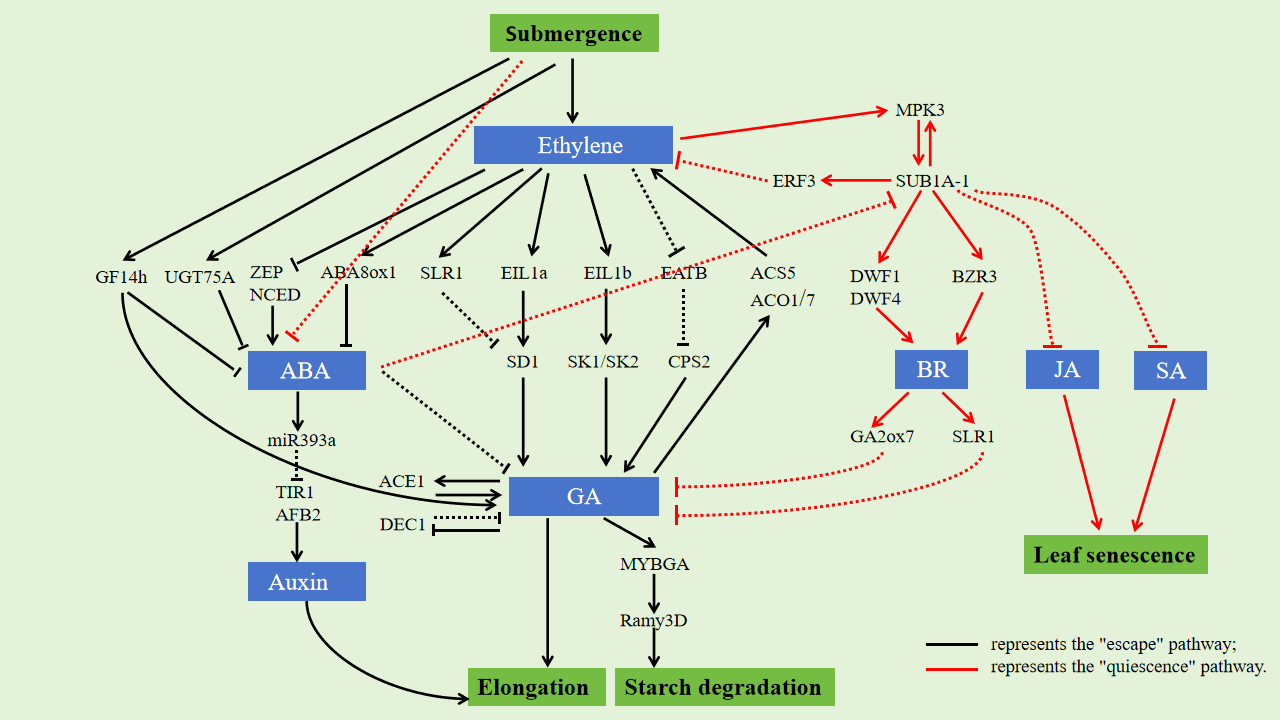
图1 水稻耐淹的激素响应机制示意图
Fig. 1. Schematic diagram of hormone response mechanisms for submergence tolerance in rice
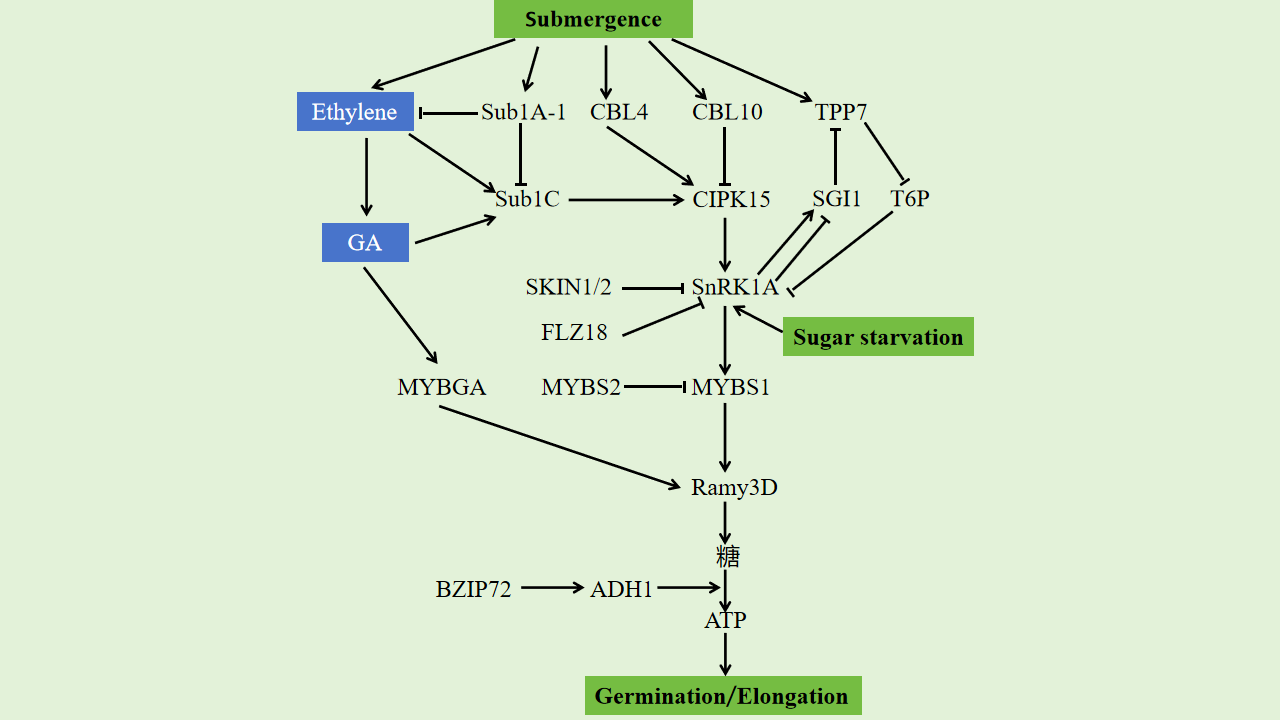
图2 水稻种子厌氧萌发的代谢路径与分子调控网络
Fig. 2. Metabolic pathways and molecular regulatory networks of anaerobic germination of rice seeds
| 基因名称 Gene name | 功能 Functions | 表型 Phenotype | 参考文献 References |
|---|---|---|---|
| Sub1A | 乙烯应答因子 | 存活率 | [ |
| OsMPK3 | 丝裂原活化蛋白激酶 | 存活率 | [ |
| OsERF3 | 乙烯应答因子 | 存活率 | [ |
| OsLdh7 | 乳酸脱氢酶基因 | 存活率 | [ |
| SNORKEL1 | 乙烯应答因子 | 节间伸长 | [ |
| SNORKEL2 | 乙烯应答因子 | 节间伸长 | [ |
| SD1 | GA合成基因 | 节间伸长 | [ |
| DEC1 | 节间伸长抑制因子 | 节间伸长 | [ |
| ACE1 | 节间伸长促进因子 | 节间伸长 | [ |
| OsEIL1a | 乙烯信号调控因子 | 节间伸长 | [ |
| OsEIL1b | 乙烯信号调控因子 | 节间伸长 | [ |
| OsSLR1 | DELLA蛋白 | 节间伸长 | [ |
| OsEATB | 乙烯应答因子 | 节间伸长 | [ |
| OsACS5 | 1-氨基环丙烷-1-羧酸合酶 | 节间伸长 | [ |
| CIPK15 | 类钙调磷酸酶B亚基互作蛋白激酶 | 厌氧萌发与胚芽鞘伸长 | [ |
| OsCBL10 | 类钙调磷酸酶B蛋白 | 厌氧萌发与胚芽鞘伸长 | [ |
| OsCBL4 | 类钙调磷酸酶B蛋白 | 厌氧萌发与胚芽鞘伸长 | [ |
| OsbZIP72 | bZIP转录因子 | 厌氧萌发与胚芽鞘伸长 | [ |
| OsGF14h | 14-3-3蛋白 | 厌氧萌发与胚芽鞘伸长 | [ |
| qSHS5 | 核酸切除修复蛋白 | 厌氧萌发与幼苗株高 | [ |
| OsTPP7 | 海藻糖-6-磷酸磷酸酶 | 胚芽鞘伸长 | [ |
| OsFLZ18 | 锌指蛋白 | 胚芽鞘伸长 | [ |
| OsUGT75A | 吲哚乙酸糖基转移酶 | 胚芽鞘伸长 | [ |
| ADH1 | 乙醇脱氢酶基因 | 胚芽鞘伸长 | [ |
| OsSGI1 | bHLH转录因子 | 胚芽鞘伸长 | [ |
| OsVP1 | B3转录因子 | 厌氧萌发 | [ |
| OsPIN2 | 生长素输出载体 | 根系性状 | [ |
| OsRGA1 | 编码异源三聚G蛋白α亚基 | 通气组织与根系性状 | [ |
| AOX1a | 交替氧化酶基因 | 通气组织与根系性状 | [ |
| LGF1 | 羟基类固醇脱氢酶 | 叶片气膜 | [ |
表1 调控水稻耐淹性相关基因
Table 1. Genes related to regulation of submergence tolerance in rice.
| 基因名称 Gene name | 功能 Functions | 表型 Phenotype | 参考文献 References |
|---|---|---|---|
| Sub1A | 乙烯应答因子 | 存活率 | [ |
| OsMPK3 | 丝裂原活化蛋白激酶 | 存活率 | [ |
| OsERF3 | 乙烯应答因子 | 存活率 | [ |
| OsLdh7 | 乳酸脱氢酶基因 | 存活率 | [ |
| SNORKEL1 | 乙烯应答因子 | 节间伸长 | [ |
| SNORKEL2 | 乙烯应答因子 | 节间伸长 | [ |
| SD1 | GA合成基因 | 节间伸长 | [ |
| DEC1 | 节间伸长抑制因子 | 节间伸长 | [ |
| ACE1 | 节间伸长促进因子 | 节间伸长 | [ |
| OsEIL1a | 乙烯信号调控因子 | 节间伸长 | [ |
| OsEIL1b | 乙烯信号调控因子 | 节间伸长 | [ |
| OsSLR1 | DELLA蛋白 | 节间伸长 | [ |
| OsEATB | 乙烯应答因子 | 节间伸长 | [ |
| OsACS5 | 1-氨基环丙烷-1-羧酸合酶 | 节间伸长 | [ |
| CIPK15 | 类钙调磷酸酶B亚基互作蛋白激酶 | 厌氧萌发与胚芽鞘伸长 | [ |
| OsCBL10 | 类钙调磷酸酶B蛋白 | 厌氧萌发与胚芽鞘伸长 | [ |
| OsCBL4 | 类钙调磷酸酶B蛋白 | 厌氧萌发与胚芽鞘伸长 | [ |
| OsbZIP72 | bZIP转录因子 | 厌氧萌发与胚芽鞘伸长 | [ |
| OsGF14h | 14-3-3蛋白 | 厌氧萌发与胚芽鞘伸长 | [ |
| qSHS5 | 核酸切除修复蛋白 | 厌氧萌发与幼苗株高 | [ |
| OsTPP7 | 海藻糖-6-磷酸磷酸酶 | 胚芽鞘伸长 | [ |
| OsFLZ18 | 锌指蛋白 | 胚芽鞘伸长 | [ |
| OsUGT75A | 吲哚乙酸糖基转移酶 | 胚芽鞘伸长 | [ |
| ADH1 | 乙醇脱氢酶基因 | 胚芽鞘伸长 | [ |
| OsSGI1 | bHLH转录因子 | 胚芽鞘伸长 | [ |
| OsVP1 | B3转录因子 | 厌氧萌发 | [ |
| OsPIN2 | 生长素输出载体 | 根系性状 | [ |
| OsRGA1 | 编码异源三聚G蛋白α亚基 | 通气组织与根系性状 | [ |
| AOX1a | 交替氧化酶基因 | 通气组织与根系性状 | [ |
| LGF1 | 羟基类固醇脱氢酶 | 叶片气膜 | [ |
| [1] | 尚明, 任阳阳, 宋宏利, 姚亚楠, 白磊, 李悦, 马杰. IMERG和GSMaP对中国极端降水监测能力评估[J]. 地球信息科学学报, 2023, 25(9): 1813-1826. |
| Shang M, Ren Y Y, Song H L, Yao Y N, Bai L, Li Y, Ma J. Evaluation of IMERG and GSMaP precipitation products on monitoring extreme precipitation events over China’s mainland[J]. Journal of Geo-Information Science, 2023, 25(9): 1813-1826. (in Chinese with English abstract) | |
| [2] | Singh P, Sinha A K. A positive feedback loop governed by SUB1A1 interaction with MITOGEN-ACTIVATED PROTEIN KINASE3 imparts submergence tolerance in rice[J]. The Plant Cell, 2016, 28(5): 1127-1143. |
| [3] | Phukan U J, Jindal S, Laldinsangi C, Singh P K, Longchar B. A microscopic scenario on recovery mechanisms under waterlogging and submergence stress in rice[J]. Planta, 2023, 259(1): 9. |
| [4] | Nishiuchi S, Yamauchi T, Takahashi H, Kotula L, Nakazono M. Mechanisms for coping with submergence and waterlogging in rice[J]. Rice, 2012, 5(1): 2. |
| [5] | Yu S M, Lee H T, Lo S F, Ho T D. How does rice cope with too little oxygen during its early life?[J]. New Phytologist, 2021, 229(1): 36-41. |
| [6] | Colmer T D, Voesenek L A C J. Flooding tolerance: Suites of plant traits in variable environments[J]. Functional Plant Biology, 2009, 36(8): 665-681. |
| [7] | Yuan L B, Chen M X, Wang L N, Sasidharan R, Voesenek L A C J, Xiao S. Multi-stress resilience in plants recovering from submergence[J]. Plant Biotechnology Journal, 2023, 21(3): 466-481. |
| [8] | 孙志广, 刘艳, 李景芳, 周振玲, 邢运高, 徐波, 周群, 王德荣, 卢百关, 方兆伟, 王宝祥, 徐大勇. 水稻萌发耐淹性鉴定评价方法研究及种质资源筛选[J]. 中国稻米, 2023, 29(4): 53-58. |
| Sun Z G, Liu Y, Li J F, Zhou Z L, Xing Y G, Xu B, Zhou Q, Wang D R, Lu B G, Fang Z W, Wang B X, Xu D Y. Identification and evaluation method for germinability under submerged condition in rice and germplasm screening[J]. China Rice, 2023, 29(4): 53-58. (in Chinese with English abstract) | |
| [9] | 张硕, 何永刚, 李博, 杨晓龙, 查中萍, 郭英, 焦春海, 徐延浩, 蔡海亚. 水稻种质资源淹水成苗特性评价及优异种质筛选[J]. 植物遗传资源学报, 2025, 26(2): 249-259. |
| Zhang S, He Y G, Li B, Yang X L, Zha Z P, Guo Y, Jiao C H, Xu Y H, Cai H Y. Evaluation of waterlogged seedling characteristics and screening of elite rice germplasm resources[J]. Journal of Plant Genetic Resources, 2025, 26(2): 249-259. (in Chinese with English abstract) | |
| [10] | 王晓忠, 苏锐, 邹梦思, 唐文帮, 张桂莲. 水稻耐淹性研究进展[J]. 杂交水稻, 2024, 39(3): 12-19. |
| Wang X Z, Su R, Zou M S, Tang W B, Zhang G L. Research progress on flooding tolerance in rice[J]. Hybrid Rice, 2024, 39(3): 12-19. (in Chinese with English abstract) | |
| [11] | Sun J, Zhang G, Cui Z, Kong X, Yu X, Gui R, Han Y, Li Z, Lang H, Hua Y, Zhang X, Xu Q, Tang L, Xu Z, Ma D, Chen W. Regain flood adaptation in rice through a 14-3-3 protein OsGF14h[J]. Nature Communications, 2022, 13: 5664. |
| [12] | Kretzschmar T, Pelayo M A F, Trijatmiko K R, Gabunada L F M, Alam R, Jimenez R, Mendioro M S, Slamet-Loedin I H, Sreenivasulu N, Bailey-Serres J, Ismail A M, MacKill D J, Septiningsih E M. A trehalose-6-phosphate phosphatase enhances anaerobic germination tolerance in rice[J]. Nature Plants, 2015, 1: 15124. |
| [13] | He Y, Sun S, Zhao J, Huang Z, Peng L, Huang C, Tang Z, Huang Q, Wang Z. UDP-glucosyltransferase OsUGT75A promotes submergence tolerance during rice seed germination[J]. Nature Communications, 2023, 14: 2296. |
| [14] | Xu K, Xu X, Fukao T, Canlas P, Maghirang-Rodriguez R, Heuer S, Ismail A M, Bailey-Serres J, Ronald P C, MacKill D J. Sub1A is an ethylene-response-factor-like gene that confers submergence tolerance to rice[J]. Nature, 2006, 442(7103): 705-708. |
| [15] | Fukao T, Bailey-Serres J. Submergence tolerance conferred by Sub1A is mediated by SLR1 and SLRL1 restriction of gibberellin responses in rice[J]. Proceedings of the National Academy of Sciences of the United States of America, 2008, 105(43): 16814-16819. |
| [16] | Lee K W, Chen P W, Lu C A, Chen S, Ho T D, Yu S M. Coordinated responses to oxygen and sugar deficiency allow rice seedlings to tolerate flooding[J]. Science Signaling, 2009, 2(91): e2000333. |
| [17] | Kudahettige N P, Pucciariello C, Parlanti S, Alpi A, Perata P. Regulatory interplay of the Sub1A and CIPK15 pathways in the regulation of α-amylase production in flooded rice plants[J]. Plant Biology, 2011, 13(4): 611-619. |
| [18] | Hattori Y, Nagai K, Furukawa S, Song X J, Kawano R, Sakakibara H, Wu J, Matsumoto T, Yoshimura A, Kitano H, Matsuoka M, Mori H, Ashikari M. The ethylene response factors SNORKEL1 and SNORKEL2 allow rice to adapt to deep water[J]. Nature, 2009, 460(7258): 1026-1030. |
| [19] | Voesenek L A C J, Bailey-Serres J. Flood adaptive traits and processes: An overview[J]. New Phytologist, 2015, 206(1): 57-73. |
| [20] | Wang X, Komatsu S. The role of phytohormones in plant response to flooding[J]. International Journal of Molecular Sciences, 2022, 23(12): 6383. |
| [21] | León J, Castillo M C, Gayubas B. The hypoxia-reoxygenation stress in plants[J]. Journal of Experimental Botany, 2021, 72(16): 5841-5856. |
| [22] | Lin C, Zhang Z, Shen X, Liu D, Pedersen O. Flooding-adaptive root and shoot traits in rice[J]. Functional Plant Biology, 2024, 51: FP23226. |
| [23] | Wang J, Han M, Huang Y, Zhao J, Liu C, Ma Y. Flooding tolerance of rice: Regulatory pathways and adaptive mechanisms[J]. Plants, 2024, 13(9): 1178. |
| [24] | Shikov A E, Chirkova T V, Yemelyanov V V. Post-Anoxia in plants: Reasons, consequences, and possible mechanisms[J]. Russian Journal of Plant Physiology, 2020, 67(1): 45-59. |
| [25] | Adak M K, Saha I, Dolui D, Hasanuzzaman M. An updated overview of the physiological and molecular responses of rice to Anoxia[J]. Frontiers in Bioscience, 2021, 26(11): 1240-1255. |
| [26] | Liu M S, Shih-Hsuan T, Chen T C, Mei-Chu C. Visualizing meiotic chromosome pairing and segregation in interspecific hybrids of rice by genomic in situ hybridization[J]. Rice Science, 2021, 28(1): 69-80. |
| [27] | Lin C, Sauter M. Control of adventitious root architecture in rice by darkness, light, and gravity[J]. Plant Physiology, 2018, 176(2): 1352-1364. |
| [28] | Ayi Q, Zeng B, Liu J, Li S, van Bodegom P M, Cornelissen J H C. Oxygen absorption by adventitious roots promotes the survival of completely submerged terrestrial plants[J]. Annals of Botany, 2016, 118(4): 675-683. |
| [29] | Ejiri M, Fukao T, Miyashita T, Shiono K. A barrier to radial oxygen loss helps the root system cope with waterlogging-induced hypoxia[J]. Breeding Science, 2021, 71(1): 40-50. |
| [30] | de la Cruz Jiménez J, Pellegrini E, Pedersen O, Nakazono M. Radial oxygen loss from plant roots: Methods[J]. Plants, 2021, 10(11): 2322. |
| [31] | Ejiri M, Shiono K. Prevention of radial oxygen loss is associated with exodermal suberin along adventitious roots of annual wild species of Echinochloa[J]. Frontiers in Plant Science, 2019, 10: 254. |
| [32] | Voesenek L, Bailey-Serres J. Flooding tolerance: O2 sensing and survival strategies[J]. Current Opinion in Plant Biology, 2013, 16(5): 647-653. |
| [33] | Toulotte J M, Pantazopoulou C K, Sanclemente M A, Voesenek L A C J, Sasidharan R. Water stress resilient cereal crops: Lessons from wild relatives[J]. Journal of Integrative Plant Biology, 2022, 64(2): 412-430. |
| [34] | Pedersen O, Rich S M, Colmer T D. Surviving floods: Leaf gas films improve O2 and CO2 exchange, root aeration, and growth of completely submerged rice[J]. The Plant Journal, 2009, 58(1): 147-156. |
| [35] | Herzog M, Konnerup D, Pedersen O, Winkel A, Colmer T D. Leaf gas films contribute to rice (Oryza sativa) submergence tolerance during saline floods[J]. Plant, Cell & Environment, 2018, 41(5): 885-897. |
| [36] | Kurokawa Y, Nagai K, Huan P D, Shimazaki K, Qu H, Mori Y, Toda Y, Kuroha T, Hayashi N, Aiga S, Itoh J I, Yoshimura A, Sasaki-Sekimoto Y, Ohta H, Shimojima M, Malik A I, Pedersen O, Colmer T D, Ashikari M. Rice leaf hydrophobicity and gas films are conferred by a wax synthesis gene (LGF1) and contribute to flood tolerance[J]. New Phytologist, 2018, 218(4): 1558-1569. |
| [37] | Evans D E. Aerenchyma formation[J]. New Phytologist, 2004, 161(1): 35-49. |
| [38] | Yamauchi T, Colmer T D, Pedersen O, Nakazono M. Regulation of root traits for internal aeration and tolerance to soil waterlogging-flooding stress[J]. Plant Physiology, 2018, 176(2): 1118-1130. |
| [39] | Yamauchi T, Yoshioka M, Fukazawa A, Mori H, Nishizawa N K, Tsutsumi N, Yoshioka H, Nakazono M. An NADPH oxidase RBOH functions in rice roots during lysigenous aerenchyma formation under oxygen-deficient conditions[J]. The Plant Cell, 2017, 29(4): 775-790. |
| [40] | Yamauchi T, Tanaka A, Inahashi H, Nishizawa N K, Tsutsumi N, Inukai Y, Nakazono M. Fine control of aerenchyma and lateral root development through AUX/IAA- and ARF-dependent auxin signaling[J]. Proceedings of the National Academy of Sciences of the United States of America, 2019, 116(41): 20770-20775. |
| [41] | Nguyen C D, Lu C H, Chen Y S, Lee H T, Lo S F, Wei A C, Ho T D, Yu S M. Mitochondrial AOX1a and an H2O2 feed-forward signalling loop regulate flooding tolerance in rice[J]. Plant Biotechnology Journal, 2025, 23(2): 395-411. |
| [42] | Zhao J, Wang D, Tang Y, Yu H, Zhang Y, Zhu L, Yan X, Yang J, Liu L, Chen Y. The role of OsRGA1 in aerenchyma formation and adventitious root growth in rice seedlings based on the U-Gompertz model[J]. BMC Plant Biology, 2025, 25(1): 490. |
| [43] | Mittal L, Tayyeba S, Sinha A K. Finding a breather for Oryza sativa: Understanding hormone signalling pathways involved in rice plants to submergence stress[J]. Plant, Cell & Environment, 2022, 45(2): 279-295. |
| [44] | Raskin I, Kende H. Regulation of growth in stem sections of deep-water rice[J]. Planta, 1984, 160(1): 66-72. |
| [45] | Kuroha T, Nagai K, Gamuyao R, Wang D R, Furuta T, Nakamori M, Kitaoka T, Adachi K, Minami A, Mori Y, Mashiguchi K, Seto Y, Yamaguchi S, Kojima M, Sakakibara H, Wu J, Ebana K, Mitsuda N, Ohme-Takagi M, Yanagisawa S, Yamasaki M, Yokoyama R, Nishitani K, Mochizuki T, Tamiya G, McCouch S R, Ashikari M. Ethylene-gibberellin signaling underlies adaptation of rice to periodic flooding[J]. Science, 2018, 361(6398): 181-186. |
| [46] | Fukazawa J, Mori M, Watanabe S, Miyamoto C, Ito T, Takahashi Y. DELLA-GAF1 complex is a main component in gibberellin feedback regulation of GA20 oxidase 2[J]. Plant Physiology, 2017, 175(3): 1395-1406. |
| [47] | Qi W, Sun F, Wang Q, Chen M, Huang Y, Feng Y Q, Luo X, Yang J. Rice ethylene-response AP2/ERF factor OsEATB restricts internode elongation by down-regulating a gibberellin biosynthetic gene[J]. Plant Physiology, 2011, 157(1): 216-228. |
| [48] | van Der Straeten D, Zhou Z, Prinsen E, van Onckelen H A, van Montagu M C. A comparative molecular-physiological study of submergence response in lowland and deepwater rice[J]. Plant Physiology, 2001, 125(2): 955-968. |
| [49] | Minami A, Yano K, Gamuyao R, Nagai K, Kuroha T, Ayano M, Nakamori M, Koike M, Kondo Y, Niimi Y, Kuwata K, Suzuki T, Higashiyama T, Takebayashi Y, Kojima M, Sakakibara H, Toyoda A, Fujiyama A, Kurata N, Ashikari M, Reuscher S. Time-course transcriptomics analysis reveals key responses of submerged deepwater rice to flooding[J]. Plant Physiology, 2018, 176(4): 3081-3102. |
| [50] | Ohta M, Matsui K, Hiratsu K, Shinshi H, Ohme-Takagi M. Repression domains of class II ERF transcriptional repressors share an essential motif for active repression[J]. The Plant Cell, 2001, 13(8): 1959-1968. |
| [51] | Jung K H, Seo Y S, Walia H, Cao P, Fukao T, Canlas P E, Amonpant F, Bailey-Serres J, Ronald P C. The submergence tolerance regulator Sub1A mediates stress-responsive expression of AP2/ERF transcription factors[J]. Plant Physiology, 2010, 152(3): 1674-1692. |
| [52] | Okishio T, Sasayama D, Hirano T, Akimoto M, Itoh K, Azuma T. Ethylene is not involved in adaptive responses to flooding in the Amazonian wild rice species Oryza grandiglumis[J]. Journal of Plant Physiology, 2015, 174: 49-54. |
| [53] | Huang Y C, Yeh T H, Yang C Y. Ethylene signaling involves in seeds germination upon submergence and antioxidant response elicited confers submergence tolerance to rice seedlings[J]. Rice, 2019, 12(1): 23. |
| [54] | Nagai K, Mori Y, Ishikawa S, Furuta T, Gamuyao R, Niimi Y, Hobo T, Fukuda M, Kojima M, Takebayashi Y, Fukushima A, Himuro Y, Kobayashi M, Ackley W, Hisano H, Sato K, Yoshida A, Wu J, Sakakibara H, Sato Y, Tsuji H, Akagi T, Ashikari M. Antagonistic regulation of the gibberellic acid response during stem growth in rice[J]. Nature, 2020, 584(7819): 109-114. |
| [55] | Nagai K, Ashikari M. Molecular mechanism of internode elongation in rice[J]. Breeding Science, 2023, 73(2): 108-116. |
| [56] | Hong Y F, Ho T D, Wu C F, Ho S L, Yeh R H, Lu C A, Chen P W, Yu L C, Chao A, Yu S M. Convergent starvation signals and hormone crosstalk in regulating nutrient mobilization upon germination in cereals[J]. The Plant Cell, 2012, 24(7): 2857-2873. |
| [57] | Chen P W, Chiang C M, Tseng T H, Yu S M. Interaction between rice MYBGA and the gibberellin response element controls tissue-specific sugar sensitivity of α-amylase genes[J]. The Plant Cell, 2006, 18(9): 2326-2340. |
| [58] | Fukao T, Xu K, Ronald P C, Bailey-Serres J. A variable cluster of ethylene response factor-like genes regulates metabolic and developmental acclimation responses to submergence in rice[J]. The Plant Cell, 2006, 18(8): 2021-2034. |
| [59] | Barding G A Jr, Fukao T, Béni S, Bailey-Serres J, Larive C K. Differential metabolic regulation governed by the rice SUB1A gene during submergence stress and identification of alanylglycine by 1H NMR spectroscopy[J]. Journal of Proteome Research, 2012, 11(1): 320-330. |
| [60] | Jin G, Qi J, Zu H, Liu S, Gershenzon J, Lou Y, Baldwin I T, Li R. Jasmonate-mediated gibberellin catabolism constrains growth during herbivore attack in rice[J]. The Plant Cell, 2023, 35(10): 3828-3844. |
| [61] | Liu X, Hou X. Antagonistic regulation of ABA and GA in metabolism and signaling pathways[J]. Frontiers in Plant Science, 2018, 9: 251. |
| [62] | Saika H, Okamoto M, Miyoshi K, Kushiro T, Shinoda S, Jikumaru Y, Fujimoto M, Arikawa T, Takahashi H, Ando M, Arimura S I, Miyao A, Hirochika H, Kamiya Y, Tsutsumi N, Nambara E, Nakazono M. Ethylene promotes submergence-induced expression of OsABA8ox1, a gene that encodes ABA 8'-hydroxylase in rice[J]. Plant & Cell Physiology, 2007, 48(2): 287-298. |
| [63] | Yang S H, Choi D. Characterization of genes encoding ABA 8′-hydroxylase in ethylene-induced stem growth of deepwater rice (Oryza sativa L.)[J]. Biochemical and Biophysical Research Communications, 2006, 350(3): 685-690. |
| [64] | Choi D. Ethylene-induced stem growth of deepwater rice is correlated with expression of gibberellin- and abscisic acid-biosynthetic genes[J]. Journal of Plant Biology, 2007, 50(5): 595-599. |
| [65] | van Wallendael A, Soltani A, Emery N C, Peixoto M M, Olsen J, Lowry D B. A molecular view of plant local adaptation: Incorporating stress-response networks[J]. Annual Review of Plant Biology, 2019, 70: 559-583. |
| [66] | Fukao T, Yeung E, Bailey-Serres J. The submergence tolerance regulator SUB1A mediates crosstalk between submergence and drought tolerance in rice[J]. The Plant Cell, 2011, 23(1): 412-427. |
| [67] | Guo F, Han N, Xie Y, Fang K, Yang Y, Zhu M, Wang J, Bian H. The miR393a/target module regulates seed germination and seedling establishment under submergence in rice (Oryza sativa L.)[J]. Plant, Cell & Environment, 2016, 39(10): 2288-2302. |
| [68] | Su L, Yang J, Li D, Peng Z, Xia A, Yang M, Luo L, Huang C, Wang J, Wang H, Chen Z, Guo T. Dynamic genome-wide association analysis and identification of candidate genes involved in anaerobic germination tolerance in rice[J]. Rice, 2021, 14(1): 1. |
| [69] | Shiono K, Yoshikawa M, Kreszies T, Yamada S, Hojo Y, Matsuura T, Mori I C, Schreiber L, Yoshioka T. Abscisic acid is required for exodermal suberization to form a barrier to radial oxygen loss in the adventitious roots of rice (Oryza sativa)[J]. New Phytologist, 2022, 233(2): 655-669. |
| [70] | Hao B, Zhang R, Zhang C, Wen N, Xia Y, Zhao Y, Li Q, Qiao L, Li W. Characterization of OsPIN2 mutants reveal novel roles for reactive oxygen species in modulating not only root gravitropism but also hypoxia tolerance in rice seedlings[J]. Plants, 2024, 13(4): 476. |
| [71] | Ross J J, O’Neill D P, Wolbang C M, Symons G M, Reid J B. Auxin-gibberellin interactions and their role in plant growth[J]. Journal of Plant Growth Regulation, 2001, 20(4): 346-353. |
| [72] | Schmitz A J, Folsom J J, Jikamaru Y, Ronald P, Walia H. SUB1A-mediated submergence tolerance response in rice involves differential regulation of the brassinosteroid pathway[J]. New Phytologist, 2013, 198(4): 1060-1070. |
| [73] | Zhang H, Zhou C. Signal transduction in leaf senescence[J]. Plant Molecular Biology, 2013, 82(6): 539-545. |
| [74] | Qiu K, Li Z, Yang Z, Chen J, Wu S, Zhu X, Gao S, Gao J, Ren G, Kuai B, Zhou X. EIN3 and ORE1 accelerate degreening during ethylene-mediated leaf senescence by directly activating chlorophyll catabolic genes in Arabidopsis[J]. PLoS Genetics, 2015, 11(7): e1005399. |
| [75] | Fukao T, Yeung E, Bailey-Serres J. The submergence tolerance gene SUB1A delays leaf senescence under prolonged darkness through hormonal regulation in rice[J]. Plant Physiology, 2012, 160(4): 1795-1807. |
| [76] | Greenway H, Gibbs J. Review: Mechanisms of Anoxia tolerance in plants: II. Energy requirements for maintenance and energy distribution to essential processes[J]. Functional Plant Biology, 2003, 30(10): 999-1036. |
| [77] | Miro B, Longkumer T, Entila F D, Kohli A, Ismail A M. Rice seed germination underwater: Morpho-physiological responses and the bases of differential expression of alcoholic fermentation enzymes[J]. Frontiers in Plant Science, 2017, 8: 1857. |
| [78] | Saika H, Matsumura H, Takano T, Tsutsumi N, Nakazono M. A point mutation of Adh1 gene is involved in the repression of coleoptile elongation under submergence in rice[J]. Breeding Science, 2006, 56(1): 69-74. |
| [79] | Wang S, Liu W, He Y, Adegoke T V, Ying J, Tong X, Li Z, Tang L, Wang H, Zhang J, Tian Z, Wang Y. bZIP72 promotes submerged rice seed germination and coleoptile elongation by activating ADH1[J]. Plant Physiology and Biochemistry, 2021, 169: 112-118. |
| [80] | Chatterjee Y, Tomar S, Mishra M, Pareek A, Singla-Pareek S L. OsLdh7 overexpression in rice confers submergence tolerance by regulating key metabolic pathways: Anaerobic glycolysis, ethanolic fermentation and amino acid metabolism[J]. Plant, Cell & Environment, 2025, 48(4): 2804-2820. |
| [81] | Hwang Y S, Thomas B R, Rodriguez R L. Differential expression of rice α-amylase genes during seedling development under Anoxia[J]. Plant Molecular Biology, 1999, 40(6): 911-920. |
| [82] | Guglielminetti, Yamaguchi J, Perata P, Alpi A. Amylolytic activities in cereal seeds under aerobic and anaerobic conditions[J]. Giornale Botanico Italiano, 1995, 129(4): 1105. |
| [83] | Chen Y S, Ho T D, Liu L, Lee D H, Lee C H, Chen Y R, Lin S Y, Lu C A, Yu S M. Sugar starvation-regulated MYBS2 and 14-3-3 protein interactions enhance plant growth, stress tolerance, and grain weight in rice[J]. Proceedings of the National Academy of Sciences of the United States of America, 2019, 116(43): 21925-21935. |
| [84] | Lu C A, Lin C C, Lee K W, Chen J L, Huang L F, Ho S L, Liu H J, Hsing Y I, Yu S M. The SnRK1A protein kinase plays a key role in sugar signaling during germination and seedling growth of rice[J]. The Plant Cell, 2007, 19(8): 2484-2499. |
| [85] | Lin C R, Lee K W, Chen C Y, Hong Y F, Chen J L, Lu C A, Chen K T, Ho T D, Yu S M. SnRK1A-interacting negative regulators modulate the nutrient starvation signaling sensor SnRK1 in source-sink communication in cereal seedlings under abiotic stress[J]. The Plant Cell, 2014, 26(2): 808-827. |
| [86] | Ma Y, Zhao J, Fu H, Yang T, Dong J, Yang W, Chen L, Zhou L, Wang J, Liu B, Zhang S, Edwards D. Genome-wide identification, expression and functional analysis reveal the involvement of FCS-like zinc finger gene family in submergence response in rice[J]. Rice, 2021, 14(1): 76. |
| [87] | Ye N H, Wang F Z, Shi L, Chen M X, Cao Y Y, Zhu F Y, Wu Y Z, Xie L J, Liu T Y, Su Z Z, Xiao S, Zhang H, Yang J, Gu H Y, Hou X X, Hu Q J, Yi H J, Zhu C X, Zhang J, Liu Y G. Natural variation in the promoter of rice calcineurin B-like protein10 (OsCBL10) affects flooding tolerance during seed germination among rice subspecies[J]. The Plant Journal, 2018, 94(4): 612-625. |
| [88] | Figueroa C M, Lunn J E. A tale of two sugars: Trehalose 6-phosphate and sucrose[J]. Plant Physiology, 2016, 172(1): 7-27. |
| [89] | Wang K, Li M, Zhang B, Chang Y, An S, Zhao W. Sugar starvation activates the OsSnRK1a-OsbHLH111/OsSGI1-OsTPP7 module to mediate growth inhibition of rice[J]. Plant Biotechnology Journal, 2023, 21(10): 2033-2046. |
| [90] | Zhang Y, Primavesi L F, Jhurreea D, Andralojc P J, Mitchell R A C, Powers S J, Schluepmann H, Delatte T, Wingler A, Paul M J. Inhibition of SNF1-related protein kinase1 activity and regulation of metabolic pathways by trehalose-6-phosphate[J]. Plant Physiology, 2009, 149(4): 1860-1871. |
| [91] | Tsai K J, Lin C Y, Ting C Y, Shih M C. Ethylene-regulated glutamate dehydrogenase fine-tunes metabolism during Anoxia-reoxygenation[J]. Plant Physiology, 2016, 172(3): 1548-1562. |
| [92] | Tsuji H, Meguro N, Suzuki Y, Tsutsumi N, Hirai A, Nakazono M. Induction of mitochondrial aldehyde dehydrogenase by submergence facilitates oxidation of acetaldehyde during re-aeration in rice[J]. FEBS Letters, 2003, 546(2/3): 369-373. |
| [93] | Locke A M, Barding G A Jr, Sathnur S, Larive C K, Bailey-Serres J. Rice SUB1A constrains remodelling of the transcriptome and metabolome during submergence to facilitate post-submergence recovery[J]. Plant, Cell & Environment, 2018, 41(4): 721-736. |
| [94] | Blokhina O, Virolainen E, Fagerstedt K V. Antioxidants, oxidative damage and oxygen deprivation stress: A review[J]. Annals of Botany, 2003, 91(2): 179-194. |
| [95] | Tang C, Bai D, Wang X, Dou G, Lü J, Bao Y, Wang N, Yu L, Zhou Y, Zhang J, Meng D, Zhu J, Shi Y. Identification of candidate genes for hypoxia tolerance in rice by genome-wide association analysis and transcriptome sequencing[J]. Rice, 2025, 18(1): 10. |
| [96] | Liu K, Yang J, Sun K, Li D, Luo L, Zheng T, Wang H, Chen Z, Guo T. Genome-wide association study reveals novel genetic loci involved in anaerobic germination tolerance in Indica rice[J]. Molecular Breeding, 2023, 43(2): 9. |
| [97] | Rohilla M, Singh N, Mazumder A, Sen P, Roy P, Chowdhury D, Singh N K, Mondal T K. Genome-wide association studies using 50K rice genic SNP chip unveil genetic architecture for anaerobic germination of deep-water rice population of Assam, India[J]. Molecular Genetics and Genomics, 2020, 295(5): 1211-1226. |
| [98] | Zhang M, Lu Q, Wu W, Niu X, Wang C, Feng Y, Xu Q, Wang S, Yuan X, Yu H, Wang Y, Wei X. Association mapping reveals novel genetic loci contributing to flooding tolerance during germination in indica rice[J]. Frontiers in Plant Science, 2017, 8: 678. |
| [99] | Thapa R, Tabien R E, Thomson M J, Septiningsih E M. Genetic factors underlying anaerobic germination in rice: Genome-wide association study and transcriptomic analysis[J]. The Plant Genome, 2024, 17(1): e20261. |
| [100] | Tnani H, Chebotarov D, Thapa R, Ignacio J C I, Israel W K, Quilloy F A, Dixit S, Septiningsih E M, Kretzschmar T. Enriched-GWAS and transcriptome analysis to refine and characterize a major QTL for anaerobic germination tolerance in rice[J]. International Journal of Molecular Sciences, 2021, 22(9): 4445. |
| [101] | Septiningsih E M, Ignacio J C I, Sendon P M D, Sanchez D L, Ismail A M, MacKill D J. QTL mapping and confirmation for tolerance of anaerobic conditions during germination derived from the rice Landrace Ma-Zhan Red[J]. Theoretical and Applied Genetics, 2013, 126(5): 1357-1366. |
| [102] | Wang X, Zhao Y, Jiang C, Wang L, Chen L, Li F, Zhang Y, Pan Y, Zhang T. Evolution of different rice ecotypes and genetic basis of flooding adaptability in deepwater rice by GWAS[J]. BMC Plant Biology, 2022, 22(1): 526. |
| [103] | Lu X, Yang L, Shen L, Zhan C, Dai L, Huang L, Zhang Q, Fang Y, Ren D, Zhu L, Hu J, Gao Z, Zhang G, Lin Y, Zeng D, Xue D, Qian Q, Li Q. Genome-wide association study uncovers a novel gene responsible for rice seedling submergence tolerance[J]. Plant Biotechnology Journal, 2025, 23(9): 4092-4108. |
| [104] | Khalil M I, Hassan M M, Samanta S C, Chowdhury A K, Hassan M Z, Ahmed N U, Somaddar U, Ghosal S, Robin A H K, Nath U K, Mostofa M G, Burritt D J, Van Ha C, Gupta A, Tran L P, Saha G. Unraveling the genetic Enigma of rice submergence tolerance: Shedding light on the role of ethylene response factor-encoding gene SUB1A-1[J]. Plant Physiology and Biochemistry, 2024, 206: 108224. |
| [105] | Neeraja C N, Maghirang-Rodriguez R, Pamplona A, Heuer S, Collard B C Y, Septiningsih E M, Vergara G, Sanchez D, Xu K, Ismail A M, MacKill D J. A marker-assisted backcross approach for developing submergence-tolerant rice cultivars[J]. Theoretical and Applied Genetics, 2007, 115(6): 767-776. |
| [106] | Emerick K, Ronald P C. Sub1 rice: Engineering rice for climate change[J]. Cold Spring Harbor Perspectives in Biology, 2019, 11(12): a034637. |
| [107] | Kretzschmar T, Mbanjo E G N, Magalit G A, Dwiyanti M S, Habib M A, Diaz M G, Hernandez J, Huelgas Z, Malabayabas M L, Das S K, Yamano T. DNA fingerprinting at farm level maps rice biodiversity across Bangladesh and reveals regional varietal preferences[J]. Scientific Reports, 2018, 8: 14920. |
| [108] | 肖国樱, 肖友伦, 李锦江, 邓力华, 翁绿水, 孟秋成, 于江辉. 高效是当前水稻育种的主导目标[J]. 中国水稻科学, 2019(4): 287-292. |
| Xiao G Y, Xiao Y L, Li J J, Deng L H, Weng L, Meng Q C, Yu J H. High efficiency is a dominant target for current rice breeding[J]. Chinese Journal of Rice Science, 2019(4): 287-292. (in Chinese with English abstract) | |
| [109] | 廖萍, 翁文安, 高辉, 张洪程. 我国直播稻栽培技术应用现状与发展建议[J]. 中国农业科学, 2024, 57(24): 4854-4870. |
| Liao P, Weng W A, Gao H, Zhang H C. Application status and development suggestion of direct-seeding rice cultivation in China[J]. Scientia Agricultura Sinica, 2024, 57(24): 4854-4870. (in Chinese with English abstract) | |
| [110] | Mondal S, Khan M I R, Dixit S, Sta Cruz P C, Septiningsih E M, Ismail A M. Growth, productivity and grain quality of AG1 and AG2 QTLs introgression lines under flooding in direct-seeded rice system[J]. Field Crops Research, 2020, 248: 107713. |
| [111] | Toledo A M U, Ignacio J C I, Casal C, Gonzaga Z J, Mendioro M S, Septiningsih E M. Development of improved ciherang-Sub1 having tolerance to anaerobic germination conditions[J]. Plant Breeding and Biotechnology, 2015, 3(2): 77-87. |
| [112] | Shin N H, Han J H, Vo K T X, Seo J, Navea I P, Yoo S C, Jeon J S, Chin J H. Development of a temperate climate-adapted indica multi-stress tolerant rice variety by pyramiding quantitative trait loci[J]. Rice, 2022, 15(1): 22. |
| [113] | Anumalla M, Khanna A, Catolos M, Ramos J, Sta Cruz M T, Venkateshwarlu C, Konijerla J, Pradhan S K, Dash S K, Das Y, Chowdhury D, Chetia S K, Das J, Nath P, Merugumala G R, Roy B, Pradhan N, Jana M, Dana I, Debnath S, Nath A, Singh S P, Iftekharuddaula K M, Ghosal S, Ali M, Khanam S, Islam M M U, Faruquee M, Tonny H J, Hasan M R, Rahman A, Ali J, Sinha P, Singh V K, Islam M R, Bhosale S, Kohli A, Bhardwaj H, Hussain W. Future flooding tolerant rice germplasm: Resilience afforded beyond Sub1A gene[J]. The Plant Genome, 2025, 18(2): e70040. |
| [114] | Singh S, MacKill D J, Ismail A M. Physiological basis of tolerance to complete submergence in rice involves genetic factors in addition to the SUB1 gene[J]. AoB Plants, 2014, 6: plu060. |
| [115] | Li G, An L, Yang W, Yang L, Wei T, Shi J, Wang J, Doonan J H, Xie K, Fernie A R, Lagudah E S, Wing R A, Gao C. Integrated biotechnological and AI innovations for crop improvement[J]. Nature, 2025, 643(8073): 925-937. |
| [1] | 郝栖贤, 周坤能, 云鹏, 张彩娟, 夏加发, 李泽福. 水稻E3泛素连接酶的功能研究进展[J]. 中国水稻科学, 2026, 40(6): 705-725. |
| [2] | 李洪洲, 陈家乐, Muhammad ZUBAIR, 张健, 杨隆维, 应杰政. 水稻穗粒数的遗传基础和育种利用[J]. 中国水稻科学, 2026, 40(6): 726-741. |
| [3] | 赵冬生, 李羽帆, 赵贝贝, 张涛, 李钱峰, 刘巧泉. 水稻短圆粒突变体srg10的基因克隆及其功能分析[J]. 中国水稻科学, 2026, 40(6): 756-766. |
| [4] | 魏松红, 王奕鸣, 罗杭, 张良坤, 王梦雨, 王妍. 水稻OsPAL6与OsPetc蛋白互作响应纹枯菌侵染的机制研究[J]. 中国水稻科学, 2026, 40(6): 767-773. |
| [5] | 高凌霄, 叶凡, 李帅, 陈云, 刘立军. 干湿交替灌溉对黑龙江稻区水稻产量和品质的影响[J]. 中国水稻科学, 2026, 40(6): 786-795. |
| [6] | 汤洪伟, 吴岳, 朱新霞, 刘雪梅, 杨晴, 王丹英, 刘元辉. 微生物菌剂对水稻吸收富集镉及根系微生物群落的影响[J]. 中国水稻科学, 2026, 40(6): 808-820. |
| [7] | 童毅, 钱前, 高振宇. 水稻分子设计育种研究进展[J]. 中国水稻科学, 2026, 40(5): 569-583. |
| [8] | 柴炳泽, 王俊格, 吴凯雄, 刘嘉龙, 吴越, 王荟森, 谭霖, 任德勇, 高振宇, 朱丽, 张强, 张光恒, 钱前, 胡江. 水稻粒形和穗粒数基因GSN4的克隆与单倍型分析[J]. 中国水稻科学, 2026, 40(5): 584-597. |
| [9] | 冯莆淋, 杨绮文, 吴佳益, 范鸣谦, 程艳双, 邱忠华, 郭然, 陈温福, 王嘉宇. 水稻颖壳发育基因AGL1的图位克隆与功能分析[J]. 中国水稻科学, 2026, 40(5): 607-617. |
| [10] | 于冰洁, 王浩宇, 葛语桐, 崔格格, 张海鹏, 魏海燕, 张洪程, 许方甫. 油菜秸秆还田下增苗减氮对中熟晚粳稻产量和品质的影响[J]. 中国水稻科学, 2026, 40(5): 618-631. |
| [11] | 杨昌南, 何子欣, 谈亚文, 张学智, 张业诚, 田浩然, 危常州, 张新疆. 滴灌配施不同形态氮肥管理对水稻根际氮转化过程及产量形成的影响[J]. 中国水稻科学, 2026, 40(5): 632-647. |
| [12] | 王新雅, 何卓婷, 李潇, 尤赛雅, 朱练峰, 孔亚丽, 朱春权, 田文昊, 张均华, 金千瑜, 曹小闯. 秸秆分层还田耦合腐解菌剂通过调控土壤有机碳转化和微生物群落结构提高水稻产量[J]. 中国水稻科学, 2026, 40(5): 648-662. |
| [13] | 许永炜, 刘淑华, 冯泽霖, 罗举, 倪兆新, 杨保军, 姚青, 李阿根. 基于多模态融合的水稻生育期智能识别方法[J]. 中国水稻科学, 2026, 40(5): 663-678. |
| [14] | 冯爱卿, 张亚博, 周继勇, 苏菁, 封金奇, 陈凯玲, 陈炳, 梁美玲, 朱小源, 汪聪颖, 陈深. 10个抗白叶枯病基因在华南水稻品种中的分布研究[J]. 中国水稻科学, 2026, 40(5): 679-695. |
| [15] | 陈春晓, 付琳丽, 张微, 卜庆云, 田晓杰. 水稻MAPK家族基因功能研究进展[J]. 中国水稻科学, 2026, 40(4): 425-435. |
| 阅读次数 | ||||||
|
全文 |
|
|||||
|
摘要 |
|
|||||
