
中国水稻科学 ›› 2026, Vol. 40 ›› Issue (6): 726-741.DOI: 10.16819/j.1001-7216.2026.251208
李洪洲1,3, 陈家乐1,3, Muhammad ZUBAIR3, 张健2,3, 杨隆维1,*( ), 应杰政2,3,*()
收稿日期:2025-12-23
修回日期:2026-03-12
出版日期:2026-11-10
发布日期:2026-11-09
通讯作者:
*email: ylwei1968@126.com;基金资助:
LI Hongzhou1,3, CHEN Jiale1,3, Muhammad ZUBAIR3, ZHANG Jian2,3, YANG Longwei1,*(), YING Jiezheng2,3,*()
Received:2025-12-23
Revised:2026-03-12
Online:2026-11-10
Published:2026-11-09
摘要:
水稻每穗粒数是决定水稻产量的关键要素。遗传研究和育种实践表明提高穗粒数可有效提升水稻单位面积产量。穗粒数的形成涉及复杂的生理过程,包括穗分生组织的分化与退化、养分的源库分配和平衡以及多种激素信号的协同作用等。充足的同化物供应、健全的维管系统以及适宜的环境条件共同构成穗粒数形成的基础。目前已经克隆和鉴定了众多控制穗粒数的基因,这些基因之间形成了纵横交织的调控网络,通过影响穗部形态建成、分生组织活性、枝梗分化、花器官发育及激素代谢等途径调控水稻每穗粒数。控制穗粒数基因大多具有多效性,参与调控分蘖数、粒型、开花期等其他重要农艺性状,从而产生协同和拮抗效应。基于这些基因的作用机理和调控网络,通过分子设计育种聚合优良等位基因以及基因编辑等手段将穗粒数基因应用于水稻遗传改良。本文综述了水稻穗粒数形成的生理和遗传基础的最新研究进展,总结了控制穗粒数基因在我国水稻品种改良中的应用情况,并对未来的研究方向和分子育种前景进行了展望。
李洪洲, 陈家乐, Muhammad ZUBAIR, 张健, 杨隆维, 应杰政. 水稻穗粒数的遗传基础和育种利用[J]. 中国水稻科学, 2026, 40(6): 726-741.
LI Hongzhou, CHEN Jiale, Muhammad ZUBAIR, ZHANG Jian, YANG Longwei, YING Jiezheng. Genetic Basis and Breeding Applications of Grain Number per Panicle in Rice[J]. Chinese Journal OF Rice Science, 2026, 40(6): 726-741.
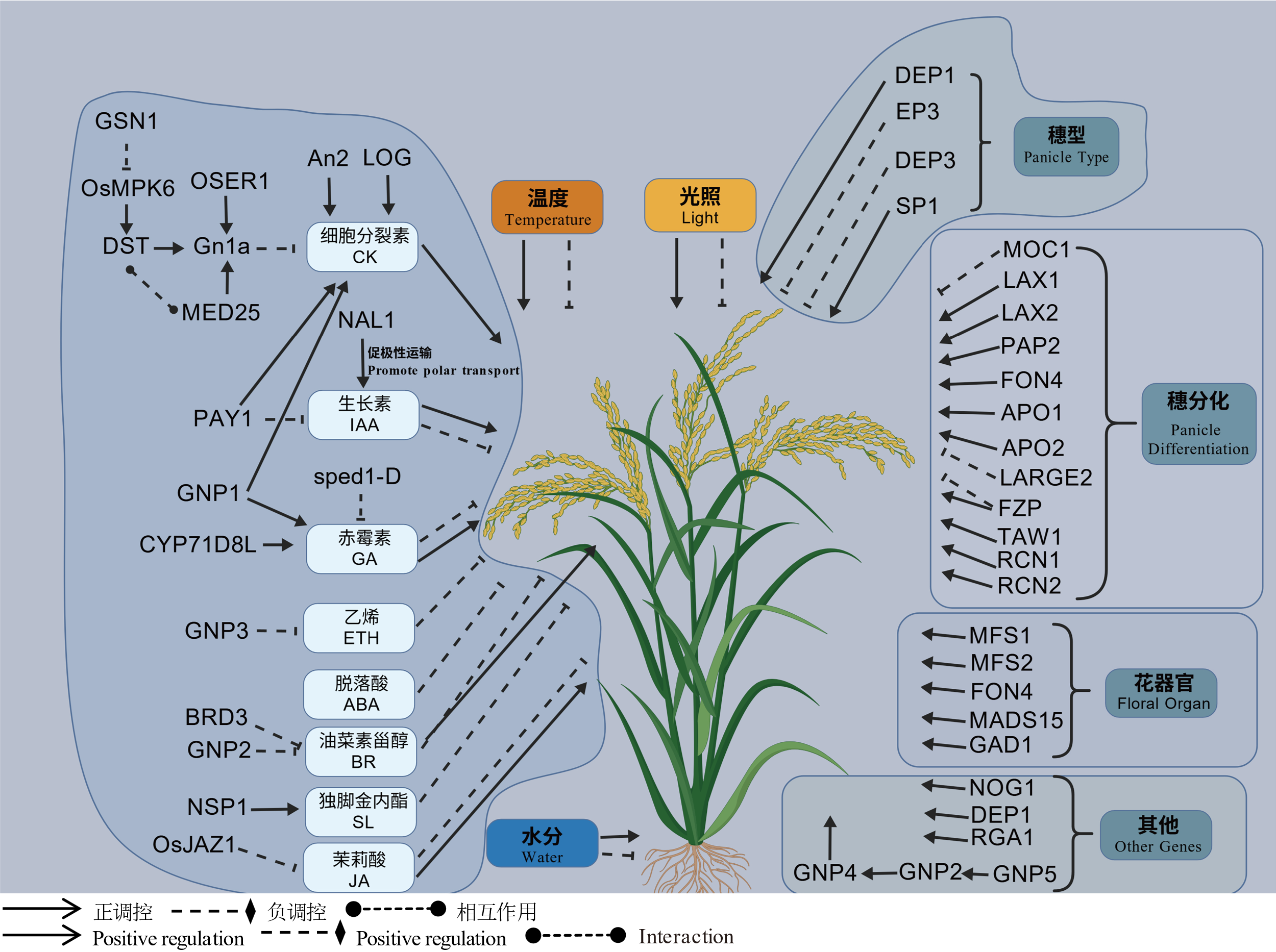
图1 水稻穗粒数的遗传调控
Fig. 1. Genetic regulation of grain number per panicle in rice
| 基因 Gene | 基因编号 Gene ID | 蛋白类型 Protein type | 功能要点 Functional description | 文献 Reference |
|---|---|---|---|---|
| NOG1 | LOC_Os01g54860 | 烯醇辅酶水合酶 enoyl-CoA hydratase | 促进小穗分化并增加每穗粒数,改善脂肪酸和能量代谢 Promote spikelet differentiation and increase grain number per panicle, improve fatty acid and energy metabolism | [ |
| Ghd7 | LOC_Os07g15770 | 转录因子 CCT motif family protein | 延迟抽穗时间,维持穗分生组织活动,显著提高穗粒数并改善维管发育 Delay heading time, maintain panicle meristem activity, significantly increase grain number per panicle and improve vascular development | [ |
| NAL1 | LOC_Os04g52479 | 调控蛋白 Regulating proteins | 影响叶片和穗颈维管束结构,增强生长素极性运输,增加产量和穗粒数 Affects the structure of vascular bundles in leaves and panicle neck, enhances the polar transport of auxin, and increases yield and grain number per panicle | [ |
| OsCOMT | LOC_Os08g06100 | O-甲基转移酶 O-methyltransferase | 提高褪黑素合成,增强维管发育并延缓衰老,增加穗粒数 Increase melatonin synthesis, enhance vascular development and delay aging, increase the number of grains per panicle | [ |
| PAY1 | LOC_Os08g31470 | 株型调控蛋白 Plant type regulatory protein | 调节极性生长素运输,降低穗部生长素浓度,增加分枝数和穗粒数 Regulating polar auxin transport, reducing auxin concentration in panicle, increasing branch number and grain number per panicle | [ |
| ETR2 | LOC_Os04g08740 | 乙烯受体 Ethylene receptor | 延迟营养生长向生殖生长转变,高水平乙烯导致小穗退化 Delay the transition from vegetative growth to reproductive growth, and high levels of ethylene lead to spikelet degeneration | [ |
| GNP3 | LOC_Os03g49640 | 乙烯相关转录因子 Ethylene-related transcription factors | 减少乙烯合成/信号传递,提升穗粒数 Reduce ethylene synthesis/signal transmission and increase grain number per panicle | [ |
| BRD3 | LOC_Os06g39880 | 染色质识别因子 Chromatin recognition factor | 靶向增强BR分解,延缓小穗退化,形成簇生小穗并提升单穗粒数 Targeted enhancement of BR decomposition, delaying spikelet degradation, forming clustered spikelets and increasing the number of grains per panicle | [ |
| GNP2 | LOC_Os01g10840 | GSK3样激酶 GSK3-like kinase | BR信号负调控因子,增强穗分生组织发育和分枝形成,提高穗粒数 BR signal negative regulators, enhanced panicle meristem development and branching formation, increased grain number per panicle | [ |
| NSP2 | LOC_Os03g15680 | 信号转导蛋白 Signal transducin | 低磷条件下促进独脚金内酯(SL)生物合成,调控株型和产量 Promote the biosynthesis of strigolactone (SL), regulate plant type and yield under low phosphorus conditions | [ |
| OsJAZ11 | LOC_Os03g08320 | JAZ家族蛋白 ZIM domain containing protein | 参与茉莉酸信号精细平衡,影响小穗及花器官发育与结实 Involved in the fine balance of jasmonic acid signals and affects the development and fruiting of spikelets and floral organs | [ |
| OsPRMT6a | LOC_Os10g34740 | 精氨酸甲基转移酶 Arginine methyltransferase | 维持茉莉酸(JA)响应,保障小穗正常发育并提高高温适应性 Maintaining jasmonic acid (JA) response, ensuring normal development of spikelets and improving high temperature adaptability | [ |
| Gn1a (OsCKX2) | LOC_Os01g10110 | 细胞分裂素氧化酶 Cytokinin oxidase | 降解细胞分裂素;功能缺失可提高分生组织CK含量,增加分枝和小穗 Degrading cytokinin; loss of function can increase CK content in meristem, increase branches and spikelets | [ |
| LOG | LOC_Os01g40630 | 细胞分裂素激活酶 Cytokinin activated enzyme | 负责将前体转化为活性细胞分裂素,促进穗分生组织发育 Responsible for converting precursors into active cytokinins, promoting the development of panicle meristems | [ |
| An-2 | LOC_Os04g43840 | 细胞分裂素合成酶 Cytokinin synthase | 参与CK合成,控制芒长度,功能缺失导致每穗粒数降低 Participate in CK synthesis, control the length of Miscanthus sinensis, and functional deficiency leads to a reduction in the number of grains per panicle | [ |
| DST (LHD1) | LOC_Os03g57240 | C2H2锌指转录因子 C2H2 zinc finger transcription factor | 促进Gn1a表达,降低CK含量;突变可显著增加穗粒数 Promote the expression of Gn1a and reduce CK content; mutations can significantly increase the number of grains per panicle | [ |
| OsER1 | LOC_Os06g10230 | 跨膜受体蛋白激酶 Transmembrane receptor protein kinase | 促进细胞分裂素分解途径(上调CKX),负调控穗粒数 Promoting cytokinin degradation pathway (upregulating CKX), negatively regulating grain number per panicle | [ |
| GSN1 | LOC_Os05g02500 | MAPK磷酸酶 MAPK phosphatase | 使OsMPK6失活,提高CK水平,增加穗粒数(与粒型粒重拮抗) Inactivate OsMPK6, increase CK levels, increase grain number per panicle (antagonistic to grain type and weight) | [ |
| OsMED25 | LOC_Os09g13610 | 转录介体复合体亚基 Transcription mediator complex subunit | 与DST互作并募集RNA聚合酶II至Gn1a启动子,负调控穗粒数 Interacts with DST and recruits RNA polymerase II to the Gn1a promoter, negatively regulating grain number per panicle | [ |
| OsCYP71D8L | LOC_Os02g09220 | 细胞色素P450酶 Cytochrome P450 enzyme | 促进GA生物合成,抑制穗的分枝伸长并降低穗粒数 Promotes GA biosynthesis, inhibits panicle branching elongation and reduces grain number | [ |
| sped1-D | LOC_Os06g39650 | PPR蛋白 PPR protein | 缺陷导致多个GA受体下调,表现为穗轴缩短,二次枝梗变少 Defects lead to down-regulation of multiple GA receptors, manifesting as shortened panicle axis and fewer secondary rachis branches | [ |
| GNP1 | LOC_Os03g63970 | GA-20-氧化酶 GA-20-oxidase | 增加穗部GA含量并反馈上调CK水平,促进穗粒数 Increases panicle GA content and feedback upregulates CK levels, promoting grain number | [ |
| DEP1 (qPE9-1) | LOC_Os09g26999 | G蛋白γ亚基 G protein gamma subunit | 突变导致G蛋白信号持续激活,使穗形紧凑、着粒密度显著提高 Mutation causes continuous activation of G protein signaling, resulting in compact panicle shape and significantly increased grain density | [ |
| RGB1 | LOC_Os03g46650 | G蛋白β/α亚基 G protein beta/alpha subunit | 参与异源三聚体G蛋白通路,与转录因子互作调控穗粒数与粒型 Participates in the heterotrimeric G protein pathway, interacting with transcription factors to regulate grain number and grain shape | [ |
| RGA1 | LOC_Os05g26890 | G蛋白β/α亚基 G protein beta/alpha subunit | 参与异源三聚体G蛋白通路,与转录因子互作调控穗粒数与粒型 Participates in the heterotrimeric G protein pathway, interacting with transcription factors to regulate grain number and grain shape | [ |
| EP3 | LOC_Os02g15950 | 调控蛋白 Regulatory protein | 影响穗分枝角度和排列,功能缺失导致穗缩短、粒数增加 Affects panicle branching angle and arrangement, loss of function results in shortened panicle and increased grain number | [ |
| DEP3 | LOC_Os06g46350 | 含Patatin样磷脂酶域蛋白 Patatin-like protein | 影响维管束发育与穗形态,突变致穗紧凑并增加粒数 Affects vascular bundle development and panicle morphology, mutation leads to compact panicle and increased grain number | [ |
| SP1 | LOC_Os11g12740 | 肽类转运蛋白 (PTR) Peptide transporter (PTR) | 主要在维管束表达,促进穗轴伸长、分枝变长,增加分枝数和粒数 Mainly expressed in vascular bundles, promotes panicle axis elongation, branching lengthening, and increases branching number and grain number | [ |
| MOC1 | LOC_Os06g40780 | GRAS转录因子 GRAS transcription factor | 侧芽和侧生分生组织起始必需因子;缺失则几乎无分蘖和二次枝梗 Essential factor for lateral bud and lateral meristem initiation; loss results in almost no tillering and secondary rachis branches | [ |
| LAX1 | LOC_Os01g61480 | bHLH转录因子 bHLH transcription factor | 维持分枝分生组织的形成和持续分裂,突变减少二次枝梗和小穗 Maintains the formation and continuous division of branching meristems, mutation reduces secondary rachis branches and spikelets | [ |
| LAX2 (Gnp4) | LOC_Os04g32510 | 核定位蛋白 Nuclear localization protein | 协同LAX1调控侧生分生组织,维持穗分枝;可被GNP2磷酸化稳定 Collaborates with LAX1 to regulate lateral meristems, maintaining panicle branching; can be stabilized by GNP2 phosphorylation | [ |
| PAP2 | LOC_Os03g54170 | MADS-box转录因子 MADS-box transcription factor | 延长穗分生组织活动期,推迟花分生组织转变,增加分枝和小穗 Extends the activity period of panicle meristematic tissue, delays the transition to floral meristematic tissue, and increases branching and spikelets | [ |
| FON4 | LOC_Os11g38270 | CLE肽类配体 CLE peptide ligand | 控制穗顶端分生组织规模,限制分生组织大小以避免畸形多花小穗 Controls the scale of panicle apical meristematic tissue, limits meristematic tissue size to avoid malformed multiple-flowered spikelets | [ |
| APO2 (RFL) | LOC_Os04g51000 | LEAFY同源转录因子 LEAFY homologous transcription factor | 与APO1互作,共同抑制穗分生组织过早进入花分化阶段 Interacts with APO1 to jointly inhibit premature entry of panicle meristematic tissue into the floral differentiation stage | [ |
| LARGE2 | LOC_Os12g24080 | E3泛素连接酶 E3 ubiquitin ligase | 专门介导APO1和APO2蛋白降解,负向调节穗分枝特性维持 Specifically mediates the degradation of APO1 and APO2 proteins, negatively regulates the maintenance of panicle branching characteristics | [ |
| APO1 (SCM2) | LOC_Os06g45460 | F-box蛋白 F-box protein | 维持分枝分生组织特性更长时间,延缓成花,增加穗分枝和粒数 Maintains branching meristem characteristics for a longer time, delays flowering, and increases panicle branching and grain number | [ |
| FZP | LOC_Os07g47330 | AP2家族转录因子 AP2 family transcription factor | 终止新分枝分化并促使转为花分生组织;抑制其表达可增加分枝和粒数 Terminates new branching differentiation and promotes transition to floral meristematic tissue; inhibiting its expression can increase branching and grain number | [ |
| TAW1 | LOC_Os10g33780 | TCP转录因子 TCP transcription factor | 延缓小穗分化、维持分枝分生组织活性,使穗分枝延长并增加枝梗 Delays spikelet differentiation, maintains branching meristem activity, extends panicle branching and increases rachis branches | [ |
| RCN1 | LOC_Os11g05470 | TFL1同源蛋白 (PEBP) TFL1 homologous protein (PEBP) | 延迟穗分生组织向花转变,增加分枝级次和粒数 Delays the transition of panicle meristematic tissue to floral tissue, increases branching order and grain number | [ |
| RCN2 | LOC_Os02g32950 | TFL1同源蛋白 (PEBP) TFL1 homologous protein (PEBP) | 延迟穗分生组织向花转变,增加分枝级次和粒数 Delays the transition of panicle meristematic tissue to floral tissue, increases branching order and grain number | [ |
| MFS1 | LOC_Os05g41760 | AP2类转录因子 AP2-like transcription factor | 控制小穗分生组织命运,突变形成一穗多粒的多花小穗表型 Controls the fate of spikelet meristematic tissue, mutation results in a multi-grain multi-flowered spikelet phenotype | [ |
| MFS2 | LOC_Os04g47890 | MYB转录因子 MYB transcription factor | 抑制小穗过早确定,功能缺失导致多器官和多花小穗 Suppresses premature determination of spikelets, loss of function leads to multi-organ and multi-flowered spikelets | [ |
| OsMADS15 | LOC_Os07g01820 | MADS-box转录因子 MADS-box transcription factor | 参与花序发育,过量表达会扰乱花器官,造成颖花败育、粒数降低 Participates in inflorescence development, overexpression disrupts floral organs, causing glume abortion and reduced grain number | [ |
表1 已克隆的控制穗粒数基因
Table 1. Cloned genes controlling grain number per panicle
| 基因 Gene | 基因编号 Gene ID | 蛋白类型 Protein type | 功能要点 Functional description | 文献 Reference |
|---|---|---|---|---|
| NOG1 | LOC_Os01g54860 | 烯醇辅酶水合酶 enoyl-CoA hydratase | 促进小穗分化并增加每穗粒数,改善脂肪酸和能量代谢 Promote spikelet differentiation and increase grain number per panicle, improve fatty acid and energy metabolism | [ |
| Ghd7 | LOC_Os07g15770 | 转录因子 CCT motif family protein | 延迟抽穗时间,维持穗分生组织活动,显著提高穗粒数并改善维管发育 Delay heading time, maintain panicle meristem activity, significantly increase grain number per panicle and improve vascular development | [ |
| NAL1 | LOC_Os04g52479 | 调控蛋白 Regulating proteins | 影响叶片和穗颈维管束结构,增强生长素极性运输,增加产量和穗粒数 Affects the structure of vascular bundles in leaves and panicle neck, enhances the polar transport of auxin, and increases yield and grain number per panicle | [ |
| OsCOMT | LOC_Os08g06100 | O-甲基转移酶 O-methyltransferase | 提高褪黑素合成,增强维管发育并延缓衰老,增加穗粒数 Increase melatonin synthesis, enhance vascular development and delay aging, increase the number of grains per panicle | [ |
| PAY1 | LOC_Os08g31470 | 株型调控蛋白 Plant type regulatory protein | 调节极性生长素运输,降低穗部生长素浓度,增加分枝数和穗粒数 Regulating polar auxin transport, reducing auxin concentration in panicle, increasing branch number and grain number per panicle | [ |
| ETR2 | LOC_Os04g08740 | 乙烯受体 Ethylene receptor | 延迟营养生长向生殖生长转变,高水平乙烯导致小穗退化 Delay the transition from vegetative growth to reproductive growth, and high levels of ethylene lead to spikelet degeneration | [ |
| GNP3 | LOC_Os03g49640 | 乙烯相关转录因子 Ethylene-related transcription factors | 减少乙烯合成/信号传递,提升穗粒数 Reduce ethylene synthesis/signal transmission and increase grain number per panicle | [ |
| BRD3 | LOC_Os06g39880 | 染色质识别因子 Chromatin recognition factor | 靶向增强BR分解,延缓小穗退化,形成簇生小穗并提升单穗粒数 Targeted enhancement of BR decomposition, delaying spikelet degradation, forming clustered spikelets and increasing the number of grains per panicle | [ |
| GNP2 | LOC_Os01g10840 | GSK3样激酶 GSK3-like kinase | BR信号负调控因子,增强穗分生组织发育和分枝形成,提高穗粒数 BR signal negative regulators, enhanced panicle meristem development and branching formation, increased grain number per panicle | [ |
| NSP2 | LOC_Os03g15680 | 信号转导蛋白 Signal transducin | 低磷条件下促进独脚金内酯(SL)生物合成,调控株型和产量 Promote the biosynthesis of strigolactone (SL), regulate plant type and yield under low phosphorus conditions | [ |
| OsJAZ11 | LOC_Os03g08320 | JAZ家族蛋白 ZIM domain containing protein | 参与茉莉酸信号精细平衡,影响小穗及花器官发育与结实 Involved in the fine balance of jasmonic acid signals and affects the development and fruiting of spikelets and floral organs | [ |
| OsPRMT6a | LOC_Os10g34740 | 精氨酸甲基转移酶 Arginine methyltransferase | 维持茉莉酸(JA)响应,保障小穗正常发育并提高高温适应性 Maintaining jasmonic acid (JA) response, ensuring normal development of spikelets and improving high temperature adaptability | [ |
| Gn1a (OsCKX2) | LOC_Os01g10110 | 细胞分裂素氧化酶 Cytokinin oxidase | 降解细胞分裂素;功能缺失可提高分生组织CK含量,增加分枝和小穗 Degrading cytokinin; loss of function can increase CK content in meristem, increase branches and spikelets | [ |
| LOG | LOC_Os01g40630 | 细胞分裂素激活酶 Cytokinin activated enzyme | 负责将前体转化为活性细胞分裂素,促进穗分生组织发育 Responsible for converting precursors into active cytokinins, promoting the development of panicle meristems | [ |
| An-2 | LOC_Os04g43840 | 细胞分裂素合成酶 Cytokinin synthase | 参与CK合成,控制芒长度,功能缺失导致每穗粒数降低 Participate in CK synthesis, control the length of Miscanthus sinensis, and functional deficiency leads to a reduction in the number of grains per panicle | [ |
| DST (LHD1) | LOC_Os03g57240 | C2H2锌指转录因子 C2H2 zinc finger transcription factor | 促进Gn1a表达,降低CK含量;突变可显著增加穗粒数 Promote the expression of Gn1a and reduce CK content; mutations can significantly increase the number of grains per panicle | [ |
| OsER1 | LOC_Os06g10230 | 跨膜受体蛋白激酶 Transmembrane receptor protein kinase | 促进细胞分裂素分解途径(上调CKX),负调控穗粒数 Promoting cytokinin degradation pathway (upregulating CKX), negatively regulating grain number per panicle | [ |
| GSN1 | LOC_Os05g02500 | MAPK磷酸酶 MAPK phosphatase | 使OsMPK6失活,提高CK水平,增加穗粒数(与粒型粒重拮抗) Inactivate OsMPK6, increase CK levels, increase grain number per panicle (antagonistic to grain type and weight) | [ |
| OsMED25 | LOC_Os09g13610 | 转录介体复合体亚基 Transcription mediator complex subunit | 与DST互作并募集RNA聚合酶II至Gn1a启动子,负调控穗粒数 Interacts with DST and recruits RNA polymerase II to the Gn1a promoter, negatively regulating grain number per panicle | [ |
| OsCYP71D8L | LOC_Os02g09220 | 细胞色素P450酶 Cytochrome P450 enzyme | 促进GA生物合成,抑制穗的分枝伸长并降低穗粒数 Promotes GA biosynthesis, inhibits panicle branching elongation and reduces grain number | [ |
| sped1-D | LOC_Os06g39650 | PPR蛋白 PPR protein | 缺陷导致多个GA受体下调,表现为穗轴缩短,二次枝梗变少 Defects lead to down-regulation of multiple GA receptors, manifesting as shortened panicle axis and fewer secondary rachis branches | [ |
| GNP1 | LOC_Os03g63970 | GA-20-氧化酶 GA-20-oxidase | 增加穗部GA含量并反馈上调CK水平,促进穗粒数 Increases panicle GA content and feedback upregulates CK levels, promoting grain number | [ |
| DEP1 (qPE9-1) | LOC_Os09g26999 | G蛋白γ亚基 G protein gamma subunit | 突变导致G蛋白信号持续激活,使穗形紧凑、着粒密度显著提高 Mutation causes continuous activation of G protein signaling, resulting in compact panicle shape and significantly increased grain density | [ |
| RGB1 | LOC_Os03g46650 | G蛋白β/α亚基 G protein beta/alpha subunit | 参与异源三聚体G蛋白通路,与转录因子互作调控穗粒数与粒型 Participates in the heterotrimeric G protein pathway, interacting with transcription factors to regulate grain number and grain shape | [ |
| RGA1 | LOC_Os05g26890 | G蛋白β/α亚基 G protein beta/alpha subunit | 参与异源三聚体G蛋白通路,与转录因子互作调控穗粒数与粒型 Participates in the heterotrimeric G protein pathway, interacting with transcription factors to regulate grain number and grain shape | [ |
| EP3 | LOC_Os02g15950 | 调控蛋白 Regulatory protein | 影响穗分枝角度和排列,功能缺失导致穗缩短、粒数增加 Affects panicle branching angle and arrangement, loss of function results in shortened panicle and increased grain number | [ |
| DEP3 | LOC_Os06g46350 | 含Patatin样磷脂酶域蛋白 Patatin-like protein | 影响维管束发育与穗形态,突变致穗紧凑并增加粒数 Affects vascular bundle development and panicle morphology, mutation leads to compact panicle and increased grain number | [ |
| SP1 | LOC_Os11g12740 | 肽类转运蛋白 (PTR) Peptide transporter (PTR) | 主要在维管束表达,促进穗轴伸长、分枝变长,增加分枝数和粒数 Mainly expressed in vascular bundles, promotes panicle axis elongation, branching lengthening, and increases branching number and grain number | [ |
| MOC1 | LOC_Os06g40780 | GRAS转录因子 GRAS transcription factor | 侧芽和侧生分生组织起始必需因子;缺失则几乎无分蘖和二次枝梗 Essential factor for lateral bud and lateral meristem initiation; loss results in almost no tillering and secondary rachis branches | [ |
| LAX1 | LOC_Os01g61480 | bHLH转录因子 bHLH transcription factor | 维持分枝分生组织的形成和持续分裂,突变减少二次枝梗和小穗 Maintains the formation and continuous division of branching meristems, mutation reduces secondary rachis branches and spikelets | [ |
| LAX2 (Gnp4) | LOC_Os04g32510 | 核定位蛋白 Nuclear localization protein | 协同LAX1调控侧生分生组织,维持穗分枝;可被GNP2磷酸化稳定 Collaborates with LAX1 to regulate lateral meristems, maintaining panicle branching; can be stabilized by GNP2 phosphorylation | [ |
| PAP2 | LOC_Os03g54170 | MADS-box转录因子 MADS-box transcription factor | 延长穗分生组织活动期,推迟花分生组织转变,增加分枝和小穗 Extends the activity period of panicle meristematic tissue, delays the transition to floral meristematic tissue, and increases branching and spikelets | [ |
| FON4 | LOC_Os11g38270 | CLE肽类配体 CLE peptide ligand | 控制穗顶端分生组织规模,限制分生组织大小以避免畸形多花小穗 Controls the scale of panicle apical meristematic tissue, limits meristematic tissue size to avoid malformed multiple-flowered spikelets | [ |
| APO2 (RFL) | LOC_Os04g51000 | LEAFY同源转录因子 LEAFY homologous transcription factor | 与APO1互作,共同抑制穗分生组织过早进入花分化阶段 Interacts with APO1 to jointly inhibit premature entry of panicle meristematic tissue into the floral differentiation stage | [ |
| LARGE2 | LOC_Os12g24080 | E3泛素连接酶 E3 ubiquitin ligase | 专门介导APO1和APO2蛋白降解,负向调节穗分枝特性维持 Specifically mediates the degradation of APO1 and APO2 proteins, negatively regulates the maintenance of panicle branching characteristics | [ |
| APO1 (SCM2) | LOC_Os06g45460 | F-box蛋白 F-box protein | 维持分枝分生组织特性更长时间,延缓成花,增加穗分枝和粒数 Maintains branching meristem characteristics for a longer time, delays flowering, and increases panicle branching and grain number | [ |
| FZP | LOC_Os07g47330 | AP2家族转录因子 AP2 family transcription factor | 终止新分枝分化并促使转为花分生组织;抑制其表达可增加分枝和粒数 Terminates new branching differentiation and promotes transition to floral meristematic tissue; inhibiting its expression can increase branching and grain number | [ |
| TAW1 | LOC_Os10g33780 | TCP转录因子 TCP transcription factor | 延缓小穗分化、维持分枝分生组织活性,使穗分枝延长并增加枝梗 Delays spikelet differentiation, maintains branching meristem activity, extends panicle branching and increases rachis branches | [ |
| RCN1 | LOC_Os11g05470 | TFL1同源蛋白 (PEBP) TFL1 homologous protein (PEBP) | 延迟穗分生组织向花转变,增加分枝级次和粒数 Delays the transition of panicle meristematic tissue to floral tissue, increases branching order and grain number | [ |
| RCN2 | LOC_Os02g32950 | TFL1同源蛋白 (PEBP) TFL1 homologous protein (PEBP) | 延迟穗分生组织向花转变,增加分枝级次和粒数 Delays the transition of panicle meristematic tissue to floral tissue, increases branching order and grain number | [ |
| MFS1 | LOC_Os05g41760 | AP2类转录因子 AP2-like transcription factor | 控制小穗分生组织命运,突变形成一穗多粒的多花小穗表型 Controls the fate of spikelet meristematic tissue, mutation results in a multi-grain multi-flowered spikelet phenotype | [ |
| MFS2 | LOC_Os04g47890 | MYB转录因子 MYB transcription factor | 抑制小穗过早确定,功能缺失导致多器官和多花小穗 Suppresses premature determination of spikelets, loss of function leads to multi-organ and multi-flowered spikelets | [ |
| OsMADS15 | LOC_Os07g01820 | MADS-box转录因子 MADS-box transcription factor | 参与花序发育,过量表达会扰乱花器官,造成颖花败育、粒数降低 Participates in inflorescence development, overexpression disrupts floral organs, causing glume abortion and reduced grain number | [ |
| [1] | Xing Y, Zhang Q. Genetic and molecular bases of rice yield[J]. Annual Review of Plant Biology, 2010, 61: 421-442. |
| [2] | Huo X, Wu S, Zhu Z, Liu F, Fu Y, Cai H, Sun X, Gu P, Xie D, Tan L, Sun C. NOG1 increases grain production in rice[J]. Nature Communications, 2017, 8: 1497. |
| [3] | Khush G S. What it will take to feed 5.0 billion rice consumers in 2030[J]. Plant Molecular Biology, 2005, 59(1): 1-6. |
| [4] | Xiao N, Pan C, Li Y, Wu Y, Cai Y, Lu Y, Wang R, Yu L, Shi W, Kang H, Zhu Z, Huang N, Zhang X, Chen Z, Liu J, Yang Z, Ning Y, Li A. Genomic insight into balancing high yield, good quality, and blast resistance of Japonica rice[J]. Genome Biology, 2021, 22(1): 283. |
| [5] | Tuhina-Khatun M, Hanafi M M, Rafii Yusop M, Wong M Y, Salleh F M, Ferdous J. Genetic variation, heritability, and diversity analysis of upland rice (Oryza sativa L.) genotypes based on quantitative traits[J]. BioMed Research International, 2015, 2015(1): 290861. |
| [6] | Ikeda K, Sunohara H, Nagato Y. Developmental course of inflorescence and spikelet in rice[J]. Breeding Science, 2004, 54(2): 147-156. |
| [7] | Kato Y, Kamoshita A, Yamagishi J. Preflowering abortion reduces spikelet number in upland rice (Oryza sativa L.) under water stress[J]. Crop Science, 2008, 48(6): 2389-2395. |
| [8] | Jiang H, Thobakgale T, Li Y, Liu L, Su Q, Cang B, Bai C, Li J, Song Z, Wu M, Wang D, Cui J, Wei X, Wu Z. Construction of dominant rice population under dry cultivation by seeding rate and nitrogen rate interaction[J]. Scientific Reports, 2021, 11: 7189. |
| [9] | Liao S, Yan J, Xing H, Tu Y, Zhao H, Wang G. Genetic basis of vascular bundle variations in rice revealed by genome-wide association study[J]. Plant Science, 2021, 302: 110715. |
| [10] | Xue W, Xing Y, Weng X, Zhao Y, Tang W, Wang L, Zhou H, Yu S, Xu C, Li X, Zhang Q. Natural variation in Ghd7 is an important regulator of heading date and yield potential in rice[J]. Nature Genetics, 2008, 40(6): 761-767. |
| [11] | Chen M, Luo J, Shao G, Wei X, Tang S, Sheng Z, Song J, Hu P. Fine mapping of a major QTL for flag leaf width in rice, qFLW4, which might be caused by alternative splicing of NAL1[J]. Plant Cell Reports, 2012, 31(5): 863-872. |
| [12] | Huangfu L, Chen R, Lu Y, Zhang E, Miao J, Zuo Z, Zhao Y, Zhu M, Zhang Z, Li P, Xu Y, Yao Y, Liang G, Xu C, Zhou Y, Yang Z. OsCOMT, encoding a caffeic acid O-methyltransferase in melatonin biosynthesis, increases rice grain yield through dual regulation of leaf senescence and vascular development[J]. Plant Biotechnology Journal, 2022, 20(6): 1122-1139. |
| [13] | Jameson P E, Song J. Cytokinin: A key driver of seed yield[J]. Journal of Experimental Botany, 2016, 67(3): 593-606. |
| [14] | Zhao L, Tan L, Zhu Z, Xiao L, Xie D, Sun C. PAY1 improves plant architecture and enhances grain yield in rice[J]. The Plant Journal, 2015, 83(3): 528-536. |
| [15] | Gao S, Chu C. Gibberellin metabolism and signaling: Targets for improving agronomic performance of crops[J]. Plant and Cell Physiology, 2020, 61(11): 1902-1911. |
| [16] | Wuriyanghan H, Zhang B, Cao W H, Ma B, Lei G, Liu Y F, Wei W, Wu H J, Chen L J, Chen H W, Cao Y R, He S J, Zhang W K, Wang X J, Chen S Y, Zhang J S. The ethylene receptor ETR2 delays floral transition and affects starch accumulation in rice[J]. The Plant Cell, 2009, 21(5): 1473-1494. |
| [17] | Ma Z, Ming Y, Li J, Li H, Wang H, Zhu X, Xu Y, Zhao Y, Hu Q, Liu R, Pan Y, Li D, Wang W, Xu J, Sun X, Li J, Zhang H, Li Z, Zhang Z. Natural variation in GNP3 determines grain number and grain yield in rice[J]. Nature Communications, 2025, 16: 5892. |
| [18] | Farooq M, Wahid A, Lee D J. Exogenously applied polyamines increase drought tolerance of rice by improving leaf water status, photosynthesis and membrane properties[J]. Acta Physiologiae Plantarum, 2009, 31(5): 937-945. |
| [19] | Zhang X, Meng W, Liu D, Pan D, Yang Y, Chen Z, Ma X, Yin W, Niu M, Dong N, Liu J, Shen W, Liu Y, Lu Z, Chu C, Qian Q, Zhao M, Tong H. Enhancing rice panicle branching and grain yield through tissue-specific brassinosteroid inhibition[J]. Science, 2024, 383(6687): eadk8838. |
| [20] | Hu Q, Zhao Z, Ma L, Xia H, Ma Z, Xu P, Wang X, Zhu R, Zhao Y, Guo H, Zhu X, Zeng Y, Pan Y, Li D, Sun X, Li J, Zhang H, Li Z, Zhang Z. Natural variation of GNP2 enhances grain number to benefit rice yield[J]. Nature Communications, 2025, 16: 8848. |
| [21] | Hu Q, Liu H, He Y, Hao Y, Yan J, Liu S, Huang X, Yan Z, Zhang D, Ban X, Zhang H, Li Q, Zhang J, Xin P, Jing Y, Kou L, Sang D, Wang Y, Wang Y, Meng X, Fu X, Chu J, Wang B, Li J. Regulatory mechanisms of strigolactone perception in rice[J]. Cell, 2024, 187(26): 7551-7567.e17. |
| [22] | Yuan K, Zhang H, Yu C, Luo N, Yan J, Zheng S, Hu Q, Zhang D, Kou L, Meng X, Jing Y, Chen M, Ban X, Yan Z, Lu Z, Wu J, Zhao Y, Liang Y, Wang Y, Xiong G, Chu J, Wang E, Li J, Wang B. Low phosphorus promotes NSP1-NSP2 heterodimerization to enhance strigolactone biosynthesis and regulate shoot and root architecture in rice[J]. Molecular Plant, 2023, 16(11): 1811-1831. |
| [23] | Dong K, Wu F, Cheng S, Li S, Zhang F, Xing X, Jin X, Luo S, Feng M, Miao R, Chang Y, Zhang S, You X, Wang P, Zhang X, Lei C, Ren Y, Zhu S, Guo X, Wu C, Yang D L, Lin Q, Cheng Z, Wan J. OsPRMT6a-mediated arginine methylation of OsJAZ1 regulates jasmonate signaling and spikelet development in rice[J]. Molecular Plant, 2024, 17(6): 900-919. |
| [24] | Mehra P, Pandey B K, Verma L, Prusty A, Singh A P, Sharma S, Malik N, Bennett M J, Parida S K, Giri J, Tyagi A K. OsJAZ11 regulates spikelet and seed development in rice[J]. Plant Direct, 2022, 6(5): e401. |
| [25] | Park J R, Kim E G, Jang Y H, Kim K M. Screening and identification of genes affecting grain quality and spikelet fertility during high-temperature treatment in grain filling stage of rice[J]. BMC Plant Biology, 2021, |
| [26] | Ashikari M, Sakakibara H, Lin S Y, Yamamoto T, Takashi T, Nishimura A, Angeles E R, Qian Q, Kitano H, Matsuoka M. Cytokinin oxidase regulates rice grain production[J]. Science, 2005, 309(5735): 741-745. |
| [27] | Feng X, Wang C, Nan J, Zhang X, Wang R, Jiang G, Yuan Q, Lin S. Updating the elite rice variety Kongyu 131 by improving the Gn1a locus[J]. Rice, 2017, 10(1): 35. |
| [28] | Kurakawa T, Ueda N, Maekawa M, Kobayashi K, Kojima M, Nagato Y, Sakakibara H, Kyozuka J. Direct control of shoot meristem activity by a cytokinin-activating enzyme[J]. Nature, 2007, 445(7128): 652-655. |
| [29] | Gu B, Zhou T, Luo J, Liu H, Wang Y, Shangguan Y, Zhu J, Li Y, Sang T, Wang Z, Han B. An-2 encodes a cytokinin synthesis enzyme that regulates awn length and grain production in rice[J]. Molecular Plant, 2015, 8(11): 1635-1650. |
| [30] | Li S, Zhao B, Yuan D, Duan M, Qian Q, Tang L, Wang B, Liu X, Zhang J, Wang J, Sun J, Liu Z, Feng Y Q, Yuan L, Li C. Rice zinc finger protein DST enhances grain production through controlling Gn1a/OsCKX2 expression[J]. Proceedings of the National Academy of Sciences of the United States of America, 2013, 110(8): 3167-3172. |
| [31] | Guo T, Lu Z Q, Shan J X, Ye W W, Dong N Q, Lin H X. ERECTA1 acts upstream of the OsMKKK10- OsMKK4-OsMPK6 cascade to control spikelet number by regulating cytokinin metabolism in rice[J]. The Plant Cell, 2020, 32(9): 2763-2779. |
| [32] | Guo T, Chen K, Dong N Q, Shi C L, Ye W W, Gao J P, Shan J X, Lin H X. GRAIN SIZE AND NUMBER1 negatively regulates the OsMKKK10- OsMKK4- OsMPK6 cascade to coordinate the trade-off between grain number per panicle and grain size in rice[J]. The Plant Cell, 2018, 30(4): 871-888. |
| [33] | Guo N, Gu M, Hu J, Qu H, Xu G. Rice OsLHT1 functions in leaf-to-panicle nitrogen allocation for grain yield and quality[J]. Frontiers in Plant Science, 2020, 11: 1150. |
| [34] | Lin L, Du M, Li S, Sun C, Wu F, Deng L, Chen Q, Li C. Mediator complex subunit MED25 physically interacts with DST to regulate spikelet number in rice[J]. Journal of Integrative Plant Biology, 2022, 64(4): 871-883. |
| [35] | Liang W H, Shang F, Lin Q T, Lou C, Zhang J. Tillering and panicle branching genes in rice[J]. Gene, 2014, 537(1): 1-5. |
| [36] | Jiang G, Xiang Y, Zhao J, Yin D, Zhao X, Zhu L, Zhai W. Regulation of inflorescence branch development in rice through a novel pathway involving the pentatricopeptide repeat protein sped1-D[J]. Genetics, 2014, 197(4): 1395-1407. |
| [37] | Bessho-Uehara K, Wang D R, Furuta T, Minami A, Nagai K, Gamuyao R, Asano K, Angeles-Shim R B, Shimizu Y, Ayano M, Komeda N, Doi K, Miura K, Toda Y, Kinoshita T, Okuda S, Higashiyama T, Nomoto M, Tada Y, Shinohara H, Matsubayashi Y, Greenberg A, Wu J, Yasui H, Yoshimura A, Mori H, McCouch S R, Ashikari M. Loss of function atRAE2, a previously unidentified EPFL, is required for awnlessness in cultivated Asian rice[J]. Proceedings of the National Academy of Sciences of the United States of America, 2016, 113(32): 8969-8974. |
| [38] | Huang X, Qian Q, Liu Z, Sun H, He S, Luo D, Xia G, Chu C, Li J, Fu X. Natural variation at the DEP1 locus enhances grain yield in rice[J]. Nature Genetics, 2009, 41(4): 494-497. |
| [39] | Sun H, Qian Q, Wu K, Luo J, Wang S, Zhang C, Ma Y, Liu Q, Huang X, Yuan Q, Han R, Zhao M, Dong G, Guo L, Zhu X, Gou Z, Wang W, Wu Y, Lin H, Fu X. Heterotrimeric G proteins regulate nitrogen-use efficiency in rice[J]. Nature Genetics, 2014, 46(6): 652-656. |
| [40] | Piao R, Jiang W, Ham T H, Choi M S, Qiao Y, Chu S H, Park J H, Woo M O, Jin Z, An G, Lee J, Koh H J. Map-based cloning of the ERECT PANICLE 3 gene in rice[J]. Theoretical and Applied Genetics, 2009, 119(8): 1497-1506. |
| [41] | Qiao Y, Piao R, Shi J, Lee S I, Jiang W, Kim B K, Lee J, Han L, Ma W, Koh H J. Fine mapping and candidate gene analysis of dense and erect panicle 3, DEP3 which confers high grain yield in rice (Oryza sativa L.)[J]. Theoretical and Applied Genetics, 2011, 122(7): 1439-1449. |
| [42] | Li S, Qian Q, Fu Z, Zeng D, Meng X, Kyozuka J, Maekawa M, Zhu X, Zhang J, Li J, Wang Y. Short panicle1 encodes a putative PTR family transporter and determines rice panicle size[J]. The Plant Journal, 2009, 58(4): 592-605. |
| [43] | Li X, Qian Q, Fu Z, Wang Y, Xiong G, Zeng D, Wang X, Liu X, Teng S, Hiroshi F, Yuan M, Luo D, Han B, Li J. Control of tillering in rice[J]. Nature, 2003, 422(6932): 618-621. |
| [44] | Oikawa T, Kyozuka J. Two-step regulation of LAX PANICLE1 protein accumulation in axillary meristem formation in rice[J]. The Plant Cell, 2009, 21(4): 1095-1108. |
| [45] | Tabuchi H, Zhang Y, Hattori S, Omae M, Shimizu-Sato S, Oikawa T, Qian Q, Nishimura M, Kitano H, Xie H, Fang X, Yoshida H, Kyozuka J, Chen F, Sato Y. LAX PANICLE2 of rice encodes a novel nuclear protein and regulates the formation of axillary meristems[J]. The Plant Cell, 2011, 23(9): 3276-3287. |
| [46] | Kobayashi K, Maekawa M, Miyao A, Hirochika H, Kyozuka J. PANICLE PHYTOMER2 (PAP2), encoding a SEPALLATA subfamily MADS-box protein, positively controls spikelet meristem identity in rice[J]. Plant and Cell Physiology, 2010, 51(1): 47-57. |
| [47] | Chu H, Qian Q, Liang W, Yin C, Tan H, Yao X, Yuan Z, Yang J, Huang H, Luo D, Ma H, Zhang D. TheFLORAL ORGAN NUMBER4Gene encoding a putative ortholog of Arabidopsis Clavata3 regulates apical meristem size in rice[J]. Plant Physiology, 2006, 142(3): 1039-1052. |
| [48] | Ikeda-Kawakatsu K, Maekawa M, Izawa T, Itoh J I, Nagato Y. ABERRANT PANICLE ORGANIZATION 2/RFL, the rice ortholog of Arabidopsis Leafy, suppresses the transition from inflorescence meristem to floral meristem through interaction with APO1[J]. The Plant Journal, 2012, 69(1): 168-180. |
| [49] | Huang L, Hua K, Xu R, Zeng D, Wang R, Dong G, Zhang G, Lu X, Fang N, Wang D, Duan P, Zhang B, Liu Z, Li N, Luo Y, Qian Q, Yao S, Li Y. The LARGE2-APO1/APO2 regulatory module controls panicle size and grain number in rice[J]. The Plant Cell, 2021, 33(4): 1212-1228. |
| [50] | Ikeda-Kawakatsu K, Yasuno N, Oikawa T, Iida S, Nagato Y, Maekawa M, Kyozuka J. Expression level ofABERRANT PANICLE ORGANIZATION1Determines rice inflorescence form through control of cell proliferation in the meristem[J]. Plant Physiology, 2009, 150(2): 736-747. |
| [51] | Bai X, Huang Y, Mao D, Wen M, Zhang L, Xing Y. Regulatory role of FZP in the determination of panicle branching and spikelet formation in rice[J]. Scientific Reports, 2016, 6: 19022. |
| [52] | Fujishiro Y, Agata A, Ota S, Ishihara R, Takeda Y, Kunishima T, Ikeda M, Kyozuka J, Hobo T, Kitano H. Comprehensive panicle phenotyping reveals that qSrn7/FZP influences higher-order branching[J]. Scientific Reports, 2018, 8: 12511. |
| [53] | Huang Y, Zhao S, Fu Y, Sun H, Ma X, Tan L, Liu F, Sun X, Sun H, Gu P, Xie D, Sun C, Zhu Z. Variation in the regulatory region of FZP causes increases in secondary inflorescence branching and grain yield in rice domestication[J]. The Plant Journal, 2018, 96(4): 716-733. |
| [54] | Yuan H, Xu Z, Tan X, Gao P, Jin M, Song W, Wang S, Kang Y, Liu P, Tu B, Wang Y, Qin P, Li S, Ma B, Chen W. A natural allele of TAW1 contributes to high grain number and grain yield in rice[J]. The Crop Journal, 2021, 9(5): 1060-1069. |
| [55] | Nakagawa M, Shimamoto K, Kyozuka J. Overexpression of RCN1 and RCN2, rice TERMINAL FLOWER 1/CENTRORADIALIS homologs, confers delay of phase transition and altered panicle morphology in rice[J]. The Plant Journal, 2002, 29(6): 743-750. |
| [56] | Ren D, Li Y, Zhao F, Sang X, Shi J, Wang N, Guo S, Ling Y, Zhang C, Yang Z, He G. MULTI-FLORET SPIKELET1, which encodes an AP2/ERF protein, determines spikelet meristem fate and sterile lemma identity in rice[J]. Plant Physiology, 2013, 162(2): 872-884. |
| [57] | Li Y F, Zeng X Q, Li Y, Wang L, Zhuang H, Wang Y, Tang J, Wang H L, Xiong M, Yang F Y, Yuan X Z, He G H. MULTI-FLORET SPIKELET 2, a MYB transcription factor, determines spikelet meristem fate and floral organ identity in rice[J]. Plant Physiology, 2020, 184(2): 988-1003. |
| [58] | Lu S J, Wei H, Wang Y, Wang H M, Yang R F, Zhang X B, Tu J M. Overexpression of a transcription factor OsMADS15 modifies plant architecture and flowering time in rice (Oryza sativa L.)[J]. Plant Molecular Biology Reporter, 2012, 30(6): 1461-1469. |
| [59] | Jin J, Hua L, Zhu Z, Tan L, Zhao X, Zhang W, Liu F, Fu Y, Cai H, Sun X, Gu P, Xie D, Sun C. GAD1 encodes a secreted peptide that regulates grain number, grain length, and awn development in rice domestication[J]. The Plant Cell, 2016, 28(10): 2453-2463. |
| [60] | Zhou Y, Tao Y, Yuan Y, Zhang Y, Miao J, Zhang R, Yi C, Gong Z, Yang Z, Liang G. Characterisation of a novel quantitative trait locus, GN4-1, for grain number and yield in rice (Oryza sativa L.)[J]. Theoretical and Applied Genetics, 2018, 131(3): 637-648. |
| [61] | Heng Y, Wu C, Long Y, Luo S, Ma J, Chen J, Liu J, Zhang H, Ren Y, Wang M, Tan J, Zhu S, Wang J, Lei C, Zhang X, Guo X, Wang H, Cheng Z, Wan J. OsALMT7 maintains panicle size and grain yield in rice by mediating malate transport[J]. The Plant Cell, 2018, 30(4): 889-906. |
| [62] | Liu Q, Han R, Wu K, Zhang J, Ye Y, Wang S, Chen J, Pan Y, Li Q, Xu X, Zhou J, Tao D, Wu Y, Fu X. G-protein βγ subunits determine grain size through interaction with MADS-domain transcription factors in rice[J]. Nature Communications, 2018, 9: 852. |
| [63] | Jiao Y, Wang Y, Xue D, Wang J, Yan M, Liu G, Dong G, Zeng D, Lu Z, Zhu X, Qian Q, Li J. Regulation of OsSPL14 by OsmiR156 defines ideal plant architecture in rice[J]. Nature Genetics, 2010, 42(6): 541-544. |
| [64] | Miura K, Ikeda M, Matsubara A, Song X J, Ito M, Asano K, Matsuoka M, Kitano H, Ashikari M. OsSPL14 promotes panicle branching and higher grain productivity in rice[J]. Nature Genetics, 2010, 42(6): 545-549. |
| [65] | Fan Y, Li Y. Molecular, cellular and Yin-Yang regulation of grain size and number in rice[J]. Molecular Breeding, 2019, 39(12): 163. |
| [66] | Fan C, Xing Y, Mao H, Lu T, Han B, Xu C, Li X, Zhang Q. GS3, a major QTL for grain length and weight and minor QTL for grain width and thickness in rice, encodes a putative transmembrane protein[J]. Theoretical and Applied Genetics, 2006, 112(6): 1164-1171. |
| [67] | Song X J, Huang W, Shi M, Zhu M Z, Lin H X. A QTL for rice grain width and weight encodes a previously unknown RING-type E3 ubiquitin ligase[J]. Nature Genetics, 2007, 39(5): 623-630. |
| [68] | Sheng P, Wu F, Tan J, Zhang H, Ma W, Chen L, Wang J, Wang J, Zhu S, Guo X, Wang J, Zhang X, Cheng Z, Bao Y, Wu C, Liu X, Wan J. A CONSTANS-like transcriptional activator, OsCOL13, functions as a negative regulator of flowering downstream of OsphyB and upstream of Ehd1 in rice[J]. Plant Molecular Biology, 2016, 92(1): 209-222. |
| [69] | Yan W, Liu H, Zhou X, Li Q, Zhang J, Lu L, Liu T, Liu H, Zhang C, Zhang Z, Shen G, Yao W, Chen H, Yu S, Xie W, Xing Y. Natural variation in Ghd7.1 plays an important role in grain yield and adaptation in rice[J]. Cell Research, 2013, 23(7): 969-971. |
| [70] | Tu B, Tao Z, Wang S, Zhou L, Zheng L, Zhang C, Li X, Zhang X, Yin J, Zhu X, Yuan H, Li T, Chen W, Qin P, Ma B, Wang Y, Li S. Loss of Gn1a/OsCKX2 confers heavy-panicle rice with excellent lodging resistance[J]. Journal of Integrative Plant Biology, 2022, 64(1): 23-38. |
| [71] | Lu Y, Zhou D X, Zhao Y. Understanding epigenomics based on the rice model[J]. Theoretical and Applied Genetics, 2020, 133(5): 1345-1363. |
| [72] | Deng Y, Zhai K, Xie Z, Yang D, Zhu X, Liu J, Wang X, Qin P, Yang Y, Zhang G, Li Q, Zhang J, Wu S, He Z. Epigenetic regulation of antagonistic receptors confers rice blast resistance with yield balance[J]. Science, 2017, 355(6328): 962-965. |
| [73] | Gouda G, Gupta M K, Donde R, Mohapatra T, Vadde R, Behera L. Marker-assisted selection for grain number and yield-related traits of rice (Oryza sativa L.)[J]. Physiology and Molecular Biology of Plants, 2020, 26(5): 885-898. |
| [74] | Singh V K, Ellur R K, Singh A K, Nagarajan M, Singh B D, Singh N K. Effect of qGN4.1 QTL for grain number per panicle in genetic backgrounds of twelve different mega varieties of rice[J]. Rice, 2018, 11(1): 8. |
| [75] | Ayaad M, Han Z, Zheng K, Hu G, Abo-Yousef M, El S Sobeih S, Xing Y. Bin-based genome-wide association studies reveal superior alleles for improvement of appearance quality using a 4-way MAGIC population in rice[J]. Journal of Advanced Research, 2021, 28: 183-194. |
| [76] | Fujita D, Trijatmiko K R, Tagle A G, Sapasap M V, Koide Y, Sasaki K, Tsakirpaloglou N, Gannaban R B, Nishimura T, Yanagihara S, Fukuta Y, Koshiba T, Slamet-Loedin I H, Ishimaru T, Kobayashi N. NAL1allele from a rice Landrace greatly increases yield in modernindicacultivars[J]. Proceedings of the National Academy of Sciences of the United States of America, 2013, 110(51): 20431-20436. |
| [77] | Wang W, Mauleon R, Hu Z, Chebotarov D, Tai S, Wu Z, Li M, Zheng T, Fuentes R R, Li Z, Leung H. Genomic variation in 3, 010 diverse accessions of Asian cultivated rice[J]. Nature, 2018, 557(7703): 43-49. |
| [78] | Agata A, Ando K, Ota S, Kojima M, Takebayashi Y, Takehara S, Doi K, Ueguchi-Tanaka M, Suzuki T, Sakakibara H, Matsuoka M, Ashikari M, Inukai Y, Kitano H, Hobo T. Diverse panicle architecture results from various combinations of Prl5/GA20ox4 and Pbl6/APO1 alleles[J]. Communications Biology, 2020, 3: 302. |
| [79] | Gao C, Chen J. CRISPR adventures in China[J]. The CRISPR Journal, 2021, 4(3): 304-306. |
| [80] | Crossa J, Pérez-Rodríguez P, Cuevas J, Montesinos- López O, Jarquín D, de los Campos G, Burgueño J, Varshney R K. Genomic selection in plant breeding: Methods, models, and perspectives[J]. Trends in Plant Science, 2017, 22(11): 961-975. |
| [81] | Cui Y, Li R, Li G, Zhang F, Zhu T, Zhang Q, Ali J, Li Z, Xu S. Hybrid breeding of rice via genomic selection[J]. Plant Biotechnology Journal, 2020, 18(1): 57-67. |
| [82] | Bayer P E, Edwards D. Machine learning in agriculture: From silos to marketplaces[J]. Plant Biotechnology Journal, 2021, 19(4): 648-650. |
| [83] | Seki M, Feugier F G, Song X J, Ashikari M, Nakamura H, Ishiyama K, Yamaya T, Inari-Ikeda M, Kitano H, Satake A. A mathematical model of phloem sucrose transport as a new tool for designing rice panicle structure for high grain yield[J]. Plant and Cell Physiology, 2015, 56(4): 605-619. |
| [84] | Deveshwar P, Prusty A, Sharma S, Tyagi A K. Phytohormone-mediated molecular mechanisms involving multiple genes and QTL govern grain number in rice[J]. Frontiers in Genetics, 2020, 11: 586462. |
| [85] | Wang J, Wang Y, Chen Y, Chen H, Xiang J, Zhang Y, Wang Z, Zhang Y. Progress on physiological mechanisms of rice spikelet degeneration at different panicle positions caused by abiotic stress[J]. Rice Science, 2025, 32(2): 193-202. |
| [86] | Lu Y, Chuan M, Wang H, Chen R, Tao T, Zhou Y, Xu Y, Li P, Yao Y, Xu C, Yang Z. Genetic and molecular factors in determining grain number per panicle of rice[J]. Frontiers in Plant Science, 2022, 13: 964246. |
| [87] | Li T, Li W J, Xu J H. DNA methylation in rice: Mechanisms, regulatory roles, and beyond[J]. International Journal of Molecular Sciences, 2025, 26(17): 8454. |
| [1] | 郝栖贤, 周坤能, 云鹏, 张彩娟, 夏加发, 李泽福. 水稻E3泛素连接酶的功能研究进展[J]. 中国水稻科学, 2026, 40(6): 705-725. |
| [2] | 侯鹰翔, 费思恬, 陈海波, 孙清, 王伟平, 张超. 水稻耐淹的适应机制及分子调控研究进展[J]. 中国水稻科学, 2026, 40(6): 742-755. |
| [3] | 赵冬生, 李羽帆, 赵贝贝, 张涛, 李钱峰, 刘巧泉. 水稻短圆粒突变体srg10的基因克隆及其功能分析[J]. 中国水稻科学, 2026, 40(6): 756-766. |
| [4] | 魏松红, 王奕鸣, 罗杭, 张良坤, 王梦雨, 王妍. 水稻OsPAL6与OsPetc蛋白互作响应纹枯菌侵染的机制研究[J]. 中国水稻科学, 2026, 40(6): 767-773. |
| [5] | 牛付安, 储黄伟, 张安鹏, 周继华, 孙滨, 代雨婷, 谢开珍, 石凤珍, 尹子辉, 侯聪, 王奕, 李璟, 程灿, 曹黎明. 基于高密度基因芯片的上海杂交粳稻亲本基因型鉴定与育种利用[J]. 中国水稻科学, 2026, 40(6): 774-785. |
| [6] | 高凌霄, 叶凡, 李帅, 陈云, 刘立军. 干湿交替灌溉对黑龙江稻区水稻产量和品质的影响[J]. 中国水稻科学, 2026, 40(6): 786-795. |
| [7] | 汤洪伟, 吴岳, 朱新霞, 刘雪梅, 杨晴, 王丹英, 刘元辉. 微生物菌剂对水稻吸收富集镉及根系微生物群落的影响[J]. 中国水稻科学, 2026, 40(6): 808-820. |
| [8] | 童毅, 钱前, 高振宇. 水稻分子设计育种研究进展[J]. 中国水稻科学, 2026, 40(5): 569-583. |
| [9] | 柴炳泽, 王俊格, 吴凯雄, 刘嘉龙, 吴越, 王荟森, 谭霖, 任德勇, 高振宇, 朱丽, 张强, 张光恒, 钱前, 胡江. 水稻粒形和穗粒数基因GSN4的克隆与单倍型分析[J]. 中国水稻科学, 2026, 40(5): 584-597. |
| [10] | 冯莆淋, 杨绮文, 吴佳益, 范鸣谦, 程艳双, 邱忠华, 郭然, 陈温福, 王嘉宇. 水稻颖壳发育基因AGL1的图位克隆与功能分析[J]. 中国水稻科学, 2026, 40(5): 607-617. |
| [11] | 于冰洁, 王浩宇, 葛语桐, 崔格格, 张海鹏, 魏海燕, 张洪程, 许方甫. 油菜秸秆还田下增苗减氮对中熟晚粳稻产量和品质的影响[J]. 中国水稻科学, 2026, 40(5): 618-631. |
| [12] | 杨昌南, 何子欣, 谈亚文, 张学智, 张业诚, 田浩然, 危常州, 张新疆. 滴灌配施不同形态氮肥管理对水稻根际氮转化过程及产量形成的影响[J]. 中国水稻科学, 2026, 40(5): 632-647. |
| [13] | 王新雅, 何卓婷, 李潇, 尤赛雅, 朱练峰, 孔亚丽, 朱春权, 田文昊, 张均华, 金千瑜, 曹小闯. 秸秆分层还田耦合腐解菌剂通过调控土壤有机碳转化和微生物群落结构提高水稻产量[J]. 中国水稻科学, 2026, 40(5): 648-662. |
| [14] | 许永炜, 刘淑华, 冯泽霖, 罗举, 倪兆新, 杨保军, 姚青, 李阿根. 基于多模态融合的水稻生育期智能识别方法[J]. 中国水稻科学, 2026, 40(5): 663-678. |
| [15] | 冯爱卿, 张亚博, 周继勇, 苏菁, 封金奇, 陈凯玲, 陈炳, 梁美玲, 朱小源, 汪聪颖, 陈深. 10个抗白叶枯病基因在华南水稻品种中的分布研究[J]. 中国水稻科学, 2026, 40(5): 679-695. |
| 阅读次数 | ||||||
|
全文 |
|
|||||
|
摘要 |
|
|||||
