
中国水稻科学 ›› 2026, Vol. 40 ›› Issue (6): 767-773.DOI: 10.16819/j.1001-7216.2026.251203
魏松红1, 王奕鸣1, 罗杭2, 张良坤1, 王梦雨1, 王妍1,*( )
收稿日期:2025-12-24
修回日期:2026-01-26
出版日期:2026-11-10
发布日期:2026-11-09
基金资助:
WEI Songhong1, WANG Yiming1, LUO Hang2, ZHANG Liangkun1, WANG Mengyu1, WANG Yan1,*()
Received:2025-12-24
Revised:2026-01-26
Online:2026-11-10
Published:2026-11-09
Contact:
*email: 8806wy@163.com摘要:
【目的】由立枯丝核菌引起的水稻纹枯病是世界上最严重的水稻病害之一,严重影响水稻产量。研究水稻苯丙氨酸解氨酶编码基因OsPAL6在水稻-立枯丝核菌互作中发挥的功能,同时探究OsPAL6和OsPetc可能参与的抗病通路具有重要意义。【方法】利用抗感水稻品种接种立枯丝核菌后的转录组数据筛选到OsPAL6,并通过qPCR验证OsPAL6对纹枯病菌侵染的响应以及OsPAL6在不同组织中的相对表达量。构建OsPAL6的亚细胞定位载体,检测OsPAL6在烟草细胞中的定位。构建OsPAL6的转基因株系,对不同株系离体叶片接种纹枯病菌,测量相对病斑面积。此外,通过酵母双杂筛库,筛选到与OsPAL6可能的互作蛋白OsPetc,并用酵母双杂交(Y2H),双分子荧光互补(BiFC)实验验证二者是否互作。【结果】OsPAL6在不同时间段均响应纹枯病菌侵染,且在叶片中的相对表达量最高。OsPAL6定位在细胞核和细胞质膜,过表达植株的相对病斑面积显著低于野生型植株,突变体植株的相对病斑面积显著高于野生型植株,且OsPAL6和OsPetc相互作用。【结论】OsPAL6正调控水稻对纹枯病的抗性,且可能通过与OsPetc互作而发挥抗病功能。综上,本研究揭示了苯丙氨酸代谢通路参与水稻抗纹枯病过程的调控网络,为水稻-立枯丝核菌互作机制研究提供新思路。
魏松红, 王奕鸣, 罗杭, 张良坤, 王梦雨, 王妍. 水稻OsPAL6与OsPetc蛋白互作响应纹枯菌侵染的机制研究[J]. 中国水稻科学, 2026, 40(6): 767-773.
WEI Songhong, WANG Yiming, LUO Hang, ZHANG Liangkun, WANG Mengyu, WANG Yan. Molecular Mechanism of OsPAL6-OsPetc Interaction in Rice Response to Rhizoctonia solani Infection[J]. Chinese Journal OF Rice Science, 2026, 40(6): 767-773.
| 引物 Primer | 引物序列 Primer sequence (5’-3’) | 引物用途 Usage | |
|---|---|---|---|
| OsPAL6-QPCR | Primer-F | TACTCTGGCATCCGGTTCGAG | 组织表达分析,相对表达量检测 Tissue expression analysis, relative expression level detection |
| Primer-R | GATGTAGGAGAGCGGGACGA | ||
| OsUBC-QPCR | Primer-F | CCGTTTGTAGAGCCATAATTGCA | 内参基因 Reference gene |
| Primer-R | AGGTTGCCTGAGTCACAGTTAAGTG | ||
| pGBKT7-OsPAL6-CDS | Primer-F | TGCATATGGCCATGGAGGCCGAATTCATGGAG TGCGAGAACGGG | 酵母双杂交 Yeast two-hybrid |
| Primer-R | TTATGCTAGTTATGCGGCCGCTGCAGTCAGCAG ATGGGCAGAGGCT | ||
| pGADT7-OsPetc-CDS | Primer-F | ATATGGCCATGGAGGCCAGTGAATTCATGGCCTC CACCGCGCT | |
| Primer-R | ATCTGCAGCTCGAGCTCGATGGATCCTTACGCCC ACCACGGGTTG | ||
| pCAMBIA1302-OsPAL6-CDS | Primer-F | AGAACACGGGGGACTCTTGACCATGGATGGAGT GCGAGAACGGG | 亚细胞定位 Subcellular localization |
| Primer-R | GTGAAAAGTTCTTCTCCTTTACTAGTTCAGCAGA TGGGCAGAGGCT | ||
| pCAMBIA1302-OsPetc-CDS | Primer-F | AGAACACGGGGGACTCTTGACCATGGATGGCCT CCACCGCGCT | |
| Primer-R | GTGAAAAGTTCTTCTCCTTTACTAGTTTACGCCC ACCACGGGTTG | ||
| OsPAL6-PXC-CDS | Primer-F | GGGGACAAGTTTGTACAAAAAAGCAGGCTTCAT GGAGTGCGAGAACGGGCA | 烟草双分子荧光互补 Bimolecular fluorescence complementation in tobacco |
| Primer-R | GGGGACCACTTTGTACAAGAAAGCTGGGTGGCA GATGGGCAGAGGCTC | ||
| OsPetc-PXN-CDS | Primer-F | GGGGACAAGTTTGTACAAAAAAGCAGGCTTCAT GGCCTCCACCGCGCTCT | |
| Primer-R | GGGGACCACTTTGTACAAGAAAGCTGGGTGCGC CCACCACGGGTTGTC | ||
| pRTVcVN-OsPAL6 | Primer-F | CAGATTACGCTGGATCCATGGAGTGCGAGAACG GGCA | 水稻双分子荧光互补 Bimolecular fluorescence complementation in rice |
| Primer-R | GCCGCACTAGTAAGCTTTCAGCAGATGGGCAGAG | ||
| pRTVcVC-OsPetc | Primer-F | CAGATCCAGTGGGATCCATGGCCTCCACCGCG | |
| Primer-R | GCCGCACTAGTAAGCTTCGCCCACCACGGGTTGT |
表1 本研究中使用的引物
Table 1. Primers used in this study
| 引物 Primer | 引物序列 Primer sequence (5’-3’) | 引物用途 Usage | |
|---|---|---|---|
| OsPAL6-QPCR | Primer-F | TACTCTGGCATCCGGTTCGAG | 组织表达分析,相对表达量检测 Tissue expression analysis, relative expression level detection |
| Primer-R | GATGTAGGAGAGCGGGACGA | ||
| OsUBC-QPCR | Primer-F | CCGTTTGTAGAGCCATAATTGCA | 内参基因 Reference gene |
| Primer-R | AGGTTGCCTGAGTCACAGTTAAGTG | ||
| pGBKT7-OsPAL6-CDS | Primer-F | TGCATATGGCCATGGAGGCCGAATTCATGGAG TGCGAGAACGGG | 酵母双杂交 Yeast two-hybrid |
| Primer-R | TTATGCTAGTTATGCGGCCGCTGCAGTCAGCAG ATGGGCAGAGGCT | ||
| pGADT7-OsPetc-CDS | Primer-F | ATATGGCCATGGAGGCCAGTGAATTCATGGCCTC CACCGCGCT | |
| Primer-R | ATCTGCAGCTCGAGCTCGATGGATCCTTACGCCC ACCACGGGTTG | ||
| pCAMBIA1302-OsPAL6-CDS | Primer-F | AGAACACGGGGGACTCTTGACCATGGATGGAGT GCGAGAACGGG | 亚细胞定位 Subcellular localization |
| Primer-R | GTGAAAAGTTCTTCTCCTTTACTAGTTCAGCAGA TGGGCAGAGGCT | ||
| pCAMBIA1302-OsPetc-CDS | Primer-F | AGAACACGGGGGACTCTTGACCATGGATGGCCT CCACCGCGCT | |
| Primer-R | GTGAAAAGTTCTTCTCCTTTACTAGTTTACGCCC ACCACGGGTTG | ||
| OsPAL6-PXC-CDS | Primer-F | GGGGACAAGTTTGTACAAAAAAGCAGGCTTCAT GGAGTGCGAGAACGGGCA | 烟草双分子荧光互补 Bimolecular fluorescence complementation in tobacco |
| Primer-R | GGGGACCACTTTGTACAAGAAAGCTGGGTGGCA GATGGGCAGAGGCTC | ||
| OsPetc-PXN-CDS | Primer-F | GGGGACAAGTTTGTACAAAAAAGCAGGCTTCAT GGCCTCCACCGCGCTCT | |
| Primer-R | GGGGACCACTTTGTACAAGAAAGCTGGGTGCGC CCACCACGGGTTGTC | ||
| pRTVcVN-OsPAL6 | Primer-F | CAGATTACGCTGGATCCATGGAGTGCGAGAACG GGCA | 水稻双分子荧光互补 Bimolecular fluorescence complementation in rice |
| Primer-R | GCCGCACTAGTAAGCTTTCAGCAGATGGGCAGAG | ||
| pRTVcVC-OsPetc | Primer-F | CAGATCCAGTGGGATCCATGGCCTCCACCGCG | |
| Primer-R | GCCGCACTAGTAAGCTTCGCCCACCACGGGTTGT |
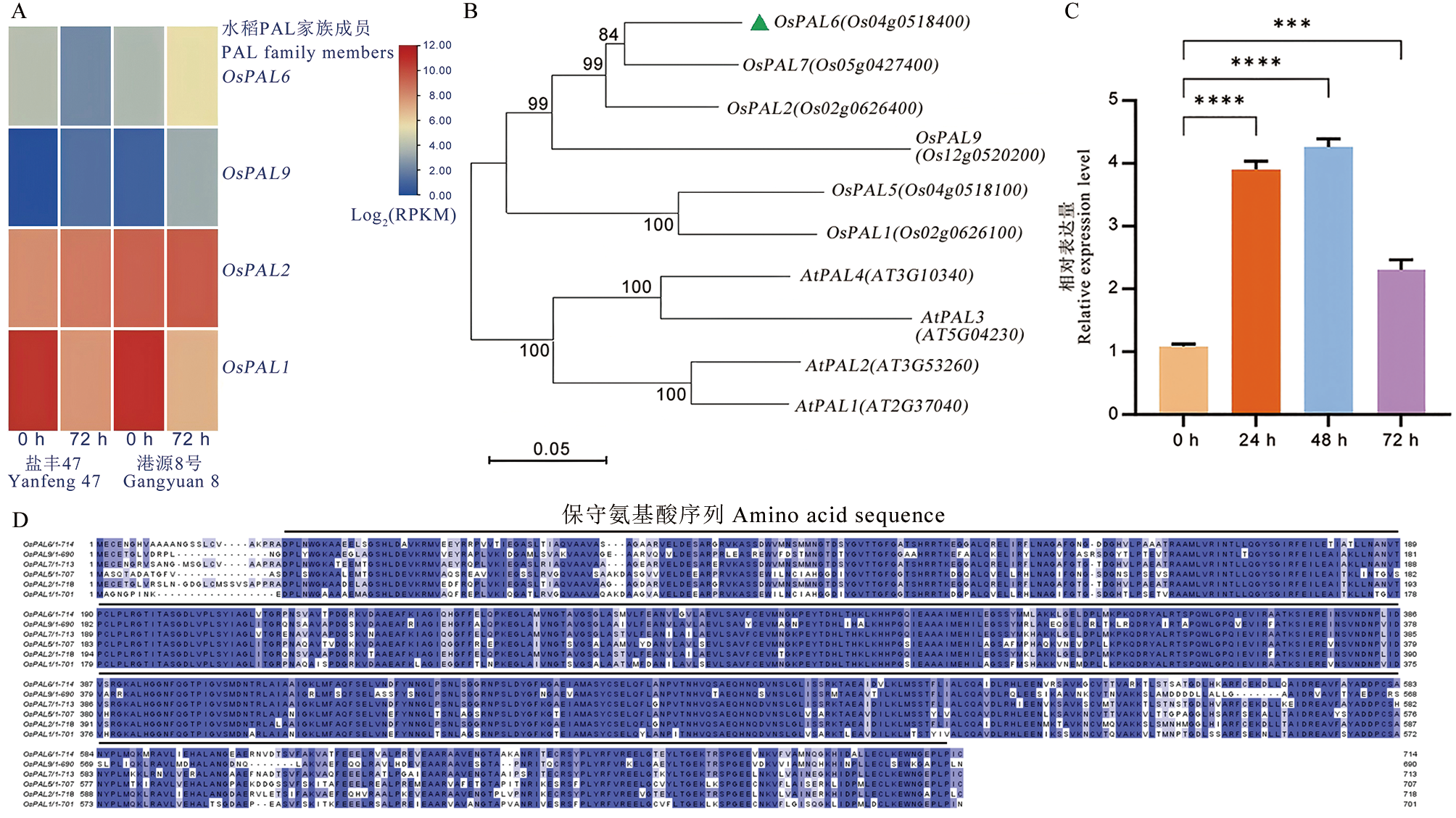
图1 OsPAL6的筛选和生物信息学分析 A:热图表示水稻4个PAL家族成员在转录组数据中的表达水平。B:OsPAL6的系统进化树,使用MEGA11软件构建。C:水稻叶片不同接种时间点OsPAL6的相对表达量,数据表示平均值±标准误(n=3)。D: 水稻PAL家族成员的多序列比对,使用Jalview软件构建。***,****表示通过单因素方差分析中Dunnett检验确定的显著性差异;***, P<0.001,****, P<0.0001。
Fig. 1. Screening and bioinformatics analysis of the OsPAL6 gene A, Heat map represents the expression levels of four PAL family members in rice based on transcriptomic data; B, Phylogenetic tree of OsPAL6 constructed using MEGA11 software; C, Relative expression levels of OsPAL6 in rice leaves at different time points following inoculation. Data are presented as mean±standard error (n=3); D, Multiple sequence alignment of rice PAL family members conducted with Jalview software; Data are presented as mean ± standard error (n=3). *** and **** indicate significant differences determined by the Dunnett's test in one-way ANOVA;***, P< 0.001 and ****, P< 0.0001.
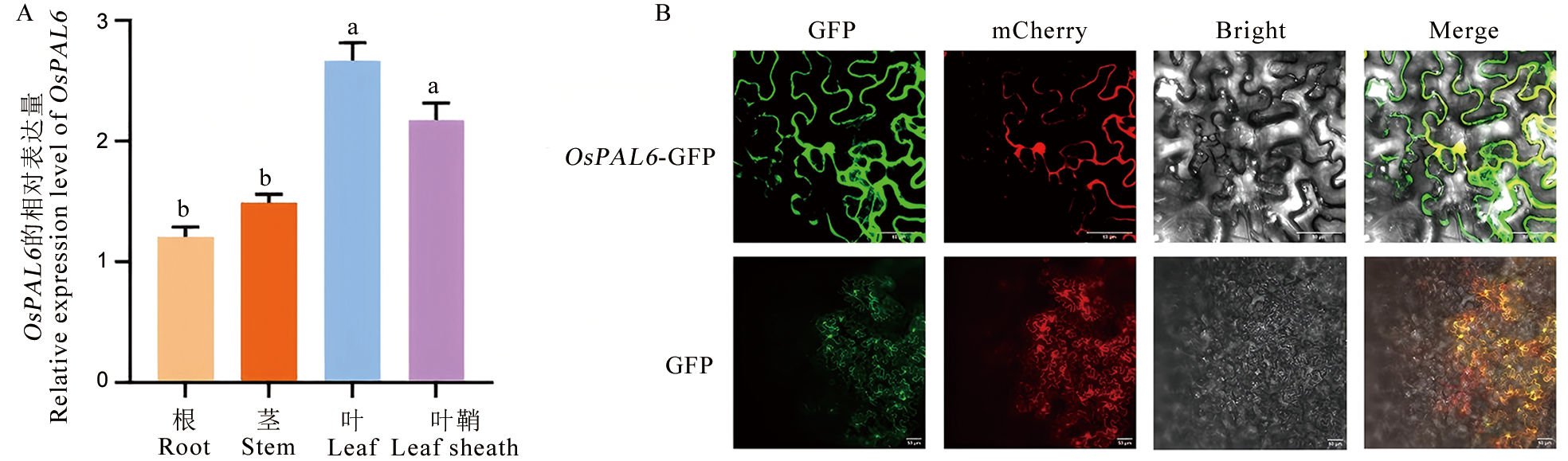
图2 OsPAL6的组织表达分析和亚细胞定位 A:OsPAL6在不同组织中的相对表达量,数据表示平均值±标准误(n=3)。B:OsPAL6在烟草细胞中的亚细胞定位,以pCAMBIA1302空质粒为对照,比例尺=50 μm。不同字母表示通过单因素方差分析中Tukey检验确定差异显著(P<0.05)。
Fig. 2. Tissue-specific expression analysis and subcellular localization of OsPAL6 A, Relative expression levels of OsPAL6 in different tissues. Data represent mean ± SE (n=3). B, Subcellular localization of OsPAL6 in tobacco cells, using the pCAMBIA1302 plasmid as a control, bar=50 μm. Different letters indicate significant differences determined by the Tukey's test in one-way ANOVA(P < 0.05).
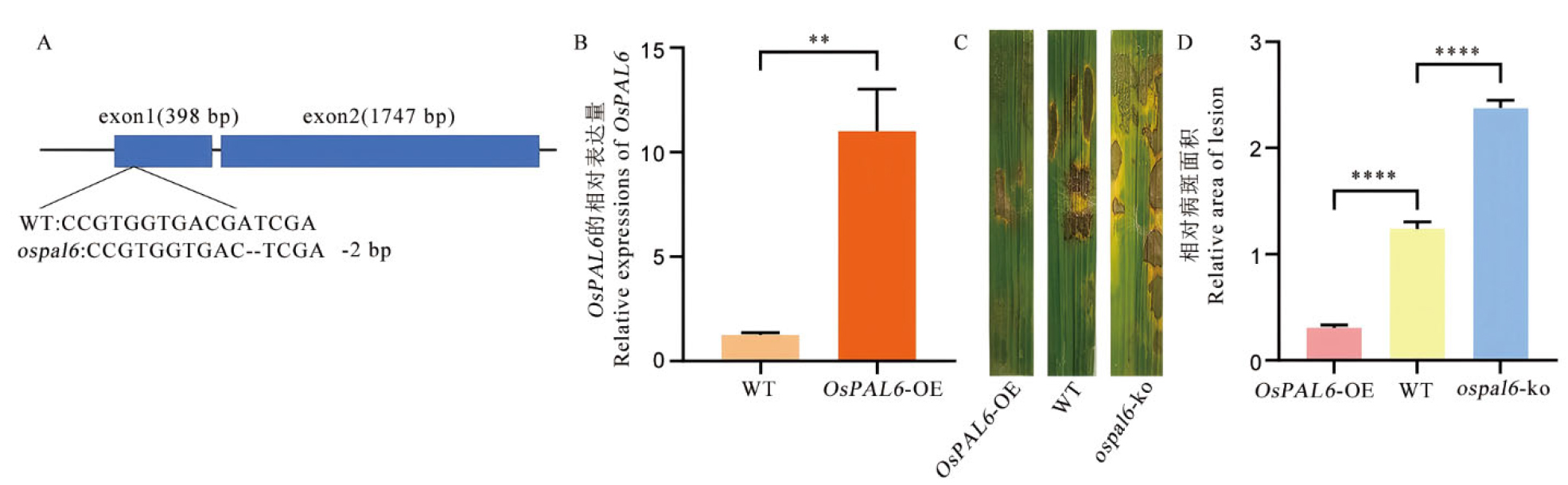
图3 OsPAL6的抗病功能研究 A:ospal6的突变位点分析,采用CRISPR/Cas9方法敲除OsPAL6,敲除位点位于第一个外显子,缺失2 bp碱基。B:OsPAL6在野生型和过表达植株中的相对表达量,数据表示平均值±标准误(n=3)。C:OsPAL6正调控水稻对纹枯病的抗性。D:三种类型植株接种纹枯病菌后叶片的相对病斑面积,数据表示平均值±标准误(n=3)。**表示通过单尾t检验确定的差异显著;****表示通过单因素方差分析中Dunnett检验差异显著;**P<0.01,****P<0.0001。
Fig. 3. Research on the disease resistance function of OsPAL6 A, Analysis of mutation sites in ospal6. OsPAL6 was knocked out using the CRISPR/Cas9 method, with the knockout site located in the first exon, resulting in a 2-bp deletion. B, Relative expression levels of OsPAL6 in the wild-type and the overexpression plants. Data represent mean ± SE (n=3). C, OsPAL6 positively regulates rice resistance to sheath blight. D, Relative lesion area on leaves from the three types of plants after inoculation with Rhizoctonia solani. Data represent mean ± SE (n=3). ** indicates a significant difference determined by a one-tailed t-test; **** indicates significant differences determined by Dunnett's test in one-way ANOVA; **P < 0.01, ****P < 0.0001.
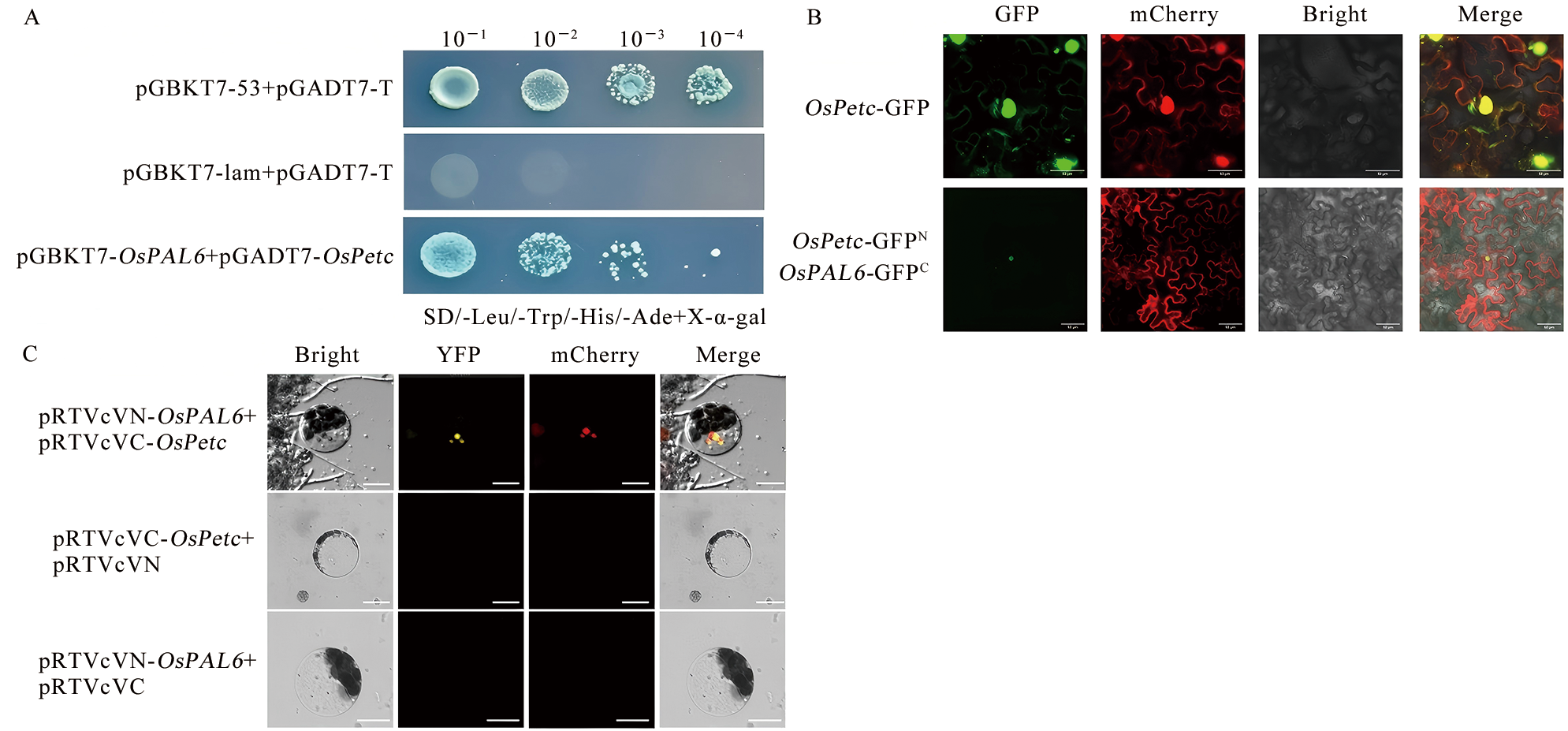
图4 OsPAL6与OsPetc的相互作用 A:酵母双杂交实验证明OsPAL6与OsPetc互作。B:烟草双分子荧光互补(BiFC)实验证明OsPAL6和OsPetc在细胞核中互作。C:水稻双分子荧光互补(BiFC)实验证明OsPAL6和OsPetc在细胞核中互作。
Fig. 4. Interaction between OsPAL6 and OsPetc A, Yeast two-hybrid assay demonstrates the interaction between OsPAL6 and OsPetc. B, The tobacco Bimolecular fluorescence complementation (BiFC) assay confirms that OsPAL6 interacts with OsPetc in cell nucleus; C, The Rice Bimolecular fluorescence complementation (BiFC) assay confirms that OsPAL6 interacts with OsPetc in the cell nucleus.
| [1] | Bhaskar Rao T, Chopperla R, Prathi N B, Balakrishnan M, Prakasam V, Laha G S, Balachandran S M, Mangrauthia S K. A comprehensive gene expression profile of pectin degradation enzymes reveals the molecular events during cell wall degradation and pathogenesis of rice sheath blight pathogen Rhizoctonia solani AG1-IA[J]. Journal of Fungi, 2020, 6(2): 71. |
| [2] | Reddy M S Y. Rice sheath blight: A review of disease and pathogen management approaches[J]. Journal of Plant Pathology & Microbiology, 2014, 5(4): 241. |
| [3] | Molla K A, Karmakar S, Molla J, Bajaj P, Varshney R K, Datta S K, Datta K. Understanding sheath blight resistance in rice: The road behind and the road ahead[J]. Plant Biotechnology Journal, 2020, 18(4): 895-915. |
| [4] | Chen X J, Chen Y, Zhang L N, Xu B, Zhang J H, Chen Z X, Tong Y H, Zuo S M, Xu J Y. Overexpression of OsPGIP1 enhances rice resistance to sheath blight[J]. Plant Disease, 2016, 100(2): 388-395. |
| [5] | Camm E L, Neil Towers G H. Phenylalanine ammonia lyase[J]. Phytochemistry, 1973, 12(5): 961-973. |
| [6] | Minamikawa T, Uritani I. Phenylalanine ammonia-lyase in sliced sweet potato roots[J]. Agricultural and Biological Chemistry, 1965, 29(11): 1021-1026. |
| [7] | Wanner L A, Li G, Ware D, Somssich I E, Davis K R. The phenylalanine ammonia-lyase gene family in Arabidopsis thaliana[J]. Plant Molecular Biology, 1995, 27(2): 327-338. |
| [8] | Calabrese J C, Jordan D B, Boodhoo A, Sariaslani S, Vannelli T. Crystal structure of phenylalanine ammonia lyase: Multiple helix dipoles implicated in catalysis[J]. Biochemistry, 2004, 43(36): 11403-11416. |
| [9] | Shields S E, Wingate V P, Lamb C J. Dual control of phenylalanine ammonia-lyase production and removal by its product cinnamic acid[J]. European Journal of Biochemistry, 1982, 123(2): 389-395. |
| [10] | Zhou X G, Liao H C, Chern M, Yin J J, Chen Y F, Wang J P, Zhu X B, Chen Z X, Yuan C, Zhao W, Wang J, Li W T, He M, Ma B T, Wang J C, Qin P, Chen W L, Wang Y P, Liu J L, Qian Y W, Wang W M, Wu X J, Li P, Zhu L H, Li S G, Ronald P C, Chen X W. Loss of function of a rice TPR-domain RNA-binding protein confers broad-spectrum disease resistance[J]. Proceedings of the National Academy of Sciences of the United States of America, 2018, 115(12): 3174-3179. |
| [11] | Duan L, Liu H, Li X, Xiao J, Wang S. Multiple phytohormones and phytoalexins are involved in disease resistance to Magnaporthe oryzae invaded from roots in rice[J]. Physiologia Plantarum, 2014, 152(3): 486-500. |
| [12] | Yan J, Aboshi T, Teraishi M, Strickler S R, Spindel J E, Tung C W, Takata R, Matsumoto F, Maesaka Y, McCouch S R, Okumoto Y, Mori N, Jander G. The tyrosine aminomutase TAM1 is required for β-tyrosine biosynthesis in rice[J]. The Plant Cell, 2015, 27(4): 1265-1278. |
| [13] | Tonnessen B W, Manosalva P, Lang J M, Baraoidan M, Bordeos A, Mauleon R, Oard J, Hulbert S, Leung H, Leach J E. Rice phenylalanine ammonia-lyase gene OsPAL4 is associated with broad spectrum disease resistance[J]. Plant Molecular Biology, 2015, 87(3): 273-286. |
| [14] | Bhattacharyya D, Chakraborty S. Chloroplast: The Trojan horse in plant-virus interaction[J]. Molecular Plant Pathology, 2018, 19(2): 504-518. |
| [15] | Cramer W A, Zhang H. Consequences of the structure of the cytochrome b6f complex for its charge transfer pathways[J]. Biochimica et Biophysica Acta, 2006, 1757(5/6): 339-345. |
| [16] | Wang Y, Luo H, Wang H, Xiang Z, Wei S, Zheng W. Comparative transcriptome analysis of rice cultivars resistant and susceptible to Rhizoctonia solani AG1-IA[J]. BMC Genomics, 2022, 23(1): 606. |
| [17] | Raes J, Rohde A, Christensen J H, van de Peer Y, Boerjan W. Genome-wide characterization of the lignification toolbox in Arabidopsis[J]. Plant Physiology, 2003, 133(3): 1051-1071. |
| [18] | Barros J, Serrani-Yarce J C, Chen F, Baxter D, Venables B J, Dixon R A. Role of bifunctional ammonia-lyase in grass cell wall biosynthesis[J]. Nature Plants, 2016, 2: 16050. |
| [19] | van Butselaar T, van den Ackerveken G. Salicylic acid steers the growth-immunity tradeoff[J]. Trends in Plant Science, 2020, 25(6): 566-576. |
| [20] | Garcion C, Lohmann A, Lamodière E, Catinot J, Buchala A, Doermann P, Métraux J P. Characterization and biological function of the ISOCHORISMATE SYNTHASE2 gene of Arabidopsis[J]. Plant Physiology, 2008, 147(3): 1279-1287. |
| [21] | Wang R Y, You X M, Zhang C Y, Fang H, Wang M, Zhang F, Kang H X, Xu X, Liu Z, Wang J Y, Zhao Q Z, Wang X L, Hao Z Y, He F, Tao H, Wang D B, Wang J S, Fang L, Qin M C, Zhao T X, Zhang P P, Xing H F, Xiao Y P, Liu W D, Xie Q, Wang G L, Ning Y S. An ORFeome of rice E3 ubiquitin ligases for global analysis of the ubiquitination interactome[J]. Genome Biology, 2022, 23(1): 154. |
| [22] | He J, Liu Y Q, Yuan D Y, Duan M J, Liu Y L, Shen Z J, Yang C Y, Qiu Z Y, Liu D M, Wen P Z, Huang J, Fan D J, Xiao S Z, Xin Y Y, Chen X N, Jiang L, Wang H Y, Yuan L P, Wan J M. An R2R3 MYB transcription factor confers brown planthopper resistance by regulating the phenylalanine ammonia-lyase pathway in rice[J]. Proceedings of the National Academy of Sciences of the United States of America, 2020, 117(1): 271-277. |
| [23] | Littlejohn G R, Breen S, Smirnoff N, Grant M. Chloroplast immunity illuminated[J]. The New Phytologist, 2021, 229(6): 3088-3107. |
| [24] | 郑红英. TuMV HC-Pro蛋白自身互作及其与拟南芥编码Rieske Fe/S蛋白的互作研究[D]. 武汉: 华中农业大学, 2011. |
| Zheng H Y. Study on the interaction between TuMV HC-Pro protein and Rieske Fe/S protein encoded by Arabidopsis thaliana[D]. Wuhan: Huazhong Agricultural University, 2011. (in Chinese with English abstract) | |
| [25] | Qiu T C, Wei S, Fang K X, Zhang M, Li Y X, Feng Y Y, Cheng Y P, Zhang S W, Tian J G, Gao A A, Yang Q Y, Yang M N, Bhadauria V, Li J J, Peng Y L, Zhao W S. The atypical Dof transcriptional factor OsDes1 contributes to stay-green, grain yield, and disease resistance in rice[J]. Science Advances, 2024, 10(34): eadp0345. |
| [1] | 郝栖贤, 周坤能, 云鹏, 张彩娟, 夏加发, 李泽福. 水稻E3泛素连接酶的功能研究进展[J]. 中国水稻科学, 2026, 40(6): 705-725. |
| [2] | 李洪洲, 陈家乐, Muhammad ZUBAIR, 张健, 杨隆维, 应杰政. 水稻穗粒数的遗传基础和育种利用[J]. 中国水稻科学, 2026, 40(6): 726-741. |
| [3] | 侯鹰翔, 费思恬, 陈海波, 孙清, 王伟平, 张超. 水稻耐淹的适应机制及分子调控研究进展[J]. 中国水稻科学, 2026, 40(6): 742-755. |
| [4] | 赵冬生, 李羽帆, 赵贝贝, 张涛, 李钱峰, 刘巧泉. 水稻短圆粒突变体srg10的基因克隆及其功能分析[J]. 中国水稻科学, 2026, 40(6): 756-766. |
| [5] | 高凌霄, 叶凡, 李帅, 陈云, 刘立军. 干湿交替灌溉对黑龙江稻区水稻产量和品质的影响[J]. 中国水稻科学, 2026, 40(6): 786-795. |
| [6] | 汤洪伟, 吴岳, 朱新霞, 刘雪梅, 杨晴, 王丹英, 刘元辉. 微生物菌剂对水稻吸收富集镉及根系微生物群落的影响[J]. 中国水稻科学, 2026, 40(6): 808-820. |
| [7] | 童毅, 钱前, 高振宇. 水稻分子设计育种研究进展[J]. 中国水稻科学, 2026, 40(5): 569-583. |
| [8] | 柴炳泽, 王俊格, 吴凯雄, 刘嘉龙, 吴越, 王荟森, 谭霖, 任德勇, 高振宇, 朱丽, 张强, 张光恒, 钱前, 胡江. 水稻粒形和穗粒数基因GSN4的克隆与单倍型分析[J]. 中国水稻科学, 2026, 40(5): 584-597. |
| [9] | 冯莆淋, 杨绮文, 吴佳益, 范鸣谦, 程艳双, 邱忠华, 郭然, 陈温福, 王嘉宇. 水稻颖壳发育基因AGL1的图位克隆与功能分析[J]. 中国水稻科学, 2026, 40(5): 607-617. |
| [10] | 于冰洁, 王浩宇, 葛语桐, 崔格格, 张海鹏, 魏海燕, 张洪程, 许方甫. 油菜秸秆还田下增苗减氮对中熟晚粳稻产量和品质的影响[J]. 中国水稻科学, 2026, 40(5): 618-631. |
| [11] | 杨昌南, 何子欣, 谈亚文, 张学智, 张业诚, 田浩然, 危常州, 张新疆. 滴灌配施不同形态氮肥管理对水稻根际氮转化过程及产量形成的影响[J]. 中国水稻科学, 2026, 40(5): 632-647. |
| [12] | 王新雅, 何卓婷, 李潇, 尤赛雅, 朱练峰, 孔亚丽, 朱春权, 田文昊, 张均华, 金千瑜, 曹小闯. 秸秆分层还田耦合腐解菌剂通过调控土壤有机碳转化和微生物群落结构提高水稻产量[J]. 中国水稻科学, 2026, 40(5): 648-662. |
| [13] | 许永炜, 刘淑华, 冯泽霖, 罗举, 倪兆新, 杨保军, 姚青, 李阿根. 基于多模态融合的水稻生育期智能识别方法[J]. 中国水稻科学, 2026, 40(5): 663-678. |
| [14] | 冯爱卿, 张亚博, 周继勇, 苏菁, 封金奇, 陈凯玲, 陈炳, 梁美玲, 朱小源, 汪聪颖, 陈深. 10个抗白叶枯病基因在华南水稻品种中的分布研究[J]. 中国水稻科学, 2026, 40(5): 679-695. |
| [15] | 陈春晓, 付琳丽, 张微, 卜庆云, 田晓杰. 水稻MAPK家族基因功能研究进展[J]. 中国水稻科学, 2026, 40(4): 425-435. |
| 阅读次数 | ||||||
|
全文 |
|
|||||
|
摘要 |
|
|||||
