
中国水稻科学 ›› 2026, Vol. 40 ›› Issue (6): 821-837.DOI: 10.16819/j.1001-7216.2026.260114
刘皓东1, 丁启朔1,*( ), 陈少桦1, 李毅念1, 颜晓元2, 徐高明3, 何瑞银1
收稿日期:2026-01-23
修回日期:2026-05-18
出版日期:2026-11-10
发布日期:2026-11-09
通讯作者:
*email: qsding@njau.edu.cn基金资助:
LIU Haodong1, DING Qishuo1,*(), CHEN Shaohua1, LI Yinian1, YAN Xiaoyuan2, XU Gaoming3, HE Ruiyin1
Received:2026-01-23
Revised:2026-05-18
Online:2026-11-10
Published:2026-11-09
摘要:
【目的】研制旱稻覆膜旱作配套机具,探讨不同机械化栽培技术对机具作业质量及出苗等农艺效应的影响,为机具优化升级和机直播优质栽培提供理论依据。【方法】针对覆膜旱直播(MS)和旱直播覆膜(SM)两种作业方式研制配套样机,结合全膜覆土(1)、带状覆土(2)、不覆土(3)的覆土方式构建6种机械化栽培技术(MS1,MS2,MS3,SM1,SM2及不覆膜CK),构建机具作业质量、农艺效应评价指标集,探究覆土方式对机具作业质量和栽培技术对农艺效应的影响,并探讨指标间的内在联系。【结果】不同覆土方式对机具作业质量影响显著,MS1、MS2的孔穴错位率较MS3降低60.74%~71.45%、种子覆土厚度提高21.99%~31.59%,播种作业质量显著优于MS3,出苗率提高27.16%~32.23%;SM1的膜土贴合度较SM2提高17.72%,出苗率提高了6.81%;2种作业方式的农艺效应存在显著差异,SM的土壤含水率较MS提高9.30%~22.00%、杂草密度降低75.12%~79.24%,但出苗率降低16.15%~18.37%、产量降低4.31%~5.50%。在作业质量与农艺效应的关系方面,孔穴错位率、膜土贴合度与出苗率的相关系数分别为−0.949、0.818,且出苗率与有效穗数、产量显著正相关。MS作业方式的出苗及产量指标与作业质量、环境因子等多指标显著相关,而SM中仅与膜土贴合度等作业质量指标显著相关。【结论】旱直播覆膜和覆膜旱直播各具技术优势,需结合区域生产条件选用适配技术并优化配套机具,以充分发挥机械化栽培的农艺增益效应。同时膜上覆土厚度需稳定在15~20 mm,保障机具作业质量与田间出苗效果。
刘皓东, 丁启朔, 陈少桦, 李毅念, 颜晓元, 徐高明, 何瑞银. 旱稻覆膜旱作机械化栽培技术的构建与评价[J]. 中国水稻科学, 2026, 40(6): 821-837.
LIU Haodong, DING Qishuo, CHEN Shaohua, LI Yinian, YAN Xiaoyuan, XU Gaoming, HE Ruiyin. Development and Evaluation of Mechanized Cultivation Techniques for Film-mulched Dry Farming of Upland Rice[J]. Chinese Journal OF Rice Science, 2026, 40(6): 821-837.
| 栽培技术 Cultivation technique | 作业流程 Operation process | 特征 Characteristics |
|---|---|---|
| MS1 | 先覆膜后破膜直播,膜上覆土全膜覆盖 Film mulching followed by perforation and direct seeding with soil covering the entire film surface | 覆土厚度10~20 mm Soil covering thickness 10~20 mm |
| MS2 | 先覆膜后破膜直播,种行膜上带状覆土 Film mulching followed by perforation and direct seeding with soil covering the entire film surface | 覆土宽度100 mm,覆土厚度10~20 mm Soil covering width 100 mm, soil covering thickness 10~20 mm |
| MS3 | 先覆膜后破膜直播,膜上无覆土 Film mulching followed by perforated direct seeding, with no soil covering the film | 地表裸膜覆盖 Bare film mulching on the soil surface |
| SM1 | 先旱地直播后覆膜,膜上覆土全膜覆盖 Dry direct seeding followed by full-film mulching with soil covering the film | 覆土厚度10~20 mm Soil covering thickness 10~20 mm |
| SM2 | 先旱地直播后覆膜,种行膜上带状覆土 Dry direct seeding followed by film mulching, with strip soil covering the film along the seed rows | 覆土宽度100 mm,覆土厚度10~20 mm Soil covering width 100 mm, soil covering thickness 10~20 mm |
| CK | 旱地直播不覆膜 Dry direct seeding without film mulching | 裸地表 Bare soil surface |
表1 不同机械化栽培技术的作业特征
Table 1. Operation characteristics of different mechanized cultivation techniques
| 栽培技术 Cultivation technique | 作业流程 Operation process | 特征 Characteristics |
|---|---|---|
| MS1 | 先覆膜后破膜直播,膜上覆土全膜覆盖 Film mulching followed by perforation and direct seeding with soil covering the entire film surface | 覆土厚度10~20 mm Soil covering thickness 10~20 mm |
| MS2 | 先覆膜后破膜直播,种行膜上带状覆土 Film mulching followed by perforation and direct seeding with soil covering the entire film surface | 覆土宽度100 mm,覆土厚度10~20 mm Soil covering width 100 mm, soil covering thickness 10~20 mm |
| MS3 | 先覆膜后破膜直播,膜上无覆土 Film mulching followed by perforated direct seeding, with no soil covering the film | 地表裸膜覆盖 Bare film mulching on the soil surface |
| SM1 | 先旱地直播后覆膜,膜上覆土全膜覆盖 Dry direct seeding followed by full-film mulching with soil covering the film | 覆土厚度10~20 mm Soil covering thickness 10~20 mm |
| SM2 | 先旱地直播后覆膜,种行膜上带状覆土 Dry direct seeding followed by film mulching, with strip soil covering the film along the seed rows | 覆土宽度100 mm,覆土厚度10~20 mm Soil covering width 100 mm, soil covering thickness 10~20 mm |
| CK | 旱地直播不覆膜 Dry direct seeding without film mulching | 裸地表 Bare soil surface |
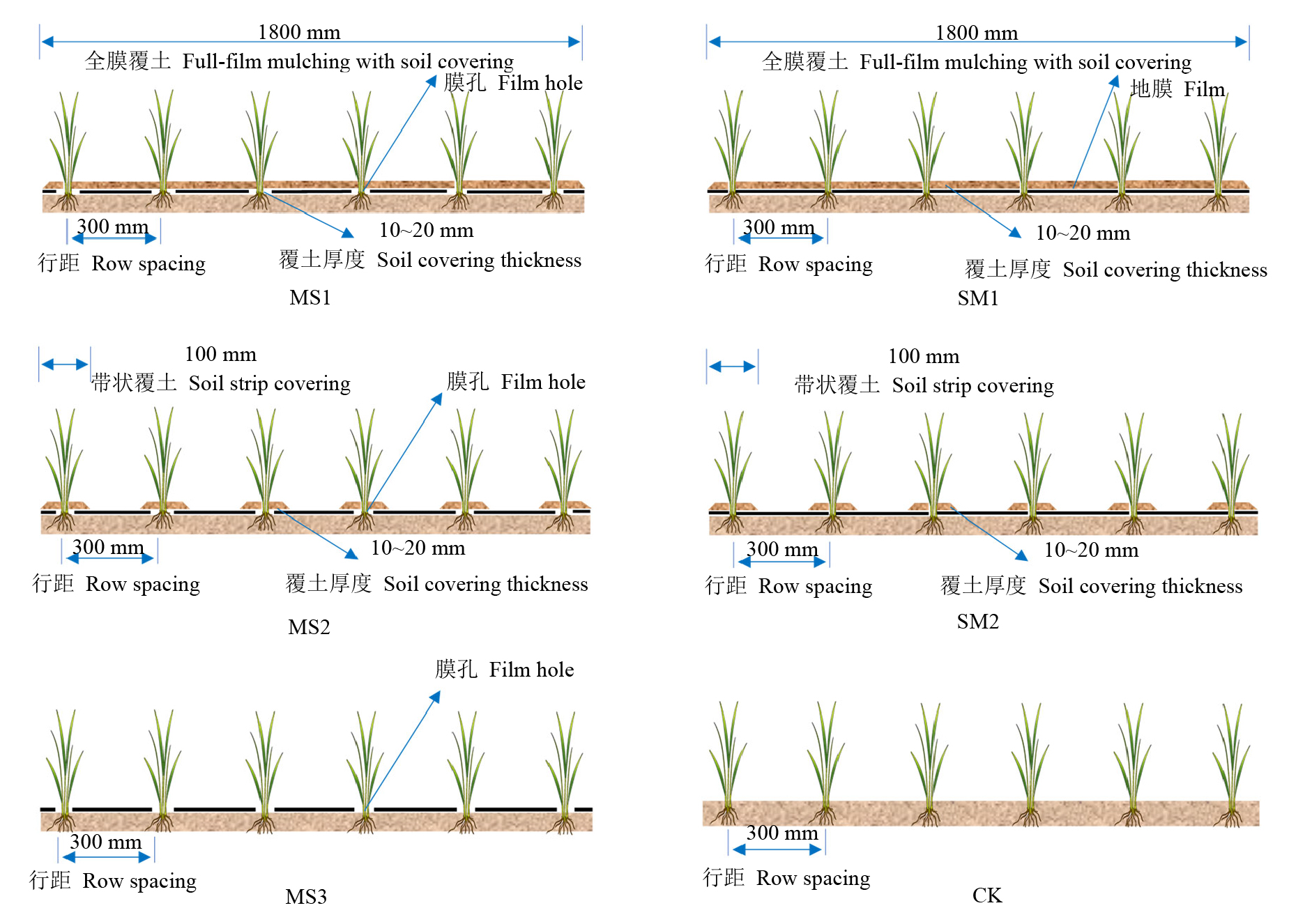
图1 旱稻覆膜旱作机械化栽培技术示意图
Fig. 1. Schematic diagrams of various mechanized cultivation techniques for film-mulched dry farming of upland rice
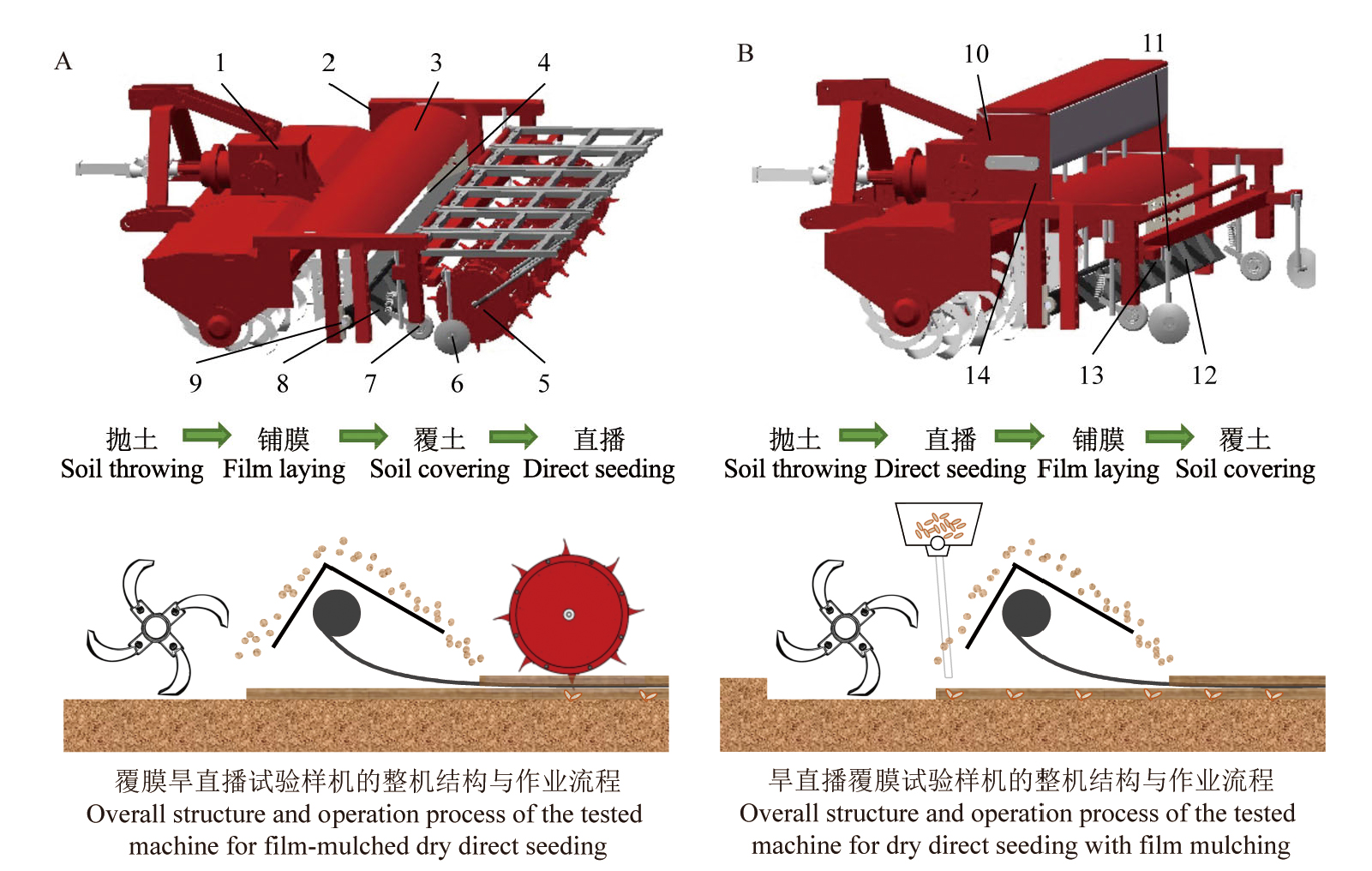
图2 两种旱稻覆膜旱作试验样机的整机结构与作业流程 1: 旋耕机; 2: 机架; 3: 挡土罩; 4: 导土板; 5: 破膜穴播器; 6: 覆土圆盘; 7: 压膜轮; 8: 覆土板; 9: 铺膜装置; 10: 直播装置; 11: 栅条入土口; 12: 栅条出土口; 13: 分土栅条; 14: 输种管。
Fig. 2. Overall machine structure and operation processes of two types of tested film-mulching dry farming machines for upland rice 1, Rotary tiller; 2, Machine frame; 3, Soil retaining shield; 4, Soil guiding plate; 5, Hole seeder; 6, Soil covering disc; 7, Film pressing wheel; 8, Soil covering plate; 9, Film mulching device; 10, Direct seeding device; 11, Soil inlet of grid bar; 12, Soil outlet of grid bar; 13, Soil dividing grid bars; 14, Seed tube.
| 参数 Parameter | 数值 Value | 参数 Parameter | 数值 Value |
|---|---|---|---|
| 整机尺寸(长×宽×高) Overall dimensions(length×width×height) (mm) | 1,468×2,118×930 | 覆土层厚度 Soil covering thickness (mm) | 10~20 |
| 作业幅宽 Working width (mm) | 2,000 | 行数 Number of rows | 6 |
| 刀轴转速 Rotor speed (r/min) | 200~600 | 播种行距 Row spacing (mm) | 300 |
| 作业耕深 Working depth (mm) | 30~70 | 穴距 Hill spacing (mm) | 150 |
| 作业速度Working speed (km/h) | 2~5 | 穴粒数 Seeds per hill | 3~6 |
表2 覆膜旱直播试验样机作业参数
Table 2. Operation parameters of the tested machine for film-mulched dry direct seeding
| 参数 Parameter | 数值 Value | 参数 Parameter | 数值 Value |
|---|---|---|---|
| 整机尺寸(长×宽×高) Overall dimensions(length×width×height) (mm) | 1,468×2,118×930 | 覆土层厚度 Soil covering thickness (mm) | 10~20 |
| 作业幅宽 Working width (mm) | 2,000 | 行数 Number of rows | 6 |
| 刀轴转速 Rotor speed (r/min) | 200~600 | 播种行距 Row spacing (mm) | 300 |
| 作业耕深 Working depth (mm) | 30~70 | 穴距 Hill spacing (mm) | 150 |
| 作业速度Working speed (km/h) | 2~5 | 穴粒数 Seeds per hill | 3~6 |
| 参数 Parameter | 数值 Value | 参数 Parameter | 数值 Value |
|---|---|---|---|
| 整机尺寸(长×宽×高) Overall dimensions (length×width×height) (mm) | 1,388×2,118×930 | 覆土层厚度 Soil covering thickness (mm) | 10~20 |
| 作业幅宽 Working width (mm) | 2,000 | 行数 Number of rows | 6 |
| 刀轴转速 Rotor speed (r/min) | 200~600 | 播种行距 Row spacing (mm) | 300 |
| 作业耕深 Working depth (mm) | 30~70 | 穴距 Hill spacing (mm) | 150 |
| 作业速度Working speed (km/h) | 3~6 | 穴粒数 Seeds per hill | 3~8 |
表3 旱直播覆膜试验样机作业参数
Table 3. Operation parameters of the tested machine for dry direct seeding with film mulching
| 参数 Parameter | 数值 Value | 参数 Parameter | 数值 Value |
|---|---|---|---|
| 整机尺寸(长×宽×高) Overall dimensions (length×width×height) (mm) | 1,388×2,118×930 | 覆土层厚度 Soil covering thickness (mm) | 10~20 |
| 作业幅宽 Working width (mm) | 2,000 | 行数 Number of rows | 6 |
| 刀轴转速 Rotor speed (r/min) | 200~600 | 播种行距 Row spacing (mm) | 300 |
| 作业耕深 Working depth (mm) | 30~70 | 穴距 Hill spacing (mm) | 150 |
| 作业速度Working speed (km/h) | 3~6 | 穴粒数 Seeds per hill | 3~8 |
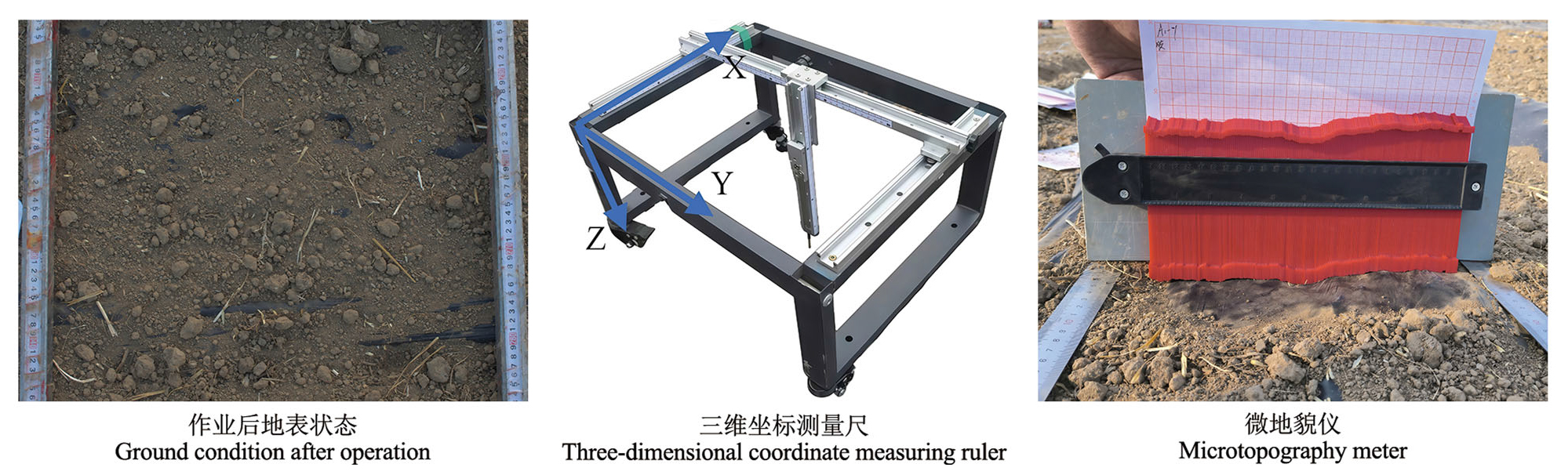
图3 机具作业后地表状态与测试工具
Fig. 3. Ground condition and testing tools after machine operation
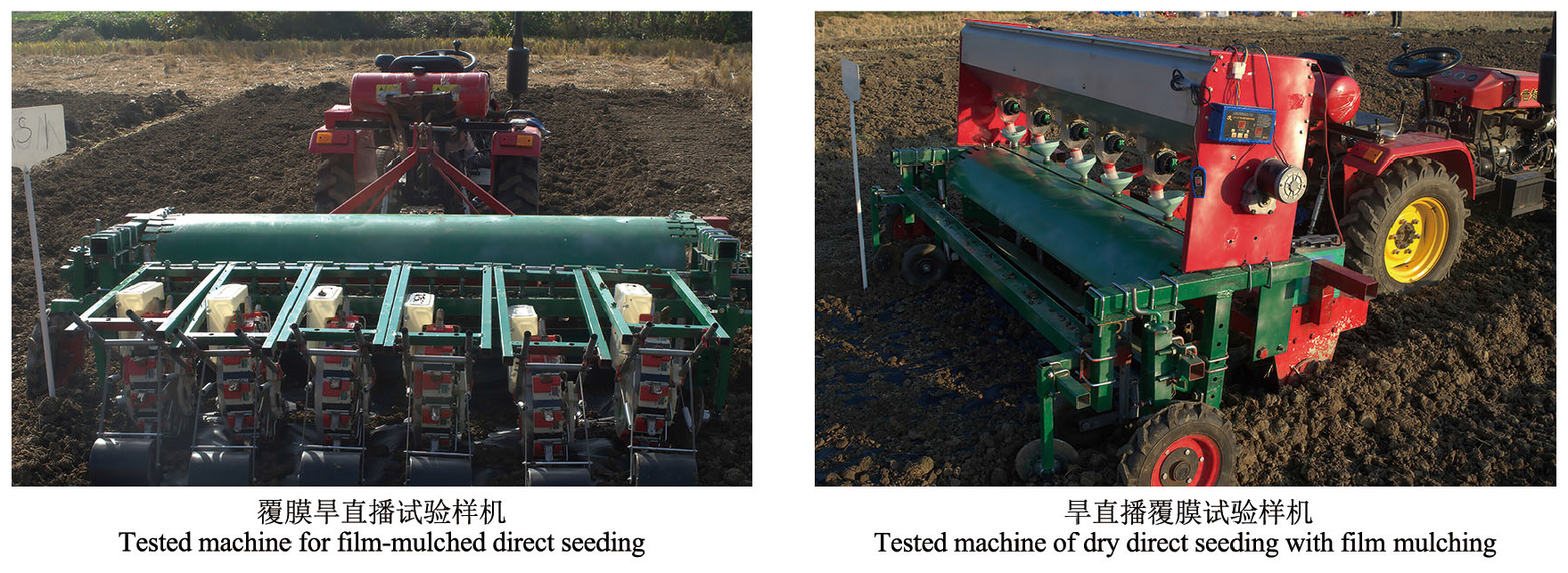
图4 两台旱稻覆膜旱作试验样机田间作业展示
Fig. 4. Field operation display of two tested film-mulching dry farming machines for upland rice
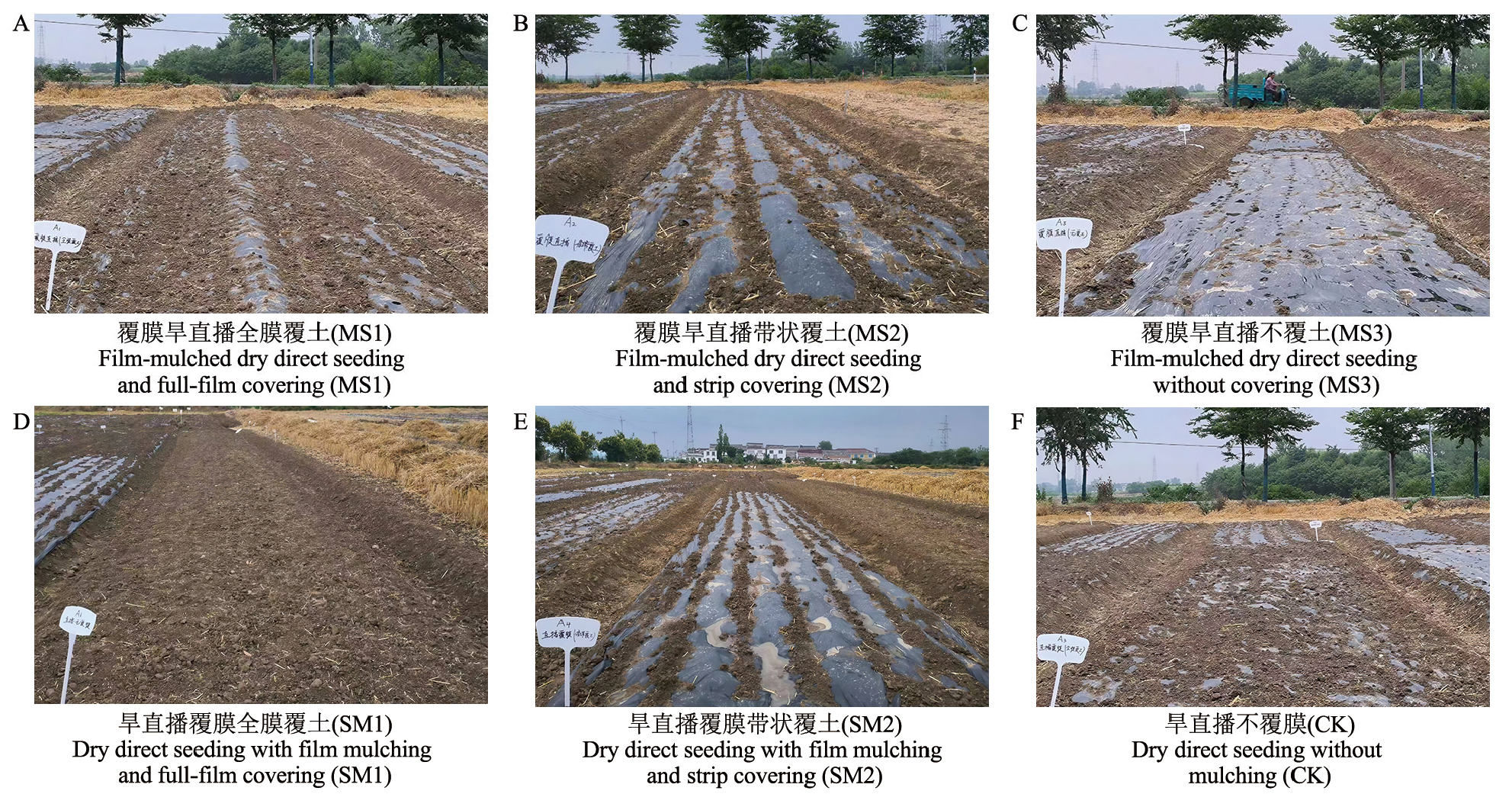
图5 旱稻覆膜旱作机械化栽培技术的田间作业效果
Fig. 5. Field operation performance of mechanized cultivation techniques for film-mulched dry farming of upland rice
| 栽培技术 Cultivation technique | 膜孔横向长度Transverse length of film holes (mm) | 膜孔纵向长度Longitudinal length of film holes (mm) | 种-孔中心距 Seed-hole center distance (mm) | 种子覆土厚度 Seed covering thickness (mm) | 孔穴错位率 Hole dislocation rate (%) |
|---|---|---|---|---|---|
| MS1 | 25.33±0.57 c | 21.74±1.57 b | 4.86±0.16 b | 24.70±0.30 a | 5.33±4.16 b |
| MS2 | 27.23±0.26 b | 20.23±1.70 b | 5.97±0.21 b | 22.90±1.04 b | 7.33±3.06 b |
| MS3 | 34.40±0.26 a | 16.37±1.04 a | 7.57±1.25 a | 18.77±1.12 c | 18.67±3.06 a |
| F值F value | 12.93** | 10.75** | 446.12** | 10.20* | 34.37** |
表4 覆膜旱直播各机械化栽培技术的作业质量
Table 4. Operation quality of various mechanized cultivation techniques for film-mulched dry direct seeding
| 栽培技术 Cultivation technique | 膜孔横向长度Transverse length of film holes (mm) | 膜孔纵向长度Longitudinal length of film holes (mm) | 种-孔中心距 Seed-hole center distance (mm) | 种子覆土厚度 Seed covering thickness (mm) | 孔穴错位率 Hole dislocation rate (%) |
|---|---|---|---|---|---|
| MS1 | 25.33±0.57 c | 21.74±1.57 b | 4.86±0.16 b | 24.70±0.30 a | 5.33±4.16 b |
| MS2 | 27.23±0.26 b | 20.23±1.70 b | 5.97±0.21 b | 22.90±1.04 b | 7.33±3.06 b |
| MS3 | 34.40±0.26 a | 16.37±1.04 a | 7.57±1.25 a | 18.77±1.12 c | 18.67±3.06 a |
| F值F value | 12.93** | 10.75** | 446.12** | 10.20* | 34.37** |
| 栽培技术 Cultivation technique | 膜土间隙的各尺度区间分布占比 Film-soil gap distribution in each scale interval (%) | 膜土贴合度 Film-soil contact degree (%) | 种子覆土厚度 Seed covering thickness (mm) | |||
|---|---|---|---|---|---|---|
| 0~3 mm | 3~6 mm | 6~9 mm | >9 mm | |||
| SM1 | 70.89±4.28 a | 13.33±1.76 a | 8.22±1.68 a | 7.33±3.53 a | 70.89±4.28 a | 20.87±2.04 a |
| SM2 | 60.22±4.44 b | 12.67±1.33 a | 13.33±3.53 a | 13.78±1.02 b | 60.22±4.44 b | 19.00±1.11 a |
| F值F value | 8.96* | ns | ns | 9.25* | 8.96* | ns |
表5 旱直播覆膜各机械化栽培技术的作业质量
Table 5. Operation quality of various mechanized cultivation techniques for dry direct seeding with film mulching
| 栽培技术 Cultivation technique | 膜土间隙的各尺度区间分布占比 Film-soil gap distribution in each scale interval (%) | 膜土贴合度 Film-soil contact degree (%) | 种子覆土厚度 Seed covering thickness (mm) | |||
|---|---|---|---|---|---|---|
| 0~3 mm | 3~6 mm | 6~9 mm | >9 mm | |||
| SM1 | 70.89±4.28 a | 13.33±1.76 a | 8.22±1.68 a | 7.33±3.53 a | 70.89±4.28 a | 20.87±2.04 a |
| SM2 | 60.22±4.44 b | 12.67±1.33 a | 13.33±3.53 a | 13.78±1.02 b | 60.22±4.44 b | 19.00±1.11 a |
| F值F value | 8.96* | ns | ns | 9.25* | 8.96* | ns |
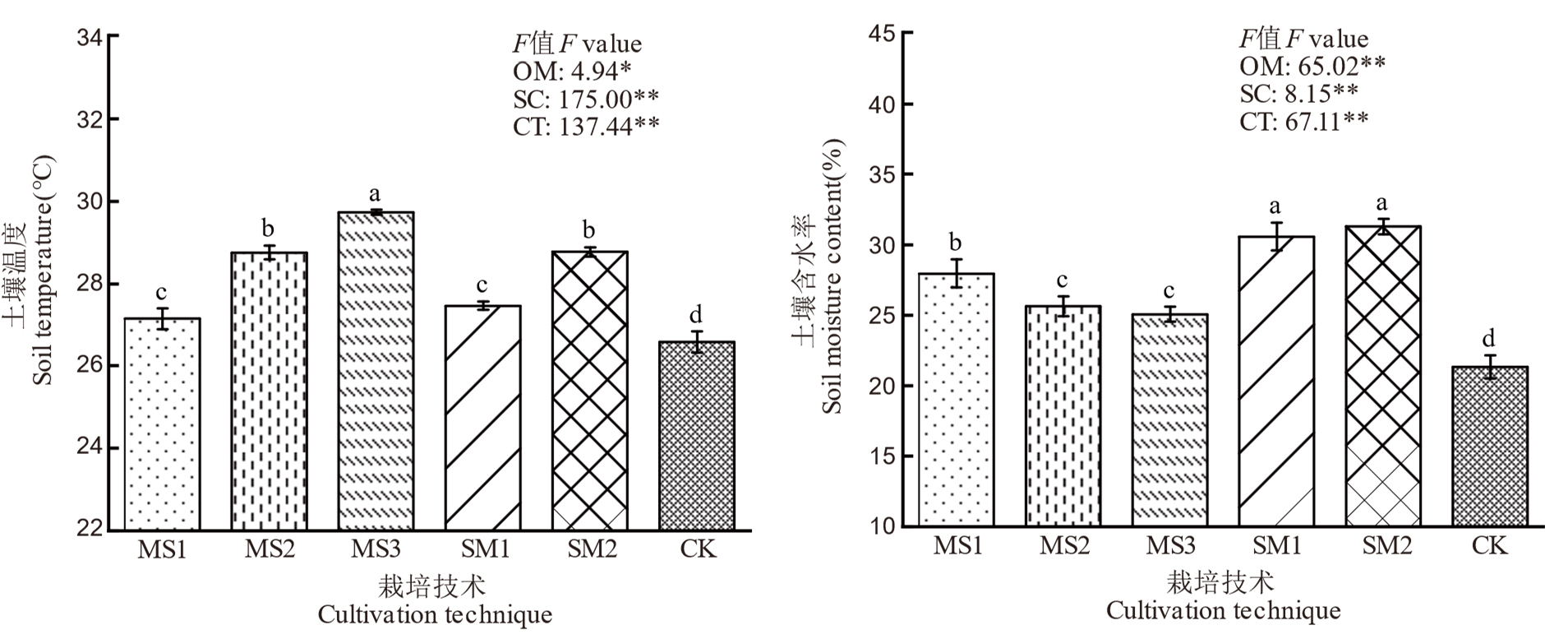
图6 不同机械化栽培技术作业后的土壤温度和含水率 OM:作业方式;SC:覆土方式;CT:栽培技术。柱上不同字母表示在0.05水平上差异显著。*和**分别表示达到0.05和0.01显著水平。下同。
Fig. 6. Soil temperature and moisture content after operation of different mechanized cultivation techniques OM, Operation mode; SC, Soil covering mode; CT, Cultivation technique. Different letters indicate significant differences among treatments at the 0.05 level. * and ** indicate different significances at the 0.05 and 0.01 levels, respectively. The same below.
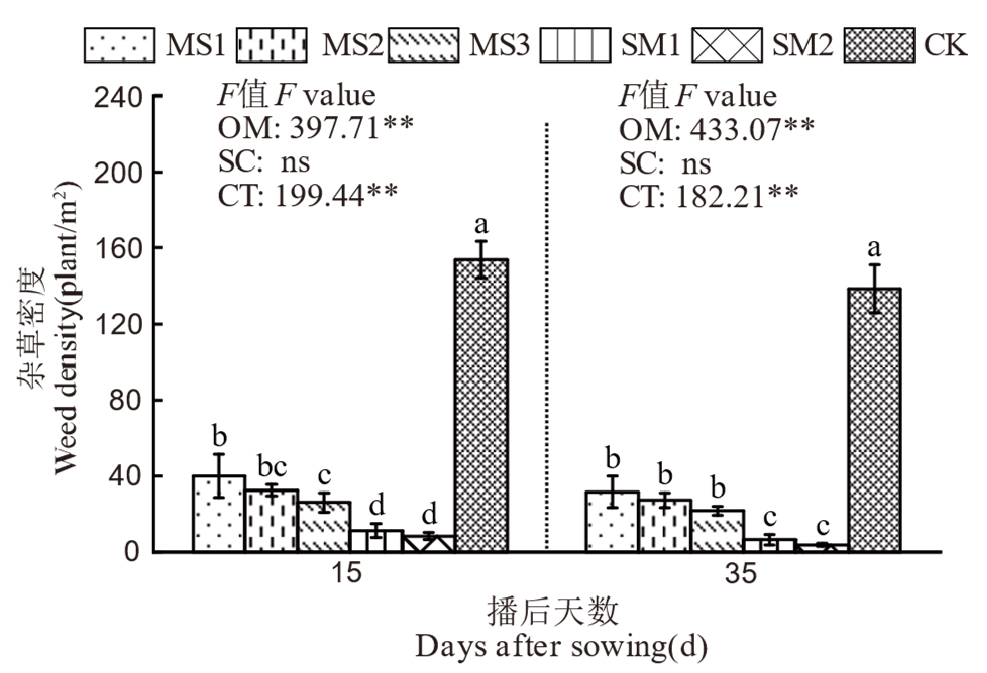
图7 不同机械化栽培技术作业后的杂草密度
Fig. 7. Weed density after operation of different mechanized cultivation techniques
| 作业方式 Operation mode | 栽培技术 Cultivation technique | 出苗率 Emergence rate (%) | 地上部干物质量 Aboveground dry matter weight (mg/10 plants) | 地下部干物质量 Underground dry matter weight (mg/10 plants) | 株高 Plant height (cm) |
|---|---|---|---|---|---|
| MS | MS1 | 83.40±1.83 a | 172.90±2.69 bc | 70.15±1.50 ab | 14.17±0.36 ab |
| MS2 | 80.20±1.80 ab | 169.77±3.56 c | 67.67±1.11 bc | 14.02±0.35 bc | |
| MS3 | 63.07±3.91 d | 163.25±3.63 d | 65.31±1.55 cd | 13.47±0.25 c | |
| SM | SM1 | 69.93±1.60 c | 177.58±4.87 ab | 72.91±1.52 a | 14.49±0.27 ab |
| SM2 | 65.47±2.39 cd | 180.15±0.44 a | 73.15±2.17 a | 14.75±0.07 a | |
| 平均 Mean | MS | 75.56±9.75 A | 168.64±5.14 B | 67.71±2.42 B | 13.89±0.43 B |
| SM | 67.70±3.05 A | 178.86±3.40 A | 73.03±1.68 A | 14.62±0.23 A | |
| CK | 76.20±4.42 bA | 157.49±4.76 dC | 61.86±3.47 dC | 12.52±0.57 dC | |
| F值 F value | |||||
| OM | ns | 22.80** | 23.02** | 27.95** | |
| SC | 41.29** | 4.54* | 4.54* | 3.95* | |
| CT | 24.26** | 16.73** | 14.25** | 16.29** | |
表6 不同机械化栽培技术作业后的出苗率与幼苗素质
Table 6. Emergence rate and seedling quality after operation of different mechanized cultivation techniques
| 作业方式 Operation mode | 栽培技术 Cultivation technique | 出苗率 Emergence rate (%) | 地上部干物质量 Aboveground dry matter weight (mg/10 plants) | 地下部干物质量 Underground dry matter weight (mg/10 plants) | 株高 Plant height (cm) |
|---|---|---|---|---|---|
| MS | MS1 | 83.40±1.83 a | 172.90±2.69 bc | 70.15±1.50 ab | 14.17±0.36 ab |
| MS2 | 80.20±1.80 ab | 169.77±3.56 c | 67.67±1.11 bc | 14.02±0.35 bc | |
| MS3 | 63.07±3.91 d | 163.25±3.63 d | 65.31±1.55 cd | 13.47±0.25 c | |
| SM | SM1 | 69.93±1.60 c | 177.58±4.87 ab | 72.91±1.52 a | 14.49±0.27 ab |
| SM2 | 65.47±2.39 cd | 180.15±0.44 a | 73.15±2.17 a | 14.75±0.07 a | |
| 平均 Mean | MS | 75.56±9.75 A | 168.64±5.14 B | 67.71±2.42 B | 13.89±0.43 B |
| SM | 67.70±3.05 A | 178.86±3.40 A | 73.03±1.68 A | 14.62±0.23 A | |
| CK | 76.20±4.42 bA | 157.49±4.76 dC | 61.86±3.47 dC | 12.52±0.57 dC | |
| F值 F value | |||||
| OM | ns | 22.80** | 23.02** | 27.95** | |
| SC | 41.29** | 4.54* | 4.54* | 3.95* | |
| CT | 24.26** | 16.73** | 14.25** | 16.29** | |
| 作业方式 Operation mode | 栽培技术 Cultivation technique | 有效穗数 Effective panicles (104/hm2) | 穗粒数 Spikelet number per panicle | 结实率 Seed setting rate (%) | 千粒重 1000-grain weight (g) | 产量 Grain yield (t/hm2) |
|---|---|---|---|---|---|---|
| MS | MS1 | 249.97±3.39 a | 146.43±1.10 b | 80.43±0.31 bc | 26.23±0.15 a | 7.54±0.22 a |
| MS2 | 243.80±4.16 a | 147.00±3.54 b | 81.27±1.34 ab | 26.13±0.21 a | 7.39±0.21 b | |
| MS3 | 215.23±1.25 c | 137.60±4.90 c | 80.23±0.38 bc | 26.22±0.08 a | 6.09±0.18 c | |
| SM | SM1 | 230.77±4.80 b | 151.13±2.91 ab | 82.53±0.83 a | 26.29±0.10 a | 7.13±0.17 b |
| SM2 | 226.27±5.07 b | 152.80±0.60 a | 82.80±0.46 a | 26.20±0.20 a | 7.07±0.15 b | |
| 平均 Mean | MS | 236.32±16.28 A | 143.64±5.50 B | 80.60±0.86 A | 26.22±0.14 A | 7.00±0.72 A |
| SM | 228.52±5.06 A | 151.97±2.09 A | 82.67±0.62 A | 26.24±0.15 A | 7.13±0.15 A | |
| CK | 229.20±3.91 bA | 129.20±1.76 dC | 79.03±1.30 cB | 26.03±0.31 aA | 5.97±0.08 cB | |
| F值 F value | ||||||
| OM | ns | 28.83** | 12.01** | ns | 5.19* | |
| SC | 44.05** | 6.11* | ns | ns | 36.74** | |
| CT | 29.88** | 29.22** | 8.09** | ns | 44.73** | |
表7 不同机械化栽培技术的产量及产量构成
Table 7. Yield and yield components of different mechanized cultivation techniques
| 作业方式 Operation mode | 栽培技术 Cultivation technique | 有效穗数 Effective panicles (104/hm2) | 穗粒数 Spikelet number per panicle | 结实率 Seed setting rate (%) | 千粒重 1000-grain weight (g) | 产量 Grain yield (t/hm2) |
|---|---|---|---|---|---|---|
| MS | MS1 | 249.97±3.39 a | 146.43±1.10 b | 80.43±0.31 bc | 26.23±0.15 a | 7.54±0.22 a |
| MS2 | 243.80±4.16 a | 147.00±3.54 b | 81.27±1.34 ab | 26.13±0.21 a | 7.39±0.21 b | |
| MS3 | 215.23±1.25 c | 137.60±4.90 c | 80.23±0.38 bc | 26.22±0.08 a | 6.09±0.18 c | |
| SM | SM1 | 230.77±4.80 b | 151.13±2.91 ab | 82.53±0.83 a | 26.29±0.10 a | 7.13±0.17 b |
| SM2 | 226.27±5.07 b | 152.80±0.60 a | 82.80±0.46 a | 26.20±0.20 a | 7.07±0.15 b | |
| 平均 Mean | MS | 236.32±16.28 A | 143.64±5.50 B | 80.60±0.86 A | 26.22±0.14 A | 7.00±0.72 A |
| SM | 228.52±5.06 A | 151.97±2.09 A | 82.67±0.62 A | 26.24±0.15 A | 7.13±0.15 A | |
| CK | 229.20±3.91 bA | 129.20±1.76 dC | 79.03±1.30 cB | 26.03±0.31 aA | 5.97±0.08 cB | |
| F值 F value | ||||||
| OM | ns | 28.83** | 12.01** | ns | 5.19* | |
| SC | 44.05** | 6.11* | ns | ns | 36.74** | |
| CT | 29.88** | 29.22** | 8.09** | ns | 44.73** | |
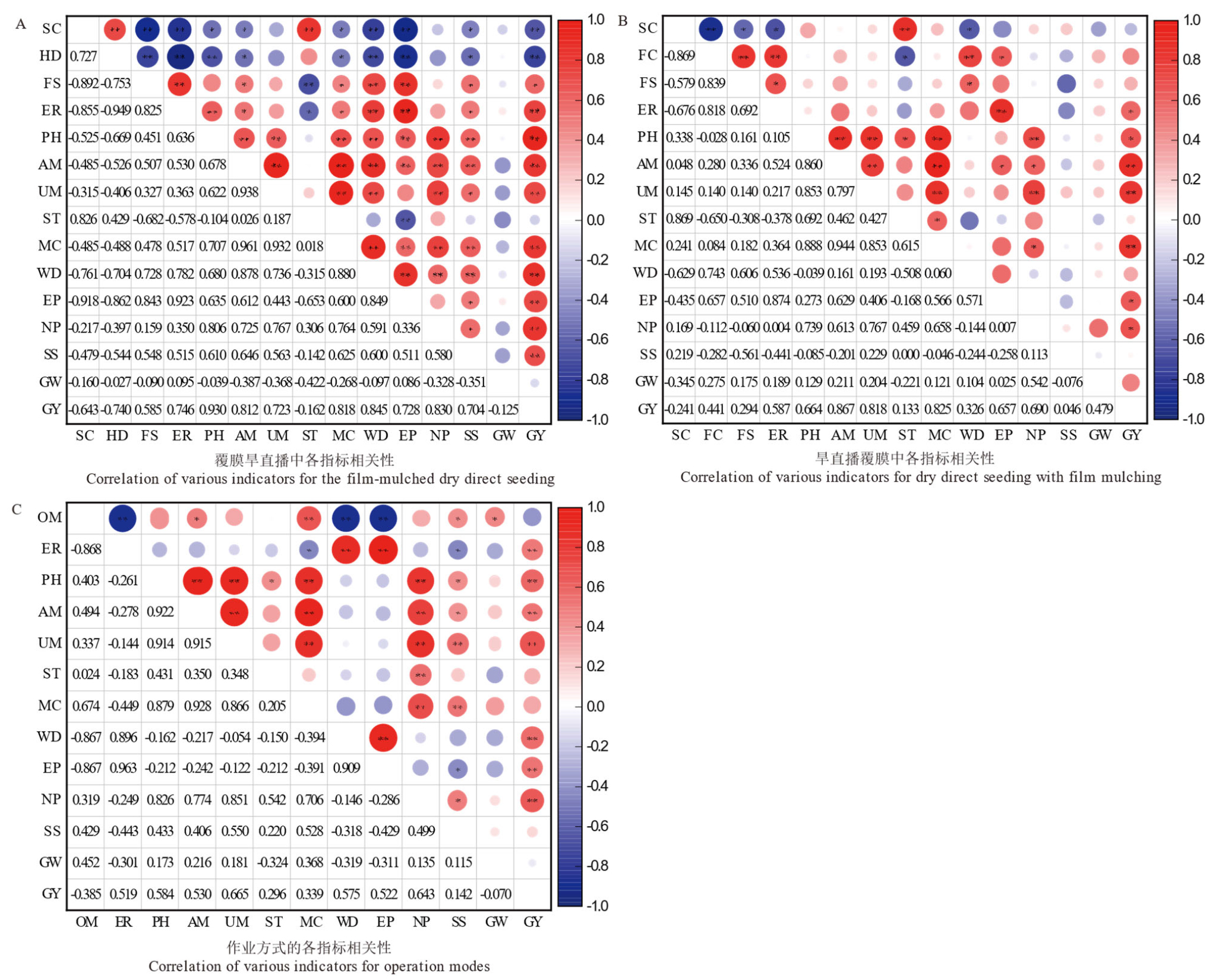
图8 不同机械化栽培技术下的各指标相关性 SC: 覆土方式; HD: 孔穴错位率; FS: 覆土厚度; ER: 出苗率; PH: 株高; AM: 地上部干物质量; UM: 地下部干物质量; ST: 土壤温度; MC: 土壤含水率; WD: 杂草密度; EP: 有效穗数; NP: 穗粒数; SS: 结实率; GW: 千粒重; GY: 产量; FC: 膜土贴合度; OM: 作业方式。*和**分别表示在0.05和0.01水平上显著相关
Fig. 8. Correlation of various indicators for different mechanized cultivation techniques SC, Soil covering mode; HD, Hole dislocation rate; FS, Covering thickness; ER, Emergence rate; PH, Plant height; AM, Aboveground dry matter mass; UM, Underground dry matter mass; ST, Soil temperature; MC, Soil moisture content; WD, Weed density; EP, Effective panicles; NP, Spikelet number per panicle; SS, Seed setting rate; GW, 1000-grain weight; GY, Grain yield; FC, Film-soil contact degree; OM, Operation mode. * and ** indicate significant correlation at P<0.05 and P<0.01 levels, respectively.
| [1] | NY/T 2862—2015 节水抗旱稻术语[S]. 北京: 中国农业出版社, 2015. |
| NY/T 2862—2015 Water-saving and drought-resistance rice-Terminology[S]. Beijing: China Agriculture Press, 2015. (in Chinese with English abstract) | |
| [2] | 程平, 高欢, 万重山, 赵考诚, 程功, 章红, 方江林, 赵洪阳. 节水抗旱稻的推广应用及产业发展探讨[J]. 中国种业, 2024(6): 20-24. |
| Cheng P, Gao H, Wan C S, Zhao K C, Cheng G, Zhang H, Fang J L, Zhao H Y. Discussion on extension and application of water-saving and drought-resistant rice and its industrial development[J]. China Seed Industry, 2024(6): 20-24. (in Chinese with English abstract) | |
| [3] | 杨永刚, 袁晓娟, 曹云, 陈雪芳, 尹慧来, 王志强, 文艳芳, 杨志远, 孙园园, 贾现文, 马均, 孙永健. 品种和播种量互作对机械旱直播水稻与杂草养分竞争的影响[J]. 中国水稻科学, 2024, 38(2): 185-197. |
| Yang Y G, Yuan X J, Cao Y, Chen X F, Yin H L, Wang Z Q, Wen Y F, Yang Z Y, Sun Y Y, Jia X W, Ma J, Sun Y J. Effects of variety and seeding rate interaction on nutrient competition between mechanized dry direct seeded rice and weeds[J]. Chinese Journal of Rice Science, 2024, 38(2): 185-197. (in Chinese with English abstract) | |
| [4] | 周洲. 节水抗旱稻的推广实践与发展刍议[J]. 杂交水稻, 2024, 39(6): 112-116. |
| Zhou Z. Discussion on the promotion practice and development of water-saving and drought-resistant rice[J]. Hybrid Rice, 2024, 39(6): 112-116. (in Chinese with English abstract) | |
| [5] | 侯丹平, 谭金松, 毕庆宇, 张安宁, 刘毅, 王飞名, 刘国兰, 余新桥, 毕俊国, 罗利军. 水分胁迫对节水抗旱稻产量形成和根系形态生理特性的影响[J]. 中国水稻科学, 2021, 35(1): 27-37. |
| Hou D P, Tan J S, Bi Q Y, Zhang A N, Liu Y, Wang F M, Liu G L, Yu X Q, Bi J G, Luo L J. Effects of water stress on yield formation and root morphological and physiological characteristics of water-saving and drought-resistant rice[J]. Chinese Journal of Rice Science, 2021, 35(1): 27-37. (in Chinese with English abstract) | |
| [6] | 赵龙, 张友良, 王娟, 田承伟, 苗恒录. 水稻覆膜旱作对土壤环境及水稻生长的影响研究进展[J]. 水资源与水工程学报, 2020, 31(5): 255-260. |
| Zhao L, Zhang Y L, Wang J, Tian C W, Miao H L. Research progress of effects of ground cover rice production system with plastic film mulch on soil environment and rice growth[J]. Journal of Water Resources and Water Engineering, 2020, 31(5): 255-260. (in Chinese with English abstract) | |
| [7] | 付第慧, 邢志鹏程爽, 王忠祥, 陈飞扬, 黄志成, 胡雅杰, 郭保卫, 魏海燕, 张洪程. 水稻覆膜栽培技术应用研究现状与展望[J]. 中国稻米, 2024, 30(6): 1-6. |
| Fu D H, Xing Z P, Cheng S, Wang Z X, Chen F Y, Huang Z C, Hu Y J, Guo B W, Wei H Y, Zhang H C. Current status and prospects of research on rice film mulching cultivation technology[J]. China Rice, 2024, 30(6): 1-6. (in Chinese with English abstract) | |
| [8] | 罗利军, 赵洪阳, 余新桥, 毕俊国, 廖志刚, 刘鸿艳, 张剑锋, 夏辉, 刘毅. 节水抗旱稻的研究进展及在边际土地上的应用[J]. 华南农业大学学报, 2026, 47(2): 209-215. |
| Luo L J, Zhao H Y, Yu X Q, Bi J G, Liao Z G, Liu H Y, Zhang J F, Xia H, Liu Y. Research progress of water-saving and drought-resistance rice and its application on marginal land[J]. Journal of South China Agricultural University, 2026, 47(2): 209-215. (in Chinese with English abstract) | |
| [9] | Zhang Y L, Zhu K C, Tang Y Q, Feng S Y. Rice cultivation under film mulching can improve soil environment and be beneficial for rice production in China[J]. Rice Science, 2024, 31(5): 545-555. |
| [10] | 胡国辉, 朱德峰, 徐一成, 陈惠哲, 向镜, 张义凯, 张玉屏. 水稻覆膜栽培研究进展[J]. 中国农业科技导报, 2019, 21(6): 163-170. |
| Hu G H, Zhu D F, Xu Y C, Chen H Z, Xiang J, Zhang Y K, Zhang Y P. Research progress on rice cultivated by film mulching[J]. Journal of Agricultural Science and Technology, 2019, 21(6): 163-170. (in Chinese with English abstract) | |
| [11] | 郭峰, 王小刚, 赵考诚, 程平, 章红, 毕俊国, 赵洪阳. 抗旱稻机覆全生物降解膜栽培技术要点[J]. 中国农技推广, 2023, 39(5): 50-52. |
| Guo F, Wang X G, Zhao K C, Cheng P, Zhang H, Bi J G, Zhao H Y. Key points of cultivation techniques of drought-resistant rice covered with full biodegradable film[J]. China Agricultural Technology Extension, 2023, 39(5): 50-52. (in Chinese with English abstract) | |
| [12] | Li H, Zeng S, Luo X, Fang L, Liang Z, Yang W. Design, DEM simulation, and field experiments of a novel precision seeder for dry direct-seeded rice with film mulching[J]. Agriculture, 2021, 11(5): 378. |
| [13] | 熊雪, 曹雪仙, 向镜, 陈惠哲, 武辉, 张义凯, 王亚梁, 王志刚, 王晶卿, 徐一成, 赵福建, 张玉屏. 水田覆膜直播压槽与覆盖物对水稻出苗的影响[J]. 中国稻米, 2024, 30(3): 63-66. |
| Xiong X, Cao X X, Xiang J, Chen H Z, Wu H, Zhang Y K, Wang Y L, Wang Z G, Wang J Q, Xu Y C, Zhao F J, Zhang Y P. Effects of film mulching direct seeding groove and mulch on emergence of rice[J]. China Rice, 2024, 30(3): 63-66. (in Chinese with English abstract) | |
| [14] | 解孝水, 张玉珍. 水稻机械覆膜旱直播免打孔绿色高产栽培技术[J]. 农业知识, 2024(6): 20-21. |
| Xie X S, Zhang Y Z. Green high-yield cultivation techniques of rice with mechanical film mulching and dry direct seeding without punching[J]. Agriculture Knowlege, 2024(6): 20-21. (in Chinese) | |
| [15] | 赵桂涛, 杨洪国, 王世伟, 孙士满, 孙卿, 张雷, 赵理. 水稻覆膜抗旱栽培新技术[J]. 中国农技推广, 2019, 35(12): 43-46. |
| Zhao G T, Yang H G, Wang S W, Sun S M, Sun Q, Zhang L, Zhao L. New technology of rice mulching drought-resistant cultivation[J]. China Agricultural Technology Extension, 2019, 35(12): 43-46. (in Chinese with English abstract) | |
| [16] | 常传义, 吴家安, 高明宇, 刘恩宏, 闫博巍. 有机水稻覆膜栽培技术与机具研究进展[J]. 江苏农业科学, 2022, 50(22): 46-55. |
| Chang C Y, Wu J A, Gao M Y, Liu E H, Yan B W. Research progress of organic rice film mulching cultivation technology and machinery[J]. Jiangsu Agricultural Sciences, 2022, 50(22): 46-55. (in Chinese with English abstract) | |
| [17] | 许春林, 单伊尹, 辛亮, 解江涛, 李峥, 赵匀. 探出开孔式高速水稻膜上插秧机分插机构设计与试验[J]. 农业机械学报, 2020, 51(5): 79-87. |
| Xu C L, Shan Y Y, Xin L, Xie J T, Li Z, Zhao Y. Design and experiment of high-speed rice transplanter with extensible mulch cutting mechanism in mulching cultivation system[J]. Transactions of the Chinese Society for Agricultural Machinery, 2020, 51(5): 79-87. (in Chinese with English abstract) | |
| [18] | 孙鉴. 水稻种膜直播机关键部件的设计与试验[D]. 沈阳: 沈阳农业大学, 2023. |
| Sun J. Design and test of key components of rice seed film broadcast machine[D]. Shenyang: Shenyang Agricultural University, 2023. (in Chinese with English abstract) | |
| [19] | 李辉. 水稻覆膜旱直播技术与装备研究[D]. 长春: 吉林大学, 2021. |
| Li H. Study on technology and equipment for direct-seeded rice using film mulching in dryland[D]. Changchun: Jilin University, 2021. (in Chinese with English abstract) | |
| [20] | 赵立军, 何堤, 周福君. 2BF-1400型水稻覆膜播种机覆土机构参数优化与试验[J]. 农业工程学报, 2015, 31(8): 21-26. |
| Zhao L J, He D, Zhou F J. Parameter optimization and test on soil-covering mechanism of 2BF-1400 rice mulching film seeder machine[J]. Transactions of the Chinese Society of Agricultural Engineering, 2015, 31(8): 21-26. (in Chinese with English abstract) | |
| [21] | 段鑫驰. 水稻覆膜播种机关键机构的设计与试验[D]. 沈阳: 沈阳农业大学, 2023. |
| Duan X C. Design and experimental of key mechanism of rice film mulching seeder[D]. Shenyang: Shenyang Agricultural University, 2023. (in Chinese with English abstract) | |
| [22] | 万于. 水稻旋耕施肥覆膜穴播机铺膜覆土装置设计与试验[D]. 合肥: 安徽农业大学, 2024. |
| Wan Y. Design and test of film covering device for rice rotary tillage and fertilization mulching burrow planter[D]. Hefei: Anhui Agricultural University, 2024. (in Chinese with English abstract) | |
| [23] | 康建明, 王士国, 陈学庚, 颜利民. 同步铺膜铺管旱作水稻播种机的设计与试验[J]. 中国农业大学学报, 2016, 21(2): 124-131. |
| Kang J M, Wang S G, Chen X G, Yan L M. Design and experiment of synchronous laying membrane and irrigation pipe for dry-land rice planter[J]. Journal of China Agricultural University, 2016, 21(2): 124-131. (in Chinese with English abstract) | |
| [24] | 曾山. 同步开沟起垄施肥铺膜水稻旱穴直播机设计与试验[D]. 广州: 华南农业大学, 2011. |
| Zeng S. Design and experiment of rice dry hole direct seeder with simultaneous ditching, ridging, fertilizing and film mulching[D]. Guangzhou: South China Agricultural University, 2011. (in Chinese with English abstract) | |
| [25] | 程晋. 2BSM210型水稻种膜覆膜直播机结构与作业效果分析[J]. 农业科技与装备, 2023(1): 56-57. |
| Cheng J. Analysis of structure and operation effect of 2BSM210 type rice seed film mulching direct seeding machines[J]. Agricultural Science & Technology and Equipment, 2023(1): 56-57. (in Chinese with English abstract) | |
| [26] | 戴飞, 赵武云, 张华, 马明义, 王久鑫, 马军民. 旱地小麦全膜覆土穴播联合机覆土作业性能试验[J]. 干旱地区农业研究, 2017, 35(6): 294-299. |
| Dai F, Zhao W Y, Zhang H, Ma M Y, Wang J X, Ma J M. Performance experiment of soil mulching on plastic-film and dibble machine for dry-land wheat[J]. Agricultural Research in the Arid Areas, 2017, 35(6): 294-299. (in Chinese with English abstract) | |
| [27] | 丁启朔, 敖宏贵, 徐高明, 何瑞银, 李毅念, 刘皓东. 旋耕抛-导土式膜上覆土关键技术与抗旱稻覆膜旱直播机研究[J]. 农业机械学报, 2026, 57(3): 176-185. |
| Ding Q S, Ao H G, Xu G M, He R Y, Li Y N, Liu H D. Rotary-till soil-casting key technology for above-film soil cover and development of film-mulching dry direct-seeder for drought-resistant rice[J]. Transactions of the Chinese Society for Agricultural Machinery, 2026, 57(3): 176-185. (in Chinese with English abstract) | |
| [28] | JB/T 7732—2023 铺膜播种机[S]. 北京: 机械工业出版社, 2023. |
| JB/T 7732—2023 Seed sowing machine for the mulching film[S]. Beijing: China Machine Press, 2023. (in Chinese with English abstract) | |
| [29] | GB/T 5262—2008 农业机械试验条件测定方法的一般规定[S]. 北京: 中国标准出版社, 2008. |
| GB/T 5262—2008 Agricultural machinery testing conditions-general rules for measuring methods[S]. Beijing: China Standards Press, 2008. (in Chinese with English abstract) | |
| [30] | NY/T 986—2006 铺膜机作业质量[S]. 北京: 中国农业出版社, 2006. |
| NY/T 986—2006 Operating quality for film player[S]. Beijing: China Agriculture Press, 2006. (in Chinese with English abstract) | |
| [31] | 胡国辉, 宋顺奇, 向镜, 朱德峰, 陈惠哲, 张义凯, 王亚梁, 徐一成, 易子豪, 王军可, 张玉屏. 生物可降解膜覆盖对机插水稻生长和稻米品质的影响[J]. 中国水稻科学, 2020, 34(2): 159-170. |
| Hu G H, Song S Q, Xiang J, Zhu D F, Chen H Z, Zhang Y K, Wang Y L, Xu Y C, Yi Z H, Wang J K, Zhang Y P. Effect of biodegradable film mulching on growth and quality of mechanically transplanted rice(Oryza sativa L.)[J]. Chinese Journal of Rice Science, 2020, 34(2): 159-170. (in Chinese with English abstract) | |
| [32] | 王文霞, 曾研华, 曾勇军, 梁喜欢, 谭雪明, 石庆华, 潘晓华. 不同直播方式对南方稻田杂草发生及早籼稻产量的影响[J]. 核农学报, 2018, 32(3): 555-560. |
| Wang W X, Zeng Y H, Zeng Y J, Liang X H, Tan X M, Shi Q H, Pan X H. Effects of different direct seeding methods on weed occurrence in paddy field and grain yield of early season indica rice in south of China[J]. Journal of Nuclear Agricultural Sciences, 2018, 32(3): 555-560. (in Chinese with English abstract) | |
| [33] | 田金明, 程兴田, 刘博, 金红伟, 潘卫云. NY/T 1768—2009 免耕播种机质量评价技术规范[S]. 北京: 中国农业出版社, 2009. |
| Tian J M, Cheng X T, Liu B, Jin H W, Pan W Y. NY/T 1768—2009 Technical specifications of quality evaluation for no-tillage drilling machinery[S]. Beijing: China Agriculture Press, 2009. (in Chinese with English abstract) | |
| [34] | 林明, 鲁伟丹, 陈友强, 刘华君, 潘竟海, 阿不都卡地尔·库尔班, 周远航, 王志敏. 覆膜方式与灌水量对滴灌甜菜叶丛生长及光合特性的影响[J]. 干旱地区农业研究, 2022, 40(5): 182-189. |
| Lin M, Lu W D, Chen Y Q, Liu H J, Pan J H, Abdukadier K, Zhou Y H, Wang Z M. Effects of film mulching method and drip irrigation amount on foliage growth and photosynthetic characteristics of sugar beet leaves[J]. Agricultural Research in the Arid Areas, 2022, 40(5): 182-189. (in Chinese with English abstract) | |
| [35] | 文利军, 史文娟, 高志永, 郭建忠, 何子建, 石肖肖. 不同覆膜开孔率下土壤水分和潜水蒸发的模拟研究[J]. 水土保持学报, 2020, 34(1): 225-229. |
| Wen L J, Shi W J, Gao Z Y, Guo J Z, He Z J, Shi X X. Simulated study on soil moisture and phreatic evaporation under different aperture ratios of film mulching[J]. Journal of Soil and Water Conservation, 2020, 34(1): 225-229. (in Chinese with English abstract) | |
| [36] | 李毅, 任鑫. 覆膜开孔条件下斥水性层状土壤蒸发实验[J]. 农业机械学报, 2012, 43(11): 58-64. |
| Li Y, Ren X. Evaporation experiments on layered water-repellent soil under perforated plastic mulch[J]. Transactions of the Chinese Society for Agricultural Machinery, 2012, 43(11): 58-64. (in Chinese with English abstract) | |
| [37] | 王文霞, 周燕芝, 曾勇军, 吴自明, 谭雪明, 潘晓华, 石庆华, 曾研华. 不同机直播方式对南方优质晚籼稻产量及抗倒伏特性的影响[J]. 中国水稻科学, 2020, 34(1): 46-56. |
| Wang W X, Zhou Y Z, Zeng Y J, Wu Z M, Tan X M, Pan X H, Shi Q H, Zeng Y H. Effects of different mechanical direct seeding patterns on yield and lodging resistance of high-quality late indica rice in South China[J]. Chinese Journal of Rice Science, 2020, 34(1): 46-56. (in Chinese with English abstract) | |
| [38] | 李绍平, 邢志鹏, 田晋钰, 程爽, 胡群, 胡雅杰, 郭保卫, 魏海燕, 张洪程. 机械旱直播方式对水稻产量和光合物质生产特征的影响[J]. 农业工程学报, 2022, 38(7): 1-9. |
| Li S P, Xing Z P, Tian J Y, Cheng S, Hu Q, Hu Y J, Guo B W, Wei H Y, Zhang H C. Effects of mechanical dry direct seeding ways on rice yield and photosynthetic material production characteristics[J]. Transactions of the Chinese Society of Agricultural Engineering, 2022, 38(7): 1-9. (in Chinese with English abstract) | |
| [39] | Yang W J, Xu D T S, Li S Y, Tang X R, Pan S G, Chen X F, Mo Z W. Emergence and seedling establishment of rice varieties at different sowing depths[J]. Journal of Plant Growth Regulation, 2022, 41(4): 1672-1686. |
| [40] | 朱鹏, 凌溪铁, 王金彦, 张保龙, 杨郁文, 许轲, 裘实. 机直播条件下不同控草方式对抗除草剂水稻产量和品质差异性研究[J]. 中国水稻科学, 2025, 39(4): 501-515. |
| Zhu P, Ling X T, Wang J Y, Zhang B L, Yang Y W, Xu K, Qiu S. Effects of weed control methods on grain yield and quality of herbicide-resistant rice under direct seeding[J]. Chinese Journal of Rice Science, 2025, 39(4): 501-515. (in Chinese with English abstract) | |
| [41] | Mir M S, Singh P, Kanth R H, Ahmad Shah Z, Ahmad Dar E, Ahmad Bhat J, Nazir A, Amin Z, Lone A H, Nain M S, Yousuf D, Ahmad Alie B, Ahmad Ahngar T, Abd-ElGawad A M, Mattar M A. Influence of sowing dates and weed management practices on weed dynamics, productivity and profitability of direct seeded rice[J]. Scientific Reports, 2024, 14: 18877. |
| [42] | 王超瑞, 周宇琨, 温雅, 张瑛, 法晓彤, 肖治林, 张耗. 秸秆还田方式对稻田土壤特性和温室气体排放的影响及其水肥互作调控[J]. 中国水稻科学, 2025, 39(3): 295-305. |
| Wang C R, Zhou Y K, Wen Y, Zhang Y, Fa X T, Xiao Z L, Zhang H. Effects of straw returning methods on soil characteristics and greenhouse gas emissions in paddy fields and their regulation through water-fertilizer interactions[J]. Chinese Journal of Rice Science, 2025, 39(3): 295-305. (in Chinese with English abstract) | |
| [43] | 宋玉秋, 张强, 陈天佑, 辛明金, 刘翠红, 邬立岩, 张本华, 孔爱菊, 崔红光, 任文涛. 可降解种膜直播对水稻生长和产量的影响[J]. 华中农业大学学报, 2017, 36(4): 1-6. |
| Song Y Q, Zhang Q, Chen T Y, Xin M J, Liu C H, Wu L Y, Zhang B H, Kong A J, Cui H G, Ren W T. Effects of degradable mulch-seeds direct seeding on growth and yield of rice[J]. Journal of Huazhong Agricultural University, 2017, 36(4): 1-6. (in Chinese with English abstract) | |
| [44] | 郭慧, 李树杏, 杨占烈, 何强, 甘雨, 张武汉, 向关伦, 孙平勇, 舒服, 邓华凤. 覆膜直播与常规手栽种植方式对水稻光合物质生产特征的影响[J]. 华北农学报, 2016, 31(4): 146-152. |
| Guo H, Li S X, Yang Z L, He Q, Gan Y, Zhang W H, Xiang G L, Sun P Y, Shu F, Deng H F. Effect of characteristics of photosynthesis and matter production of rice under two different planting methods with film mulching way of direct seeding and traditional manual transplanting[J]. Acta Agriculturae Boreali-Sinica, 2016, 31(4): 146-152. (in Chinese with English abstract) | |
| [45] | Hou D P, Bi J G, Ma L, Zhang K K, Li D Y, Rehmani M I A, Tan J S, Bi Q Y, Wei Y, Liu G L. Effects of soil moisture content on germination and physiological characteristics of rice seeds with different specific gravity[J]. Agronomy, 2022, 12(2): 500. |
| [46] | 柳开元, 孙伟, 张华, 刘小龙, 李辉, 王亨泰, 田斌. 机械化膜上覆土技术发展概况[J]. 农业装备与车辆工程, 2023, 61(5): 10-13. |
| Liu K Y, Sun W, Zhang H, Liu X L, Li H, Wang H T, Tian B. General situation of development of mechanized soil covering technology on film[J]. Agricultural Equipment & Vehicle Engineering, 2023, 61(5): 10-13. (in Chinese with English abstract) | |
| [47] | 牛琪, 王士国, 陈学庚. 膜下滴灌水稻穴直播机研究[J]. 农业机械学报, 2016, 47(S1): 90-95, 102. |
| Niu Q, Wang S G, Chen X G. Design of rice planter with plastic film mulched drip irrigation[J]. Transactions of the Chinese Society for Agricultural Machinery, 2016, 47(S1): 90-95, 102. (in Chinese with English abstract) | |
| [48] | 石林榕, 赵武云, 孙步功, 戴飞, 辛尚龙, 孙伟, 冯斌. 非圆齿轮驱动式玉米直插穴播机设计与试验[J]. 农业机械学报, 2024, 55(10): 157-167. |
| Shi L R, Zhao W Y, Sun B G, Dai F, Xin S L, Sun W, Feng B. Design and experiment of non-circular gear-driven maize hole seeder with vertical insertion[J]. Transactions of the Chinese Society for Agricultural Machinery, 2024, 55(10): 157-167. (in Chinese with English abstract) | |
| [49] | 丁启朔, 冯守可, 颜晓元, 李毅念, 何瑞银. 用于华东稻麦轮作区细碎苗床耕作的不同土层土壤耕性研究[J/OL]. 南京农业大学学报, 1-11[2026-04-10]. https://link.cnki.net/urlid/32.1148.S.20250721.1227.004. |
| Ding Q S, Feng S K, Yan X Y, Li Y N, He R Y. Study on soil fertility of different soil layers for finely choppedseedbed tillage in rice-wheat rotation area of East China[J/OL]. Journal of Nanjing Agricultural University, 1-11[2026-04-10]. https://link.cnki.net/urlid/32.1148.S.20250721.1227.004. (in Chinese with English abstract) | |
| [50] | 廖庆喜, 张季钦, 张青松, 杜文斌, 林建新, 王立宗. 平行犁组翻扣与旋耕组合式油菜种床制备装置研究[J]. 农业机械学报, 2024, 55(10): 190-201. |
| Liao Q X, Zhang J Q, Zhang Q S, Du W B, Lin J X, Wang L Z. Design and test of rapeseed seed bed preparation device combined with parallel plow group turnbuckle and rotary tillage[J]. Transactions of the Chinese Society for Agricultural Machinery, 2024, 55(10): 190-201. (in Chinese with English abstract) |
| [1] | 刘福祥, 甄浩洋, 彭焕, 郑刘春, 彭德良, 文艳华. 广东省水稻孢囊线虫病调查与鉴定[J]. 中国水稻科学, 2024, 38(4): 456-461. |
| [2] | 黄勇椿, 叶姗, 袁涛, 周建宇, 彭德良, 黄文坤, 丁中. 湖南长沙一季晚稻旱稻孢囊线虫发生动态及危害损失[J]. 中国水稻科学, 2021, 35(1): 98-102. |
| [3] | 袁涛, 叶姗, 周建宇, 彭德良, 黄文坤, 丁中. 湖南水稻主推品种对旱稻孢囊线虫的抗性及评价方法[J]. 中国水稻科学, 2019, 33(1): 85-89. |
| [4] | 卓侃1,宋汉达1 ,王宏洪1 ,陶冶1 ,张洪玲1,陆秀红2,黄金玲2,刘志明2 ,廖金铃1,*. 旱稻孢囊线虫在广西的发生及其rDNAITS异质性分析[J]. 中国水稻科学, 2014, 28(1): 78-84. |
| [5] | 郑小国1,2,# ,陈亮1,# ,楼巧君1 ,夏辉1,李明寿1,罗利军1, 2, *. 干旱驯化后节水抗旱稻苗期不同发育时间DNA甲基化模式变化分析[J]. 中国水稻科学, 2014, 28(1): 32-40. |
| [6] | 杜兴彬1,2,罗利军1,陈晨1,李双喜3,刘国兰1,王飞名1,张安宁1,顾晓君2,余新桥1,2,*. 稻油轮作连续免耕直播对作物产量及土壤理化性状的影响[J]. 中国水稻科学, 2013, 27(6): 617-623. |
| [7] | 丁中1,2,NAMPHUENG Janthathang1,何旭峰1,伍敏敏1,洪宏1. 旱稻孢囊线虫生活史及侵染特性[J]. 中国水稻科学, 2012, 26(6): 746-750. |
| [8] | 邓姗,李华娟,冯芳君,徐小艳,黄志诚, 罗利军,梅捍卫. 旱稻品种IRAT109辐照诱变突变体的筛选和鉴定[J]. 中国水稻科学, 2010, 24(5): 523-526 . |
| [9] | 张安宁, 王飞名, 余新桥, 李明寿, 梁文兵, 梅捍卫, 罗利军. 水旱稻三交种的应用价值初步研究[J]. 中国水稻科学, 2009, 23(3): 327-330 . |
| [10] | 艾林,李召虎,李建民,田晓莉,王保民,翟志席,段留生. 植物生长物质冠菌素诱导旱稻、水稻幼苗抗旱性的效应及生理机制[J]. 中国水稻科学, 2008, 22(4): 443-446 . |
| [11] | 李勇,周毅,郭世伟,沈其荣. 铵态氮和硝态氮营养对水、旱稻根系形态及水分吸收的影响[J]. 中国水稻科学, 2007, 21(3): 294-298 . |
| [12] | 汤美玲,程旺大, 姚海根,徐民. 早稻直播覆膜旱作对灌浆成熟期根叶生理特性及产量的影响[J]. 中国水稻科学, 2005, 19(5): 475-478 . |
| [13] | 李东坡, 武志杰. 旱稻田苗后杂草化学防除技术研究[J]. 中国水稻科学, 2002, 16(4): 378-380 . |
| [14] | 彭世彰, 李荣超. 覆膜旱作水稻干物质生产光截获模型研究[J]. 中国水稻科学, 2002, 16(4): 372-374 . |
| 阅读次数 | ||||||
|
全文 |
|
|||||
|
摘要 |
|
|||||
